1917–1922: The Russian Civil War
The Russian Civil War
- Dates:
- 7 November 1917 – 25 October 1922
- Front:
- Central and Eastern Europe
- Location:
- The territory of the former Russian Empire from the Baltic and the White Sea to the Black Sea, the Caucasus and the Pacific – above all the Don and the Kuban, Ukraine, the Volga region, the Urals, Siberia, the Petrograd area, the Crimea and the Russian Far EastOn the battle map →
- Sides:
- The Whites (the Volunteer Army and the Armed Forces of South Russia, the armies of Kolchak, Yudenich and Wrangel), at various times supported by the intervention of the great powersLavr Kornilov, Mikhail Alekseyev, Anton Denikin, Alexander Kolchak, Pyotr Wrangel, Nikolai YudenichSoviet Russia (the Bolsheviks, the Red Army)Leon Trotsky, Sergei Kamenev, Mikhail Tukhachevsky, Mikhail Frunze
- Result:
- Bolshevik victory. The White armies were destroyed and the interventionists withdrew from Russia. In December 1922 the Soviet Union was founded on the ruins of the empire.
- Author:
- Natalia
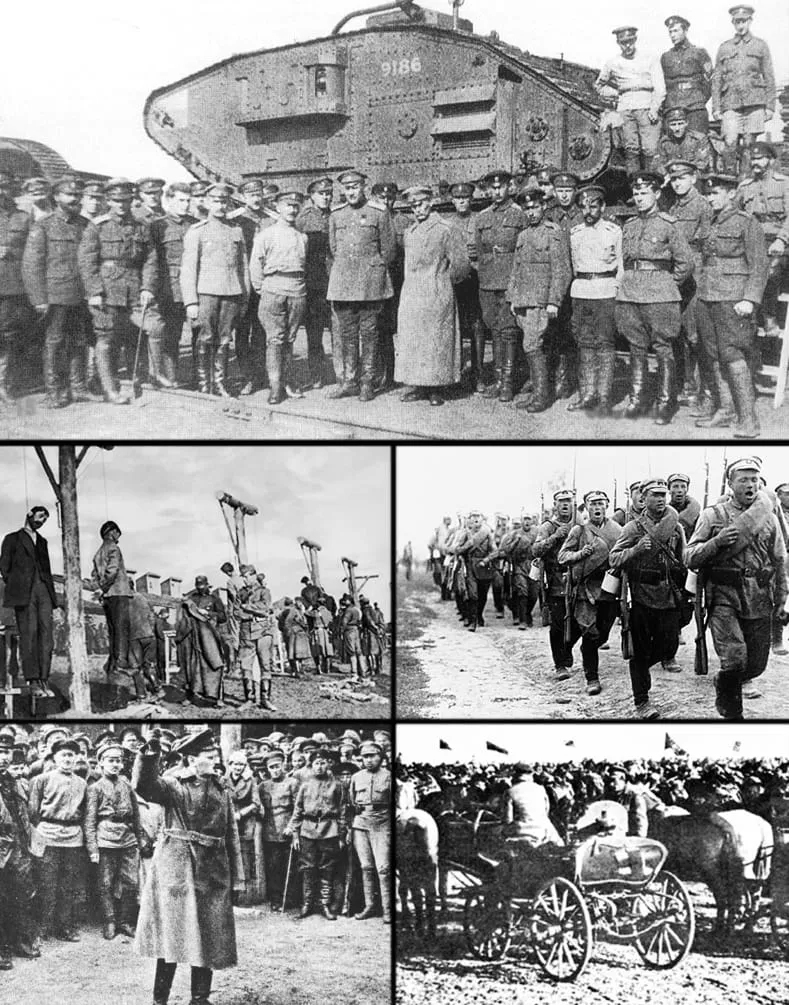
The Russian Civil War was the bloodiest conflict in Europe between the First and Second World Wars. For five years, across an area stretching from the Baltic to the Pacific, the Bolsheviks, who had seized power in Petrograd in November 1917, fought officers of the old army, Cossacks, the socialists they had ousted from power, rebellious peasants and the nations of the disintegrating empire – and at times also the troops of the great powers that had landed on Russia’s fringes. The war was waged without fixed fronts, along railway lines and rivers, and was accompanied by terror on both sides, pogroms, epidemics and famine. Victory went to the party of Vladimir Lenin, which emerged from the war with a vast political police, a Red Army several million strong and the conviction that it was surrounded by a hostile capitalist world. Its victory gave birth to the Soviet Union, and the commanders, methods and grievances of 1917–1922 stayed with it right up to the Second World War.
Name and dates
Polish historians speak of the civil war in Russia, Russian historians simply of the Civil War (Grazhdanskaya voyna), while Soviet historiography for decades wrote of the “Civil War and military intervention”, stressing the part played by foreign powers. The combatants were named after colours: the Bolsheviks were the “Reds”, their opponents from the old army and the national-conservative camp the “Whites”. The peasant bands that fought against both were called the Greens or Green armies.
The war had neither a declaration nor a peace treaty, so its limits are a matter of convention. According to the dating most common today, it lasted from 7 November 1917 – the Bolshevik coup in Petrograd, followed at once by fighting in Moscow – to 25 October 1922, when the People’s Revolutionary Army of the Far Eastern Republic entered Vladivostok, the last large city in White hands. From the time of Joseph Stalin Soviet historiography narrowed the war to the years 1918–1920, from the revolt of the Czechoslovak Legion in May 1918 to the evacuation of the Crimea in November 1920, and some Western historians date it in a similar way. Isolated White detachments were still fighting in 1923 in Yakutia and on the coast of the Sea of Okhotsk, and the Basmachi guerrilla movement in Central Asia was not suppressed until the end of the 1920s.
The dates given follow the Gregorian calendar. Soviet Russia adopted it on 14 February 1918, but the Whites in southern Russia often used the Old Style, which in those years was 13 days behind.
Background
The Russian Empire entered 1917 exhausted by war. The February Revolution overthrew Tsar Nicholas II, but the Provisional Government neither ended the war nor gave the peasants land, and the army was disintegrating under the influence of soldiers’ committees and desertion. General Lavr Kornilov’s failed march on Petrograd in September 1917 discredited both the right and the Prime Minister, Alexander Kerensky, and the Bolsheviks emerged from it as the defenders of the revolution. On 7 November 1917 they seized power in Petrograd and, after a week of bloody fighting, in Moscow as well.
The new regime met resistance at once. Kerensky tried to retake the capital with the help of General Pyotr Krasnov’s Cossacks, but his expedition collapsed within a few days. The ataman of the Don Cossacks, Aleksey Kaledin, and the Orenburg ataman, Alexander Dutov, refused to recognise Lenin’s government. Within a few weeks the Bolsheviks closed down opposition newspapers and set up a political police, the Cheka, headed by Felix Dzerzhinsky, and in January 1918 they dispersed the Constituent Assembly, in which the Socialist Revolutionaries (SRs) held a majority. For many socialists and liberals this was a sign that no settlement with the new regime was possible except by force. The separate peace with Germany, signed at Brest-Litovsk in March 1918, made some officers and politicians want to resume the war at the side of the Entente, and made the Western powers fear that the war stocks gathered in Russian ports would fall into German hands.
The first months: the Don and the Ice March
Opponents of the Bolsheviks began to gather on the Don, where they counted on the Cossacks. In November 1917 General Mikhail Alekseyev, the Tsar’s former chief of staff, began forming at Novocherkassk a detachment of officers, cadets and students, from which the Volunteer Army grew. At the beginning of December General Nikolai Dukhonin, the acting commander-in-chief, released from prison at Bykhov Kornilov, Anton Denikin and the other generals arrested after the September revolt. All of them made their way to the Don. Kornilov took military command, while Alekseyev took charge of politics and money. Yet the army numbered barely a few thousand men, and the Cossacks, weary of war, did not want to fight. As Red units closed on Rostov and Kaledin committed suicide, Kornilov led some four thousand volunteers out into the Kuban steppe during the night of 22–23 February 1918.
The First Kuban Campaign, known as the Ice March, became a legend of the Whites. The volunteers, with their wounded and refugees, marched through blizzards and mud, in constant combat with a more numerous enemy. Both sides shot prisoners. On 13 April 1918, during the assault on Yekaterinodar, Kornilov was killed by a shell. Denikin broke off the assault and led the army out of encirclement back to the Don, where a Cossack rising against the Bolsheviks had just broken out. At the same time German troops stood in Ukraine, Belarus and on the Baltic, having occupied vast areas of the former empire after the Treaty of Brest-Litovsk. The new Don ataman, Pyotr Krasnov, took weapons from the Germans; Denikin, loyal to the Entente, refused any cooperation with them. In Belarus, as early as January and February 1918, the Polish corps of General Józef Dowbor-Muśnicki was fighting the Bolsheviks.
1918: the Czechoslovaks, Komuch and the Red Terror
In the spring of 1918 the war spread across the whole country because of the Czechoslovak Legion. Some 40,000 former Austro-Hungarian prisoners of war, Czechs and Slovaks who had fought against the Habsburgs in the Russian army, were travelling along the Trans-Siberian Railway to Vladivostok, intending to reach France from there by sea. After an incident at Chelyabinsk, Leon Trotsky, the Commissar for War, ordered them to be disarmed. At the end of May the Legion revolted and within a few weeks seized the railway from the Volga to the Pacific. In its shadow anti-Bolshevik governments sprang up: in June, at Samara, the SR Komuch – the Committee of Members of the Constituent Assembly – with its own People’s Army, and at Omsk the Provisional Siberian Government. On 7 August the troops of Colonel Vladimir Kappel and the Czechoslovaks took Kazan, and with it a large part of the Russian state’s gold reserve.
The summer of 1918 was the most dangerous moment for Soviet power. In July the Left SRs, until recently the Bolsheviks’ allies, rose in revolt in Moscow; in Yaroslavl an uprising organised by Boris Savinkov broke out; and during the night of 16–17 July, in Yekaterinburg, which the Czechoslovaks were approaching, the Bolsheviks murdered Nicholas II and his family. A few weeks earlier, in Perm, they had killed his brother, Grand Duke Michael Alexandrovich. On 30 August Lenin was seriously wounded in an assassination attempt, and on 5 September the Council of People’s Commissars adopted the resolution on the Red Terror: the mass shooting of hostages and “class enemies”. The Whites answered with the terror of their counter-intelligence services and punitive detachments, often just as ruthless, though less centralised.
Meanwhile Trotsky was building the Red Army. In the spring of 1918 the volunteer army of Red Guards and sailors was replaced by compulsory conscription, the election of commanders was abolished, and tens of thousands of officers of the tsarist army – the so-called military specialists – were drafted, watched over by political commissars and often by hostages taken from their families. According to the calculations of Russian historians, some 75,000 former officers served in the Red Army during the war. In the autumn of 1918 the Red Army numbered some 800,000 men, and at the end of 1920 more than five million, though only a small fraction of them fought at the front. In September 1918 the Reds retook Kazan. Trotsky, who toured the fronts in an armoured train, had the commander, the commissar and some of the soldiers of a regiment that had fled the battlefield near Sviyazhsk shot.
In the south Denikin, who had commanded the Volunteer Army since Kornilov’s death, led a second campaign into the Kuban in the spring and summer of 1918 and took Yekaterinodar in August. Alekseyev died there in October, and Denikin concentrated all power in his own hands. In the east, in September, SRs and White politicians from Siberia set up at Ufa the Provisional All-Russian Government, known as the Directory, but on 18 November 1918 officers in Omsk arrested its SR members, and Admiral Alexander Kolchak assumed dictatorial power as Supreme Ruler of Russia. From then on the White movement was above all a military dictatorship.
The intervention
The first troops of the great powers landed in Russia while the Great War was still going on. The British entered Murmansk in the spring of 1918, and in August they occupied Arkhangelsk, where the government of the Northern Region was formed. In August 1918 the United States, Japan, Britain and France sent troops to Siberia and Vladivostok, officially to help the Czechoslovaks and protect the depots. The largest contingent in the Siberian intervention, more than 70,000 men, was sent by Japan, under the government of Prime Minister Masatake Terauchi, which had in mind a sphere of influence in the Russian Far East. The Americans, of whom there were about eight thousand, were sent by President Woodrow Wilson largely to keep an eye on the Japanese. After Turkey’s surrender the French and British entered the Black Sea ports. In December 1918 the French landed at Odessa, but by the beginning of April 1919 they had evacuated it, and a few days later sailors mutinied in the French squadron in the Black Sea.
The intervention never became a war between the great powers and the Bolsheviks. After the armistice with Germany, soldiers and public opinion in the West did not want a new war, and governments were divided. The British Secretary of State for War, Winston Churchill, wanted to “strangle Bolshevism in its cradle”; the Prime Minister, David Lloyd George, preferred trade with Russia. The greatest help to the Whites came in deliveries of weapons, ammunition and uniforms, mostly British. The British left northern Russia in the autumn of 1919, the Americans left Siberia in the spring of 1920. Only the Japanese stayed in the Far East until 1922, and on northern Sakhalin until 1925. For Soviet propaganda, however, the intervention became proof that the whole capitalist world had conspired against the revolution, and one of the foundations of the obsession with “hostile encirclement”.
Ukraine, Makhno and Petliura
No part of the former empire went through as many changes of rule as Ukraine. Between 1918 and 1920 Kiev changed hands more than a dozen times. The Ukrainian Central Rada was driven out in January 1918 by the Bolsheviks; they in turn were driven out by the Germans and Austrians, who in April installed Hetman Pavlo Skoropadsky in Kiev. After the Germans withdrew, power passed to the Directorate of the Ukrainian People’s Republic under Symon Petliura; in February 1919 to the Bolsheviks again; and in the summer to Denikin’s Whites, who regarded Ukraine merely as part of “one and indivisible Russia”. On the steppes of southern Ukraine the peasant army of the anarchist Nestor Makhno fought, sometimes as an ally and sometimes as an enemy of the Reds, and alongside it dozens of atamans who changed sides.
Ukraine in 1918–1921 saw the greatest wave of pogroms against Jews before the Second World War. According to various estimates, they claimed from several tens of thousands to more than a hundred thousand lives. According to Nahum Gergel’s classic tabulation of 1928, the largest number of pogroms were the work of soldiers and atamans linked to the Ukrainian People’s Republic; next came independent warlords and Denikin’s troops, who were responsible for roughly one attack in six; and a few per cent were attributed to units of the Red Army.
1919: the year of three offensives
In 1919 the Whites came closest to victory. Their armies advanced on Moscow from three directions, but never at the same time. In the east Kolchak’s armies attacked in March, took Ufa and by the end of April had come close to Kazan, Samara and the Volga. At the end of April the counter-offensive of the Eastern Front began, commanded by Sergei Kamenev, with its southern group under Mikhail Frunze. In June the Reds retook Ufa, and Mikhail Tukhachevsky’s Fifth Army crossed the Urals and in July took Zlatoust and Chelyabinsk. On 14 November 1919 the Red Army entered Omsk. The remnants of Kolchak’s armies retreated east in the Great Siberian Ice March, while peasant partisan warfare grew in their rear. Kolchak, detained by the Czechoslovaks, was handed over in January 1920 in Irkutsk to the city’s left-wing authorities, and during the night of 6–7 February 1920 he was shot by the Bolsheviks. Fighting alongside the Whites in Siberia was the Polish 5th Rifle Division, which covered the retreat along the railway and capitulated near Krasnoyarsk in January 1920.
In the south Denikin, from January 1919 commander-in-chief of the Armed Forces of South Russia, defeated the Reds in the summer in the Donbas and on the Manych. At the end of June his troops took Kharkiv, and General Pyotr Wrangel’s Caucasian Army took Tsaritsyn on the Volga. On 3 July, at Tsaritsyn, Denikin issued the so-called Moscow Directive: all his armies were to march on Moscow. In August the Whites took Odessa and Kiev, in September Kursk, and on 13 October Oryol, some 350 kilometres from Moscow. As early as July Lenin had called Denikin’s offensive “the most critical moment of the socialist revolution”, and in October the Bolsheviks were preparing to evacuate government offices and organise an underground party in Moscow.
In the same month, October 1919, General Nikolai Yudenich’s North-Western Army, formed in Estonia with British help, struck at Petrograd. It took Gatchina and Tsarskoye Selo and around 20 October reached the Pulkovo Heights on the outskirts of the former capital. Some of the Bolshevik leaders were ready to give up the city. Trotsky came to Petrograd, armed the workers and brought up reinforcements, while Grigory Zinoviev, head of the Petrograd Bolsheviks, organised the defence on the spot. Yudenich’s army, some fifteen thousand strong, received no help from Finland, and the Estonians, to whom the Whites would not guarantee independence, supported it reluctantly. At the end of October it began to fall back, withdrew into Estonia and was disarmed there.
Denikin’s offensive collapsed in the same weeks. His armies, stretched along a front from Kiev to Tsaritsyn, had no reserves, and in the autumn of 1919 a raid by Makhno in their rear cut their supplies and forced the Whites to pull troops from the front. The peasants feared that the Whites would give the land back to the landowners, and the nations of the former empire were repelled by the slogan of “one and indivisible Russia”. Alexander Yegorov became commander of the Reds’ Southern Front, with Joseph Stalin as its commissar, and Semyon Budyonny’s cavalry corps routed the White Cossack cavalry at Voronezh and Kastornoye. At Oryol and Kromy the Volunteers lost a battle against the Latvian Riflemen and divisions brought over from other fronts. On 20 October Oryol was Red again. The long retreat south began. Its course was also affected by the policy of Józef Piłsudski: regarding a victory of the Whites, who would not hear of a Polish frontier east of the Bug, as more dangerous than a victory of the Reds, he halted operations on the front against the Bolsheviks in the autumn of 1919, and they were able to transfer forces against Denikin. Polish talks with Denikin, conducted by the military mission of General Aleksander Karnicki (PL), brought no agreement.
1920: Novorossiysk and the Crimea
In January 1920 the Whites lost Rostov and Odessa, and in March the remnants of their armies fell back to the Black Sea port of Novorossiysk. The evacuation of 26–27 March took place in panic, under fire and without enough ships. Some 35,000–40,000 soldiers were carried to the Crimea; thousands of others were left on the quays. On 4 April 1920 Denikin handed over command to Wrangel and went into exile.
Wrangel, an energetic and capable politician, renamed his forces the Russian Army, proclaimed a land reform and tried to reach an understanding with the nations of the former empire. In the summer of 1920, while the Red Army was fighting Poland, he broke out of the Crimea and took Northern Taurida. After the ceasefire on the Polish front in October the Bolsheviks turned overwhelming forces against him. The Southern Front, now commanded by Frunze and supported by Makhno’s men, briefly allied with the Reds, attacked on 7 November 1920 the fortifications of Perekop and across the frozen shallows of the Sivash. On 11 November the defence broke. On 13–16 November Wrangel shipped some 145,000 people, soldiers and civilians, from the Crimean ports to Constantinople in 126 vessels. Those who stayed behind in the Crimea were the ones who believed in the promised amnesty. The revolutionary committee of Béla Kun and Rosalia Zemlyachka shot, within a few months and according to various estimates, from more than ten thousand to several tens of thousands of them.
Peasant revolts and Kronstadt
The defeat of the Whites did not bring peace. The policy of War Communism, and above all the forcible seizure of grain by requisitioning detachments, provoked peasant risings throughout the country. The largest broke out in August 1920 in Tambov province under the SR Alexander Antonov. The Tambov Rebellion was put down in the summer of 1921 by Tukhachevsky, who took hostages, set up camps for the rebels’ families and ordered the use of poison gas against those hiding in the forests. In January 1921 another great peasant rising broke out in western Siberia. In March 1921 the sailors of Kronstadt, once the pride of the revolution, mutinied, demanding free elections to the soviets and freedom of trade. The mutiny was crushed by an assault across the ice, while at the same time the Tenth Party Congress adopted the New Economic Policy, which replaced requisitioning with a tax and restored small-scale trade.
In 1920–1921 the Red Army also occupied the countries in the Caucasus that had declared independence – Azerbaijan, Armenia and Georgia – and, in Central Asia, Bukhara and Khiva. In August 1921 Makhno fled to Romania. In Ukraine and the Volga region the famine of 1921–1922, caused by drought and requisitioning, killed millions of people.
The Far East
After Kolchak’s defeat the Bolsheviks did not want a war with Japan, which kept troops in the Maritime Province (Primorye) and Transbaikalia. In April 1920, therefore, the Far Eastern Republic was created – formally independent but in fact run from Moscow – with its capital at Verkhneudinsk and later at Chita. In Transbaikalia it was fought by the Japanese-backed ataman Grigory Semyonov, who in October 1920 was driven out of Chita into Manchuria. In 1921 the White baron Roman von Ungern-Sternberg expelled the Chinese from Mongolia, and after his defeat the Red Army entered Urga, which marked the beginning of a Mongolia dependent on Moscow.
In Vladivostok the Whites again took power in May 1921, and in 1922 they were led by General Mikhail Diterikhs, who proclaimed himself Voyevoda of the Zemskaya Rat (the Land Host) and tried to revive pre-Petrine Rus’. When Japan, under pressure from the United States and its own public opinion, agreed to withdraw its troops, the army of the Far Eastern Republic under Ieronim Uborevich took Spassk in October 1922 and on 25 October entered Vladivostok, which the last Japanese had left that same day. The Whites sailed away to China and Korea. On 15 November 1922 the Far Eastern Republic was incorporated into Soviet Russia, and on 30 December 1922 the Union of Soviet Socialist Republics came into being.
Losses
The victims of the Civil War cannot be counted precisely. According to Russian research, the irrecoverable losses of the Red Army – killed, dead of wounds and disease, and missing – came to some 940,000 men, while the White and national armies lost, by estimate, some 650,000. Far more civilians died: from the terror of both sides, pogroms, epidemics of typhus, which killed some three million people, and famine. Historians estimate the total population losses of 1917–1922, including the famine of 1921–1922, at 8–10 million people, and some put them higher. Between one and a half and two million people emigrated, including a large part of the educated classes of old Russia. Millions of homeless children were left on the streets, and the output of large-scale industry fell to about a fifth of its level before the World War.
Significance
The Bolshevik victory determined the shape of the state that twenty years later was one of the main participants in the Second World War. The war taught the Bolsheviks to rule by terror and states of emergency. The Cheka became the GPU, the OGPU and the NKVD, which in the 1930s carried out collectivisation and the Great Purge. The party, which during the Civil War had governed through commissars and extraordinary commissions, carried this style over into peacetime. The intervention of the great powers, limited though it was, fixed in Moscow the conviction of “capitalist encirclement”. The borderlands of the former empire were divided: Finland, the Baltic states and Poland kept their independence, but Ukraine, Belarus and the Caucasus became part of the USSR. The war with Poland, which in 1920 became entangled with the Civil War, left a border that Stalin did not accept as final and which he erased in 1939.
The Red Army of the Civil War provided the cadres who held command in the 1930s and 1940s. Tukhachevsky, Yegorov, Vasily Blyukher and Uborevich perished in the purge of 1937–1938, which weakened the army on the eve of war. Those who survived were the men linked to Stalin since the defence of Tsaritsyn and the First Cavalry Army: Kliment Voroshilov, Budyonny and Semyon Timoshenko, who in 1941 commanded strategic directions and struggled to find their feet in a war of machines. The commanders who won the war against Germany also began their careers in the Civil War: Georgy Zhukov and Konstantin Rokossovsky as cavalrymen, Ivan Konev as a commissar, and Boris Shaposhnikov, a former colonel of the tsarist General Staff, as one of the officers of the high command. The myth of a Civil War won by cavalry charges and revolutionary fervour weighed on Soviet doctrine right up to the catastrophe of 1941.
The White emigration carried the memory of this war across Europe. Russian émigrés brought The Protocols of the Elders of Zion and the myth of “Judeo-Bolshevism” to Germany. From the circles of Baltic Germans who had fled the revolution came Alfred Rosenberg, one of the ideologues of Adolf Hitler. The White army survived in exile in the Russian All-Military Union (ROVS), which Soviet intelligence penetrated so deeply that in 1930 and 1937 it kidnapped two of its successive chairmen in Paris. In the Second World War the White émigrés divided. Krasnov, General Andrei Shkuro and Semyonov collaborated with Germany or Japan and after the war were executed in the Soviet Union. Denikin rejected German offers and urged émigrés not to fight against Russia at Hitler’s side. For Japan, for its part, the Siberian intervention was a first lesson that the presence of troops on the continent brought influence, and nine years after the withdrawal from Vladivostok the Japanese Kwantung Army occupied Manchuria.