- Category:
- Politics
- Date:
- 7 November 1917
- Author:
- Natalia
- Tags:
- Russia, Russian Revolution, Bolsheviks, Vladimir Lenin
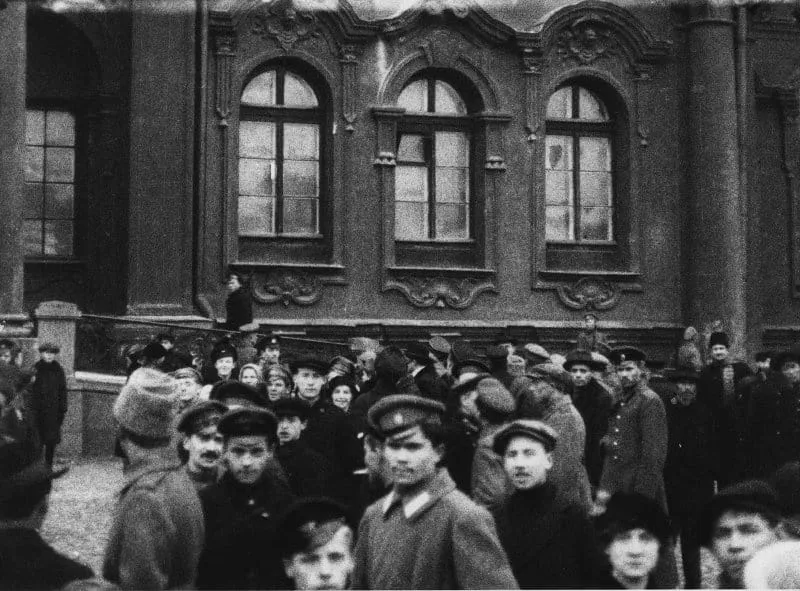
On 7 November 1917 (25 October by the Julian calendar) the Bolsheviks seized power in Petrograd, the capital of Russia. During the night and the following day the forces of the Petrograd Soviet’s Military Revolutionary Committee (PL) – the workers’ Red Guard, soldiers of the garrison and sailors of the Baltic Fleet – occupied the bridges, the railway stations, the telegraph office, the telephone exchange, the power station and the State Bank, almost without firing a shot. At 10 a.m. the committee announced that the Provisional Government had been overthrown. The Prime Minister, Alexander Kerensky, had left the city to fetch troops from the front, while his ministers, shut up in the Winter Palace, waited for help that never came. At around 2 a.m. on the night of 7–8 November the palace was taken and the ministers arrested. The Second All-Russian Congress of Soviets, then in session at the Smolny, assumed power, and the next day it formed a government headed by Vladimir Lenin.
The coup that gave its name to the “October Revolution” was brief and shed little blood. Its consequences, however, proved enormous. The overthrow of the Provisional Government did not end the struggle for Russia but opened a new chapter in it: a civil war from which emerged the world’s first state ruled by a communist party. Some Western chronologies date the coup to 8 November, because that was the day the news reached the Western capitals and the Winter Palace fell in the early hours. The rising itself, however, took place during the night of 6–7 November and over the following twenty-four hours.
From February to October
Eight months earlier the February Revolution had overthrown Tsar Nicholas II. Power passed to the Provisional Government of Prince Georgy Lvov, made up mainly of liberals, but alongside it there arose the Petrograd Soviet of Workers’ and Soldiers’ Deputies, which commanded obedience in the barracks and factories. This arrangement, known as dual power, worked only as long as the Soviet, led by moderate socialists – the Mensheviks and the Socialist Revolutionaries (SRs) – was willing to support the government. The government wanted to go on fighting the war alongside the Entente and postponed all the great decisions, above all land reform, until the Constituent Assembly could be convened. Meanwhile the soldiers wanted peace, the peasants land, and the workers in the towns bread and work.
In the spring of 1917 the Bolsheviks were one of the smaller socialist parties. The return of their leader changed everything. Lenin, who had spent the war in Switzerland, travelled through Germany with the Germans’ consent and on 16 April (3 April O.S.) arrived at the Finland Station in Petrograd. The next day he presented his April Theses: no support for the Provisional Government, all power to the soviets, an end to the war, confiscation of the landed estates. Many socialists, including some Bolsheviks, considered this programme divorced from reality. Within a few weeks, however, Lenin had won the party over. The slogan “peace, land, bread” chimed with the mood of the masses, and the Bolsheviks, who had stayed out of the government, were free to blame it for everything that went wrong. In May Leon Trotsky, Lenin’s former opponent in party disputes, arrived in Petrograd from America. Now both men wanted the same thing.
The government was steadily losing support. In May the Foreign Minister, Pavel Milyukov, whose note on fighting the war to a victorious end had provoked demonstrations, left the government, and moderate socialists joined the cabinet. Kerensky became Minister of War. The offensive he launched at the front in July collapsed within a few days. In mid-July the so-called July Days broke out in Petrograd: armed soldiers, sailors from Kronstadt and workers took to the streets demanding power for the soviets. The Bolsheviks, not fully in control of the movement, put themselves at its head, but the rising failed. The government published material purporting to show that Lenin was a German agent and issued a warrant for his arrest. Lenin went into hiding outside Petrograd and then in Finland. Trotsky and many other Bolsheviks were arrested. In July Kerensky became Prime Minister.
The party was saved by General Lavr Kornilov, the Commander-in-Chief, in whom the right saw a man capable of restoring order. At the beginning of September (the end of August O.S.), after murky negotiations with the Prime Minister through intermediaries, Kornilov sent a cavalry corps towards the capital. Kerensky declared him a rebel and called on everyone, the Bolsheviks included, to defend the revolution. The soviets and the railwaymen’s unions halted the troops before they reached Petrograd, and the workers armed for the occasion kept their weapons. The government emerged victorious from the crisis only in appearance: the officers never forgave Kerensky for imprisoning Kornilov, while the left suspected that he himself had been part of the plot. The Bolsheviks came out of hiding and within a few weeks won majorities in the soviets of Petrograd and Moscow. On 8 October (25 September O.S.) Trotsky became chairman of the Petrograd Soviet.
The decision to rise
From mid-September Lenin, still in hiding, sent letter after letter to the Central Committee demanding that power be seized at once. He believed the moment was exceptional: the government was powerless, the army was disintegrating, in the countryside the peasants were seizing manorial land on their own initiative, and revolution was ripening in Germany. At the beginning of October he secretly returned to the capital. On 23 October (10 October O.S.), at a night meeting in the flat of the Menshevik Nikolai Sukhanov, whose wife was a Bolshevik, the Central Committee resolved that an armed uprising was “on the agenda”. Lev Kamenev and Grigory Zinoviev voted against and a few days later made their opposition public in the press. The whole of Petrograd therefore knew of the Bolsheviks’ plans, and every few days the newspapers predicted the date of the rising.
The instrument of the coup was the Military Revolutionary Committee, set up by the Petrograd Soviet in late October, formally to defend the capital against the Germans, who had just occupied the islands of the Gulf of Riga, and against “counter-revolution”. Its members were Bolsheviks, among them Nikolai Podvoisky and Vladimir Antonov-Ovseyenko, and Left SRs, while in practice its operations were directed by Trotsky. It was he who argued that the coup should be carried out under the banner of the Soviet and linked to the Second Congress of Soviets, called for 7 November, so that it would pass for a defence of the revolution rather than a conspiracy of a single party. On 31 October (18 October O.S.) representatives of the regiments resolved that the garrison would carry out the orders of the district staff only with the Soviet’s consent, and the committee sent its commissars out to the units. When, a few days later, the commissars took control of the barracks, the government was left without troops in the capital before a single shot had been fired.
The night of 6–7 November
The government struck first. On the morning of 6 November (24 October O.S.) junkers – cadets of the military schools – occupied the printing works of the Bolshevik newspaper Rabochy Put. Kerensky asked the Pre-Parliament, the Provisional Council of the Republic, for support against the “rebels” and received it only in half-hearted form. The Military Revolutionary Committee recaptured the printing works, and when the government ordered the bridges over the Neva to be raised in order to cut the workers’ districts off from the centre, the committee’s forces began seizing them. Late in the evening Lenin, his face bandaged and wearing a wig, made his way from his hiding place in the Vyborg district to the Smolny, the former institute for young ladies of noble birth, which housed the Soviet and the committee.
During the night the committee’s forces methodically occupied one point in the city after another. It looked more like a changing of the guard than a battle: a commissar would arrive with a detachment, and the soldiers guarding the building would either disperse or join the newcomers. Sailors were on their way from Kronstadt and Helsingfors. At 10 a.m. on 7 November the committee issued its proclamation “To the Citizens of Russia!”: power had passed into the hands of an organ of the Petrograd Soviet, and the cause for which the people had fought – an immediate democratic peace, the abolition of landlords’ ownership of the land, workers’ control and a soviet government – “is assured”.
At around 11 a.m. Kerensky left the Winter Palace by car for Gatchina and from there for Pskov, the headquarters of the Northern Front, to bring troops from the front. At noon soldiers and sailors dispersed the Pre-Parliament from the Mariinsky Palace. In the afternoon Lenin appeared in public for the first time since July, at an extraordinary session of the Petrograd Soviet, and declared that the workers’ and peasants’ revolution, whose necessity the Bolsheviks had long proclaimed, had been accomplished.
The Winter Palace
All that was left to the government was the Winter Palace. It was defended by junkers from the officers’ schools, a company of the women’s Battalion of Death, Cossacks, artillerymen and war invalids. Estimates of their number range from a few hundred to about three thousand. In the evening most of them drifted away. The ministers, led by Deputy Prime Minister Alexander Konovalov, were waiting for troops from the front and rejected the ultimatum that Antonov-Ovseyenko sent them in the evening from the Peter and Paul Fortress. They declared that they could surrender power only to the Constituent Assembly.
At around 9.40 p.m. the cruiser Aurora, anchored in the Neva, fired a single blank round. Soviet tradition made it the signal for the storming and a symbol of the revolution, although shooting around the palace had begun earlier and from its position the ship could not have shelled the building effectively. Later the fortress guns opened fire. According to most accounts, only a few shells hit the palace. Red Guards, soldiers and sailors were filtering in ever greater numbers into the maze of its corridors, and the defenders no longer put up much resistance. At around 2.10 a.m. Antonov-Ovseyenko entered the room where the ministers were sitting and declared them under arrest. They were escorted to the Peter and Paul Fortress.
There were few casualties, though exact figures are lacking; researchers speak of a handful of dead. The storming, which later Soviet films and paintings depicted as a great battle, was in essence a long, chaotic siege of an almost defenceless building. The coup cost incomparably less blood than the February Revolution.
The Congress of Soviets and the first decrees
At 10.40 p.m., while there was still shooting around the palace, the Menshevik Fyodor Dan opened the Second All-Russian Congress of Soviets of Workers’ and Soldiers’ Deputies at the Smolny. According to the congress bureau’s figures, some 650 delegates attended, of whom about 390 were Bolsheviks; together with the Left SRs they had a clear majority. The Mensheviks, the Right SRs and the delegates of the Jewish Bund condemned the coup as a “military conspiracy” and walked out. Trotsky dismissed them with the words that their place was in “the dustbin of history”. Their departure left the Bolsheviks a free hand. In the early hours the congress adopted an appeal written by Lenin: the Provisional Government had been overthrown, the congress was taking power, and in the localities all power was passing to the soviets.
On the evening of 8 November the congress met again. It passed the Decree on Peace, which called on all the belligerent states to conclude an immediate armistice and a just peace “without annexations or indemnities”, abolished secret diplomacy and promised to publish the secret treaties. During the night it adopted the Decree on Land, which abolished landlords’ ownership of the land without compensation and placed the landed estates at the disposal of peasant committees. This was in essence the SRs’ agrarian programme, but Lenin had no qualms about taking it over: he was sanctioning what the peasants were already doing. In the early hours of 9 November the congress formed a new government, the Council of People’s Commissars, known as Sovnarkom. It consisted solely of Bolsheviks. Lenin became chairman, Trotsky took foreign affairs and Joseph Stalin nationalities. The title “people’s commissar” was meant to set the new authorities apart from the old “ministers”.
Why it succeeded
The Provisional Government had no reliable force in the capital. The garrison, which feared being sent to the front, recognised the authority of the Soviet. The Cossacks stayed neutral, and the officers, alienated by Kerensky’s treatment of Kornilov, were in no hurry to defend him. The Bolsheviks promised what most soldiers, workers and peasants wanted, and they had in Lenin a leader determined to take power and in Trotsky an efficient organiser. They could not, however, count on the support of the whole country. Their opponents spoke from the outset of a one-party coup d’état, and historians still argue over whether October was a popular revolution or a coup by a well-organised minority that exploited the paralysis of the state. Most agree that the two were intertwined: the Bolsheviks took over a power that no one any longer knew how to wield and exploited the radicalisation of the masses, but the decision itself was taken by a narrow group of leaders and carried out by an armed rising prepared by a single party.
Petrograd accepted the change of government with astonishing calm. The trams ran, the theatres played, and many residents learned of the coup from the newspapers. It was different in Moscow, where fighting with the junkers went on for over a week, until 15 November. Kerensky managed to gather outside Petrograd only a few hundred Cossacks under General Pyotr Krasnov. After the clash at Pulkovo on 12 November the Cossacks were ready to hand him over to the Bolsheviks, and the deposed Prime Minister escaped disguised as a sailor.
The long shadow of October
Lenin had announced that the government of commissars would be “provisional” until the Constituent Assembly was convened. In the elections at the end of November 1917, however, the Bolsheviks won only about a quarter of the vote, and the SRs took the majority. When the assembly met in January 1918 and refused to recognise the authority of the commissars, the Bolsheviks dispersed it after a single day’s session. As early as December 1917 they had set up a political police, the Cheka, and they had begun closing down the opposition press a few days after the coup. Contrary to the hopes of some socialists, no government of all the socialist parties came into being. The Left SRs joined the government for a few months, and then they too were removed. Russia was becoming a one-party state.
The Decree on Peace led straight to separate negotiations with Germany. In March 1918 Soviet Russia signed the Treaty of Brest-Litovsk and surrendered to the Central Powers lands stretching from Finland to Ukraine. Peace abroad opened the way to war at home. The Russian Civil War, in which the Reds fought the Whites, peasant rebels, national movements and the intervention of Russia’s former allies, lasted until 1920, and on the distant fringes of the former empire even longer. Together with the famine and epidemics that accompanied it, it cost millions of lives. From its ashes, in December 1922, emerged the Union of Soviet Socialist Republics.
The October Revolution changed the politics of the whole of Europe for the next two decades. The Bolsheviks wanted to ignite world revolution and in 1919 founded the Communist International in Moscow. In 1920 the Red Army marched on Warsaw, hoping to reach Germany through Poland. Fear of communism became one of the most powerful driving forces of the right in Germany, Hungary, Italy and elsewhere, and Adolf Hitler built his programme largely on the struggle against “Jewish Bolshevism”. At the same time the two states excluded from the Versailles order, Germany and Soviet Russia, quickly found common ground: in 1922 at Rapallo they established relations and began secret military cooperation. The Bolshevik party gave rise to Stalin’s dictatorship, which in the 1930s carried out collectivisation and the Great Terror and in August 1939 concluded the Molotov–Ribbentrop Pact with Hitler. On 17 September 1939 the Red Army entered Poland. The road to that day began at the Smolny on the night of 7–8 November 1917.
Sources
Related events
(04)The same battle, people or subject.
- 2 March 1919 · PoliticsThe founding of the CominternOn 2 March 1919 communists from many countries met in the Kremlin. On 4 March they founded the Third International to build a world republic of soviets.
- 14 February 1919 · Central and Eastern EuropeThe Polish–Soviet War beginsOn 14 February 1919 Polish troops clashed with the Red Army at Mosty on the Neman and at Bereza Kartuska. A war began that would last until the autumn of 1920.
- 7 March 1921 · Central and Eastern EuropeThe Kronstadt rebellionOn 7 March 1921 the Red Army began its assault on Kronstadt, whose sailors demanded free soviets without the Bolsheviks. The revolt was crushed on 18 March.
- 21 March 1919 · PoliticsThe proclamation of the Hungarian Soviet RepublicOn 21 March 1919 Social Democrats and Communists took power in Budapest and proclaimed the dictatorship of the proletariat. Béla Kun was its real leader.