Hungary
Gyula Peidl
Minister of Labour and Social Welfare (1919), Prime Minister of Hungary (1–6 August 1919), Social Democratic member of parliament (1922–1931)
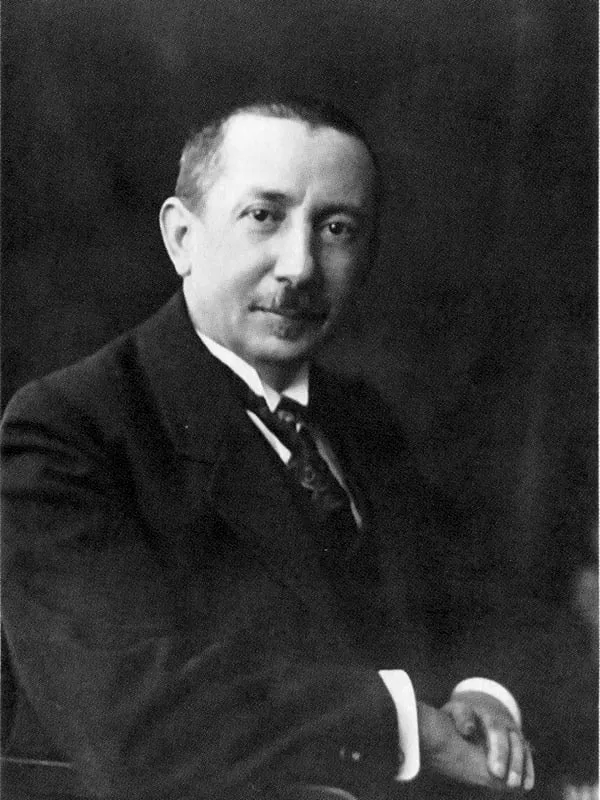
- Born:
- 4 April 1873, Ravazd (Kingdom of Hungary)
- Died:
- 22 January 1943, Budapest
- Author:
- Łukasz
- Photo:
- autor nieznany, domena publiczna, Wikimedia Commons

Gyula Peidl was one of those Hungarian Social Democrats who spent their whole lives in trade unions and cooperatives and entered high politics only briefly, at the worst possible moment. A typesetter by trade and for twenty years an activist of the printers’ union, in 1919 he served for two months as Minister of Labour in the democratic government of the People’s Republic, and when the communist Soviet Republic fell in August that year he became head of a “trade union government”. His task was to lead Hungary from dictatorship to democracy and to reconcile the country with the Entente. He did not have time. After six days his government was overthrown by right-wing conspirators, while the Romanians occupying Budapest looked on with indifference, and they opened the way to a quarter of a century of rule by Admiral Miklós Horthy. For almost ten years afterwards Peidl was one of the leaders of the Social Democratic opposition in a parliament that Horthy tolerated but in which the left never had any chance of power.
Typesetter and trade unionist
He was born on 4 April 1873 in the village of Ravazd in Győr county, in western Hungary. According to his biographers he lost his father early and was brought up by his mother. In 1886–1890 he trained as a typesetter at the printing works of the Franklin Society in Budapest, one of the largest publishing houses in the country. As a journeyman, following the old custom of craftsmen, he travelled through Austria, Switzerland and Germany. There he came to know the local Social Democratic movement and learned German.
On his return he quickly became one of the leaders of the printers, the best-organised and most educated group of workers in Hungary. From 1900 to 1918 he edited their journal, Typographia. In 1904 he was among the founders of the General Consumers’ Cooperative (ÁFOSZ); in 1908 he became its secretary, and from 1909 he edited the cooperative weekly. He also sat on the board of the National Workers’ Insurance Fund. In 1909 he joined the leadership of the Social Democratic Party of Hungary. He belonged to its moderate, reformist wing, which relied on trade unions, cooperatives and the struggle for universal suffrage rather than on revolution.
Minister of the People’s Republic
In the autumn of 1918 the Austro-Hungarian monarchy fell apart. After the Aster Revolution power passed to Count Mihály Károlyi, whose government relied heavily on the Social Democrats. On 16 November the Hungarian People’s Republic was proclaimed. On 19 January 1919, when Károlyi became provisional president and Dénes Berinkey prime minister, Peidl took over the Ministry of Labour and Social Welfare in the new government. The country was then losing one territory after another to its neighbours, and the communists of Béla Kun were agitating against the republic in factories and barracks.
On 20 March 1919 the Entente’s representative, the French Lieutenant Colonel Fernand Vix, demanded a further withdrawal of Hungarian troops. Berinkey’s government resigned, and the Social Democratic leaders, convinced that only an alliance with the communists and with Bolshevik Russia could save the country’s borders, merged with Kun’s party. Peidl was against this. He agreed neither to the merger of the two workers’ parties nor to the dictatorship of the proletariat. When the Hungarian Soviet Republic was proclaimed on 21 March, he resigned from all his leadership posts, though he remained a member of the united party. For the following months he stood aside, among those Social Democrats who believed that the communist experiment would end in disaster.
Six days
In the summer of 1919 the Soviet Republic was losing the Hungarian–Romanian War. Social Democrats, among them the envoy in Vienna, Vilmos Böhm, were discussing with Entente representatives how to remove the communists from power. The Allies promised to lift the blockade and halt the Romanians if a moderate Social Democratic government were formed in Budapest. When at the end of July the Romanian army crossed the Tisza and advanced on the capital, the trade unions came out in favour of such a solution. On 1 August came the fall of the Hungarian Soviet Republic. The Revolutionary Governing Council resigned, Kun left for Austria, and Sándor Garbai, until then the Council’s chairman, asked Peidl to form a government and handed him a ready-made list of ministers. Peidl accepted it reluctantly. The new cabinet included several former people’s commissars, among them Garbai himself, who took the education ministry.
The government, dubbed the “trade union government”, consisted almost entirely of Social Democrats and trade union officials. Peidl was prime minister and at the same time acting head of state. On 2 August he signed the new government’s first decree, which restored the name “Hungarian People’s Republic”. Within a few days the government dissolved the revolutionary tribunals and the Red Guard, released political prisoners, restored the old courts and police, returned nationalised apartment buildings, factories and shops to their owners, and withdrew the money printed by the communists. Peidl began talks with the leaders of the peasant and Christian parties about a coalition government, as the Allies expected.
His authority, however, was purely nominal. On 2 August the Supreme Council of the Paris Peace Conference, under pressure from Georges Clemenceau, refused to recognise a government made up solely of socialists. The Romanians did not stop, and on 3–4 August they entered Budapest; their command demanded a heavy indemnity from the government, which Peidl refused. The government had no army whatsoever. The capital’s middle classes, terrified by 133 days of communism, did not trust the socialists, who after all had handed power to Kun in March. On 6 August right-wing conspirators from the “White House” association arrested the Interior Minister, Károly Peyer, and surrounded the palace where the government was meeting. Romanian soldiers stationed nearby did not intervene. Peidl protested, but under threat of arrest and in return for a promise that a coalition government would be formed, the ministers stepped down. Power passed to István Friedrich, and the next day Archduke Joseph August proclaimed himself regent. A few days later even the People’s Republic that Peidl had restored was gone.
In exile and in parliament
After the coup Peidl went back to work in the printers’ union and took part in rebuilding the shattered party. In the autumn of 1919 he took part in the talks on a coalition government held under the supervision of the British diplomat George Clerk. But the White Terror was raging in the country. Officer detachments of the National Army of Horthy, who entered Budapest on 16 November, were murdering communists, socialists and Jews, and Social Democratic leaders were receiving death threats. According to his biographers, Peidl left for Austria on 18 November 1919. He lived in Vienna and in Sankt Radegund near Graz, where he worked as a proofreader.
He returned in November 1921, when the Prime Minister, István Bethlen, was seeking an understanding with the moderate left. In December that year the Social Democrats concluded an agreement with the government that allowed them to operate legally in return for giving up agitation among agricultural workers and civil servants. Peidl became head of the printers’ union and of the ÁFOSZ cooperative, rejoined the party leadership and in 1922 was elected to parliament. According to some accounts he led the Social Democratic parliamentary group. In 1924, when Bethlen’s government was seeking a League of Nations loan, Peidl was a member of the Social Democratic delegation that asked the British in London to make the aid conditional on the restoration of universal and secret suffrage, the abolition of restrictions on Jews at universities, and freedom of assembly. The British granted the loan.
In 1931, before the next elections, Peidl withdrew from politics. He spent his last years in Budapest, watching Hungary under Horthy and his prime ministers draw closer to the Germany of Adolf Hitler, pass one anti-Jewish law after another and in 1941 go to war against the Soviet Union. He died in Budapest on 22 January 1943, in the days when the Hungarian Second Army was being destroyed by the Red Army on the Don. He was buried in the Fiumei Road (Kerepesi) Cemetery.
Assessment
Peidl was neither a great orator nor a theorist. He was a typical representative of the generation of trade unionists who built the labour movement in Hungary before 1914 through patient organisational work. In 1919 he found himself at the very centre of a catastrophe he had not caused. He had opposed the alliance with the communists, yet it was he who had to pay for its consequences. His government was the last attempt to return to the democracy of 1918. It fell because it had no army, no recognition from the victors and no support from a frightened society, while the powers that had demanded a moderate and representative government in Hungary accepted a right-wing government with relief.
Peidl’s six days show clearly why Hungarian democracy lost in 1919. The Social Democrats, compromised by having shared power with Kun, could no longer lead the state, and the middle-class parties were too weak. Power passed into the hands of the right and the army. Horthy’s regime tolerated Social Democrats in parliament but barred their way to government. So arose a system that for a quarter of a century combined conservative parliamentarism with anti-communism and antisemitism, and that led Hungary into alliance with Hitler.
Sources
Often appears with
People who appear in the same events.