Hungary
Béla Kun
Founder of the Communist Party of Hungary (1918), People's Commissar for Foreign Affairs and de facto leader of the Hungarian Soviet Republic (1919), Comintern official (1920–1937)
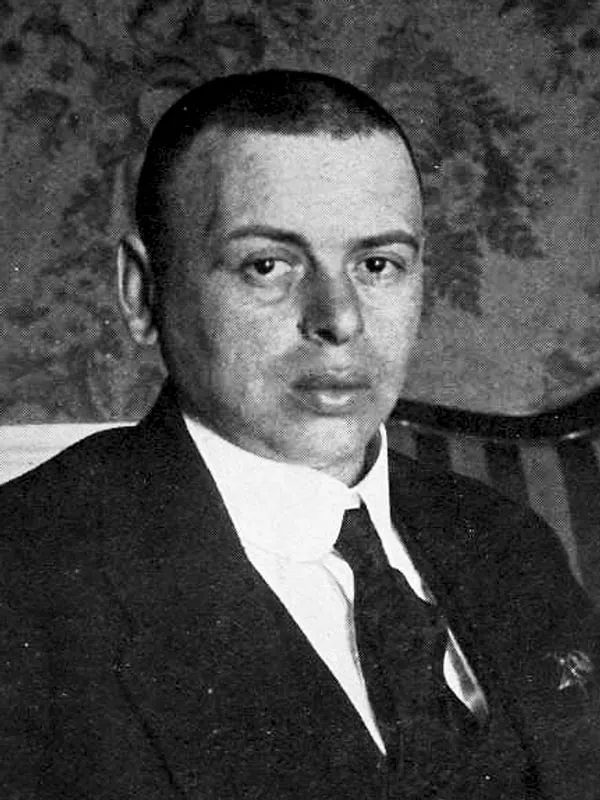
- Born:
- 20 February 1886, Lele, near Szilágycseh (Kingdom of Hungary, now Romania)
- Died:
- 29 August 1938, Kommunarka, near Moscow
- Author:
- Łukasz
- Photo:
- Gyula Jelfy, domena publiczna, Wikimedia Commons

Béla Kun headed the second communist state in Europe after Russia. In the spring of 1919, a few months after returning from Russian captivity, he led the Hungarian communists from prison to power and for 133 days ruled the Hungarian Soviet Republic, formally as People’s Commissar for Foreign Affairs. His rule was ended by the war with Romania: in August 1919 the Romanian army occupied Budapest and Kun fled to Austria. For the road to the Second World War, what the Soviet Republic left behind proved more important than the republic itself. The memory of the Red Terror, and of the fact that many of the commissars, Kun first among them, were of Jewish origin, served the counter-revolution of Miklós Horthy in building a regime that for a quarter of a century combined anti-communism with antisemitism and revisionism. Kun himself spent the rest of his life in Soviet Russia as a Comintern functionary, shared responsibility for mass executions in the Crimea, and perished in 1938 in the purges of Joseph Stalin.
Youth in Transylvania
He was born Béla Kohn on 20 February 1886 in the village of Lele near Szilágycseh in north-western Transylvania, now in Romania. His father, Samu Kohn, was a village notary of Jewish origin who was indifferent to religion. Béla attended the gymnasium in Zilah and then the famous Calvinist college in Kolozsvár (Cluj). There he won an essay competition on Sándor Petőfi, in which he wrote that revolutions are won not by moderation but by daring. From about 1904 he used the Magyarised surname Kun. In the same year he began studying law at the university in Kolozsvár, but did not graduate.
While still a schoolboy he became involved in the socialist movement, and according to some biographers he joined the Social Democratic Party of Hungary at the age of sixteen. He worked as a journalist on provincial newspapers, known for his sharp pen and hot temper, and fought several duels. He also sat on the board of the workers’ insurance fund in Kolozsvár, which was later linked to accusations of embezzlement. In Kolozsvár he befriended the poet Endre Ady, who introduced him to the circle of the Budapest left-wing intelligentsia. In 1913 he married a music teacher, Irén Gál, with whom he had two children.
Captivity and revolution in Russia
During the First World War he served in the Austro-Hungarian army on the Eastern Front. In 1916 he was taken prisoner by the Russians and sent to a prisoner-of-war camp near Tomsk in Siberia. There he came into contact with the Bolsheviks. The February Revolution of 1917 gave the prisoners more freedom, and Kun joined the Bolshevik party and began agitating among his fellow prisoners. After the October Revolution he moved to Petrograd and then to Moscow, where in March 1918, together with other prisoners, he founded the Hungarian group of the Russian Communist Party (Bolsheviks), and soon he headed the federation of all the foreign communist groups. He published newspapers for prisoners of war and recruited them into the Red Army. Tens of thousands of Hungarians fought on the Bolshevik side in the Civil War.
In Moscow he met Vladimir Lenin. At that time he belonged to the Left Communists, who opposed the Treaty of Brest-Litovsk and wanted to turn the war into a European revolution. Lenin treated him with sympathy, but also with irony. According to an often-repeated anecdote, he said of Kun that one could tell he came from a land of poets and dreamers.
Return to Hungary
After the collapse of the Austro-Hungarian monarchy and the Aster Revolution, Kun returned to Hungary with a group of several hundred comrades and money from the Soviet government. He reached Budapest in mid-November 1918, and on 24 November he founded the Party of Communists in Hungary. He launched a fierce campaign against the government of Mihály Károlyi and its Social Democratic allies. He imitated Lenin’s methods of 1917: he appealed to the unemployed, demobilised soldiers, invalids and refugees from the lands occupied by Hungary’s neighbours, infiltrated the trade unions and split the Social Democratic Party from within. He was a rousing speaker. Even so, in February 1919 the communists had at most a few tens of thousands of members, against hundreds of thousands of Social Democrats.
On 20 February 1919 a communist demonstration outside the offices of the Social Democratic newspaper Népszava ended in a shoot-out in which several policemen were killed. Kun and several dozen party leaders were imprisoned. The press reported how policemen, avenging their dead colleagues, had beaten the prisoners, and the news turned him into a martyr. The government allowed him to run the party from his cell, where he received hundreds of visitors, among them a growing number of left-wing Social Democrats.
The Soviet Republic
On 20 March 1919 the French Lieutenant Colonel Fernand Vix handed Károlyi a note from the Peace Conference ordering Hungarian troops to withdraw further west and placing a belt of territory as far as Debrecen under Allied control. Károlyi refused to accept it and resigned. The Social Democrats concluded that only an alliance with Soviet Russia could save Hungary’s territorial integrity, and came to Kun in prison. It was the imprisoned leader who dictated the terms. On 21 March the two parties merged, and the Revolutionary Governing Council proclaimed the Hungarian Soviet Republic. Formally it was chaired by the Social Democrat Sándor Garbai, but real power lay with Kun, the People’s Commissar for Foreign Affairs, who kept in constant touch with Lenin by radio-telegraph.
The republic nationalised industry, the banks, larger apartment buildings and the land. Instead of distributing the land to the peasants, it turned the great estates into state farms, often run by their former managers, which alienated the countryside. The peasants refused to accept the new government’s money, and food for the towns was requisitioned by force. The communists kept control of the political police and the revolutionary tribunals. Units such as Tibor Szamuely’s “Lenin Boys” hunted down “counter-revolutionaries”, and after uprisings were put down in June 1919 the repression intensified. According to various estimates, the Red Terror claimed between about 370 and about 600 victims. The White Terror that followed the fall of the republic cost many times more lives.
The greatest test was the war over the borders. In April Kun rejected a proposal from the Allied envoy, General Jan Smuts, and counted on help from the Red Army in Ukraine, which never came. In mid-April the Romanian army attacked in Transylvania and within two weeks reached the Tisza, while the Czechoslovaks advanced from the north. Kun admitted publicly that he had made a mistake and considered resigning, but the workers of Budapest, mobilised by the trade unions, together with patriotically minded officers of the old army, made it possible to rebuild the front. In May and June the Hungarian Red Army defeated the Czechoslovaks and advanced deep into Slovakia. Kun nevertheless agreed to withdraw it from there when the French prime minister, Georges Clemenceau, promised that the Romanians would leave the territory beyond the Tisza. The promise was not kept, and Kun alienated the officers and nationalists. On 20 July he threw the army into an offensive across the Tisza, which collapsed after a few days. The Romanians crossed the river and marched on Budapest.
On 1 August 1919 Kun gave his last speech, in which he accused the Hungarian proletariat of not wanting to defend its dictatorship, and that same day he left for Austria with his closest associates. Three days later the Romanians entered Budapest.
The Comintern and the Crimea
In Austria Kun and the other commissars were interned, first at Karlstein Castle and then at the Steinhof psychiatric hospital in Vienna. There they survived an attempt to poison them with sweets sent to them. In the summer of 1920 Austria exchanged them for its own prisoners of war in Russia. Kun never returned to Hungary. In November 1920, after the defeat of Pyotr Wrangel’s White army, he became head of the Crimean Revolutionary Committee. Together with Rosalia Zemlyachka and Georgy (Yuri) Pyatakov, he directed the mass executions of White officers and soldiers who had stayed on the peninsula trusting in a promised amnesty, as well as of civilians deemed enemies. The number of victims is disputed: estimates range from several thousand or more than ten thousand to several tens of thousands killed.
In 1921 he became a member of the Executive Committee of the Communist International and was sent to Germany. He was one of the instigators of the “March Action”, a failed attempt at a communist uprising in central Germany in March 1921. Lenin called his conduct foolishness, but Kun kept his posts. In the 1920s he worked in the Comintern, dealing mainly with Germany, Austria and Czechoslovakia. In 1928 he was arrested in Vienna for travelling on a false passport. In Moscow he quarrelled with many Hungarian émigrés and denounced some of them to the OGPU. He supported the line that the Social Democrats were “social fascists” and opposed the Comintern’s turn towards popular fronts in 1935, which weakened his position.
Death
During the Great Purge the NKVD arrested him at the end of June 1937 on charges of Trotskyism and of leading a counter-revolutionary terrorist organisation. On 29 August 1938, after a brief secret trial, he was sentenced to death and shot the same day at the Kommunarka shooting ground near Moscow. For decades his fate remained a mystery. When the Soviet authorities rehabilitated him in the mid-1950s, they informed their Hungarian comrades that he had died in prison in 1939. The true date of his death was revealed only in 1989. Among the former commissars of the Soviet Republic who survived the purge was Mátyás Rákosi, who after the Second World War became the leader of communist Hungary.
Significance
The Soviet Republic was short-lived, but its effects were felt in Hungary throughout the interwar years. The defeat by Romania and the occupation of Budapest opened the way to power for Horthy, and the counter-revolution made “Kun’s rule” its chief argument against any form of left-wing politics. The White Terror and the propaganda of the new regime identified communism with the Jews. As early as 1920 the Hungarian parliament passed the numerus clausus law restricting the admission of Jews to universities, the first anti-Jewish law in post-war Europe. Fear of a return of Bolshevism was also one of the reasons why Hungary joined Germany’s war against the USSR in 1941.
Kun’s example mattered beyond Hungary too. To opponents of communism throughout Central Europe, from Germany to Romania, the Soviet Republic was proof that the Bolshevik revolution could leap westwards from Russia, and in the propaganda of the far right, including the German far right, his name served as the prime example of supposed “Jewish Bolshevism”. For the communists themselves he became an awkward hero: the founder of the party and leader of a revolution, yet also a victim of Stalin, who after his rehabilitation was presented in official terms while the Crimean executions were passed over in silence. Historians today mostly judge him harshly, as a fanatical but politically inept revolutionary whose rule ended in national defeat and brought Hungary long years of reaction.
Sources
Commanded in battles
(01)Mentioned in battles
(01)Often appears with
People who appear in the same events.