1918–1921: Wars after the Great War
The Hungarian–Romanian War
- Dates:
- 13 November 1918 – 4 August 1919
- Front:
- Central and Eastern Europe
- Location:
- Transylvania, Crișana and Maramureș, the Great Hungarian Plain up to the Tisza and, in August 1919, western Hungary with Budapest as far as GyőrOn the battle map →
- Sides:
- Hungary (the Hungarian People's Republic; from March 1919 the Hungarian Soviet Republic)Béla Kun, Vilmos Böhm, Aurél Stromfeld, Ferenc Julier
- Result:
- Romanian victory. The Hungarian Soviet Republic collapsed, the Romanian army occupied Budapest and most of Hungary, and Transylvania, together with Crișana and the eastern Banat, passed to Romania.
- Author:
- Łukasz
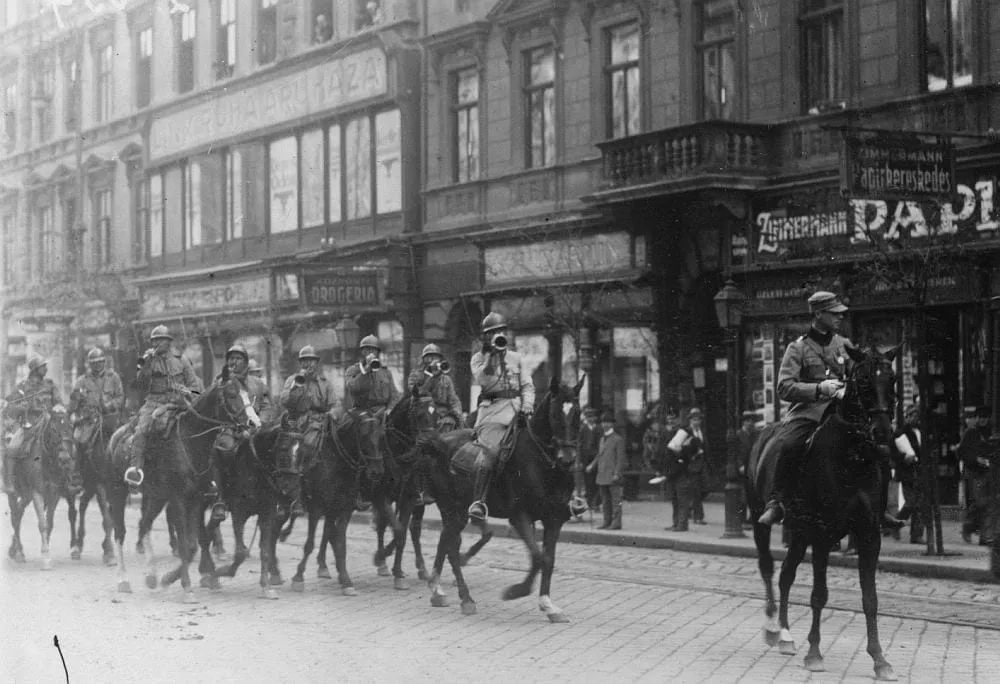
The Hungarian–Romanian War was the first of the wars that broke out in Central Europe on the ruins of the Habsburg monarchy before the Paris Peace Conference had managed to draw the new borders. It began in the autumn of 1918 almost without a shot being fired: while Hungary, after the Aster Revolution, was disbanding its army, Romanian troops crossed the Carpathians and step by step occupied Transylvania, where Romanians made up the majority of the population. Real fighting broke out only in the spring of 1919, after the communists of Béla Kun had seized power in Budapest. In April the Romanians routed the Hungarian forces and reached the Tisza; in July they repulsed a Hungarian offensive across the river and then crossed it themselves. On 1 August the Hungarian Soviet Republic collapsed, and on 3 and 4 August the Romanian army entered Budapest. The occupation that followed, and the lands Hungary lost to Romania in 1920, poisoned relations between the two states for twenty years, and in 1940 became one of the issues Adolf Hitler used to play them off against each other.
Name and dates
The war is usually dated 13 November 1918 – 4 August 1919. Many war chronologies and other accounts date its start to 13 November 1918. On that day in Belgrade representatives of the Hungarian government signed a military convention with the command of the Allied forces in the Balkans, which drew a demarcation line between Hungary and the areas the Allies were entitled to occupy; according to some accounts, mainly Hungarian ones, the first Romanian patrols crossed the passes of the Eastern Carpathians into Transylvania in those same days. It should be borne in mind, however, that for the first five months this was not a war in the ordinary sense. Romania did not declare war on Hungary; the Romanian army occupied successive demarcation lines with the consent of the Allied command and clashed with Hungarian units only in skirmishes. For this reason some historians, especially Romanian ones, speak of the war of 1919 and date it from the Romanian offensive of mid-April 1919, calling the period from November to April the occupation of the demarcation line.
The end of the war can be placed on 4 August 1919, when the main Romanian forces entered Budapest and marched through the city centre past General Traian Moșoiu. The first squadrons of Romanian cavalry had entered the capital on the evening of 3 August, and some accounts give that day as the end of the war. By then the Hungarian forces had ceased to exist as an organised force, and the government that replaced the communists put up no further fight. The occupation of Hungary, however, lasted many more months. The Romanians left Budapest on 14 November 1919, and their last units withdrew from the lands east of the Tisza that the Treaty of Trianon left to Hungary only at the end of March 1920. Sources differ on the details: some give 28 March, others 30 March, and some speak of the evacuation being completed as early as February 1920. Some authors therefore extend the war as a whole to the spring of 1920.
Hungarians call the fighting the Hungarian–Romanian War (magyar–román háború), and often describe the spring and summer campaigns of 1919 together with the war against Czechoslovakia as the Hungarian Soviet Republic’s war for its borders.
Background
The promise of 1916. Romania entered the First World War on the side of the Entente in August 1916 because in the secret Treaty of Bucharest the Great Powers had promised it in return Transylvania, Bukovina and the Banat – the lands of the Kingdom of Hungary up to the Tisza. The war ended in defeat for Romania: in December 1916 the Germans took Bucharest, and in May 1918 the government in Iași signed a separate peace with the Central Powers. King Ferdinand I, however, never ratified it, and on 10 November 1918, as the French army of General Louis Franchet d’Espèrey was crossing the Danube, Romania re-entered the war. General Constantin Prezan once again became Chief of the General Staff. The prime minister, Ion I. C. Brătianu, wanted Romania to be treated at the peace conference as an ally entitled to everything it had been promised in 1916.
The disintegration of Hungary. In the last days of October 1918 the Austro-Hungarian monarchy fell apart. In Budapest the Aster Revolution brought to power Count Mihály Károlyi, who broke with Austria and Germany and on 16 November proclaimed the Hungarian People’s Republic. Károlyi favoured an understanding with the Entente and hoped that the victors would treat a democratic Hungary leniently. His minister of war, Béla Linder, ordered the soldiers to lay down their arms at the beginning of November, and the army, exhausted by four years of war, was going home anyway. Hungary was left practically without an army at the very moment its neighbours were laying claim to its lands. Transylvania was a land of many nations. Romanians formed the majority, but Hungarians predominated in the towns; in the east lived the Székelys, the Hungarian-speaking population of the Eastern Carpathians, and around Sibiu and Brașov the Transylvanian Saxons.
The Belgrade Convention. On 13 November 1918 in Belgrade representatives of Károlyi’s government signed with the Allies a military convention known as the Armistice of Belgrade. It laid down a line behind which the Hungarian army had to withdraw. In the east it ran from the upper Someș through Bistrița to the Mureș and along that river to the Tisza. East and south of this line the Allies could station troops, while the Hungarians kept the administration. Borders were not decided; the line was to remain in force until the peace treaty.
Course of the war
November 1918 to March 1919: the occupation of Transylvania
Romania, whose army had largely been demobilised, had few troops under arms. Mobilisation was announced on 10 November, and those that set out were chiefly the divisions stationed in Moldavia: the 7th Infantry Division and the 1st Rifle (Vânători) Division. Sources differ on exactly when they crossed the former border of Transylvania. According to Hungarian accounts, the first Romanian patrols appeared at the Tölgyes Pass on 12 November and at Gyimesbükk a day later; Romanian archival studies, by contrast, indicate that the leading units of the division set off a few days after mobilisation and reached Toplița and Miercurea Ciuc only at the end of November. Behind the 7th Division the 1st Division entered the mountains from the Bistrița valley. The Hungarian local authorities and the remnants of their units withdrew without a fight. The Romanians advanced slowly, following in the wake of the German troops of Field Marshal August von Mackensen, who were returning home under the terms of the Armistice of Compiègne.
On 1 December 1918, at Alba Iulia, an assembly of more than a thousand Romanian delegates from Transylvania, the Banat, Crișana and Maramureș proclaimed the union of these lands with Romania. A Ruling Council in Sibiu headed by Iuliu Maniu was placed at its head. Three weeks later the Hungarians of Transylvania met in Cluj and demanded to remain in the Hungarian state. Meanwhile the Romanians had taken Brașov and reached the Mureș. Bucharest lobbied the Allies for permission to advance further, and the Allied command in the East moved the line the Romanian army could reach to the western slopes of the Apuseni Mountains. On 24 December the Romanians entered Cluj, and by January 1919 they controlled most of Transylvania. General Traian Moșoiu took command of the Romanian forces in Transylvania at Sibiu.
The Hungarians had only one force of any consequence there: the Székely Division, formed in December at Cluj from the remnants of Hungarian units and volunteers by Colonel Károly Kratochvil. At first it numbered fewer than two thousand men; by the spring of 1919, according to Hungarian figures, it had more than twelve thousand. In January and February it held a front running from the area of Satu Mare through Ciucea to Beiuș, covering Oradea, and clashed with the Romanians several times. These were skirmishes, however, not battles. For Bucharest and Budapest alike, what mattered most was what would be decided in Paris.
At the end of February 1919 the Supreme Council of the peace conference decided to move the demarcation line further west, along the Satu Mare – Oradea – Arad railway, and to create a neutral zone behind it. The towns themselves were to remain beyond the reach of the Romanian army. On 20 March the head of the Allied military mission in Budapest, the French Lieutenant Colonel Fernand Vix, handed Károlyi a note demanding the withdrawal of Hungarian troops. The line demanded cut off from Hungary territory as far as Debrecen and Makó. In Budapest everyone took it to be the future border. Károlyi refused to accept the note and resigned. On 21 March power was seized by the united Social Democrats and Communists, who proclaimed the Hungarian Soviet Republic. Formally the government was headed by the Social Democrat Sándor Garbai, but its real leader was the People’s Commissar for Foreign Affairs, Béla Kun, released from prison that very day.
April 1919: the Romanians reach the Tisza
Kun hoped that Hungary would defend its borders with the help of Bolshevik Russia, whose Red Army was then fighting in Ukraine, not far from the Carpathians. On 4 April an envoy of the peace conference, the South African General Jan Smuts, arrived in Budapest with the offer of a more lenient demarcation line. Kun rejected it, demanding that the Romanians withdraw behind the Mureș. The Hungarians began to form a Red Army in which former imperial and royal officers served alongside worker volunteers from Budapest.
Romania was preparing too. On the Transylvanian front, commanded by April by General Gheorghe Mărdărescu, two groups were deployed: a northern one under General Moșoiu and a southern one. The plan was for the northern group to take Carei and Oradea and cut the Székely Division off from the rest of the Hungarian forces. On the night of 15–16 April the Hungarians struck first but failed to break the Romanian lines, and on 16 April the Romanian offensive began. Some sources date its start to 15 or 17 April. After heavy fighting the Romanians took the passes of the Apuseni Mountains, occupied Carei on 19 April and Oradea on 20 April. The Hungarian front collapsed. Instead of halting on the line set out in the Vix Note, the Romanians pressed on westwards towards the Tisza, a river that was easy to defend.
On 23 April the Romanian army entered Debrecen, and on 25 and 26 April, after heavy fighting, Békéscsaba. The Székely Division, cut off in the north-east, laid down its arms at Demecser on 26 April, and in those same days Czechoslovak troops entered Hungary from the north. By 1 May the Romanians held the entire eastern bank of the Tisza, from Tokaj to the area of Szeged, and had broken through the Hungarian positions in front of Szolnok. They were less than a hundred kilometres from Budapest. Panic gripped the capital. Kun admitted publicly that rejecting the Allied proposal had been a mistake, and on 2 May offered Romania an armistice and recognition of its territorial claims. The Romanians halted, but not because of Hungarian pleas. Paris demanded that Brătianu keep the army from crossing the Tisza, and the prime minister promised to do so.
May–June 1919: the war in the north
The revolutionary Hungarian government did not fall. The Social Democratic trade unions mobilised tens of thousands of workers in Budapest, and former officers who did not want to surrender the country to its neighbours began to volunteer for the Red Army. Its commander was the Social Democrat Vilmos Böhm, and its chief of staff Colonel Aurél Stromfeld, an able general staff officer of the old army. Stromfeld struck not at the Romanians but at the weaker Czechoslovaks. The northern offensive, launched in May, recovered Miskolc and Košice within a few weeks and pushed deep into Slovakia. The Romanians, who tried to strike at the Hungarian flank, had to fall back into a bridgehead at Tokaj and defend it at the end of May, and at the beginning of June they withdrew behind the Tisza.
The success did not last. On 16 June the Slovak Soviet Republic was proclaimed in Prešov. For officers who were fighting for the integrity of old Hungary, this was a sign that the communists were thinking of world revolution rather than the country’s borders. When the French prime minister, Georges Clemenceau, in notes sent in June, demanded the withdrawal of Hungarian troops from Slovakia and promised in return that the Romanians would leave the lands beyond the Tisza, Kun agreed. At the beginning of July the Hungarians evacuated Slovakia, and Stromfeld resigned in protest. Romania, however, did not withdraw from the Tisza. Brătianu declared that it would do so only once Hungary had disarmed its army. Kun concluded that, since the Entente was not keeping its word, it was time to try the fortunes of war against the Romanians. On 11 July the Supreme Council instructed Marshal Ferdinand Foch to prepare a joint operation by French, Serbian and Romanian troops against Hungary, but it never took place.
20–26 July 1919: the offensive on the Tisza
In July two armies, each of roughly fifty to sixty thousand men, faced each other along the Tisza on a front some 250 kilometres long, from Tokaj to the area of Szeged. The Hungarian Red Army, in which professional officers were watched with suspicion by political commissars, was in practice commanded by its chief of staff, Ferenc Julier, Stromfeld’s successor. The plan was to cross the Tisza in three groups: the northern one was to advance on Satu Mare, the central and strongest one from Szolnok on Oradea, and the southern one on Arad. Kun also hoped that success would encourage Bolshevik Russia to attack Romanian Bessarabia. The Romanians deployed their forces in three echelons: a thin first line on the river was to delay the enemy, while the strongest divisions, including both cavalry divisions, waited in reserve along the Carei – Oradea – Arad railway, ready to counter-attack. According to many studies, the Romanian command in fact knew the Hungarian plan.
After several days of shelling, at around 3 a.m. on 20 July the Hungarians crossed the Tisza along the whole front. In the north they took Rakamaz and several neighbouring villages but could not break out of the bridgehead, which the Romanians eliminated on 26 July. In the south the Hungarian 2nd Division took Szentes, and Hódmezővásárhely changed hands several times before the Romanians finally retook it on 23 July. The most dangerous blow fell in the centre. From Szolnok three Hungarian divisions broke out of the bridgehead, took Törökszentmiklós, Mezőtúr and Túrkeve, and drove several dozen kilometres deep into the eastern bank.
On 24 July the Romanians launched a counter-attack from the north into the flank of the Hungarian wedge. General Cleante Davidoglu’s 2nd Cavalry Division, the 1st Infantry Division and the 6th Infantry Division struck from the area of Kunhegyes and Fegyvernek. The Hungarians counter-attacked, but on 25 July their lines began to give way and their divisions fell back towards the bridge at Szolnok. On 26 July the Hungarians blew up the bridge, and by evening the entire eastern bank of the Tisza was once again in Romanian hands. The offensive on which Kun had staked the fate of the republic had collapsed within six days.
27 July – 4 August 1919: the march on Budapest
The Romanians did not wait for Paris to decide. They brought the 7th Division from Bessarabia and further units from Romania itself, and according to Romanian figures concentrated on the Tisza some 84,000 infantry, 12,000 cavalry and nearly 400 guns. After several days of reconnaissance, on the night of 29–30 July, they crossed the river at a bend near Fegyvernek, while mounting feint attacks elsewhere. The surprise worked. Hungarian aircraft tried to bomb the Romanian pontoon bridge but were driven off. By 31 July the Hungarian divisions were retreating in disorder towards the capital, and soldiers were deserting en masse.
On 1 August the revolutionary government resigned. Kun made a last speech in which he accused the Hungarian proletariat of being unwilling to fight, and that same day left for Austria with his closest associates. Power passed to a Social Democratic government under the trade unionist Gyula Peidl, which restored the old order and hoped that the Allies would stop the Romanians. The Romanians, however, kept advancing. On the evening of 3 August three squadrons of the 6th Cavalry Regiment under General Gheorghe Rusescu rode into Budapest. Until noon on 4 August there were only a few hundred Romanian soldiers in the city, with two guns; then the main forces arrived and marched through the streets past General Moșoiu (according to some Romanian sources it was General Mărdărescu who took the salute). Moșoiu assumed command of the occupation forces west of the Tisza, and General Ștefan Holban became commandant of Budapest itself. Over the following days the Romanians advanced further west, as far as Győr. Only the area around Lake Balaton and the westernmost fringes of the country remained beyond their reach.
The occupation
On 6 August Peidl’s government was overthrown by counter-revolutionaries, who proclaimed Archduke Joseph August head of state and István Friedrich prime minister. The Romanians did nothing to prevent the coup. The Allies, however, would not accept a Habsburg at the head of Hungary, and at the end of August the archduke had to step down. The Supreme Council sent to Budapest an inter-Allied military mission of four generals – American, British, French and Italian – to supervise the disarmament of Hungary and the withdrawal of the Romanian troops. Relations between the mission and the Romanians were bad. The American General Harry Hill Bandholtz recorded in his diary many complaints about Romanian requisitions, and on 5 October personally sealed the doors of the National Museum to prevent its collections from being carried off.
Romania took the view that, since Germany and Austria-Hungary had plundered it during the occupation of 1916–1918, it was entitled to compensation from Hungary. The Romanians requisitioned above all state property – weapons, the equipment of arms factories, locomotives and rolling stock – but also grain, cattle, horses and farm machinery, and when the quotas fell short they turned to private property. According to tallies cited in the literature, Hungary lost half its railway rolling stock in this way – from around 800 to nearly 1,300 locomotives and from 19,000 to more than 34,000 wagons, depending on the source – as well as some 30 per cent of its livestock and farm implements. These figures are disputed, but for Hungarians the occupation long remained a symbol of plunder, and for Romanians one of just retribution. Romanian troops also dealt with the communists in the towns they occupied. Beyond their reach, meanwhile, the National Army was growing; it had been organised since June at Szeged, under the protection of French troops, by Admiral Miklós Horthy. Its units, stationed around Siófok on Lake Balaton, launched the so-called White Terror against communists, Social Democrats and Jews.
Under pressure from the Allies and the British diplomat George Clerk, the Romanians left Budapest on 14 November 1919 and withdrew behind the Tisza; two days later Horthy rode into the capital on a white horse. The last Romanian units left the lands east of the Tisza that were assigned to Hungary in March 1920. Brătianu, who had refused to give way in his dispute with the Great Powers over Hungary and reparations, had already resigned in September 1919.
Losses
According to Romanian figures, the Romanian army lost 123 officers and 6,434 men in the 1919 campaign, including 39 officers and 1,730 men killed, 81 officers and 3,125 men wounded, and 3 officers and 1,579 men missing. By 8 August the Romanians had taken prisoner 1,235 Hungarian officers and some 10,000 men and captured around 350 guns, more than 300 machine guns, more than 50,000 rifles and 87 aircraft. Hungarian losses in killed and wounded cannot be given with similar precision, because the army of the Soviet Republic disintegrated in August and much of its documentation has been lost. Nor are there reliable figures for civilian victims, who died both in the fighting and in the reprisals carried out by both sides.
Significance
The war decided the fate of Transylvania, even though it was not the war that formally fixed the border. On 4 June 1920 Hungary signed the Treaty of Trianon, which awarded Romania Transylvania, the eastern part of the Banat, Crișana and Maramureș – more than a hundred thousand square kilometres, more than Hungary itself was left with. The border, drawn so that the Satu Mare – Oradea – Arad railway and those towns lay in Romania, left more than one and a half million Hungarians on the Romanian side. Romania doubled its territory and became “Greater Romania”, but with a large Hungarian minority that felt itself wronged.
For Hungarians, 1919 was a succession of humiliations: disarmament under Károlyi, the loss of land without a fight, communist dictatorship, the occupation of the capital by a neighbour, and Trianon. From this experience grew the Horthy regime, which for a quarter of a century made revision of the treaty the chief aim of its policy. The counter-revolution born in 1919 combined fear of communism with antisemitism, since many leaders of the Soviet Republic, Kun among them, were of Jewish origin. The memory of the Soviet Republic also meant that Hungary, like Romania, long regarded Soviet Russia as a mortal enemy.
For Romania, the war confirmed its standing as a regional power and a bulwark of Europe against Bolshevism. Bucharest tied itself to France and, in 1921, joined Czechoslovakia and Yugoslavia in the Little Entente, directed above all against Hungarian revisionism. Hungary therefore sought support from those who also wanted to overturn the Versailles order: first from Benito Mussolini’s Italy, then from Hitler’s Germany. Revision came at their hands. On 30 August 1940, in the Second Vienna Award, Germany and Italy imposed a partition of Transylvania, giving Hungary its northern part, including Cluj. Both sides that had fought on the Tisza in 1919 then went to war against the USSR alongside Hitler, competing for his favour and for Transylvania. When Romania changed sides to the Allies in August 1944, its troops again fought the Hungarians in Transylvania and on the Great Hungarian Plain, and the peace treaty of 1947 restored the Trianon border. The dispute over Transylvania that began in November 1918 was thus one of the threads that led Central and Eastern Europe into the Second World War and shaped the course of that war in the region.