Hungary
Sándor Garbai
Chairman of the building workers' union (from 1903), President of the Revolutionary Governing Council of the Hungarian Soviet Republic (1919)
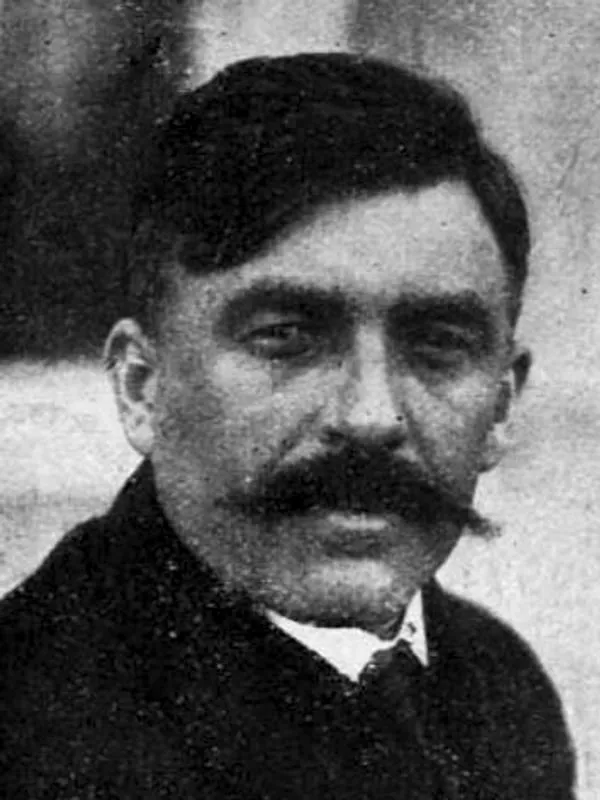
- Born:
- 27 March 1879, Kiskunhalas (Austria-Hungary)
- Died:
- 7 November 1947, Paris (France)
- Author:
- Natalia
- Photo:
- Pál M. Vajda, domena publiczna, Wikimedia Commons

For 133 days Sándor Garbai was formally the most important man in Hungary. As President of the Revolutionary Governing Council in 1919 he headed both the government and the state of the Hungarian Soviet Republic, but real power lay with the communist Béla Kun. Garbai, a bricklayer with a few years of elementary schooling, was one of the most respected figures in the Hungarian trade union movement, and it was thanks to him that in March 1919 the Social Democratic rank and file followed the dictatorship of the proletariat, of which many of its leaders were afraid. His words that what the West had not given Hungary must be sought in the East became the most famous sentence of that day. After the republic fell he lived in exile for almost thirty years, distrustful of the communists and rejected by the Social Democrats, and he died in Paris, forgotten and in poverty.
The bricklayer from Kiskunhalas
He was born on 27 March 1879 in Kiskunhalas, a farming town on the Great Hungarian Plain, into a poor Calvinist family. His father was Gábor Garbai and his mother Julianna Vili. He completed six years of elementary school and from childhood worked as a bricklayer’s mate and day labourer. At fifteen he moved to Budapest, where the building trade was growing fast, and there he learned the bricklayer’s craft. In 1905 he married a factory worker, Zsófia Pötördi.
In the capital he came into contact with the labour movement. Around 1901 he joined the Social Democratic Party of Hungary, and as early as 1902, at the age of twenty-three, he was elected to its leadership. From 1903 he headed the national building workers’ union, one of the strongest unions in the country, and ran workers’ insurance institutions. From 1907 he edited the union paper Építőmunkás (“The Building Worker”), and wrote on housing in the party’s theoretical monthly. He was a typical representative of the generation that built Hungarian Social Democracy: self-taught, a good speaker and organiser, a patient negotiator who chaired countless congresses and meetings. In a state in which fewer than ten per cent of the inhabitants had the vote, the Social Democrats had no representatives in parliament and fought above all through the trade unions and strikes.
The Aster Revolution and 1919
After the Aster Revolution of October 1918 the Social Democrats joined the government of Mihály Károlyi. Garbai did not become a minister, but he chaired the state Housing Council and Building Council. In the winter of 1918–1919 he was one of the activists who demanded that, instead of sharing power with the bourgeois parties, the Social Democrats should form a government on their own. He regarded Kun’s communists with reserve. In January 1919 he went to one of their meetings, but left it offended and indignant.
On 20 March 1919 the head of the Allied military mission in Budapest, Lieutenant Colonel Fernand Vix, handed Károlyi a note demanding a further withdrawal of Hungarian troops. The government rejected it and resigned, and the Social Democrats were to take power. The next morning, after a stormy debate, the party leadership decided to come to terms with the imprisoned communists. Garbai then opposed Ernő Garami, who warned that an alliance with the Bolsheviks would destroy the labour movement, and supported sending a delegation to the prison. In the afternoon he opened the meeting of the party’s executive council. Those present remembered that he spoke without his usual fervour, amid a deathly silence in the hall. “Like sleepwalkers we must walk along the edge of the abyss,” he is reported to have said.
In the evening he addressed the Budapest Workers’ Council at the city hall. He recalled the armistice, the demarcation lines broken by the neighbouring states and the promises of self-determination of which nothing remained. He accused the powers assembled in Paris of wanting an imperialist peace and declared that there was no other way than to accept a different kind of dictatorship. What the West had not given Hungary had to be sought in the East, and the Hungarian proletariat was offering a fraternal alliance to the government of Soviet Russia, whose army was approaching the Carpathians. Vilmos Böhm later called this speech an expression of “national Bolshevism”. The Workers’ Council enthusiastically adopted the motion to merge the parties and take power.
Late that evening the leaders of the two parties formed the Revolutionary Governing Council, and Garbai became its president. He had been a candidate to head the government even before, and after the agreement with the communists everything spoke in his favour: since January he had been the chief advocate of a purely Social Democratic government, he enjoyed the trust of the trade unionists, and he could do the communists no harm. Some memoirists and historians add that at a table at which many of the future commissars were of Jewish origin, the Calvinist Garbai was a convenient candidate for that reason too. When the composition of the new government was read out that night at the communists’ headquarters, there was silence at Garbai’s name, as one participant recalled, because the young communists thought they had misheard.
President of the Governing Council
Garbai was at once head of the government and formal head of state. He chaired the Council’s meetings, signed its decrees and spoke at rallies. The real decisions, however, were taken elsewhere. Kun, the People’s Commissar for Foreign Affairs, was the only one with a direct line to Vladimir Lenin; he spoke first, amended the motions of others and pronounced on matters outside his remit. Over the following weeks the influence of the communists grew, while the Social Democrats, who had joined the government in the hope of restraining it, lost ground. The Governing Council disbanded the old army and police, set up revolutionary tribunals, and nationalised industry, the banks and the great estates. Garbai had no influence over the communist security apparatus, run by Ottó Korvin and Tibor Szamuely, and by his own later accounts he watched the Red Terror with alarm, but he did not condemn it publicly. At the congress of councils in June 1919, after the constitution had been adopted, he was again placed at the head of the Governing Council. His position did not change: he was the face of a government led by Kun.
The republic fell in war with its neighbours. On 20 July its army attacked the Romanians beyond the Tisza; the offensive collapsed after a few days, and the Romanian army advanced on Budapest, deciding the Hungarian–Romanian War. On 1 August 1919 the Revolutionary Governing Council resigned. Kun and his closest associates left for Austria, and power passed to the Social Democratic government of Gyula Peidl. Garbai did not flee. According to Hungarian biographers he served in that government for a few days as Minister of Education, until on 6 August it was overthrown by István Friedrich’s counter-revolutionaries.
Exile
After the fall of the republic Garbai fell into Romanian hands and was interned in Kolozsvár (Cluj). He regained his freedom at the beginning of 1920; sources differ on whether he was released or escaped under an assumed name. He could not return to a country ruled by Admiral Miklós Horthy, where the White Terror was raging. Travelling through Czechoslovakia, he reached Vienna, the main centre of the Hungarian political emigration.
In exile he was a lonely man. He spoke no foreign languages and had no international connections; the communists regarded him as an opportunist, and the Social Democrats who had not gone along with Kun in 1919 as one of those to blame for the disaster. In the spring of 1920, together with Vilmos Böhm and Zsigmond Kunfi, he helped to found a group of Social Democrats in Vienna centred on the paper Világosság. In 1927, after disputes, he was expelled from it and founded his own group and his own newspaper, Előre (“Forward”). In 1933 he published the book Új utakon a hatalomért (“By New Roads to Power”), in which he argued for democratic socialism and an alliance of the workers with the democratic middle classes instead of class dictatorship. He struggled to make a living. With his family he ran a restaurant in Vienna, which went bankrupt.
When in February 1934 the Austrian government crushed the Social Democratic uprising and dissolved their party, Garbai had to leave Austria and moved to Bratislava, in Czechoslovakia, which was still a democracy. In 1936 he travelled to the United States, where he promoted a popular front against fascism among Hungarian émigrés. After the Munich Agreement and the dismemberment of Czechoslovakia in 1938 he left for Paris. He lived through the war and the German occupation in France. He did not join the Resistance, and the occupiers left him alone. In 1944 the Hungarian far-right press spread a rumour of his arrest, which he himself denied in a letter to the editor.
Last years
After 1945 Garbai wanted to return to Hungary, but the authorities refused permission. To the communists who came home from Moscow led by Mátyás Rákosi, he was a man who had failed in 1919 and had criticised their policies during his years in exile. Garbai wrote his memoirs and, increasingly embittered, looked for the causes of the 1919 defeat in the role played by radical intellectuals, including Jewish ones, in the leadership of the Soviet Republic. These views, noted by his biographers, further barred his way into the communist pantheon. He died in poverty in Paris on 7 November 1947. The Hungarian press gave him no more than a brief mention.
Significance
Garbai was not the creator of the Soviet Republic, but without men like him it could not have come into being. In March 1919 the communists numbered at most a few tens of thousands, whereas the trade unions organised hundreds of thousands of workers. It was the authority of the old trade unionists that made these masses accept the dictatorship of the proletariat as a continuation of their own struggle rather than a coup by a handful of Bolsheviks. His speech of 21 March also shows how great a part national humiliation played in the birth of the Soviet Republic: many Hungarians supported the communists not because they wanted world revolution, but because they were counting on Russian help in defending the borders against neighbours backed by the Entente.
The failure of that calculation had long-lasting consequences. The rule of the Council over which Garbai presided ended with the Romanian occupation of Budapest, the White Terror and Horthy’s regime, which for a quarter of a century equated socialism with Bolshevism and treason. Hungarian Social Democracy, forced onto the defensive, never regained its former strength in the interwar years, and in order to operate legally its leaders had to renounce the revolution of 1919. Communist Hungary after 1945 honoured Szamuely, and after his rehabilitation in 1956 Kun as well, but for decades it said nothing about Garbai, the formal head of the first Hungarian communist state.
Sources
Mentioned in battles
(01)Often appears with
People who appear in the same events.