Germany
Joachim Schepke
Commander of the submarines U-3 (1938–1940), U-19 (1940) and U-100 (1940–1941), Kapitänleutnant in the Kriegsmarine
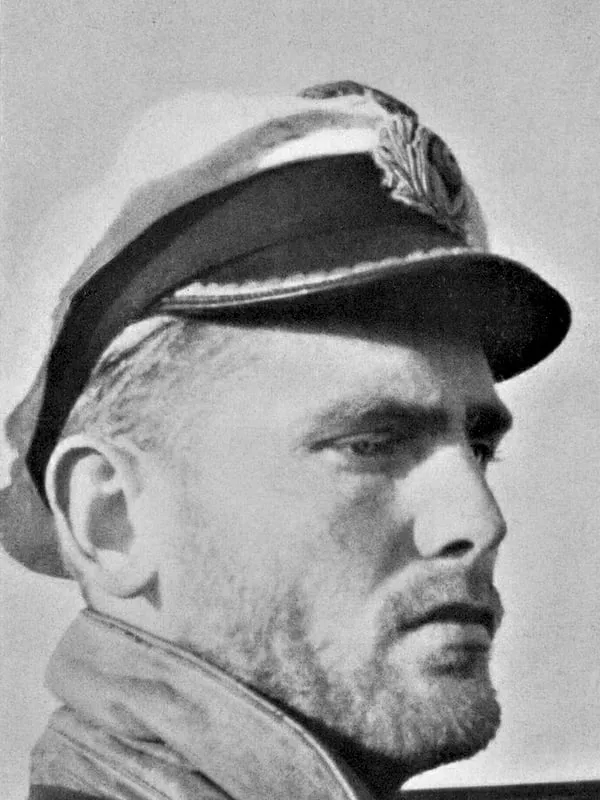
- Born:
- 8 March 1912, Flensburg (German Empire)
- Died:
- 17 March 1941, North Atlantic, south-east of Iceland
- Author:
- Natalia
- Photo:
- autor nieznany, domena publiczna, Wikimedia Commons

Joachim Schepke was a German naval officer and commander of the submarine U-100, one of the three most famous aces of the German U-boat arm – alongside Günther Prien and Otto Kretschmer – in the first phase of the Battle of the Atlantic. Handsome, easy-going and fond of appearing in public, he was a favourite of Third Reich propaganda: he wrote and illustrated books about life aboard a submarine, addressed young people, and his photographs went round the newspapers. He was one of the first commanders to enter the midst of a convoy on the surface at night, and in less than a year he sank several dozen ships. He also became notorious for exaggerated reports of the tonnage he had sunk. He was killed at the age of 29, on the night of 16–17 March 1941, when a British destroyer rammed his boat during an attack on convoy HX 112.
Youth and the Reichsmarine
He was born on 8 March 1912 in Flensburg in Schleswig-Holstein, into a seafaring family: his father, Botho Schepke, was an officer in the Imperial Navy. On 1 April 1930 he joined the Reichsmarine as an officer cadet, in the same intake (“Crew 30”) as Otto Kretschmer. He went through the usual course of training, with training cruises and studies at the naval academy at Mürwik near Flensburg, and on 1 October 1934 he became a Leutnant zur See. For about two years he served in the new armoured ship Deutschland (later the Lützow), one of the most modern ships of the German fleet.
In October 1935, a few months after Germany had begun openly building submarines thanks to the naval agreement with Britain, he transferred to the new U-boat arm. After training he was, until the autumn of 1936, first watch officer of the small boat U-13. He then spent several months at the naval school in Stralsund, and from the spring of 1937, for eighteen months, he was an instructor at the torpedo school at Flensburg-Mürwik. On 1 June 1936 he was promoted to Oberleutnant zur See, and on 1 June 1939 to Kapitänleutnant.
U-3 and U-19
On 29 October 1938 he took command of the small Type IIA training boat U-3. It was there that the outbreak of war found him. The small boat could operate only in the North Sea and at the entrance to the Skagerrak, where it checked neutral shipping. On 30 September 1939, some 35 miles north-west of Hanstholm in Denmark, he stopped two neutral ships. He sank the Danish steamer Vendia, sailing in ballast to England, with a torpedo when, after being stopped, the ship began to turn towards the submarine. Schepke reported that the Danes had tried to ram him; the master and the survivors testified before a Danish maritime court that the ship had been turned by the wind and the swell and that no one had given an order to attack. Eleven of the 17 crew were killed. The same day the Swedish ship Gun, carrying a cargo the Germans deemed contraband, was sunk after her crew had taken to the boats; no one was killed.
From 3 January to 30 April 1940 he commanded another small boat, the Type IIB U-19. In five short patrols in the North Sea he sank nine ships totalling about 15,700 GRT, mostly small neutral vessels – Norwegian and Danish, as well as a Latvian one. On the night of 19–20 March 1940, off the coast of Scotland, he torpedoed without warning four Danish ships sailing from Britain to Denmark; none of the 20 crew of the steamer Charkow survived. Such attacks on neutral shipping were an everyday occurrence in the North Sea at the time and contributed to tension in Germany’s relations with the Scandinavian countries just before the invasion of Denmark and Norway. In February 1940 Schepke received the Iron Cross First Class.
U-100 and the “happy time”
On 30 May 1940, at the Germaniawerft yard in Kiel, Schepke commissioned the new ocean-going Type VIIB boat U-100. A black panther was painted on her conning tower. She sailed on her first patrol from Kiel on 9 August 1940 and ended it at Lorient in occupied France, having sunk six ships on the way, including five from convoy OA 204 on the night of 29 August. This was the beginning of the period that U-boat crews called the “happy time”: from the French bases the boats had only a short run to the Atlantic, and British convoys, escorted by one or two warships, were defenceless against night attacks on the surface.
His second patrol brought him fame. On the night of 21–22 September 1940 Schepke slipped on the surface between the columns of convoy HX 72 and within a few hours sank seven ships totalling more than 50,000 GRT, including two large tankers. On 24 September he was awarded the Knight’s Cross of the Iron Cross for it. In October he took part in the greatest convoy battles of the autumn, against SC 7 and HX 79: in the first he damaged three ships, in the second he sank two tankers and the freighter Loch Lomond, which had stopped to rescue survivors. On 23 November, against convoy SC 11, he sank or wrecked seven ships in a single night. Shortly afterwards, on 1 December 1940, he received the Oak Leaves to the Knight’s Cross, the seventh member of the Wehrmacht and the third U-boat commander to do so. In December he sank three more ships, among them, on 18 December, the Napier Star, sailing alone to New Zealand, on which 71 people died, twelve of them passengers.
Propaganda favourite and “Schepke tonnage”
Schepke differed from his two famous colleagues. Prien was above all a symbol created by propaganda after Scapa Flow, while Kretschmer avoided microphones and was known as “Silent Otto”. Schepke liked appearing in public and was elegant and self-assured; in the navy he was nicknamed “Her Majesty’s best-looking officer” (Ihrer Majestät bestaussehender Offizier). In 1940 he published a book, U-Boot-Fahrer von heute (“Today’s Submariners”), which described life aboard a submarine in simple language and which he illustrated himself. After the boat returned from patrol at the beginning of January 1941 she was refitted in Kiel, and during this time, as the British later wrote on the basis of prisoner interrogations, the commander and crew were used almost continuously for propaganda purposes. In February 1941 Schepke addressed several thousand schoolchildren on submarine warfare at the Berlin Sportpalast.
Among his colleagues he had a different reputation. His reports of tonnage sunk were clearly inflated – during and after the war people spoke of “Schepke tonnage”. He received the Oak Leaves when, by German reckoning, he had passed the 200,000 GRT mark, and a Wehrmacht communiqué eventually credited him with almost 234,000 GRT. On comparison of German and Allied records he is now credited with sinking 37 ships (counting one wrecked as a total loss) totalling about 156,000 GRT and damaging four more. German authors point out that overestimating tonnage was common among U-boat commanders and that Schepke differed from the others in the scale rather than in the habit itself.
The last patrol
On 9 March 1941 U-100 left Kiel on her sixth patrol. Two days earlier Prien had gone missing in the Atlantic, and British escorts were defending convoys ever more effectively – changes that Schepke, after two months ashore, could not know from his own experience. On 15 March Karl Dönitz sent him, together with Kretschmer’s U-99 and several other boats, against convoy HX 112 from Halifax, which had been spotted by Fritz-Julius Lemp’s U-110. The convoy was escorted by Commander Donald Macintyre’s 5th Escort Group, with the destroyers Walker and Vanoc.
On the evening of 16 March Kretschmer got into the midst of the convoy and sank five ships. Schepke was unable to attack. After midnight the destroyers detected U-100 and attacked her with depth charges. The damaged boat surfaced shortly before 3 a.m., in darkness in which the lookouts on the destroyer’s bridge could not see her. She was, however, picked up by the Type 286 radar recently fitted to Vanoc – the first U-boat of the war to be detected by a surface ship’s radar and sunk. At 3.18 a.m. on 17 March 1941 Vanoc rammed U-100. Schepke was standing on the bridge and, according to survivors, was crushed to death by the destroyer’s stem as it struck the conning tower. The boat sank within a few minutes south-east of Iceland. According to the figures compiled by uboat.net, of the 44 men on board 38 were killed and six were picked up by Walker; some accounts give a higher death toll. That same night Walker sank U-99, Kretschmer was taken prisoner, and within ten days Dönitz had lost his three most famous commanders.
Memory
The German authorities concealed Schepke’s death for a long time. A Wehrmacht communiqué confirmed it only on 25 April 1941, after news of the sinking of U-100 and U-99 had spread from the British side. The Propaganda Ministry continued to present him as a model for German youth. In 1943 a collection of his writings, Kapitänleutnant Schepke erzählt (“Kapitänleutnant Schepke Tells His Story”), was published with a foreword by Karl Dönitz.
After the war Schepke remained in the shadow of Prien, around whom a legend grew up, and of Kretschmer, who survived the war, was respected by his former enemies and rose to flag rank in the Bundesmarine. He was written about mainly in connection with the great convoy battles of 1940 and “Schepke tonnage”. The German biographer Hans-Joachim Röll devoted a separate book to him in 2009.
Significance
Schepke was a typical representative of the generation of young commanders whom Dönitz trained in the 1930s and who inflicted the heaviest losses on British shipping in 1940–1941. His attack on convoy HX 72 was one of the first examples of a night surface attack from within the convoy formation – a tactic that Dönitz later made standard. Together with Prien and Kretschmer he symbolised the “happy time” of the German U-boat arm, and his death in March 1941 – rammed by a ship guided by radar – became a symbol of its end. The successes of which he was proud also had another side: hundreds of seamen and passengers, including those of neutral ships, died aboard the vessels he sank.
Schepke’s story also shows how the regime used frontline soldiers for propaganda: a commander who spoke to thousands of schoolchildren in Berlin and wrote books for young people became a hero at a time when his results were largely exaggerated, and his death was concealed for weeks so as not to spoil the image of a victorious war at sea.
Sources
Mentioned in battles
(01)Often appears with
People who appear in the same events.