Germany
Fritz-Julius Lemp
Commander of the submarines U-28 (1938), U-30 (1938–1940) and U-110 (1940–1941), Kapitänleutnant in the Kriegsmarine
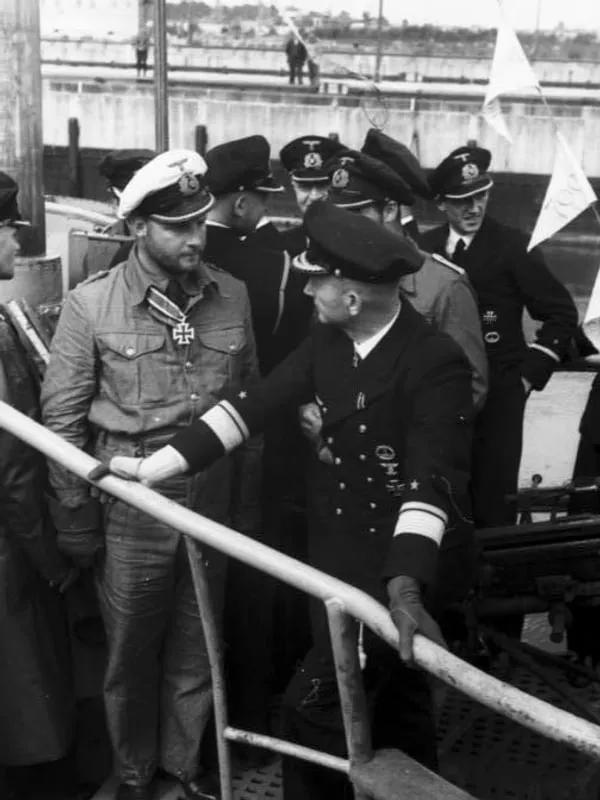
- Born:
- 19 February 1913, Qingdao (Kiautschou, German Empire)
- Died:
- 9 May 1941, North Atlantic, east of Cape Farewell (Greenland)
- Author:
- Natalia
- Photo:
- Peter, CC BY-SA 3.0 DE, Wikimedia Commons

Fritz-Julius Lemp was a German naval officer and U-boat commander whose name is linked to two events that mattered to the whole Battle of the Atlantic, although neither brought Germany any advantage. On the evening of 3 September 1939, a few hours after Britain declared war, his U-30 torpedoed the British liner Athenia without warning – an act the regime concealed for the rest of the war, blaming it on the British. A year and a half later, on 9 May 1941, British escorts forced his U-110 to the surface, and a boarding party carried off its Enigma cipher machine and secret documents that helped the codebreakers at Bletchley Park read the German navy’s signals. Lemp died in the water that day in circumstances that have never been explained. Between those two events he was one of the most successful U-boat commanders of the early part of the war and the seventh in the U-boat arm to receive the Knight’s Cross.
Early life and the Reichsmarine
He was born on 19 February 1913 in Qingdao, the main town of the German leased territory of Kiautschou on the east coast of China, where his father was serving as an officer. The colony lasted only until the autumn of 1914, when, after the outbreak of the First World War, it was taken by the Japanese and the British. Lemp grew up in Germany.
On 1 April 1931, at the age of eighteen, he joined the Reichsmarine, the small navy of the Weimar Republic, restricted by the terms of the Treaty of Versailles. He belonged to the officer intake of 1931 (“Crew 31”). He followed the usual path of an officer cadet: infantry training at Stralsund, service in the light cruiser Karlsruhe, which took cadets on long training cruises, and study at the naval officers’ school. In 1933 he became a Fähnrich zur See (midshipman), and on 1 April 1935 a Leutnant zur See.
When Germany began building submarines in 1935 – in breach of the Treaty of Versailles but now with the sanction of the Anglo-German Naval Agreement – Lemp was among the first officers posted to the new arm. From 1936 he was a watch officer in U-28, a small Type VIIA (PL) boat of the 2nd “Saltzwedel” Flotilla, and on 1 January 1937 he was promoted to Oberleutnant zur See. At the end of October 1938 he commanded U-28 for a few weeks, and in November of that year he took command of her sister boat U-30. In 1939 he received the Spanish Cross in Bronze, awarded by Germany to those who had taken part in operations during the Spanish Civil War, including the crews of ships that served in Spanish waters. When war broke out he was one of several dozen young U-boat commanders under Karl Dönitz, trained to attack convoys at night and on the surface.
The Athenia
On 22 August 1939 U-30 sailed from Wilhelmshaven into the Atlantic and took up position west of the British Isles. On the afternoon of 3 September, a few hours after Britain declared war on Germany, Lemp sighted near Rockall a large blacked-out ship steering a zigzag course away from the usual shipping lanes. He took her for an armed merchant cruiser or a troopship – a target that could be attacked without warning – and torpedoed her at around 7.40 p.m. She was the British liner Athenia, carrying more than 1,400 people to Canada, most of them civilians. Between 112 and 117 people died, among them citizens of the neutral United States. From radio traffic Lemp quickly realised what he had done. He gave no help to the survivors, did not report the attack and ordered his crew to keep silent.
The sinking of the Athenia broke not only the law of naval warfare but also Dönitz’s order not to attack passenger ships. For Adolf Hitler, who still hoped for a quick settlement with the West and feared the American reaction, it was a propaganda blow. Berlin denied that any U-boat had been in the area, and Joseph Goebbels’s propaganda accused the First Lord of the Admiralty, Winston Churchill, of having had the ship sunk himself to drag the United States into the war.
The patrol went on. On 11 September Lemp sank the freighter Blairlogie, and on 14 September he stopped the Fanad Head. Just as he was about to sink her, aircraft arrived from the carrier Ark Royal, which at the same time escaped the torpedoes of U-39. Two Blackburn Skua bombers were damaged by the blasts of their own bombs and came down in the sea. Lemp picked up both pilots, sank the Fanad Head and survived a pursuit by destroyers lasting several hours. One of his crew, Adolf Schmidt, was badly wounded. On 19 September U-30 put into Reykjavík in Iceland, then neutral, for a few hours and left him there for treatment. Schmidt was interned and, after the British occupied Iceland, taken prisoner; he later became one of the witnesses through whom the truth about the Athenia came out.
On 27 September U-30 returned to Wilhelmshaven. Lemp reported to Dönitz that he had sunk the Athenia and was summoned to Berlin. The naval command concluded that he had acted in good faith and did not court-martial him. Hitler, however, ordered the affair to be kept strictly secret: the page for 3 September was removed from the boat’s log and a new one inserted, and the crew were sworn to silence. Lemp received the Iron Cross, Second Class, and on 1 October was promoted to Kapitänleutnant. The truth was revealed only in January 1946 at the Nuremberg trial, when a statement by Dönitz was read out; the Athenia case was one of the counts against Admiral Erich Raeder.
U-30: from the Barham to Lorient
After a short and fruitless second patrol, U-30 sailed on her third on 23 December 1939, carrying mines to be laid in the approaches to Liverpool. On 28 December, west of the Hebrides, Lemp sank the armed trawler Barbara Robertson by gunfire, and in the afternoon he torpedoed the battleship HMS Barham, which struggled back to port and was out of service for several months. It was his greatest success against warships. At the beginning of January 1940 he laid mines in the mouth of the Mersey; by March five ships had been sunk on them and one damaged. On 18 January he received the Iron Cross, First Class.
In the spring of 1940 U-30 took part in the U-boat operations during the invasion of Norway. Like most German boats she achieved nothing there, and the crews discovered that their torpedoes, with magnetic and contact pistols, often failed to explode or ran too deep. In the summer the conditions of the whole submarine war changed. After the fall of France the Germans gained ports on the Bay of Biscay, hundreds of miles closer to the Atlantic routes. On 7 July 1940 U-30 became the first U-boat to put into Lorient, which soon became the main U-boat base. Between June and August Lemp sank several more ships, some of them in convoy, and on 14 August 1940 he became the seventh U-boat commander to receive the Knight’s Cross of the Iron Cross. At the end of August he took the worn-out boat to Kiel, where she was transferred to a training flotilla.
U-110
In the autumn of 1940 Lemp oversaw the completion of a new, larger ocean-going Type IXB boat at the AG Weser yard in Bremen. On 21 November 1940 he took command of U-110. Many of the petty officers from U-30 followed him. According to a British report on the interrogation of prisoners, the crew regarded him as a calm and decisive commander. Training in the Baltic was hampered, according to some sources, by an exceptionally harsh winter and frozen waters, and the boat set out on her first patrol after a shortened work-up.
On 9 March 1941 U-110 sailed from Kiel. On 15 March she found convoy HX 112 and called other boats to it, among them Otto Kretschmer’s U-99 and Joachim Schepke’s U-100. On the night of 15–16 March Lemp torpedoed the tanker Erodona, which managed to reach port, but the following night the escorts sank U-100 and U-99, and their commanders were killed or captured. On 23 March Lemp attacked the lone Norwegian freighter Siremalm. The torpedo hit but did not explode, and when the deck-gun crew opened fire without removing the muzzle plug, the shell burst the barrel and wounded three men. The damaged boat broke off the patrol and put into Lorient on 29 March.
The second patrol began on 15 April. On 27 April, west of Ireland, U-110 sank the steamer Henri Mory, with the loss of 28 lives. On 8 May Lemp made contact with convoy OB 318, and on the morning of 9 May, after conferring on the surface with Adalbert Schnee of U-201, he attacked submerged. He sank two ships, but the escort spotted his periscope. Depth charges from the corvette Aubrietia and the destroyers Bulldog and Broadway forced the damaged boat to the surface. Under British fire, convinced that a destroyer was about to ram and that the flooding boat would sink at any moment, Lemp ordered the crew to abandon ship without giving orders to destroy the cipher material or to scuttle her.
Death
The boat did not sink. According to the first watch officer, Dietrich Loewe, who was swimming beside his commander, Lemp noticed that U-110 was still afloat and that the British had given up ramming. He turned back, intending to climb aboard again and scuttle the boat, or at least throw the Enigma and the codebooks overboard. But the drifting boat was moving away from the men in the water, and a boat carrying a boarding party had already been lowered from the Bulldog. At that moment Loewe lost sight of him.
How Lemp died is still unknown. After the war several surviving members of the crew claimed that the British had shot him in the water. The leader of the boarding party, Sub-Lieutenant David Balme, flatly denied this and believed that Lemp, aware that his mistake would hand the boat’s secrets to the enemy, had chosen to die in the sea. It is also possible that he simply drowned in the icy water, like a dozen or so of his men. Of the 47 men aboard, fifteen died and 32 were taken prisoner. He was 28 years old.
The boarding party removed from U-110 the Enigma machine, bigram tables, current keys, the short signal book and other documents. The boat sank the next day under tow, and the British wrapped the affair in the strictest secrecy. In Germany U-110 was presumed lost with all hands, and it was never discovered that she had been captured.
Legacy and significance
In 10 patrols Lemp sank, according to the uboat.net records, 19 merchant ships totalling about 96,000 GRT and an armed trawler, and damaged three ships and the battleship Barham. Those results placed him among the most successful commanders of the first year of the war, although well behind Kretschmer, Schepke and Günther Prien. Both sides, however, remembered him not for the number of ships he sank but for two moments that slipped out of his control.
The torpedoing of the Athenia was the first breach in this war of rules that Germany itself professed, and the beginning of a lie that propaganda kept up throughout the war. It also showed how quickly the line between mistake and crime blurs in submarine warfare: within a few months Germany had moved to unrestricted submarine warfare, and attacking a merchant ship without warning was no longer the exception. The capture of U-110, for its part, was one of the links that enabled Bletchley Park in 1941 to read the German navy’s signals and route convoys away from the wolf packs. In hindsight, his last voyage did the Allies more good than all his successes did Germany.
After the war his death became the subject of a dispute in which German veterans accused the British of killing a defenceless survivor, and the British participants firmly denied it. The story of U-110 found its way into books and, in 2000, in reworked form, into the American film U-571, in which the cipher machine is captured by Americans – which provoked a wave of protest in Britain.
Sources
Often appears with
People who appear in the same events.