1939–1945: The Battle of the Atlantic
Battle of the Atlantic
- Dates:
- 3 September 1939 – 8 May 1945
- Front:
- Atlantic
- Location:
- The Atlantic Ocean, from the waters around the British Isles, the Bay of Biscay and the North Sea to the coasts of Canada, the United States and Brazil, the Caribbean and the Gulf of Mexico, with an offshoot in the Arctic OceanOn the battle map →
- Sides:
- Nazi Germany (and Italy)Erich Raeder, Karl DönitzUnited Kingdom, Canada, the United States and their allies (including Poland)Dudley Pound, Percy Noble, Max Horton
- Result:
- Allied victory. The U-boats failed to cut Britain's supply routes and lost the initiative after their defeat in May 1943. The ocean became the road to the invasion of Europe.
- Author:
- Natalia
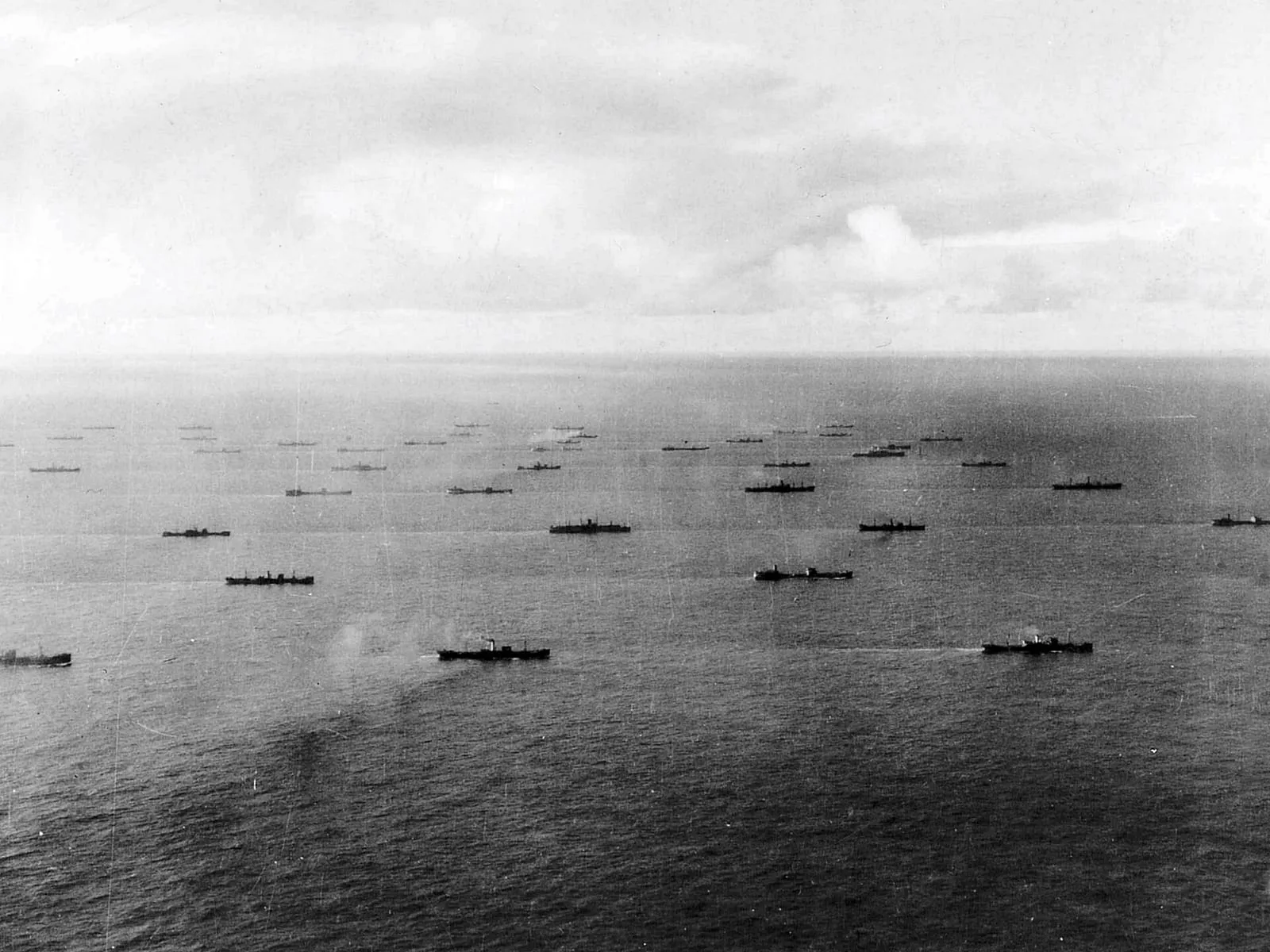
The Battle of the Atlantic was the longest campaign of the Second World War. It lasted from the first day of Britain’s war with Germany, 3 September 1939, until the surrender of the Third Reich in May 1945. What was at stake was shipping, on which the life of the British Isles depended. Britain imported by sea roughly half of its food, almost all of its oil and most of the raw materials for its industry; in wartime it needed more than a million tons of cargo a week. Germany tried to cut these routes with submarines, surface raiders, mines and aircraft, while the British – supported by Canada and, from 1941, increasingly by the United States – defended them with a system of convoys, escorts, patrol aircraft, radar and the breaking of German ciphers. Germany’s main weapon was Admiral Karl Dönitz’s U-boats, and their main tactic was the night attack on convoys by “wolf packs”.
The battle was not a series of great fleet engagements but a war of attrition, in which what counted were the tons of shipping sunk and built, the number of submarines at sea, the range of aircraft and technical progress. It cost the lives of tens of thousands of seamen on both sides. Its outcome was decided in the spring of 1943, but the U-boats fought on until the last hours of the war.
Name and dates
The name “Battle of the Atlantic” was popularised by Winston Churchill. At the beginning of March 1941, when shipping losses were rising faster than at any time since the start of the war, he issued a directive as Prime Minister declaring that Britain was now fighting the Battle of the Atlantic, and set up a special Cabinet committee to direct it. On 5 March the First Lord of the Admiralty, Albert Victor Alexander, used the term in the House of Commons, comparing the struggle at sea to the Battle of France of the previous summer. Churchill regarded himself as the author of the name, although it had appeared earlier. The Germans spoke of the Atlantikschlacht or of the “tonnage war” (Tonnagekrieg), for that was how Dönitz defined his aim: to sink ships faster than the enemy could build new ones.
The battle is taken to have begun on 3 September 1939. At 11 a.m. that day the British ultimatum expired, and in the evening the German U-30 torpedoed the British passenger liner SS Athenia, bound from Glasgow to Montreal, north-west of Ireland. A total of 117 passengers and crew were killed (the figures vary slightly between sources). The submarines and both pocket battleships, however, had already put out into the Atlantic in the second half of August, as part of the preparations for the attack on Poland. The battle is taken to have ended on 8 May 1945, the day Germany’s surrender came into force; the last ships had been sunk a few hours earlier, on 7 May. Some historians treat operations in the Arctic Ocean, the war in British coastal waters and the fighting in the Mediterranean as separate from the battle, and British and German historians divide it into different numbers of phases. The division most common in the literature is based on changes in the situation and tactics of the two sides.
Background
In the First World War German submarines had very nearly forced Britain to capitulate. In the spring of 1917, after the declaration of unrestricted submarine warfare, they were sinking more than half a million tons of shipping a month. The crisis was overcome only by the introduction of convoys. The Treaty of Versailles forbade Germany to possess submarines, and the High Seas Fleet lay at the bottom of Scapa Flow. The great powers also tried to restrict submarine warfare itself: the London Naval Treaty of 1930, and then the London Protocol of 1936, to which Germany acceded, required submarines to observe the same rules towards merchant ships as surface warships – that is, to stop a ship, search it and ensure the safety of its crew before sinking it.
The Anglo-German Naval Agreement of June 1935 allowed Germany to build submarines again. Their organisation was entrusted to Captain Dönitz, a veteran of the submarine war of 1917–1918, who from 1936, as commander of submarines, trained crews for night attacks on the surface and for operating in groups directed by radio. The Commander-in-Chief of the Navy, Admiral Erich Raeder, however, put his faith in a surface fleet. Plan Z, approved by Hitler in January 1939, provided for the construction of battleships, aircraft carriers and cruisers by the mid-1940s, and its 249 submarines were to be only one of its parts. In April 1939 Hitler repudiated the naval agreement. The war came several years too early for the navy. In September 1939 the Kriegsmarine had 57 submarines, of which only about twenty were fit for operations on the open ocean. Dönitz believed that he needed 300 to defeat Britain: a third would be fighting, a third on passage to or from their patrol areas, and a third undergoing refit.
The Royal Navy had an overwhelming superiority in surface ships but underestimated the U-boat threat. The Admiralty believed that ASDIC would make submerged boats easy to detect; it had not prepared to fight submarines attacking on the surface at night, and Coastal Command’s patrol arm had few aircraft and ineffective weapons. From June 1939 the fleet was headed by the First Sea Lord, Admiral Dudley Pound.
Course of the battle
The first months (September 1939 – May 1940)
The sinking of the Athenia broke the order to observe prize law and spare passenger ships, and for years German propaganda claimed that the British had sunk the ship themselves. The Admiralty, however, concluded at once that Germany was waging unrestricted submarine warfare: in the first days of September it introduced the convoy system, and on 16 September the first HX convoy sailed from Halifax in Canada. The Germans lifted the restrictions step by step: in September Dönitz authorised attacks without warning on ships using their radio or sailing without lights, in October on all enemy merchant ships except passenger ships, and in time also on neutral ships in zones declared around the British Isles.
The U-boats’ first successes were spectacular. On 17 September U-29 sank the aircraft carrier HMS Courageous, with the loss of 519 men, after which the Admiralty withdrew its carriers from hunting submarines. On 14 October Günther Prien in U-47 penetrated the fleet base at Scapa Flow (PL) and sank the battleship HMS Royal Oak; more than 830 sailors were killed. In the South Atlantic and the Indian Ocean the pocket battleship Admiral Graf Spee, commanded by Captain Hans Langsdorff, sank nine ships without killing a single member of their crews, until in December 1939, after the Battle of the River Plate, she was scuttled by her own crew off the coast of Uruguay. Mines were also dangerous, especially the new magnetic mines laid by submarines, destroyers and aircraft at the entrances to British ports. The British responded by degaussing ships’ hulls.
The small submarine fleet was, however, soon exhausted. Boats had to return to base, in the winter of 1939–1940 ice closed the Baltic ports, and in the spring of 1940 Dönitz had to give up almost all of his ocean-going U-boats for the invasion of Norway. During the Norwegian campaign the defects of German torpedoes came to light: both magnetic and contact pistols failed, and the torpedoes ran too deep. U-boat commanders reported dozens of failed attacks on British warships. In various forms the torpedo crisis dragged on until 1942.
“The Happy Time” (June 1940 – March 1941)
The fall of France transformed the situation completely. The Germans took the ports on the Bay of Biscay – Lorient, Brest, Saint-Nazaire, La Pallice and Bordeaux – as well as bases in Norway. The U-boats’ passage to the Atlantic was shortened by hundreds of miles, and Dönitz moved his headquarters to a villa at Kernével near Lorient. Italy entered the war and sent several dozen submarines into the Atlantic, based at Bordeaux. The Royal Navy had lost the allied French fleet, had to watch the Mediterranean and keep destroyers in the English Channel for fear of invasion, so Atlantic convoys often had only one or two escort vessels, and only on the eastern stretch of the route.
U-boat crews called this period “the Happy Time” (die glückliche Zeit). Between June and October 1940 they sank more than 270 ships. The best commanders – Prien (U-47), Otto Kretschmer (U-99) and Joachim Schepke (U-100) – became national heroes in Germany. In the autumn of 1940 Dönitz first used the “wolf pack” tactic (Rudeltaktik) successfully. The boats deployed in a patrol line across a convoy’s expected route. The one that sighted it shadowed it and reported to headquarters, which called up the others; they attacked at night on the surface, where ASDIC could not detect them and their low silhouette made them almost invisible. In October 1940 the slow convoy SC 7 lost 20 of its 35 ships, and immediately afterwards the fast convoy HX 79, despite a stronger escort, lost one ship in four. Not a single U-boat was sunk in either battle. The Germans were also helped by the B-Dienst radio monitoring and decryption service, which read part of the British naval traffic and, from 1942, also the cipher used to direct convoys. Convoys were also spotted from the air by long-range Fw 200 Condor aircraft flying from France and Norway, which themselves sank ships sailing beyond the reach of British fighters.
Britain sought help in America. Under the destroyers-for-bases agreement of 2 September 1940 the United States – formally still neutral and constrained by the Neutrality Acts – handed over 50 old destroyers to the British in exchange for leases on bases in Newfoundland and the Caribbean. British and Canadian shipyards were building hundreds of simple Flower-class corvettes.
The Allied response (March – December 1941)
In February 1941 Western Approaches Command, responsible for protecting shipping in the approaches to the British Isles, moved from Plymouth to Liverpool, and Admiral Percy Noble became its commander. Noble built up a system of permanent escort groups, which trained together and knew their commanders, and put his emphasis on training: every new escort vessel went through a gruelling course at the base at Tobermory in the Hebrides. In April the Admiralty took operational control of Coastal Command’s aircraft. The first results came quickly. In March 1941, within two weeks, Dönitz lost his three best commanders: Prien disappeared with his entire crew, Schepke was killed when U-100 was rammed, and Kretschmer was taken prisoner. On 6 March Churchill proclaimed the “Battle of the Atlantic” and set up a special Cabinet committee to conduct it.
In May 1941 the battleship Bismarck sailed into the Atlantic. On 24 May, in the Denmark Strait, she sank the battlecruiser HMS Hood, of whose crew of more than 1,400 only three survived. Three days later, after a pursuit involving dozens of ships, the Bismarck was sunk. The sorties of large surface warships, which Raeder had planned as the second pillar of the war on shipping, ended at that moment. On 9 May 1941 British sailors captured an Enigma cipher machine and documents aboard the damaged U-110. The codebreakers of Bletchley Park – who drew on the work of Polish mathematicians led by Marian Rejewski, handed over to the British and French in July 1939 – began reading the U-boat cipher from June. In the summer and autumn of 1941 this made it possible to route convoys around the U-boat patrol lines.
From June 1941 convoys were escorted across the whole ocean. On the western stretch the escort was taken over by a Canadian escort group based in Newfoundland. The Royal Canadian Navy, which in 1939 had numbered a dozen or so ships and a few thousand men, grew to several hundred ships and nearly a hundred thousand sailors and took on a large share of convoy protection. At the same time the United States was becoming ever more involved in the war. In March 1941 Lend-Lease was enacted; in July the Americans took over the protection of Iceland from the British; in August Franklin Delano Roosevelt and Churchill proclaimed the Atlantic Charter; and from September US Navy ships escorted convoys to a meeting point south of Iceland. After the incident involving the destroyer USS Greer, Roosevelt issued on 11 September the order to fire on German warships without warning. On 31 October U-552 sank the destroyer USS Reuben James; about a hundred sailors were killed. The United States was waging an undeclared war in the Atlantic before it formally entered the conflict.
The American coast: the second “Happy Time” (January – July 1942)
After the attack on Pearl Harbor and Germany’s declaration of war on the United States on 11 December 1941, Dönitz sent five large Type IX boats to the American coast. Operation Drumbeat (Paukenschlag, literally “drum roll”) began on 13 January 1942. The American coast was not prepared for war. The cities were not blacked out, the lighthouses were lit, ships sailed alone, and the commander of the fleet, Admiral Ernest King, did not introduce convoys for several months, citing a shortage of escorts. At night the U-boats picked their victims out against the lights of the cities. After the American seaboard came the turn of the Caribbean and the Gulf of Mexico, where tankers carrying oil from Venezuela and Texas were attacked. Type XIV supply boats, known as “milch cows”, allowed the U-boats to refuel at sea. For the German crews this was a second “Happy Time”. By the summer they had sunk several hundred ships in American waters, totalling more than 2 million gross register tons, while losing few boats.
The Germans were also favoured by a change of cipher. On 1 February 1942 the U-boats switched to the four-rotor Enigma, and for ten months Bletchley Park could no longer read their signals. Only material recovered on 30 October 1942 from the sinking U-559 by men of the destroyer HMS Petard – two of whom paid for it with their lives – made it possible to break the cipher again in December. Once the Americans introduced coastal convoys in May and June, followed by a system of interlocking convoys in the Caribbean, losses fell. On 19 July Dönitz withdrew the last boats from the coast of the United States.
The climax (July 1942 – May 1943)
By the summer of 1942 Dönitz at last had enough boats to set up several patrol lines at once. He sent them to the “black pit” in the middle of the North Atlantic, south of Greenland, where convoys had no air cover because no aircraft from Canada, Iceland or Britain could reach it. Convoy battles lasted several days and nights. In 1942 the U-boats sank about 1,160 ships on all the seas; November 1942 was the worst month of the war for Allied shipping. In 1942 total Allied shipping losses were still greater than the output of their shipyards, although towards the end of the year American yards began to close the gap. September 1942 also brought the Laconia incident: off the coast of Africa U-156 sank a British troopship carrying Italian prisoners of war and began rescuing the survivors, and when an American aircraft attacked the German boats with survivors on their decks, Dönitz issued an order on 17 September forbidding the rescue of the crews of sunken ships.
On 19 November 1942 command of Western Approaches passed to Admiral Max Horton, a former ace of the British submarine service in the First World War. In addition to escort groups he formed support groups, not tied to any convoy, which could come to the aid of a convoy under attack and hunt a detected boat for hours until its air ran out. The master of this tactic was Captain Frederic John Walker. On 30 January 1943 Dönitz succeeded Raeder as Commander-in-Chief of the Kriegsmarine, while retaining command of the submarines. At the Casablanca Conference in January 1943 Roosevelt and Churchill made the defeat of the U-boats the first condition for continuing the war in Europe.
In March 1943 the battle reached its peak. In the middle of the month about forty U-boats attacked two convoys, HX 229 and SC 122, sinking 22 ships for the loss of one boat. Over the whole of March the Allies lost more than 80 ships in the Atlantic. At the Admiralty there were doubts as to whether the convoy system had failed. Two months later everything was reversed. At the turn of April and May 1943 convoy ONS 5 lost thirteen ships, but its escort and aircraft sank six submarines. In May the Germans lost more than forty U-boats (41–43, depending on the method of counting), roughly a quarter of their operational strength. Among the dead was Dönitz’s younger son, Peter, a watch officer in U-954. German submariners called that month “Black May”. On 24 May 1943 Dönitz withdrew his boats from the North Atlantic.
Victory was the result of several changes coinciding. Very long-range B-24 Liberator aircraft and the first escort carriers closed the air gap over the middle of the ocean, and in the autumn of 1943 Portugal made bases in the Azores available to the Allies. Centimetric radar detected surfaced boats at night and in fog, and the German warning receivers could not pick it up. Shipborne HF/DF direction-finders located U-boats by their own radio reports, on which wolf-pack tactics depended. Over the Bay of Biscay Coastal Command aircraft equipped with the Leigh Light and radar hunted at night for boats leaving their bases. Hedgehog anti-submarine mortars fired ahead of the escort’s bow without breaking sonar contact. The Allies were again reading German ciphers, and there were more and more trained escort crews. Behind all this stood the industrial might of the United States: in 1943 alone American shipyards built more than 11 million tons of shipping, including hundreds of Liberty ships. Dönitz’s tonnage war had become unwinnable.
The last two years (June 1943 – May 1945)
Dönitz did not give up the fight. He believed that ending the submarine war would free huge Allied forces for use against Germany. In the summer of 1943 he shifted operations to the central Atlantic, where American escort-carrier groups destroyed a large proportion of his boats and “milch cows”. In September the wolf packs returned to the North Atlantic armed with acoustic torpedoes that homed in on the noise of propellers. The first battle brought them the sinking of several escort vessels, but the following ones ended in defeat, and in November Dönitz abandoned group attacks. One of the victims of the acoustic torpedoes was the Polish destroyer ORP Orkan, sunk by U-378 on 8 October 1943 while escorting convoy SC 143.
Germany’s last hope lay in new boats. The old Type VII and IX boats were fitted with the schnorkel, a tube supplying air to the diesel engines, which allowed the batteries to be charged underwater. The boats’ survival rate rose, but their effectiveness fell. The “electric boats” of Type XXI and Type XXIII, capable of long, fast underwater runs and built from prefabricated sections, were supposed to turn the tide of the war, but production was delayed by the bombing of the shipyards and by design faults. The first Type XXI did not set out on a war patrol until the end of April 1945, and attacked no one. The boats thrown against the Normandy landings in June 1944 sank only a handful of the thousands of invasion vessels and suffered heavy losses. In the summer of 1944 Germany lost its bases in France, and the remnants of the submarine fleet moved to Norway, from where, until the end of the war, schnorkel boats carried on harassing operations in British coastal waters.
The last ships were sunk off the coast of Scotland on 7 May 1945, and the last U-boat destroyed in action, U-320, went down after an attack by a British flying boat on the same day or the next. After the surrender 222 boats were scuttled by their crews and 174 surrendered to the Allies. The British sank most of the latter in 1945–1946 in Operation Deadlight.
The Polish Navy
Poland’s contribution to the Battle of the Atlantic was out of all proportion to the size of its fleet. Even before the outbreak of war, on 30 August 1939, under the Peking Plan, its three most modern destroyers – ORP Błyskawica, Grom and Burza – sailed from Gdynia for Britain in accordance with the Polish–British alliance, arriving on 1 September, the day Germany invaded Poland. In September and October they were joined by the submarines Wilk and Orzeł. The Polish Navy operated under British operational command, and the Royal Navy, which had more ships than trained crews, transferred further vessels to it: the destroyers Garland, Piorun and Orkan, Hunt-class escort destroyers and submarines.
Polish ships escorted Atlantic, Gibraltar and Arctic convoys. Grom was sunk off Narvik in May 1940, and Orzeł disappeared in the North Sea in June 1940. On the night of 26–27 May 1941 Piorun was the first ship of the destroyer flotilla to make contact with the hunted Bismarck and to open fire on her. In February 1943 Burza, together with the US Coast Guard cutter Campbell, sank the submarine U-606 while escorting convoy ON 166. The loss of Orkan, in which 179 men were killed, was the greatest loss of life in the history of the Polish Navy. Ships of the Polish merchant marine also sailed in the convoys, including the transatlantic liners Batory and Sobieski as troopships; according to the records, 18 Polish ships were sunk and more than 200 seamen killed. An indirect contribution was also made by the Polish electronics engineer Wacław Struszyński, who led a team developing shipborne HF/DF direction-finders at a British Admiralty research establishment.
Losses
Loss figures depend on whether the Arctic Ocean and coastal waters are counted as part of the battle, and they vary between compilations. According to frequently cited estimates, the Allies and the neutral states lost about 3,500 merchant ships in the Atlantic, totalling more than 14 million gross register tons, and about 175 warships, most of them sunk by U-boats. Some 72,000 Allied naval and merchant seamen were killed, including more than 30,000 seamen of the British merchant navy, recruited from all over the Empire, India and China among them.
German losses were proportionally the highest of any branch of the armed forces in the Second World War. Of the more than 1,100 submarines commissioned, Germany lost about 750–780, most of them in the Atlantic. Of some 40,000 German submariners, between 26,000 and 30,000 were killed, according to various calculations – at least two out of every three. The Bismarck and the Admiral Graf Spee also went to the bottom, and more than two thousand men were killed in the Bismarck alone.
Significance
The Battle of the Atlantic was the foundation of the whole Allied war in the West. Had the U-boats cut the routes across the ocean, Britain could not have waged war, and there would have been no supplies to the Soviet Union by the northern route, no invasions of North Africa, Italy and France, and no bombing of Germany from bases in the British Isles. The victory of May 1943 opened the road along which millions of American and Canadian soldiers and millions of tons of equipment crossed the ocean over the next two years. Churchill wrote after the war that the only thing that ever really frightened him during the war was the U-boat peril.
Historians disagree about how close Germany came to victory. Some, especially in earlier years, held that in the spring of 1943 Britain was on the brink of defeat. Others, such as the American historian Clay Blair and the German naval historian Werner Rahn, regard this as a legend: roughly 99 per cent of the ships sailing to and from Britain reached their destination, and the tonnage war had already been lost by the autumn of 1942 in the face of the enormous output of American shipyards. The debate also concerns pre-war decisions: critics, following Dönitz himself, argue that the steel and money spent on Plan Z would have sufficed for hundreds of submarines, which in 1939 might have tipped the balance.
The Battle of the Atlantic accelerated the development of technology and science: radar, radio direction-finding, codebreaking, operational research and maritime aviation. It also showed that the law of naval warfare laid down in the interwar treaties did not survive the first day of the war. At Nuremberg the judges found that the German navy had broken the rules of submarine warfare but imposed no sentence on Dönitz for it, because the American admiral Chester Nimitz testified that in the Pacific the US Navy had waged unrestricted submarine warfare from the first day of the war with Japan.