Soviet Union
Nikolai Yezhov
Secretary of the Central Committee of the All-Union Communist Party (Bolsheviks) and Chairman of the Party Control Commission (1935–1939), People's Commissar for Internal Affairs of the USSR (1936–1938), People's Commissar for Water Transport (1938–1939)
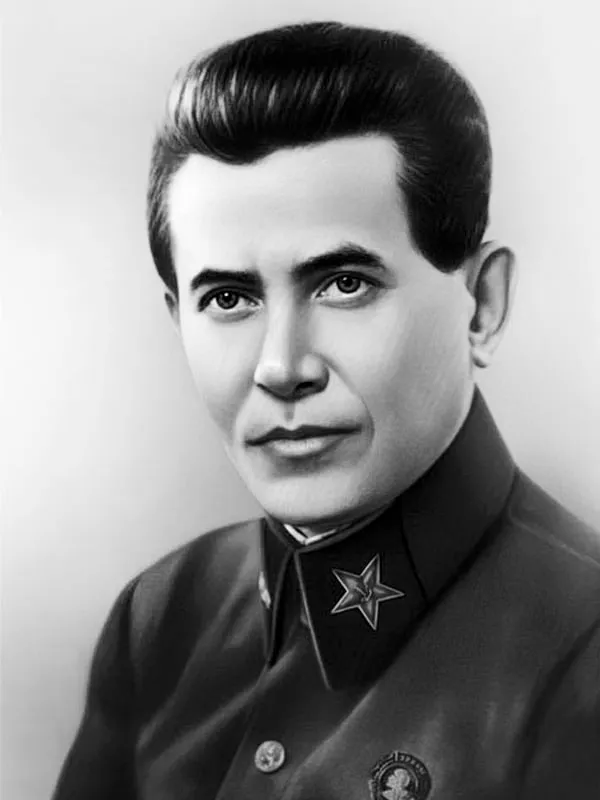
- Born:
- 1 May 1895, Probably Marijampolė, Suwałki Governorate (Russian Empire)
- Died:
- 4 February 1940, Moscow
- Author:
- Łukasz
- Photo:
- autor nieznany, domena publiczna, Wikimedia Commons

Nikolai Ivanovich Yezhov headed the NKVD during the bloodiest period of its existence. A short man, around 151 centimetres tall, and a poorly educated party functionary who had made his career in the personnel department of the Central Committee, he was made People’s Commissar for Internal Affairs in September 1936 at the wish of Joseph Stalin. Within two years his subordinates arrested more than one and a half million people and shot some 680,000. In Russia the period is named after him: the Yezhovshchina. Yezhov was a zealous and hard-working executor, but the decisions on the terror were taken by Stalin, who in the end made him answer for the “distortions” and had him arrested and shot. The Great Purge that Yezhov carried out weakened the Red Army and destroyed every trace of independence within the state only a few years before the outbreak of the Second World War.
Origins and youth
Little is known of Yezhov’s childhood, and he himself spent years covering his tracks. In official questionnaires he wrote that he had been born in 1895 in St Petersburg into the family of a foundry worker. Under interrogation in 1939 he stated that he had been born in Mariampol (Marijampolė) in the Suwałki Governorate, in what is now Lithuania, the son of a Russian from the Tula Governorate who had served there in the army and later in the rural police, and of a Lithuanian mother. His date of birth is usually given as 1 May 1895, the date Yezhov himself gave. The Russian researcher Aleksei Pavlyukov, however, found an entry in a parish register in Kaunas according to which he was born on 20 April (8 April in the Julian calendar) 1895, probably in the village of Veiveriai in the Mariampol district.
He completed only a few years of elementary school. Around 1906 he was sent to a relative in St Petersburg to learn tailoring. Official biographies of the 1930s claimed that from 1911 he worked at the Putilov Works, but the documents do not bear this out. In June 1915 he volunteered for the army and served at the front; after a light wound and an illness, and having been declared unfit for front-line service because of his height, he was sent to the artillery workshops in Vitebsk, where he became a clerk.
Revolution and a party career
In questionnaires of the 1920s Yezhov stated that he had joined the Bolshevik party in May 1917; later he moved the date back to March. According to the records of the Vitebsk Social Democratic organisation, which included both Bolsheviks and Menshevik-Internationalists, he was admitted to it only in August 1917. In the years of his power the Short Course history of the All-Union Communist Party (Bolsheviks) credited him with preparing the soldiers of the Western Front for the uprising of October 1917. This, too, was fiction.
During the Civil War he served in the Red Army, from 1919 at depots forming radio-telegraph units in Saratov and Kazan, where he rose to the post of commissar. Then his career in the party apparatus began. In 1922 he was secretary of the regional committee in the Mari Autonomous Oblast, and from 1923 to 1926 he worked in Kazakhstan, among other things as secretary of the provincial committee in Semipalatinsk. In 1927 he moved to the Central Committee apparatus in Moscow, to the department responsible for the allocation of cadres. His superior, Ivan Moskvin, valued him as an ideal worker who would carry out any order, while warning that Yezhov did not know when to stop.
In 1929–1930 Yezhov was Deputy People’s Commissar for Agriculture of the USSR and worked on forced collectivisation. In November 1930 he became head of the Central Committee’s personnel department and met Stalin, who quickly came to appreciate his diligence and loyalty. He decided on appointments throughout the country and in 1933–1934 took part in the purge of the party. At the 17th Party Congress in 1934 he chaired the credentials commission and became a member of the Central Committee and the Organisational Bureau and deputy chairman of the Party Control Commission. In February 1935 he became a Secretary of the Central Committee and chairman of that commission.
From the Kirov case to the NKVD
After the murder of Sergei Kirov in December 1934 Stalin entrusted Yezhov with overseeing the investigation. It was he who, despite the scepticism of NKVD officers, steered it towards Zinoviev’s former opposition. As he himself recalled in 1937, Stalin summoned him and instructed him to “look for the killers among the Zinovievites”. In 1935 Yezhov directed the exchange of party cards, which led to the expulsion of several hundred thousand people from the party; he ran the so-called Kremlin case and wrote a manuscript arguing that the road from intra-party opposition led straight to terrorism. Together with the deputy head of the NKVD, Yakov Agranov, he prepared the first Moscow trial of Grigory Zinoviev and Lev Kamenev in August 1936 and approved the lists of those admitted to the courtroom.
On 25 September 1936 Stalin and Andrei Zhdanov, on holiday in Sochi, demanded an immediate change at the head of the NKVD, because Genrikh Yagoda was “four years behind” in uncovering the conspiracy. On 26 September Yezhov was appointed People’s Commissar for Internal Affairs, and on 1 October he took up the post. He kept his positions as Secretary of the Central Committee and Chairman of the Party Control Commission. In January 1937 he received the rank of General Commissar of State Security, the equivalent of a marshal, and in October 1937 he became a candidate member of the Politburo.
The Great Terror
Yezhov directed the Great Purge throughout 1937 and for most of 1938. He began with a purge of the NKVD itself, replacing Yagoda’s men with his own cadres; his first deputy was Mikhail Frinovsky. Under his supervision the second and third Moscow trials took place, at which Pyatakov, Radek, Bukharin, Rykov and Yagoda himself, among others, were convicted, as did the trial of Marshal Mikhail Tukhachevsky and other commanders in June 1937.
It was Yezhov who signed the orders that set in motion the mass operations of 1937–1938: Order No. 00439 of 25 July 1937 against German citizens and Soviet Germans; Order No. 00447 of 30 July against “former kulaks, criminals and other anti-Soviet elements”, with quotas of executions for each region; and Order No. 00485 of 11 August, which launched the Polish Operation. In the last of these 111,091 people were shot, most of them Poles. On Yezhov’s report on the progress of this operation Stalin wrote in September 1937: “Very good! Keep digging and cleaning out this Polish espionage filth.”
Yezhov worked fifteen hours a day or more. According to the surviving visitors’ log, in 1937–1938 he was in Stalin’s office almost 290 times, more often than anyone except Molotov, and he sent him some 15,000 special reports. He personally took part in interrogations and the beating of prisoners. The bullets with which Zinoviev and Kamenev had been shot were later found in his desk. Propaganda made a hero of him. A poster by Boris Yefimov showed him crushing a many-headed viper of Trotskyists and Bukharinites in his “hedgehog gloves” (a play on his name, yozh meaning hedgehog), and the town of Cherkessk was renamed Yezhovo-Cherkessk in his honour.
Downfall
In the spring of 1938 his position began to weaken. In April Stalin also gave him the Commissariat of Water Transport, which may have presaged his removal. In June the head of the NKVD in the Far East, Genrikh Lyushkov, fearing arrest, defected to the Japanese in Manchukuo. In August Lavrentiy Beria became Yezhov’s first deputy and the de facto head of state security, and began arresting Yezhov’s men. On 17 November 1938 a resolution of the state and party authorities ended the mass operations and abolished the troikas, laying the blame for abuses on the NKVD. On 19 November the Politburo considered a denunciation of Yezhov, and on 23 November he submitted his resignation, in which he admitted to negligence but boasted that the NKVD had “given the enemies a proper thrashing”. Two days later Beria succeeded him. At about the same time his wife, Yevgenia, committed suicide.
In March 1939 Yezhov was not re-elected to the Central Committee. On 9 April he lost the Commissariat of Water Transport, and on 10 April he was arrested. Beaten during the investigation, he confessed to spying for Germany, Poland, Japan and Britain and to preparing a coup d’état. In court he retracted these confessions, but admitted that his fault lay in having “purged too little” of the enemies in the NKVD. On 3 February 1940 the Military Collegium of the Supreme Court sentenced him to death. He was shot on 4 February according to most sources, or on 6 February 1940 according to some archival documents. His brother and nephews were also killed. The press never reported his arrest. He simply vanished, and his figure was removed from photographs. In the best known of these, showing Stalin by the Moscow Canal, the retouching left only water where Yezhov had stood.
In 1998 the Military Collegium of the Supreme Court of Russia refused to rehabilitate him, ruling that as an organiser of mass repression he could not be regarded as a victim of political repression.
Significance
Yezhov was a tool in Stalin’s hands, and both of them knew it. The term Yezhovshchina, used after his fall, made it possible to shift responsibility for the terror onto the head of the NKVD and preserve the leader’s authority, even though the documents released after 1991 leave no doubt that Stalin personally initiated the mass operations and approved the lists of the condemned and the execution quotas. The Dutch historian Marc Jansen and the Russian researcher Nikita Petrov called Yezhov “Stalin’s loyal executioner” in their biography of 2002.
His activities had long-lasting consequences for the road to the Second World War. The purge of the Red Army carried out by Yezhov’s NKVD deprived it of a large proportion of its experienced commanders on the eve of war, which it felt painfully in Finland in the winter of 1939–1940 and in 1941. The Polish Operation of 1937–1938, which devastated the Polish minority in the USSR, foreshadowed the way the NKVD would treat Polish citizens after 17 September 1939. And a state in which, after years of terror, no one dared to oppose Stalin accepted his pact with Hitler without resistance in August 1939.
Sources
Often appears with
People who appear in the same events.