Soviet Union
Mikhail Tukhachevsky
Commander of the Western Front (1920–1921, 1922–1924), Chief of Staff of the Red Army (1925–1928), Deputy People's Commissar for Defence (1931–1937), Marshal of the Soviet Union (from 1935)
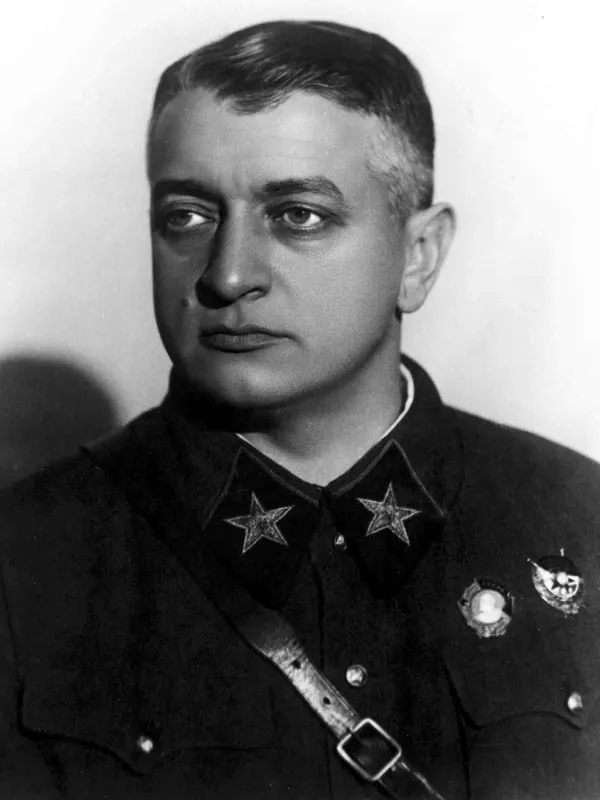
- Born:
- 16 February 1893, Aleksandrovskoye, Smolensk Governorate (Russian Empire)
- Died:
- 12 June 1937, Moscow (Soviet Union)
- Author:
- Natalia
- Photo:
- autor nieznany, domena publiczna, Wikimedia Commons

Mikhail Tukhachevsky was the best-known commander of the interwar Red Army. A young officer of the tsarist Guards, he went over to the Bolsheviks in 1918 and within two years of civil war had risen to command an entire front. In the summer of 1920 he led the Western Front from the Berezina to the gates of Warsaw, and his order proclaiming that the road to a “world-wide conflagration” led “over the corpse of White Poland” became the symbol of the Bolshevik march westwards. Defeat at Warsaw in the Polish–Soviet War halted that march and poisoned his relations with Stalin for years to come. In the 1920s and 1930s Tukhachevsky was the leading advocate of mechanising the Red Army – of tanks, aircraft and airborne troops – and a co-author of the theory of deep operations. In 1937 Stalin had him arrested and shot as an alleged traitor. His death opened the purge that, before the war with Germany, stripped the Red Army of a large part of its commanders.
Nobleman and Guards officer
He was born on 16 February 1893 (4 February in the Julian calendar) on the Aleksandrovskoye estate in Smolensk Governorate, into an impoverished noble family. His father was a nobleman; his mother came from a peasant family. The family moved to Penza and, in 1909, to Moscow. Mikhail attended a gymnasium, and in 1911 he entered the final class of the 1st Moscow Cadet Corps. He graduated top of his year in 1912 and, in July 1914, just before the outbreak of war, completed the Alexander Military School in Moscow. As a second lieutenant he chose the elite Semyonovsky Life Guards Regiment in St Petersburg. He was ambitious and self-assured. According to his fellow officers, he used to say that by the age of thirty he would be either a general or dead.
He fought with the regiment in Galicia and in the Polish lands, winning several decorations. In February 1915, during the fighting near Łomża, he was taken prisoner by the Germans. He escaped several times and, as a punishment, was sent to the camp for incorrigible escapers in the fortress of Ingolstadt in Bavaria. There he was held together with a French captain, Charles de Gaulle, and the journalist Rémy Roure, who years later described him as a romantic fascinated by Napoleon, contemptuous of the West and dreaming of a great, barbaric Russia. Tukhachevsky later admitted that in captivity he had been a “novice in politics”. His fifth attempt, in the summer of 1917, succeeded. Travelling through Switzerland, France, Britain and Scandinavia, he reached Russia in the autumn of 1917, shortly before the Bolshevik coup.
In the Red Army
After the October Revolution the old army disintegrated and Tukhachevsky found himself in the reserve. In the spring of 1918 he began working in the military department of the All-Russian Central Executive Committee, and in April he joined the Bolshevik party. He was one of the few Guards officers who went over to the Reds out of conviction rather than under compulsion. The Commissar for War, Leon Trotsky, was looking for professional officers for the new Red Army, and the 25-year-old Tukhachevsky made a career at a pace he could never have dreamt of in the tsarist army.
From June 1918 he commanded the 1st Army of the Eastern Front, which in the autumn recaptured Simbirsk and Syzran on the Volga from the Czechoslovak Legion and the Whites. He then briefly commanded the 8th Army on the Southern Front and, from April to November 1919, the 5th Army, which in an offensive across the Urals routed the forces of Admiral Alexander Kolchak and pushed on into Siberia. He favoured bold blows against the enemy’s flanks and rear, made use of cavalry and was not afraid of overstretched supply lines. At the beginning of 1920 he took command of the Caucasian Front and finished off the armies of General Anton Denikin in the Kuban, up to the evacuation of the Whites from Novorossiysk in March.
The march on Warsaw
At the end of April 1920 Tukhachevsky took command of the Western Front in Belarus, facing the army of Józef Piłsudski, which had just set off for Kiev. His first offensive, in May, stalled after a few weeks. The second, launched on 4 July, broke the Polish front on the Auta and the Berezina. His order of 2 July ended with a call to arms: “The fate of world revolution is being decided in the West. Over the corpse of White Poland lies the road to world-wide conflagration. On to Wilno, Minsk, Warsaw – forward march!” The cavalry of Gaya Bzhishkyan repeatedly outflanked the Polish positions from the north, and within six weeks Tukhachevsky’s troops had covered several hundred kilometres, taken Minsk, Wilno (Vilnius), Grodno, Białystok and Brześć (Brest), and stood before Warsaw.
In August Tukhachevsky decided to bypass Warsaw from the north and force the Vistula between Modlin and Toruń. He directed the battle from his headquarters in Minsk, several hundred kilometres from the front, with wretched communications with his armies. He was counting on support from Alexander Yegorov’s South-Western Front, but Yegorov, with Stalin as his commissar, kept advancing on Lwów (Lviv), and Semyon Budyonny’s 1st Cavalry Army came to help only when it was already too late. On 16 August a Polish strike group from the Wieprz river shattered his weak left wing and emerged in the rear of the armies fighting before Warsaw. The Western Front fell apart, and some of its troops crossed into East Prussia and were interned. In September Tukhachevsky also lost the Battle of the Niemen, after which his forces fell back beyond Minsk.
The dispute over who was to blame for the defeat went on for years. Tukhachevsky blamed the command of the South-Western Front and Stalin, who had not released the Cavalry Army to him. His opponents accused him of advancing too far, leaving chaos in his rear and underestimating the Poles. In lectures at the Military Academy in 1923, published as The March beyond the Vistula, he argued that had the Red Army won on the Vistula, the fire of revolution would have engulfed the whole continent. Piłsudski answered him in 1924 with his book The Year 1920, the Polish edition of which included Tukhachevsky’s text. The conflict with Stalin’s men from the South-Western Front, above all Kliment Voroshilov and Budyonny, never ended.
Kronstadt and Tambov
In the spring of 1921 Tukhachevsky directed the suppression of revolts against Bolshevik rule. In March he led the 7th Army in the assault on the naval fortress of Kronstadt, whose sailors had demanded free elections to the soviets and political freedoms. The soldiers advanced across the ice of the Gulf of Finland under fire from the forts’ artillery. After the fortress fell, thousands of mutineers were shot or deported. From May 1921 he commanded the forces that crushed the Tambov Rebellion, a peasant revolt against grain requisitioning. The troops resorted to mass hostage-taking, executions and the deportation of entire villages to camps, and an order of June 1921, signed by Tukhachevsky and Vladimir Antonov-Ovseyenko, directed that the forests in which the rebels were hiding be cleared with poison gas. Gas was indeed used, although historians dispute the scale on which it was employed.
Moderniser of the Red Army
After the Civil War Tukhachevsky was head of the Military Academy and then once again commander of the Western Front in Smolensk. From November 1925 to May 1928 he was Chief of Staff of the Red Army. He argued that the next war would be a war of machines and that the state would have to prepare for it with its entire economy. His visions of an army with tens of thousands of tanks and aircraft seemed fanciful at the time, and the Commissar for Defence, Voroshilov, Stalin’s old comrade from Tsaritsyn, regarded them with distaste. In 1928 Tukhachevsky was transferred to command the Leningrad Military District, which was seen as a sidelining. In 1930 the OGPU extracted testimony from two arrested officers that Tukhachevsky was planning a coup. Stalin considered having him arrested at the time, but in the end judged him to be “one hundred per cent clean”.
The first Five-Year Plan changed the situation. Once Stalin committed himself to industrialisation and rearmament, it turned out that Tukhachevsky’s ideas fitted his plans. In 1931 Tukhachevsky became Deputy People’s Commissar and Chief of Armaments of the Red Army. He launched the mass production of tanks and aircraft and promoted the creation of mechanised and airborne forces, and by the mid-1930s the Red Army had, by many estimates, more tanks than all the other armies of the world put together. With a group of officers including Vladimir Triandafillov and Georgy Isserson he developed the theory of deep operations, which envisaged striking simultaneously throughout the entire depth of the enemy’s defences and pushing fast armoured and motorised formations through the breach. It was incorporated into the Field Regulations of 1936. His exact contribution to the theory is disputed, but it was his name that came to symbolise it. In the same years the Red Army and the Reichswehr cooperated in secret, and Soviet officers, Tukhachevsky among them, became acquainted with German military thinking.
From 1933 onwards he warned against Adolf Hitler’s Germany. In 1935, in an article in Pravda, he wrote about the Reich’s war plans. On 20 November 1935 he became one of the first five Marshals of the Soviet Union, alongside Voroshilov, Budyonny, Yegorov and Vasily Blyukher. He was 42 years old. In January 1936 he represented the USSR at the funeral of King George V of Britain and visited Paris, where he was received with honours. He loved music, played the violin and was a friend of the composer Dmitri Shostakovich, on whose behalf he interceded with Stalin in 1936, when Pravda condemned his opera.
Arrest and death
In the spring of 1937, at the height of the Great Purge, the NKVD began arresting commanders of the Red Army. On 11 May Tukhachevsky was removed from his post as First Deputy Commissar for Defence and transferred to Kuibyshev to command the Volga Military District. On 22 May he was arrested there and taken to the Lubyanka prison in Moscow. The investigation was overseen by the head of the NKVD, Nikolai Yezhov, and Stalin demanded that the prisoner “tell everything”. After several days of interrogation and torture Tukhachevsky confessed to taking part in a military conspiracy and to spying for Germany. The record of his confession preserved in the archives bears traces of blood.
On 11 June 1937 a special military court tried him together with seven other senior commanders, among them Ieronim Uborevich, Iona Yakir and Vitovt Putna, in the case of the so-called Anti-Soviet Trotskyist Military Organisation. Among the members of the court were Budyonny and Blyukher. Late in the evening all the defendants were sentenced to death, and they were shot within the next few hours, during the night of 11–12 June. This is why his date of death is given sometimes as 11 June and sometimes as 12 June. His wife and two of his brothers were also shot, his sisters were sent to the Gulag, and his teenage daughter Svetlana was sent to an orphanage and later to a camp.
For decades there has been a dispute over the role played in his downfall by forged evidence fabricated by Reinhard Heydrich’s German Security Service (SD) and passed to Moscow by the President of Czechoslovakia, Edvard Beneš. Most historians now believe that Stalin had no need of German forgeries, since he had been considering dealing with Tukhachevsky as early as 1930, and that they were not used at the trial. Some scholars even think that it was the NKVD, through the double agent Nikolai Skoblin, that planted the idea of the provocation on the Germans. Tukhachevsky was rehabilitated in 1957, after Khrushchev’s Secret Speech.
Significance
Tukhachevsky’s death marked the beginning of a purge in which, in 1937–1938, tens of thousands of officers were arrested or dismissed from the army and most of the highest commanders were shot, including three of the first five marshals. The Red Army, which under Tukhachevsky had been one of the most modern armies in the world, entered 1939 with new and often inexperienced commanders. Its weakness was exposed by the war with Finland in the winter of 1939–1940, and Hitler and the German generals took it as proof that the USSR could be defeated quickly. The large tank and mechanised corps that Tukhachevsky had created were disbanded in the autumn of 1939, and after the fall of France in 1940 they began to be hastily re-formed. The defeats of 1941 are thus to a large extent the consequence of the decisions of 1937.
At the same time, Tukhachevsky’s ideas survived. Georgy Zhukov applied the principles of deep operations at Khalkhin Gol in 1939, and in 1943–1945 the Red Army conducted its great offensives according to them, from Stalingrad to Operation Bagration. For Poles he remained above all the man defeated at Warsaw, the commander who in 1920 wanted to carry revolution across Polish soil “on bayonets”. For Russians he was long a “traitor”, and after his rehabilitation a symbol of the talented commanders whom Stalin destroyed.
Sources
Commanded in battles
(02)Mentioned in battles
(01)Often appears with
People who appear in the same events.