Soviet Union
Vyacheslav Molotov
Secretary of the party Central Committee (1921–1930), Chairman of the Council of People's Commissars of the USSR (1930–1941), People's Commissar and Minister of Foreign Affairs of the USSR (1939–1949, 1953–1956)
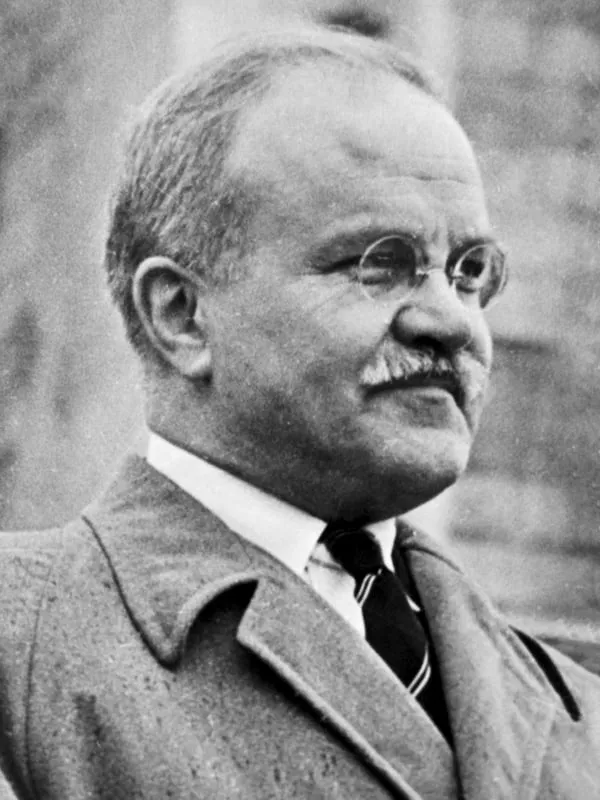
- Born:
- 9 March 1890, Kukarka, Vyatka Governorate (Russian Empire)
- Died:
- 8 November 1986, Moscow
- Author:
- Łukasz
- Photo:
- autor nieznany, CC0, Wikimedia Commons

For thirty years Vyacheslav Molotov stood at the side of Joseph Stalin as his closest, though not always well-liked, associate. In the 1920s he helped him take over the party; in the 1930s, as premier, he directed the collectivisation that caused a great famine and signed lists of the condemned during the Great Purge. In May 1939 he took charge of foreign policy, and on 23 August he put his signature to the pact with Germany whose secret protocol divided Eastern Europe between the two dictatorships. A few weeks later Poland ceased to exist, and Molotov called it, from the rostrum, “this ugly offspring of the Treaty of Versailles”. When Germany attacked in 1941 it was he who announced the outbreak of war on the radio, and later, as foreign minister, he negotiated the post-war order in Europe with the Western Allies. He outlived Stalin by more than thirty years and defended everything they had done together to the very end.
The young Bolshevik
He was born Vyacheslav Scriabin on 9 March 1890 (25 February in the Julian calendar) in Kukarka in Vyatka Governorate (today Sovetsk in Kirov Oblast), into the family of a shop clerk of the townsman class. The frequently repeated claim that he was related to the composer Alexander Scriabin is not borne out by the sources. He attended a modern school (realschule) in Kazan, and in 1906, aged sixteen, he joined the Russian Social Democratic Labour Party, soon aligning himself with the Bolsheviks. In 1909 he was arrested and exiled for two years to the Vologda region. In 1911 he began studying at the Polytechnic Institute in St Petersburg, which he never completed, and worked on the new Bolshevik newspaper, Pravda. It was there that he first came into contact with Stalin. He chose the pseudonym Molotov, from the Russian word “molot”, a hammer, because it sounded “industrial” and proletarian.
In 1915 he was arrested in Moscow and exiled to Irkutsk Governorate, from where he escaped to Petrograd in 1916. He joined the Russian Bureau of the Central Committee, which ran the party inside the country while its leaders were abroad or in exile. When the February Revolution broke out, he was one of the few Bolsheviks of any standing in the capital, and he steered Pravda on a sharp course against the Provisional Government. Stalin and Lev Kamenev, returning from exile, softened this line until Lenin, on his arrival, sided with the radicals. In the autumn Molotov was a member of the Military Revolutionary Committee (PL), which carried out the October coup, but he did not distinguish himself in it in any way.
At Stalin’s side
During the Civil War he worked as a party official and administrator, among other places in Nizhny Novgorod, and at the end of 1920 in Ukraine as secretary of the Ukrainian Communist Party. It was then that he married Polina Zhemchuzhina. In 1921 Lenin brought him to Moscow and put him at the head of the Central Committee secretariat. When Stalin became general secretary in April 1922, Molotov became his deputy and his right hand in the party apparatus. In the power struggles after Lenin’s death he always sided with Stalin: against Leon Trotsky, then against Kamenev and Grigory Zinoviev, whose Leningrad party organisation was taken over by Molotov’s commission in January 1926, and finally against Nikolai Bukharin. In 1926 he became a full member of the Politburo. Trotsky called him “mediocrity personified”, and in the party he was nicknamed “Stone Arse” for his ability to sit over papers for hours on end. Behind the façade of a colourless bureaucrat, however, lay an able and ruthless politician.
Premier of collectivisation and terror
On 19 December 1930 Molotov replaced Alexei Rykov as Chairman of the Council of People’s Commissars – in effect, premier of the USSR. Formally he directed the implementation of the five-year plans and the building of the industry that was to prepare the country for war. He was also one of the chief executors of collectivisation. As early as November 1929 he was the main speaker at the plenum that decreed it, and he urged that the kulak be treated as “the most cunning enemy”. Millions of peasants were deported to special settlements. In 1931–1932 Molotov travelled to Ukraine and other grain-growing regions, demanding fulfilment of the procurement plans despite warnings of famine from local communists, and in the autumn of 1932 he headed a commission that enforced them in Ukraine. The Great Famine of 1932–1933 killed, according to various estimates, between five and more than seven million people across the Soviet Union, several million of them in Ukraine. In 2010 a Ukrainian court found Molotov, Stalin, Lazar Kaganovich and others guilty of genocide against the Ukrainian people, while discontinuing the proceedings on account of their deaths.
In 1934–1936 his position weakened for a time, and at the first Moscow trial, in which Zinoviev and Kamenev were condemned, the defendants did not name him among the supposed targets of assassination plots. He soon returned to favour, however, and during the Great Purge he was, after Stalin, its most important executor. According to historians’ research, he signed more than 370 lists of people whom the Military Collegium of the Supreme Court was to sentence, most of them to death – more than anyone else in the leadership. Many members of his own government were shot. Half a century later, in conversations with the poet Felix Chuev, he said that “serious mistakes” had been made but that the policy of repression had been right, since without it the Soviet Union might have lost the war.
The pact with Hitler
On 3 May 1939, six weeks after Germany had seized the rest of the Czech lands and some months after the Munich Agreement, Stalin dismissed the People’s Commissar for Foreign Affairs, Maxim Litvinov – an advocate of cooperation with the West and a Jew by origin – and gave his post to Molotov, who remained premier. The next day a group of Litvinov’s closest associates was arrested. The change was a signal to Berlin. Over the summer Molotov conducted parallel talks with Britain and France and with Germany. In August, when the military talks with the Western powers stalled, among other things over the passage of the Red Army through Poland, Stalin chose Germany. On the night of 23–24 August 1939, in Stalin’s presence in the Kremlin, Molotov and the Reich Foreign Minister Joachim von Ribbentrop signed a non-aggression pact dated 23 August. Its content was decided by Stalin and Adolf Hitler, but it went down in history as the Molotov–Ribbentrop Pact. The secret protocol divided Poland along the Narew, Vistula and San rivers and assigned Finland, Estonia, Latvia and Bessarabia to Moscow. Hitler was now certain that he could attack Poland without a war on two fronts. On 1 September Germany struck.
On 17 September 1939 the Red Army entered Poland. In a radio address Molotov justified the invasion by the collapse of the Polish state and the need to protect the Ukrainians and Belarusians. On 28 September he and Ribbentrop signed the German–Soviet Boundary and Friendship Treaty, which moved the dividing line to the Bug and gave Lithuania to Moscow. On 31 October he told the Supreme Soviet that one swift blow by the German army, followed by the Red Army, had been enough for nothing to be left of “this ugly offspring of the Treaty of Versailles”, and he called a war against “Hitlerism” senseless and criminal. On 5 March 1940 Molotov was one of the four Politburo members – together with Stalin, Kliment Voroshilov and Anastas Mikoyan – who signed Lavrentiy Beria’s proposal to shoot Polish prisoners of war and prisoners. In the Katyn massacre the NKVD murdered some 22,000 people.
In the autumn of 1939 Molotov forced military base agreements on Estonia, Latvia and Lithuania, and when Finland refused, the Soviet Union launched the Winter War on 30 November. As Soviet aircraft bombed Finnish towns while Molotov claimed on the radio that they were dropping bread to the starving Finns, the Finns called the cluster bombs “Molotov’s bread baskets”, and the incendiary bottles they used against tanks “Molotov cocktails”. In June 1940, as Germany was crushing France, Molotov handed ultimatums to the Baltic states, which were soon incorporated into the USSR, and to Romania, which had to cede Bessarabia and northern Bukovina. In November 1940 he went to Berlin for talks with Hitler and Ribbentrop about the USSR joining the Tripartite Pact. He demanded a free hand in Finland, guarantees for Bulgaria and a change in the status of the Turkish Straits, and when, during a British air raid, Ribbentrop assured him in a shelter that England was already beaten, he is said to have asked whose bombs these were, then. The talks came to nothing, and in December Hitler signed the directive for the Barbarossa plan. On 13 April 1941 Molotov signed a neutrality pact with Japan in Moscow, which secured the Soviet Union in the east and allowed Japan to turn south.
The war
On 6 May 1941 Stalin himself took over as premier, and Molotov became his deputy. On 22 June, the day of the German attack, it was he, not Stalin, who addressed the nation on the radio. He called the invasion “an act of treachery unparalleled in the history of civilised nations” and ended with the words: “Our cause is just. The enemy will be beaten. Victory will be ours.” He became Stalin’s deputy on the State Defence Committee and the chief negotiator with the new allies. In May 1942 he flew in a bomber over occupied Europe to Britain, where he signed a treaty of alliance on 26 May, and then on to Washington, where he discussed a second front and Lend-Lease supplies with President Roosevelt.
Towards Poland he was a hard-line executor of Stalin’s policy. On 25 April 1943, after General Władysław Sikorski’s government had asked the International Red Cross to investigate the graves at Katyn uncovered by the Germans, Molotov read out to Ambassador Tadeusz Romer a note breaking off diplomatic relations. He accompanied Stalin to Tehran, Yalta and Potsdam, where Poland’s fate was settled, including its eastern border on the Curzon Line. In May 1945, at the founding conference of the United Nations in San Francisco, he admitted that sixteen leaders of the Polish Underground State, invited to talks and seized near Warsaw, were in Soviet hands. In June they were tried in Moscow in the Trial of the Sixteen. On 8 August 1945 Molotov handed the Japanese ambassador a declaration of war, in keeping with the promise Stalin had made at Yalta.
After the war
After the war Molotov was the face of Soviet diplomacy at the conferences of foreign ministers, and in 1947 he rejected the participation of the USSR and the countries dependent on it in the Marshall Plan. His standing with Stalin was declining, however. At the turn of 1948 and 1949 his wife, who was Jewish, was accused of contacts with “Jewish nationalists” and arrested, and Molotov had to divorce her. In March 1949 he lost the ministry to Andrei Vyshinsky. In the last months of his life Stalin attacked him publicly and, according to Nikita Khrushchev, was preparing his downfall. He was saved by the dictator’s death in March 1953. He then returned to the ministry, and his wife was released.
He soon fell out with Khrushchev. He opposed reconciliation with Yugoslavia and the reckoning with Stalin, and in June 1956 he lost the ministry. In June 1957, together with Georgy Malenkov and Kaganovich, he tried to remove Khrushchev from power. A majority of the Presidium backed the plotters, but Khrushchev appealed to the Central Committee and won. The “Anti-Party Group” was expelled from the leadership, and Molotov was sent as ambassador to Mongolia and then to the International Atomic Energy Agency in Vienna. After the 22nd Congress in 1961, at which Khrushchev openly held him jointly responsible for Stalin’s crimes, he was expelled from the party. For a quarter of a century he lived in retirement outside Moscow, reading, writing letters to the Central Committee and talking to Chuev, to whom he still denied the existence of the secret protocol to the 1939 pact. In 1984 he was readmitted to the party. He died in Moscow on 8 November 1986, aged 96, the last surviving leader from the time of the revolution. He was buried in Novodevichy Cemetery.
Significance
Winston Churchill described Molotov as a man “of outstanding ability and cold-blooded ruthlessness”, and records preserved in the archives indicate that he spent more hours in Stalin’s office than anyone else. He was not the author of policy but its most capable executor, and there is no evidence that he ever persuaded Stalin to change a decision. His name is forever tied to the agreement that in August 1939 gave Hitler a free hand in Poland and gave Stalin half of its territory and the Baltic states. For Poles he is also one of the men who signed the order for the Katyn massacre. To this day the Molotov–Ribbentrop Pact remains, in Central and Eastern Europe, the symbol of the collusion between two totalitarian regimes with which the Second World War began.
Sources
Mentioned in battles
(07)Often appears with
People who appear in the same events.
On the timeline
(130)The 40 most important of 130 events. All tagged “Vyacheslav Molotov” (11) →