Russia
Grigory Zinoviev
Chairman of the Petrograd Soviet (1917–1926), Chairman of the Executive Committee of the Communist International (1919–1926), member of the Politburo (1921–1926)
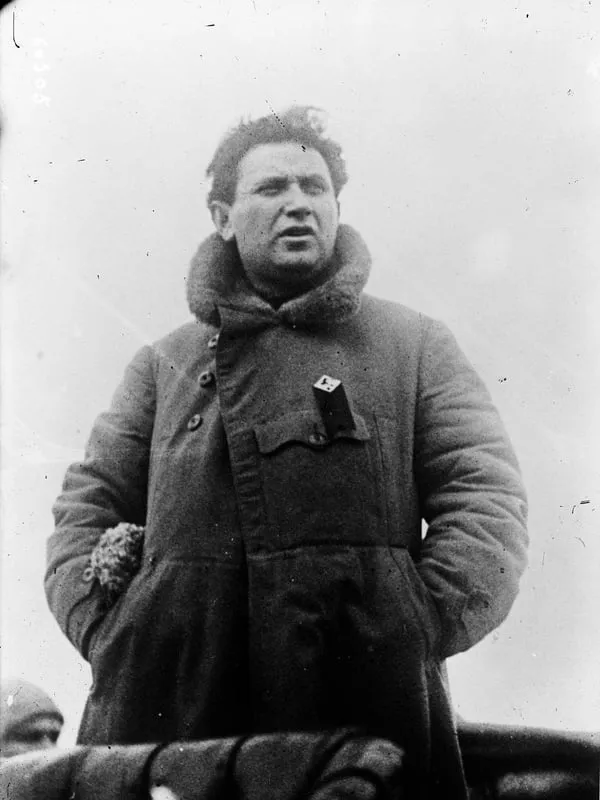
- Born:
- 23 September 1883, Yelisavetgrad, Kherson Governorate (Russian Empire)
- Died:
- 25 August 1936, Moscow
- Author:
- Łukasz
- Photo:
- no data, domena publiczna, Wikimedia Commons

For ten years before the revolution Grigory Zinoviev was Vladimir Lenin’s right-hand man in exile, and in 1917 he returned with him to Russia on the famous train through Germany. In October, however, he opposed the Bolshevik seizure of power, something Lenin never forgot. Even so, he became master of Petrograd and the first chairman of the Communist International, which was meant to set Europe ablaze with revolution but in practice subordinated the communists of the whole world to Moscow. After Lenin’s death he ruled the party together with Lev Kamenev and Joseph Stalin, helped Stalin defeat Leon Trotsky, and then himself lost the struggle for power to him. In August 1936 he was the chief defendant at the first Moscow show trial and was shot. His death opened the Great Terror, which before the war decimated the party, the state and the army of the Soviet Union.
Youth and exile
He was born Ovsei-Gershon Radomyslsky in Yelisavetgrad (today Kropyvnytskyi in Ukraine), into a prosperous Jewish family who owned a dairy farm. His official date of birth is 23 September 1883 (11 September by the Julian calendar), but surviving registers also give other days of that year, and the exact date is uncertain. He was educated at home, worked as a shop clerk and, at sixteen, came into contact with workers’ circles. In 1901 he joined the Russian Social Democratic Labour Party, and in 1902, pursued by the police, he went abroad. He travelled via Berlin to Switzerland and enrolled at the University of Bern, where he studied chemistry and later other subjects, without ever completing a degree. There he met Lenin and, after the party split in 1903, sided with the Bolsheviks.
During the 1905 Revolution he worked on the Bolshevik press in St Petersburg and agitated at mass meetings. At the party congress in London in 1907 he made his mark as a speaker and became a candidate member of the Central Committee. In 1908 the police arrested him in St Petersburg, and after his release Lenin summoned him to Geneva. From then on, for almost ten years, the two were inseparable: in Paris, and from 1912 in Kraków and in Poronin in the Podhale highlands, they lived as neighbours, edited party papers together and ran a party school. The pseudonym Zinoviev, formed from the name of his wife Zinaida Lilina, became his surname at this time. In January 1912 he joined the Central Committee of what was by then a separate Bolshevik party.
The outbreak of war in 1914 found him in Zakopane. He and Lenin moved to Bern and became the last members of the Central Committee still at liberty. In 1915 they jointly wrote the pamphlet “Socialism and War”, condemning socialists who supported their own governments, and in September of that year Zinoviev represented the Bolsheviks at the Zimmerwald Conference, where he was spokesman for its radical left.
1917: against the uprising
After the February Revolution, Zinoviev was among the group that negotiated with the Germans for the émigrés to travel through their territory. On 9 April 1917 he boarded the sealed carriage with Lenin in Zurich, and on 16 April he was with him at the Finland Station in Petrograd. When soldiers and workers took to the streets of the capital at the beginning of July, the Bolshevik leadership – in which Zinoviev was standing in for the absent Lenin – tried to bring them under control. After the collapse of the July Days, the government accused Lenin and Zinoviev of working for Germany and issued warrants for their arrest. The two hid for several weeks in a hut by Lake Razliv near Petrograd, where Lenin was finishing “The State and Revolution”.
Zinoviev almost always followed Lenin, but in the autumn he broke ranks. On 23 October (10 October Old Style), together with Kamenev, he voted in the Central Committee against an armed uprising. Both believed that support for the Bolsheviks after the collapse of Lavr Kornilov’s revolt was fragile and that the question of power should be settled by the Constituent Assembly. When Kamenev set out these views in Maxim Gorky’s newspaper Novaya Zhizn, signing on Zinoviev’s behalf as well, Lenin called them both “strike-breakers” and demanded their expulsion from the party. The Central Committee did not expel them. Zinoviev played no significant part in the coup of 7 November itself. A few days later, together with Kamenev and other moderate Bolsheviks, he resigned from the Central Committee in protest against the rejection of a coalition government of all the socialist parties, but under pressure from Lenin he soon backed down. Lenin recalled this “October episode” in his political testament, writing that it “was no accident”.
Master of Petrograd
From December 1917 Zinoviev headed the Petrograd Soviet, and when the government moved to Moscow in March 1918 he stayed behind in the former capital as its virtually sovereign ruler. In the dispute over the peace of Brest-Litovsk he backed Lenin. In the summer of 1918 Lenin rebuked him for restraining workers who demanded revenge after the murder of the Bolshevik agitator Volodarsky, but after the assassination of the head of the Petrograd Cheka, Moisei Uritsky, in August, Zinoviev was already speaking of “socialist terror” and saying that the ten million Russians who would not go along with the Bolsheviks would have to be “finished off”. During the Red Terror Petrograd was one of the scenes of the bloodiest repression. The intelligentsia called Zinoviev “Grishka the Third”, after Grishka Otrepyev and Rasputin.
In 1919 he was twice responsible for defending the city against the Whites, above all in the autumn, when the army of General Nikolai Yudenich reached the suburbs. Trotsky, who came to save Petrograd at that time, judged his leadership very harshly, and from then on the two were enemies. In February 1921 strikes broke out in the starving city, and in March the sailors of nearby Kronstadt mutinied. Zinoviev declared a state of siege in Petrograd, and the mutiny was crushed by the Red Army. That same year the Petrograd Cheka shot alleged participants in the “Tagantsev conspiracy”, among them the poet Nikolai Gumilev.
Leader of the Comintern
In March 1919 the Third International, the Comintern, was founded in Moscow, and Zinoviev became chairman of its Executive Committee. In the spring of 1919 the revolution seemed to be marching west: in Hungary Béla Kun had taken power, and in Munich a soviet republic had been proclaimed. Zinoviev predicted that within a year all of Europe would be communist. At its Second Congress in 1920 the Comintern adopted conditions of admission for new parties, which required a break with the moderate socialists and absolute discipline towards the centre. In October 1920 Zinoviev spoke for four hours in German at the congress of the Independent Social Democratic Party of Germany in Halle and persuaded its majority to merge with the communists. As a result the Communist Party of Germany became a mass party. In September of that year, at the Congress of the Peoples of the East in Baku, he called on the peoples of Asia to wage a “holy war” against British imperialism.
Successive attempts at revolution ended in defeat. In the autumn of 1923 the Comintern leadership prepared a “German October”, but the rising was called off at the last moment, and the Hamburg Uprising collapsed after a few days. In December 1924 a communist putsch in Tallinn failed. In the West, Zinoviev’s name was associated with the “Zinoviev letter”, published in the British press four days before the election of October 1924. The letter urged British communists to prepare for revolution and damaged the Labour Party of Prime Minister Ramsay MacDonald, which lost the election. Zinoviev called it a forgery from the outset, and historians today regard it as a fake.
The Comintern’s policy of those years gave rise to something that weighed heavily on Germany’s fate. Zinoviev imposed “Bolshevisation” on the communist parties – a structure and discipline on the Russian model – and fought the social democrats as traitors to the working class. In 1924 he spoke of social democracy as a “wing of fascism”. From such formulas, in the late 1920s and by then under Stalin, grew the theory of “social fascism”, because of which the German communists, right up to 1933, fought the social democrats instead of joining them against Adolf Hitler.
The triumvirate and the fall
In 1921 Zinoviev joined the Politburo. During Lenin’s illness he was first among equals: it was he who delivered the Central Committee’s reports to the party congresses of 1923 and 1924, a task that had previously been Lenin’s. Together with Kamenev and Stalin he formed the “troika”, whose aim was to push Trotsky aside. According to Trotsky and many historians, it was Zinoviev who in 1922 put forward Stalin as general secretary, expecting him to be an assistant rather than a rival. When, at the party congress in May 1924, Lenin’s testament – with its advice to remove Stalin – was read out to the delegations, Zinoviev and Kamenev spoke up for him. Petrograd, renamed Leningrad after Lenin’s death, was Zinoviev’s power base, and his native Yelisavetgrad was called Zinovievsk from 1924 to 1934.
In 1925 Zinoviev and Kamenev realised that Stalin, allied with Nikolai Bukharin, was slipping out of their grasp. At the Fourteenth Congress in December 1925 they came out against him as the “New Opposition”, but only the Leningrad delegation backed them. In January 1926 a commission including Vyacheslav Molotov arrived in Leningrad and took over the local party organisation. Zinoviev lost the city, then in July 1926 his seat on the Politburo, and soon afterwards the leadership of the Comintern. Together with Kamenev he formed an alliance with Trotsky in the so-called United Opposition, which was defeated by Stalin’s apparatus. In mid-November 1927, after an attempt to organise their own marches on the tenth anniversary of the revolution, Zinoviev and Trotsky were expelled from the party.
Unlike Trotsky, Zinoviev capitulated. In 1928 he publicly admitted his errors and returned to the party, though not to power. In October 1932 he was expelled again, for failing to report a platform critical of Stalin that was circulating in the party, and exiled to Kustanai in Kazakhstan. After another self-criticism he was readmitted to the party, and in January 1934, at the Seventeenth Congress, he delivered a speech full of praise for Stalin.
Trial and execution
On 1 December 1934 Sergei Kirov was shot dead in Leningrad. According to the investigation files, in the first days nobody linked the assassination to the former opposition, but after a few days, on orders from the very top, the investigators began to look for the killers among the “Zinovievites”. On 16 December Zinoviev was arrested. In January 1935 he was sentenced to ten years in prison for “moral responsibility” for the crime. This was only the beginning. After many months of interrogation, on 19–24 August 1936, Zinoviev, Kamenev and fourteen other defendants stood trial in the first of the three great Moscow trials, charged with the murder of Kirov and with preparing attempts on Stalin’s life on Trotsky’s orders. They confessed to everything because, according to witnesses, they had been promised their lives. On 24 August they were sentenced to death and were shot during the night of 24–25 August. Accounts of Zinoviev’s last moments, in which he is said to have begged for mercy, come from NKVD defectors and must be treated with caution. The defendants were rehabilitated in 1988.
Significance
Historians judge Zinoviev harshly. Edward Hallett Carr saw him as the man who first built the cult of Lenin, first turned “Trotskyism” into a term of abuse, and introduced the custom whereby a defeated minority had not only to submit but to confess its errors publicly. The same tools were later used against him. Trotsky wrote that Zinoviev was a brilliant agitator but lacked character. More recent scholars, such as Lars Lih, see him as a more consistent politician, though one without a feel for the struggle for power.
Two things matter for the road to the Second World War. The Comintern that Zinoviev built became an instrument of Moscow’s foreign policy, and its war on social democracy divided the German left in the years when Hitler was rising. And the trial of August 1936 began the Great Purge: Bukharin and other former leaders perished in further show trials, and in 1937–1938 hundreds of thousands of people were shot, including a large part of the Red Army’s high command. The Soviet Union that concluded a pact with Hitler in 1939 was already a state in which no one dared to oppose Stalin.
Sources
Mentioned in battles
(01)Often appears with
People who appear in the same events.