Norway
Otto Ruge
Chief of the General Staff (1933–1938), Inspector General of the Infantry (1938–1940), Commander-in-Chief of the Norwegian Army (1940), Chief of the Norwegian armed forces (1940, 1945–1946)
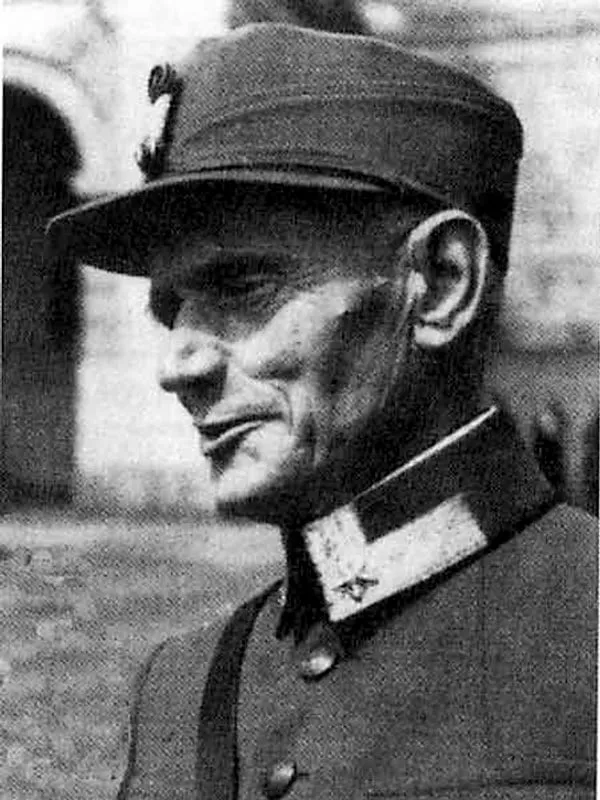
- Born:
- 9 January 1882, Kristiania (Oslo, Norway)
- Died:
- 15 August 1961, Oslo
- Author:
- Natalia
- Photo:
- autor nieznany, domena publiczna, Wikimedia Commons

Otto Ruge was a staff officer and lecturer who spent most of his life preparing the Norwegian army for war, yet led it into battle himself only at the age of 58, for two months in the spring of 1940. Appointed Commander-in-Chief the day after the German attack, he persuaded the King and the government that resistance made sense, and fought a delaying campaign in the hope of Allied relief that came too late and in too little strength. When in June 1940 King Haakon VII and the government sailed for Britain, Ruge stayed with his soldiers and went into captivity. To Norwegians he became a symbol of steadfastness, while his decisions are still debated by historians.
An officer from Kristiania
He was born on 9 January 1882 in Kristiania, as Oslo was then called, into a family with strong military traditions. His father, Carl Christian Conrad Ruge, was a chamberlain at court; his mother, Hilda Ellen af Sillén, came from a family with Swedish roots and died when her son was six. His younger brother Herman became a well-known educationalist. Otto attended the cathedral school in Kristiania, took his school-leaving examination in 1899, and in 1902, at the age of twenty, graduated from the military academy and became an officer. In 1906 he married Ingeborg Sommerfelt, a pastor’s daughter.
His generation was shaped by three great crises: the dissolution of the union with Sweden in 1905, the First World War, in which Norway remained neutral, and the growing tension of the 1930s. From 1905 Ruge studied at the Military College, and in 1915 he passed the general staff examination. He served on the General Staff from 1906 at every level, and between postings commanded a company in the 1st Akershus Brigade and a battalion in an infantry regiment from Rogaland, and was chief of staff of the 1st and 3rd Brigades. He was regarded as an outstanding teacher: in 1922–1930 he was an instructor at the infantry marksmanship school, and in 1929–1933 he lectured on strategy and military history at the Military College.
Architect of the army of the 1930s
Between the wars Ruge was one of the most influential voices in the debate over the shape of Norway’s defence. He worked with the defence commission of 1920 and on the act of 1927, and as secretary of the military commission he helped to create the new organisation of the armed forces of 1933. His starting point was an analysis of Norway’s strategic position: its coastline was too valuable to the great powers for them to leave it alone. Given the meagre funds available and politicians’ reluctance to rearm, however, he believed there was no point in presenting the government with plans it would not pay for. He favoured cutting the land forces in favour of the navy and the new air arm. In this he differed from the other great commander of 1940, General Carl Gustav Fleischer, who maintained that the size of the army must be dictated by the threat, not by the budget.
In 1933, by then a colonel, Ruge became Chief of the General Staff. After 1935, when Germany began to rearm openly, he warned of the new danger and of the weakness of the Norwegian mobilisation system. In 1937 he prepared the first joint army and navy exercises, which assumed a German invasion. He published studies on the new organisation of the army, defence readiness, Norway’s position in the event of a European war and the importance of air power in great-power politics. In 1938 he left the General Staff and became Inspector General of the Infantry.
The ninth and tenth of April
The German attack on 9 April 1940 caught him on his way back from Stockholm. He joined the King and the government, who had fled from Oslo to Hamar and then to Elverum. While some politicians and senior officers were inclined to negotiate, Ruge firmly argued for fighting. On the night of 9–10 April he organised a roadblock at Midtskogen, where a scratch force of Guardsmen and volunteers stopped a German paratroop detachment racing north to capture the King. Its commander, the German air attaché Captain Eberhard Spiller, was mortally wounded, and the Germans turned back.
On 10 April the King and the government rejected the German demands, including the appointment of Vidkun Quisling as Prime Minister. The existing Commander-in-Chief, the 65-year-old General Kristian Laake, accused of defeatism and passivity, was retired. His place was taken by Ruge, promoted to major general. He put the matter plainly: further resistance made sense only if Norway could count on swift and strong Allied help. He issued an order to resist by every means and guidelines for a delaying campaign, sent junior officers with broad powers to the scattered units, and removed commanders who lacked the will to fight. On 11 April he survived, together with the King, the German air raid on Nybergsund.
The campaign in southern Norway
Ruge commanded an army that had not had time to mobilise. The Germans held the largest towns, the ports, the airfields and many depots, and in the end some 50,000 men reported for service. From 12 April his headquarters was at Øyer in the Gudbrandsdal valley. The plan was simple: by blowing bridges and defending successive defiles, to hold as much ground as possible east of the mountains so that the Allies could land and develop a counter-offensive, without bleeding the young army white in the process. From the first days he pressed London to retake Trondheim, and warned Prime Minister Neville Chamberlain that without immediate help the war would be over within days.
The collapse of the 1st and 3rd Divisions in the south of the country in mid-April narrowed his front to the Mjøsa valley and the Gudbrandsdal. When the first British troops arrived from Åndalsnes on 19 April, Ruge demanded that instead of advancing on Trondheim they support his forces near Lillehammer, and on 20 April he threatened to resign if the British units did not submit to his decisions. He got his way, but the fighting for Trondheim and the battles in the Gudbrandsdal ended in defeat. The poorly trained British Territorial brigades were broken at Lillehammer and Tretten, the Germans dominated the air, and London often did not inform the Norwegian commander of its intentions. Ruge was disappointed with an aid that in his view proved of little military value. From 26 April he handed command of the Gudbrandsdal front to the British General Bernard Paget. On 28 April Paget, contrary to London’s instructions to keep it secret, told him openly of the decision to evacuate. Ruge spoke of betrayal at the time, but controlled himself and promised to cover the withdrawal of his allies.
In the north
At the end of April Ruge turned down an offer to go to Britain and moved with part of his staff to Tromsø, where the King and the government also arrived aboard a British cruiser. On 5 May he set up the headquarters of the High Command at Målselv. On 18 May he became head of the newly created High Command of the Armed Forces, covering both the army and the navy. In the north the front at Narvik was directed by Fleischer, and alongside the Norwegians fought the British, the French and the Poles of the Independent Highland Brigade (the Podhale Rifles). Ruge was convinced that northern Norway could be held. On 28 May the Allies recaptured Narvik, but in view of the defeat in France they had already decided to withdraw.
Before the government left on 7 June, the Ministry of Defence authorised Ruge to negotiate an end to the fighting in the country. Ruge delayed the capitulation until the Allies had had time to sail, while at the same time demobilising as many soldiers as possible to spare them captivity. He did not go to Trondheim himself. He gave his authority to Lieutenant Colonel Ragnvald Roscher Nielsen, who on 10 June at the Hotel Britannia signed an agreement with the chief of staff of General Nikolaus von Falkenhorst. Ruge made sure that the negotiators told the Germans plainly that the King and the government had left the country and that Norway as a state remained at war with the Reich. The agreement was a capitulation of the army, not a peace.
Five years in captivity
Ruge himself refused to give his word of honour that he would not take up arms against Germany again, and went into captivity. He had earlier declined a place on the warship with the government, because he wanted to share the fate of his soldiers and to use his imprisonment to underline that the war was continuing. He was interned first in Trondheim and then at Grini near Oslo, where he was the only prisoner in the governor’s house and wrote down his recollections of the campaign. The Germans hoped he would be useful in the talks on forming a Norwegian Council of State. When the talks broke down and the Reich Commissioner, Josef Terboven, appointed his own ministers, Adolf Hitler personally decided on 9 October 1940 to have him taken to Germany.
On 15 October Ruge flew to Dresden, and from there he was taken to Königstein Fortress, to Oflag IV-B, where he shared captivity with French and Polish officers. In December 1943 he was moved to a camp in Toruń, and in July 1944 to Oflag XXI-C at Ostrzeszów (Schildberg), where other Norwegian officers were held and where they chose him as their spokesman. In the winter of 1945, ahead of the approaching Red Army, the prisoners were evacuated to the camp at Luckenwalde near Berlin. There Ruge became the Allied commandant of the camp, and on 22 April 1945 he lived to see its liberation by Soviet troops.
He was taken to the headquarters of Marshal Ivan Konev and then to Moscow. There he negotiated for the Norwegian prisoners to return home via Denmark rather than via Murmansk, as had been agreed earlier. He himself returned to Oslo via Stockholm on 3 June 1945, in time to take part in the preparations to welcome the King, who arrived by sea on 7 June.
After the war
On 15 July 1945 Ruge was promoted to lieutenant general, then the highest rank in the Norwegian army, and again became Chief of the armed forces. He was also offered the post of Minister of Defence. He soon came into conflict, however, with the new minister, Jens Christian Hauge. Ruge wanted to rebuild a large army as quickly as possible by calling up the wartime age groups for short training. Hauge needed well-trained soldiers for the Norwegian brigade in occupied Germany and preferred to send those age groups to the Home Guard. The minister got his way, and Ruge left the army in protest on 1 January 1946.
He spoke out on public affairs. In the reckoning with collaborators he belonged to the so-called “silk front”, which warned against punishing too harshly those who had not committed outright treason. In 1945 he was among the founders of the Norwegian-Soviet Society, which he explained as gratitude for the sacrifices of the USSR in the war. He edited a three-volume illustrated chronicle of the Second World War (1946–1948). The army gave him a grace-and-favour residence at Høytorp Fort near Mysen, where he spent the rest of his life. He joined the Home Guard as a volunteer with the rank of corporal and went on exercises. He died in Oslo on 15 August 1961. His recollections of the 1940 campaign were not published until 1989.
Significance
Ruge received the Grand Cross with Collar of the Order of St. Olav, the French Legion of Honour, the American Bronze Star and Danish and Swedish decorations, and in 1947 the Knight’s Cross of the Virtuti Militari. His monuments stand, among other places, at Akershus Fortress in Oslo, and many Norwegian streets bear his name.
Opinions of his generalship are divided. Critics such as the retired general Torkel Hovland reproach him for having accepted the cutting back of the army in the 1930s as Chief of Staff, and for having defended too passively in 1940, unlike Fleischer at Narvik. His defenders, such as the military historian Tom Kristiansen, point out that Ruge had warned of the threat and of the weakness of the mobilisation system, and that his army was shattered by surprise before it had even come into being. Fleischer, moreover, had more time and less of the Luftwaffe overhead.
For the history of the Second World War something else matters more. Ruge decided that Norway would fight, and thanks to this an attack meant to look like a “peaceful occupation” became a two-month campaign. Resistance bought time for the evacuation of the King, the government, the gold and the merchant fleet, which served the Allies throughout the war. And his decision to stay with his soldiers and not give his word made him living proof that the capitulation of the army did not mean the capitulation of the state.
Sources
Commanded in battles
(01)Mentioned in battles
(01)Often appears with
People who appear in the same events.