Germany
Nikolaus von Falkenhorst
Commander of XXI Army Corps (1939–1940), commander of the invasion of Norway (1940), Wehrmacht Commander-in-Chief in Norway (1940–1944), Colonel General (1940)
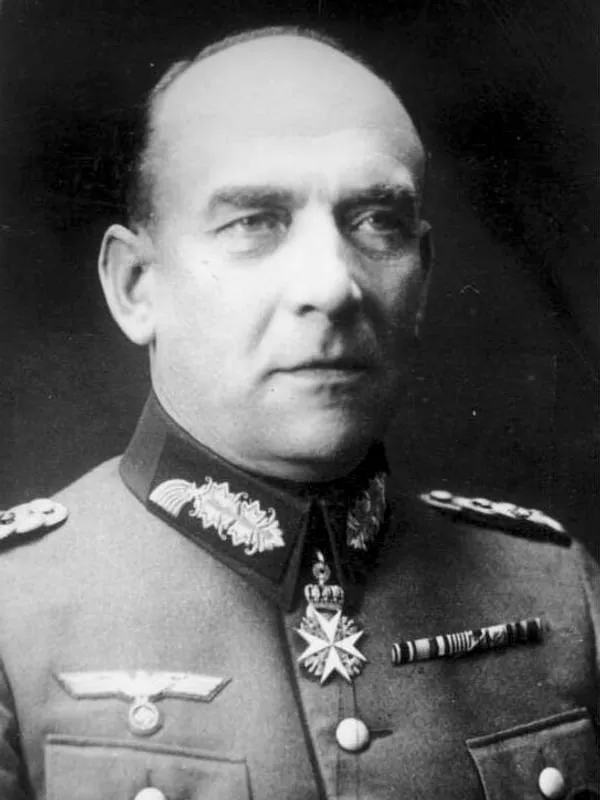
- Born:
- 17 January 1885, Wrocław (Breslau, Silesia, German Empire)
- Died:
- 18 June 1968, Holzminden (Federal Republic of Germany)
- Author:
- Łukasz
- Photo:
- autor nieznany, CC BY-SA 3.0 DE, Wikimedia Commons

Nikolaus von Falkenhorst was a typical Prussian staff officer who, until the age of fifty-five, had done nothing to set himself apart. Then, in February 1940, almost overnight, Adolf Hitler entrusted him with preparing and leading the invasion of Norway. He was chosen because he had fought in Finland in 1918 and knew what war in the harsh northern climate involved. Operation Weserübung made him a colonel general and, for almost five years, master of the German armed forces in occupied Norway. Norwegians remember him as a more restrained commander than the Reich Commissioner Josef Terboven, yet it was he who passed on to his subordinates Hitler’s order to kill captured commandos. After the war a British military court sentenced him to death for it; the sentence was commuted to imprisonment.
Jastrzembski from Wrocław
He was born on 17 January 1885 in Wrocław (Breslau) as Paul Nikolaus von Jastrzembski, into an old Silesian noble family of Polish origin which had supplied the Prussian army with officers for generations but owned neither land nor fortune. He was brought up in the cadet corps. On 22 March 1903 he joined the King William I Grenadier Regiment (2nd West Prussian) No. 7, stationed in Legnica (Liegnitz), as an officer cadet (Fähnrich). After the war school at Potsdam he was commissioned as a second lieutenant in April 1904. In 1908 he married Margarete Ulrich from Holzminden on the Weser, the town to which he would return in old age.
On 6 June 1911, as a lieutenant, he obtained permission from the Prussian authorities to change his name. The Slavonic “Jastrzembski”, from the Polish word for hawk, gave way to the German “von Falkenhorst”, meaning “falcon’s nest”, with his noble status and coat of arms retained. Polish authors explain the step as a wish to smooth his career in an army in which Polish-sounding names were no help.
From Galicia to Finland
In the First World War he held regimental and staff posts. In December 1914 he was promoted to captain. In the spring of 1918, after peace had been concluded with Russia, Germany sent to Finland, then torn by civil war, the division of General Rüdiger von der Goltz, which landed near Hanko and helped the Finnish “Whites” take Helsinki. From the summer of 1918 until the end of the war Falkenhorst was the first general staff officer (Ia) to the commander of German forces in Finland. There he learned the conditions of operations in the far north, and twenty-two years later this experience decided his selection.
After the armistice he served in the Grenzschutz Ost, a volunteer formation guarding Germany’s eastern borders during the disputes with the reborn Polish state. In 1920 he moved to a brigade staff of the 100,000-strong Reichswehr. From 1922 he worked in the Reichswehr Ministry; he became a major in 1925, took command of a battalion of the 1st Infantry Regiment in 1928 and was a lieutenant colonel by 1930. In October 1931 he became chief of staff of the 4th Division in Dresden, and a year later a colonel.
Diplomat and divisional commander
After Hitler came to power he was sent as military attaché to Prague, from where in 1933–1935 he was also responsible for Yugoslavia and Romania. In this way he came to know the countries of the Little Entente, with which the Reich would soon deal in a variety of ways. In 1935, as conscription was reintroduced and the army rapidly expanded, he was promoted to Generalmajor and became chief of staff of Army Group Command 3 in Dresden. From 1936 he commanded the 32nd Infantry Division in Koszalin (Köslin), and by 1937 he was a Generalleutnant.
September 1939 on the Osa and at Grudziądz
On 26 August 1939 Falkenhorst took command of XXI Army Corps, formed a few weeks earlier in East Prussia. In the invasion of Poland the corps formed part of the 3rd Army of General Georg von Küchler, within Fedor von Bock’s Army Group North. On 1 September its 21st and 228th Infantry Divisions advanced from the Kwidzyn area along the right bank of the Vistula towards Grudziądz. On the River Osa they ran into the Polish 16th Infantry Division (PL) of the Pomorze Army. After two days of heavy fighting the Germans broke through the Osa line, and on 4 September they entered Grudziądz, which the Polish troops had abandoned. The junction of the 3rd and 4th Armies closed the Polish Corridor. The corps was then moved to the army’s eastern flank, in the area of Pisz and Ełk. Against the background of the whole September Campaign this was a secondary role. On 1 October 1939 Falkenhorst was promoted to General der Infanterie, and in the autumn his corps was transferred to the Rhine to await the offensive in the west.
Weserübung
In the autumn of 1939 Grand Admiral Erich Raeder urged Hitler that Germany must seize Norway’s ports before the British did. On 27 January 1940 planning was taken over by the Wehrmacht High Command (OKW), where a staff for Operation Weserübung was set up under Wilhelm Keitel. What it lacked was a commander. After the incident of 16 February, when a British destroyer freed prisoners from the German ship Altmark in Norwegian waters, Hitler decided to make haste. He asked Keitel for a general who knew Scandinavian conditions, and Keitel named Falkenhorst.
On 21 February 1940 Hitler received him at the Reich Chancellery. The chief of the OKW operations staff, General Alfred Jodl, noted in his diary that Falkenhorst had “gladly accepted”. According to the general’s own account, Hitler told him to come back that same afternoon with an outline plan. Falkenhorst, who had no maps of Norway with him, bought a Baedeker travel guide in a bookshop and used it to sketch in his hotel where, and with what forces, the landings should be made. Hitler accepted the plan. The anecdote, repeated in many books, comes from Falkenhorst himself and captures well the haste with which the operation was prepared.
The staff of XXI Corps, renamed Group XXI and placed directly under the OKW, bypassing the Army High Command, developed the plan drawn up at the OKW by the staff of Captain Theodor Krancke. The planners concluded that Denmark had to be taken as well: supplies were to pass through it, and the Luftwaffe wanted its airfields. On 1 March 1940 a directive from Hitler entrusted Falkenhorst with preparing and carrying out the operation. On 9 April German troops landed simultaneously in seven Norwegian ports, and Denmark capitulated within a few hours. In Norway the attack did not go to plan: King Haakon VII and the government escaped from Oslo because the cruiser Blücher was sunk in the fjord by the guns of Oscarsborg fortress, and the Norwegians took up the fight. Falkenhorst flew into Oslo on 10 April. Over two months his troops, better armed and supported from the air, took control of the south and centre of the country. At Narvik, where Poles of the Independent Podhale Rifle Brigade also fought, the Germans found themselves in serious difficulty and were saved only by the Allied withdrawal in the face of defeat in France. Norway capitulated on 10 June 1940. On 30 April Falkenhorst had received the Knight’s Cross of the Iron Cross, and on 19 July 1940, the day of mass promotions after the victory over France, he became a colonel general. It was his last promotion.
Commander-in-Chief in Norway
On 19 December 1940 Falkenhorst became Wehrmacht Commander-in-Chief in Norway (Wehrmachtbefehlshaber Norwegen), and the staff of Group XXI became Armeeoberkommando Norwegen, the command of the Army of Norway. Civil power lay with the Reich Commissioner Josef Terboven, while the political façade was provided by the party of Vidkun Quisling. Falkenhorst thought little of either. He made sure that Terboven and the Gestapo did not meddle in military matters, and he refused to live in the royal palace. The Norwegian scholar Arvid Brodersen described him as a soldier of the old school, modest and fearless, somewhat simple in his thinking, but anxious that he and his soldiers should make a correct impression on the population. He was neither a Nazi nor an anti-Nazi. He concerned himself with the army and kept out of occupation policy, although he did intervene in a few cases. In 1941, through the Swedish explorer Sven Hedin, he supported a plea for clemency for ten Norwegians sentenced to death for espionage. Hitler commuted their sentences to imprisonment.
When Hitler decided to attack the Soviet Union, the Army of Norway was given a task in the far north. In Operation Silberfuchs, launched at the end of June 1941, General Eduard Dietl’s mountain corps attacked from the Petsamo (Pechenga) area towards Murmansk, while other groupings, together with the Finns, struck at the Murmansk railway in Karelia. The advance bogged down in the tundra on the River Litsa, a few dozen kilometres short of its objective, and Murmansk, through which Allied supplies for the USSR later flowed, was never taken. British raids on the Norwegian coast, such as the descent on the Lofoten Islands in March 1941 (Operation Claymore), confirmed Hitler in his belief that the Allies would land in Norway. Falkenhorst returned to Oslo and devoted himself to coastal defence, and from January 1942 the front in Lapland was directed by Dietl. Norway became one vast fortress, garrisoned for the rest of the war by several hundred thousand German soldiers.
The Commando Order
On 18 October 1942 Hitler issued the Commando Order, which required members of Allied sabotage units to be killed, even when captured and in uniform. Falkenhorst passed it on to the units under him and tightened it in his own instructions, recommending that commandos held for interrogation be kept alive no longer than twenty-four hours, and reminding his troops of this in 1943. On this basis those killed in Norway included the survivors of the crashed gliders of the British Operation Freshman, which in November 1942 was to have destroyed the heavy-water plant at Vemork. Some of the prisoners were handed over to the SS security police (SD), who murdered them.
As commander of the troops stationed in Norway he was also responsible for the prisoner-of-war camps in which tens of thousands of Soviet prisoners worked in inhuman conditions building roads, railways and fortifications. In 1942 Terboven and Quisling’s Norwegian police deported Norway’s Jews to Auschwitz. After the war Falkenhorst argued that he had had nothing to do with it, and understated the number of Jews in Norway.
On 18 December 1944, as the troops of the 20th Mountain Army were withdrawing from Finland into Norway, Hitler merged the commands and dismissed Falkenhorst. His place was taken by General Lothar Rendulic. Falkenhorst was placed in the officer reserve and received no further posting. He himself believed that Hitler preferred a general more devoted to the party. The end of the war found him in Germany, where he was taken prisoner by the British.
Trial and last years
In the autumn of 1945 he was interrogated in Oslo. From 29 July to 2 August 1946 he was tried by a British military court in Brunswick. The charges concerned passing on the Commando Order and handing Allied prisoners over to their deaths in seven cases. The defence invoked superior orders. On 2 August 1946 Falkenhorst was sentenced to death by firing squad. At the end of 1946 the sentence was commuted to twenty years’ imprisonment. Sven Hedin pleaded for clemency, recalling that the general had once helped to save ten Norwegians. Sources give different dates for the decision: 4 November or 4 December 1946.
He served his sentence in the prison for war criminals at Werl. In July 1953, suffering from heart disease, he was released early. In denazification proceedings in 1951 a tribunal in Hanover had found that he had not supported National Socialism. He died of a heart attack on 18 June 1968 in Holzminden and was buried there.
Significance
Falkenhorst was neither a great commander nor the author of Weserübung. The plan was born in the navy and the OKW, and he was handed it to carry out at the last moment. Yet he executed it efficiently, in conditions the German army had never known before: with landings from the sea and from the air, in mountains and snow, in a country without roads, and in the face of British naval superiority. The Norwegian campaign gave the Reich Atlantic bases and Swedish iron ore, and gave Falkenhorst his general’s stars. His later career illustrates the path of many German generals who, while keeping up an appearance of correctness towards the occupied, carried out Hitler’s criminal orders. The Brunswick verdict was one of those post-war judgements in which courts held that superior orders did not absolve a man of responsibility for killing prisoners.
Sources
Commanded in battles
(01)Mentioned in battles
(01)Often appears with
People who appear in the same events.
On the timeline
(17)1939
1940
January
February
March
April
- 09
- Key eventGermany invades NorwayOn 9 April 1940 Germany landed troops in Norwegian ports and took Oslo from the air. The king, government and gold left the capital, and Norway fought on.
- Germany occupies DenmarkOn 9 April 1940 the Wehrmacht invaded neutral Denmark. After skirmishes in Jutland and at Amalienborg the king and government ended resistance within hours.