Norway
Haakon VII
Prince of Denmark (until 1905), King of Norway (1905–1957)
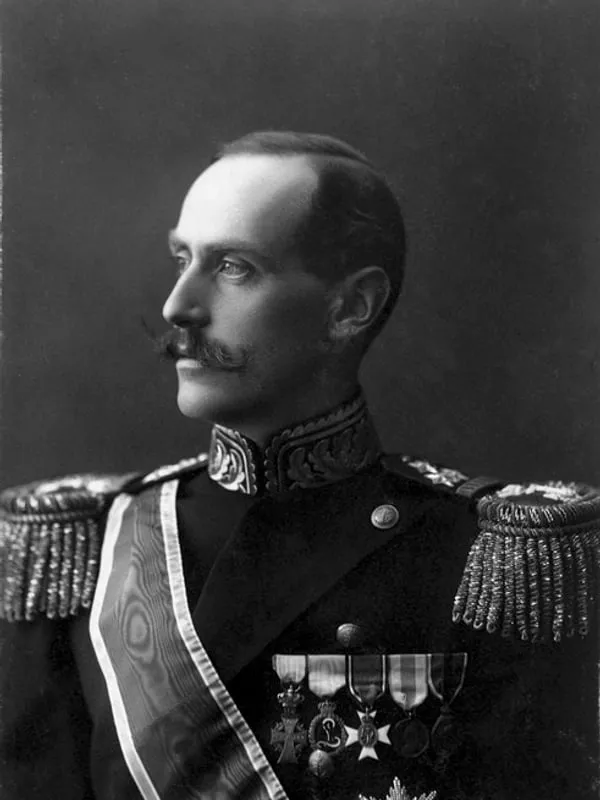
- Born:
- 3 August 1872, Charlottenlund (near Copenhagen, Denmark)
- Died:
- 21 September 1957, Oslo
- Author:
- Łukasz
- Photo:
- Gustav Borgen, CC BY-SA 3.0, Wikimedia Commons

Haakon VII was born a Danish prince, Carl, the younger son of the heir to the throne, and for the first thirty-three years of his life he was a naval officer with no prospect of a crown. In 1905, after the dissolution of the union with Sweden, the Norwegians chose him as their first king of their own in five hundred years. He reigned for more than half a century as a model constitutional monarch who left politics to the government and parliament. His defining moment came in April 1940. When Germany invaded Norway and Adolf Hitler demanded that he appoint Vidkun Quisling Prime Minister, the sixty-seven-year-old King refused and threatened to abdicate. That refusal meant that Norway, unlike his brother’s Denmark, stayed in the war on the Allied side. For five years in exile in London Haakon VII was the Norwegians’ symbol of resistance, and his monogram “H7” was painted on walls throughout the occupied country.
A Danish prince in the navy
The future king was born on 3 August 1872 at Charlottenlund Palace near Copenhagen, the second son of the Danish Crown Prince, later King Frederick VIII, and of Louise, the only daughter of Charles XV, King of Sweden and Norway. He was christened Christian Frederik Carl Georg Valdemar Axel, but within the family and to the world he was known as Prince Carl. He belonged to the house of Glücksburg, a branch of the Oldenburgs, who for centuries had ruled Denmark and Norway. His grandfather was Christian IX, the “father-in-law of Europe”, whose children sat on thrones, or beside them, from London to St Petersburg and Athens. Carl’s elder brother was the future Danish King Christian X.
The Crown Prince’s children were brought up by their mother herself, something rare in royal families at the time. Their upbringing was strict and religious, centred on duty and order. As a younger son Carl was destined for a military career, and he chose the navy himself. At seventeen he entered the officers’ school of the Royal Danish Navy, passed out as a sub-lieutenant in 1893 and was made lieutenant a year later. He was an average student, but life at sea suited him. He sailed on cruises in European waters and beyond, the last of them in 1904–1905 aboard the cruiser Heimdal in the Mediterranean and the Atlantic. To the end of his life he kept a military bearing and an interest in defence matters.
Maud
In the autumn of 1895 Carl became engaged to his cousin, the British Princess Maud, youngest daughter of the Prince of Wales, later King Edward VII, and of the Danish Princess Alexandra, the sister of Carl’s father. They were married on 22 July 1896 in the chapel of Buckingham Palace in the presence of Queen Victoria. The couple lived alternately in Copenhagen and at Appleton House on the Sandringham estate, a wedding present from the bride’s father. There, on 2 July 1903, their only son Alexander was born, the future King Olav V of Norway. The marriage tied Carl to the British royal family: he was brother-in-law of George V and uncle of George VI. In 1905 this mattered politically; in 1940 it proved invaluable.
A crown by election
On 7 June 1905 the Norwegian parliament, the Storting, unilaterally dissolved the union with Sweden. The government of Christian Michelsen offered the throne to one of the sons of the Swedish King Oscar II, but expected a refusal from the outset and looked for another candidate. The choice fell on Prince Carl. He came from the dynasty from which Norway’s former kings had descended, he was a Scandinavian, he had a son, and his wife was the daughter of the King of Great Britain, the great power on which the young state wished to lean. Carl hesitated for a long time. He wanted the consent of his grandfather and his father-in-law, and assurance that Sweden would not take offence. When in October, after the Karlstad agreement, Oscar II renounced the Norwegian crown and declined the offer on behalf of his house, Carl set one more condition: the Norwegians must express their will in a vote. He wanted to be sure that he was chosen by the nation and not by a single party, since the republican movement in the country was strong.
The referendum was held on 12 and 13 November 1905. Almost 79 per cent of those who voted, 259,563 people against 69,264, backed the monarchy and Carl’s candidacy. On 18 November the Storting unanimously elected him king. That same evening Carl accepted and announced that he was taking the Old Norse name Haakon, unused by kings for more than five hundred years, and that his son would be called Olav. As his motto he chose “All for Norway” (Alt for Norge). On 25 November, in a snowstorm, the royal family arrived by sea at Kristiania, today’s Oslo. On the way, in the roads off Oscarsborg fortress, they transferred from the Danish royal yacht to the Norwegian warship Heimdal. On 27 November Haakon VII took the oath before parliament. On 22 June 1906 he and Maud were anointed and crowned in Nidaros Cathedral in Trondheim. It was the last coronation in Norway’s history, for in 1908 the Storting removed the requirement of a coronation from the constitution.
A constitutional king
The new kingdom was poor, and its monarchy was meant to be modest, with a small court and little expense, so as to give no ammunition to the republicans. Haakon quickly mastered Norwegian pronunciation, although a Danish accent could be heard in his speech to the end. He travelled widely around the country and talked with people of every station. The polar explorer Fridtjof Nansen introduced the royal family to skiing, and the King attended the Holmenkollen competition every year. From the start he kept to the principles of parliamentary government, in force in Norway since 1884: the Council of State governed in his name, and he gave the ministers his opinion but gave way when they did not share it.
He had more influence in foreign policy, at least in the early years. The government drew on his connections in its efforts to secure the treaty by which in 1907 the great powers guaranteed Norway’s territorial integrity. Only once, in 1913, when the government of Gunnar Knudsen sought to curtail his prerogatives, did the King take a hard line, letting it be known that he might abdicate. During the First World War he supported neutrality. On 18 December 1914 he met the kings of Sweden and Denmark in Malmö, where the three monarchs issued a joint declaration of the strict neutrality of their countries; in 1917 they met again in Kristiania.
In January 1928, after the election victory of the Labour Party, which was still regarded as revolutionary and had the abolition of the monarchy in its programme, Haakon, against the advice of some politicians, asked its leader Christopher Hornsrud to form a government. The cabinet lasted eighteen days, but the gesture was remembered. The King is said to have remarked at the time that he was the communists’ king too. In the 1930s the Labour Party made its peace with the monarchy, and its government, led from 1935 by Johan Nygaardsvold, was on good terms with the King. In 1933, when Norway lost its dispute with Denmark over East Greenland before the Permanent Court of International Justice, Haakon publicly congratulated his brother. In 1936, on the advice of the Foreign Ministry, he stayed away from the ceremony at which the Nobel Peace Prize was presented to Carl von Ossietzky, a prisoner of the Nazi camps. On 20 November 1938 Queen Maud died in London. In the spring of 1939 Norway, like Sweden and Finland, rejected a German offer of a non-aggression pact, and when the Second World War broke out it declared its neutrality.
April 1940
The Germans had been preparing the invasion of Norway since the winter, and the plan for Operation Weserübung assumed that the King and the government would be taken by surprise in Oslo on the first day. During the night of 8–9 April 1940 the King was kept informed of events but took no part in the deliberations of the government, which rejected the German ultimatum. He could not be captured, because the cruiser Blücher, carrying the landing force for Oslo, was sunk in the Drøbak Narrows. In the morning a special train took the King, the Crown Prince, the government and most of the deputies to Hamar, and from there in the evening to Elverum. There the Storting met for the last time before the end of the war and gave the government full powers to act in its name. Haakon was among those who opposed negotiating with the Germans.
On 10 April the German envoy Curt Bräuer demanded that the King capitulate and appoint Quisling Prime Minister; the previous evening Quisling had proclaimed himself head of government on the radio. Bräuer cited the example of Denmark and Christian X. Haakon replied that the decision lay with the government. That evening at Nybergsund he told the ministers that he could not accept the German demands, since that would go against everything he had regarded as his duty for almost thirty-five years, and that he would rather abdicate than appoint Quisling. The government backed the King unanimously. The next day the Luftwaffe bombed Nybergsund. The King and the Crown Prince sat out the raid in a snow-covered forest.
The road north
For the following weeks the King shared the fate of a losing army. Sweden, whose border he crossed briefly on 12 April, would give no guarantee that it would not intern him, which Haakon never forgave. The King made his way by back roads to the Gudbrandsdalen valley and for several days hid near Otta, cut off from the west coast by German paratroopers at Dombås. By the end of April he had reached Molde, where during an air raid on 28 April one of Norway’s most famous wartime photographs was taken: the King and the Crown Prince in their greatcoats, sheltering from the aircraft beneath a birch tree, later known as the “King’s birch”. The King and the government had now become a target for the bombers, and the population did not everywhere welcome them gladly. According to the army commander, General Otto Ruge, Haakon bore the primitive and restless life “remarkably well for his age”.
When the Allies withdrew from central Norway after losing the fighting for Trondheim, the British cruiser HMS Glasgow took the King, the government and part of Norway’s gold reserves off from burning Molde during the night of 29–30 April. On 1 May they reached Tromsø, which for a month became the capital of free Norway. The King lived in a wooden cabin in the upper Målselv valley. At Narvik Norwegian, British and French troops and the Polish Independent Podhale Rifle Brigade finally retook the town, but the defeat of France cancelled out this success. The Allies decided to evacuate Norway, and the King and the government had to choose between staying in the country and leaving. Crown Prince Olav offered to stay, but the government would not agree. The British, mindful of the example of the Belgian King Leopold III, who had remained in his occupied country, insisted on departure. On 7 June 1940, the 35th anniversary of the break with Sweden, Haakon VII, Olav and the ministers sailed from Tromsø aboard the cruiser HMS Devonshire. A day later German battleships sank the aircraft carrier HMS Glorious, returning from Norway, together with her two escorting destroyers in the Norwegian Sea. On 10 June the Norwegian campaign ended in capitulation.
A king in exile
In the summer of 1940, when Germany was winning on every front and many in Norway blamed the King and the government for the defeat, Reich Commissioner Josef Terboven resolved to remove the monarch with the help of the Norwegians themselves. On 27 June the members of the Storting’s presidium who had remained in Oslo, under pressure from the occupier, wrote to the King asking him to abdicate. Haakon replied in a letter of 3 July and a radio broadcast of 8 July: the request was not the expression of the Norwegians’ free will but the result of the coercion of foreign occupation, and his government enjoyed the confidence of parliament expressed at Elverum. This second “no” from the King became one of the starting points of the Norwegian resistance movement. On 25 September 1940 Terboven declared the King and the government deprived of their powers and banned all activity in support of the royal family.
In Britain the King lived first as George VI’s guest at Buckingham Palace and, from the autumn of 1940, when the air raids on London began, at country houses in Berkshire: Bowdown House and later Foliejon Park near Windsor. Several times a week he came to the Norwegian legation at Palace Green in Kensington, where he presided over meetings of the Council of State, received compatriots from all over the world and gave speeches broadcast home by the BBC. He visited Norwegian soldiers, airmen and sailors, including the crews of the merchant fleet, which was Norway’s main contribution to the war. He pursued no policy of his own and always sided with the government, even when it was criticised by the military. Crown Princess Märtha and her children left Sweden for the United States in August 1940 at President Roosevelt’s invitation. On the King’s seventieth birthday, 3 August 1942, more than five thousand Norwegians gathered in the Royal Albert Hall. In the occupied country his popularity grew with every year of the war. The monogram “H7” was painted on walls and worn in lapels, and poems about the King circulated in clandestine copies.
Return and last years
Crown Prince Olav, Commander-in-Chief of the Norwegian armed forces since 1944, returned to liberated Norway on 13 May 1945. The King himself arrived in Oslo aboard the cruiser HMS Norfolk on 7 June 1945, exactly five years after leaving Tromsø, greeted by vast crowds. After his return he again confined himself to his constitutional role. In 1947 Norwegians bought him the royal yacht Norge by public subscription. In 1955 he celebrated the fiftieth anniversary of his reign. That summer he fell in the bathroom of his residence at Bygdøy and broke his thigh bone. For the rest of his life he used a wheelchair, and Olav took over his duties as regent. Haakon VII died at the Royal Palace in Oslo on 21 September 1957, aged 85. On 1 October he was buried beside Queen Maud in the royal mausoleum at Akershus Fortress. In his lifetime he had made sure that his private correspondence would be destroyed.
Significance
Haakon VII firmly established a monarchy that many Norwegians had not wanted in 1905. He did so not through politics but through restraint in politics: for half a century he observed the rules of parliamentary government, even when handing power to a party that wanted to dethrone him. That is precisely why his refusal of 10 April 1940 carried such weight. A king who had never imposed his views now said plainly that he would not put his name to the legalisation of conquest, and the government followed him. In Norway the Germans did not obtain what they got in Denmark: a legitimate authority willing to function under occupation.
As a result Norway remained a belligerent state throughout the war, an ally of Britain, with a recognised government in London, a merchant fleet in Allied service and armed forces of its own. Quisling’s collaborationist government never gained legitimacy or the support of most Norwegians. The King himself, a Dane by birth, became for them the embodiment of national dignity, and in a 2005 poll to choose the Norwegian of the century he was ranked among the very first. His “no” at Nybergsund is one of the most important decisions in Norway’s history.
Sources
Commanded in battles
(01)Mentioned in battles
(01)Often appears with
People who appear in the same events.
On the timeline
(21)1940
January
April
- 09
- Key eventGermany invades NorwayOn 9 April 1940 Germany landed troops in Norwegian ports and took Oslo from the air. The king, government and gold left the capital, and Norway fought on.
- Germany occupies DenmarkOn 9 April 1940 the Wehrmacht invaded neutral Denmark. After skirmishes in Jutland and at Amalienborg the king and government ended resistance within hours.
- The sinking of the Blücher in the Drøbak NarrowsOn 9 April 1940 the guns and torpedoes of Norway’s Oscarsborg fortress sank the cruiser Blücher. The delay let the king, government and gold leave Oslo.