Soviet Union
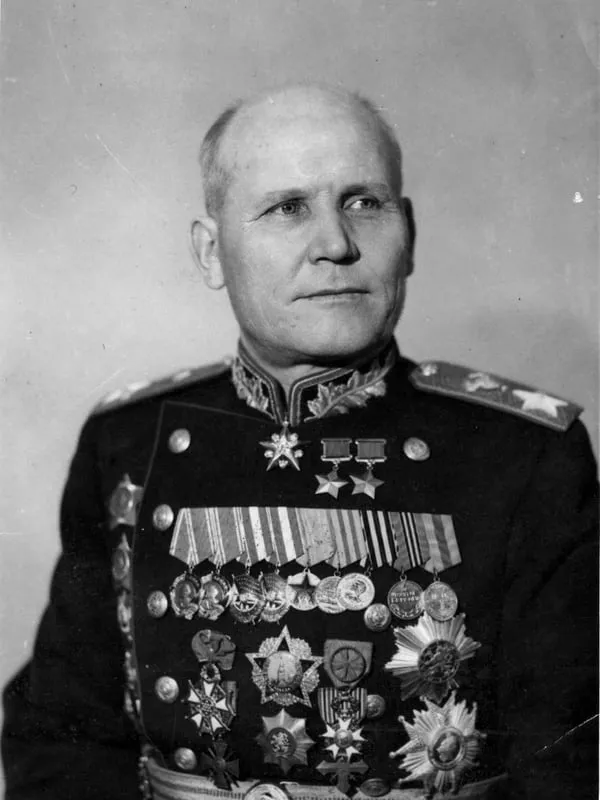
Ivan Konev
Commander of the Western and Kalinin Fronts (1941–1943) and of the Steppe, 2nd and 1st Ukrainian Fronts (1943–1945), Marshal of the Soviet Union (from 1944), Commander-in-Chief of the Unified Armed Forces of the Warsaw Pact (1955–1960)
- Born:
- 28 December 1897, Lodeyno (Russian Empire)
- Died:
- 21 May 1973, Moscow (USSR)
- Author:
- Łukasz
- Photo:
- Вадим Ковригин (Фотохроника ТАСС), domena publiczna, Wikimedia Commons

Ivan Konev was one of the most successful Red Army front commanders of the Second World War and, after it, one of the hardest-handed enforcers of the Kremlin’s will. A peasant’s son from northern Russia and a Bolshevik commissar in the Civil War, he nearly paid with his life for the disaster at Vyazma in 1941. Spared, over the next four years he fought at Kursk, Kharkiv and Korsun, and led the 1st Ukrainian Front to Lwów, to the Vistula, through Kraków and Silesia, and on to Berlin and Prague. After the war he was one of the pillars of the Soviet military machine: he presided over the court that sentenced Lavrentiy Beria, commanded the Warsaw Pact forces when the Hungarian uprising was crushed in 1956, and headed the Soviet forces in Germany when the Berlin Wall was being built.
Youth, the Civil War and an interwar career
He was born on 28 December 1897 (16 December by the Julian calendar) into a peasant family in the village of Lodeyno in Vologda Governorate. He completed a zemstvo school and worked as a lumberjack. In 1916 he was conscripted into the Tsarist army, trained in the artillery and, as an NCO, fought on the South-Western Front in 1917. After the revolution he returned to his home region, joined the Bolshevik party in 1918 and became military commissar of the Nikolsk district.
In the Russian Civil War Konev served as a political commissar rather than a line commander: from the autumn of 1919 he was commissar of the armoured train Grozny, then of a rifle brigade and a rifle division, and finally of the staff of the army of the Far Eastern Republic, which was fighting the Whites in the Far East. In March 1921, as one of the delegates to the Tenth Party Congress, he took part in crushing the Kronstadt rebellion. After the war he moved from political work to command; in 1926 he completed advanced courses at the Frunze Military Academy, and in 1932–1934 he studied in a special group at the same academy.
The army’s Great Purge, which claimed thousands of his fellow officers, passed him by, and like many survivors he was rapidly promoted into the vacated posts. In 1938 he led the Soviet troops sent into Mongolia and became the first commander of the 57th Special Corps – the same corps that Georgy Zhukov commanded a year later at the Battle of Khalkhin Gol. He then commanded the 2nd Independent Far Eastern Army in Khabarovsk, from 1940 the Trans-Baikal Military District and from the beginning of 1941 the North Caucasus Military District. In June 1940 he was promoted to lieutenant general.
1941: Vitebsk, Vyazma and a narrow escape
At the outbreak of war with Germany Konev brought the 19th Army from the Caucasus to the front. In July 1941 its units, thrown into action straight from the troop trains, failed to hold Vitebsk and were drawn into heavy fighting in the Battle of Smolensk. Stalin nevertheless thought well of Konev, and in mid-September 1941 he appointed him commander of the Western Front and promoted him to colonel general.
It was in this post that the greatest defeat of his life befell him. On 2 October the Germans launched Operation Typhoon and within a week had trapped several Soviet armies, including a large part of the Western Front, in the pockets at Vyazma and Bryansk. Soviet losses in killed and captured are estimated at several hundred thousand men; the figure most often given is around 600,000–700,000 for the operation as a whole. A State Defence Committee commission including Vyacheslav Molotov and Kliment Voroshilov arrived at front headquarters, and Konev faced a court martial – the fate that had befallen the commander of the Western Front, Dmitry Pavlov, who was shot that summer. According to the prevailing view among historians, based mainly on Zhukov’s memoirs, it was Zhukov who saved him: on taking command of the front on 10 October, he asked Stalin to keep Konev on as his deputy. A few days later Konev took over the newly formed Kalinin Front.
At its head he defended the northern approaches to Moscow, and in December he took part in the counter-offensive, recapturing Kalinin on 16 December. In 1942 his troops fought hard and very costly battles for the Rzhev salient, first in the Rzhev–Vyazma operation and then, after Konev again took over the Western Front in August 1942, in successive attacks on the salient. Failures at Zhizdra led Stalin to take the front away from him in February 1943; for several months he commanded the less important North-Western Front.
From Kursk to Lwów
In the summer of 1943 Konev was given a second chance. He took over the Steppe Military District, the strategic reserve positioned behind the Kursk salient, which after the start of the Battle of Kursk was converted into the Steppe Front. His troops took part in the counter-offensive and on 23 August captured Kharkiv. In the autumn the front, renamed the 2nd Ukrainian Front on 20 October, forced the Dnieper near Kremenchuk and fought on the bridgeheads on the Dnieper. In January 1944 it took Kirovohrad, and in February, together with Nikolai Vatutin’s front, it closed and destroyed the Korsun pocket. Stalin entrusted Konev with liquidating the encircled forces, which Vatutin took bitterly; Konev himself called the victory “a Stalingrad on the Dnieper”. Although a considerable part of the trapped troops broke out, on 20 February 1944 Konev was made a Marshal of the Soviet Union.
In March, amid the mud of the spring thaw, his troops carried out one of the fastest offensives of this phase of the war, known to the Russians as the Uman–Botoșani operation. On 10 March they took Uman, then crossed the Southern Bug and the Dniester, reached the Prut at the end of March and entered Romania. In May Konev replaced Zhukov at the head of the 1st Ukrainian Front. On 13 July he launched the Lwów–Sandomierz operation: he broke through towards Lwów (Lviv) along a narrow corridor near Kołtów, encircled a German corps at Brody and won a bridgehead across the Vistula at Sandomierz. The Home Army took part in the fighting for Lwów; its officers were subsequently arrested by the NKVD. On 29 July 1944 Konev was made a Hero of the Soviet Union.
1945: Kraków, Silesia, Berlin and Prague
On 12 January 1945 the 1st Ukrainian Front struck from the Sandomierz bridgehead, opening the Vistula–Oder offensive. On 19 January its troops took Kraków, which survived without major damage. Soviet historiography, and Konev himself in his memoirs, attributed this to his decision to force the Germans to withdraw by a rapid envelopment rather than destroy the city with artillery and aircraft; some Polish historians regard this version as largely a legend and point out that the hasty German retreat also decided the city’s fate. On 27 January soldiers of the 60th Army of Konev’s front entered the Auschwitz-Birkenau camp. Konev used a similar manoeuvre in Upper Silesia: by leaving the Germans a line of retreat to the south-west, he took the industrial district with little damage to its mines and steelworks. In February and March his troops carried out the Lower Silesian and Upper Silesian operations, encircling Wrocław (Breslau), which held out until 6 May.
In April Stalin drew Konev into the race for Berlin. The plan of the Berlin operation left the boundary between Zhukov’s and Konev’s fronts undrawn all the way up to the city itself, which both marshals read as an invitation to compete. On 16 April the 1st Ukrainian Front forced the Lusatian Neisse, and when Zhukov’s attack stalled on the Seelow Heights, the tank armies of Rybalko and Lelyushenko swung north towards the southern suburbs of Berlin. On 25 April Konev’s soldiers met the Americans on the Elbe at Torgau, while in Berlin itself Stalin ultimately left the capture of the centre and the Reichstag to Zhukov. The last operation of the war was the Prague offensive: on 9 May, after an uprising had broken out in Prague, Konev’s tanks entered the Czechoslovak capital. As early as March 1945 he had received the Order of Victory for the liberation of Poland and the crossing of the Oder, and on 1 June he was awarded a second Gold Star of a Hero of the Soviet Union.
After the war: Austria, Beria, Hungary and Berlin
From 1945 Konev commanded the Central Group of Forces, stationed in Austria and Hungary, and was Soviet High Commissioner in Austria. In 1946, when Stalin sidelined Zhukov, Konev succeeded him as Commander-in-Chief of the Ground Forces; in the following years he was Chief Inspector of the Army and commander of the Carpathian Military District in Lviv. In December 1953 he presided over the special session of the Supreme Court of the USSR that sentenced Beria and his closest associates to death.
When the Warsaw Pact was created in 1955, Konev became the first Commander-in-Chief of its Unified Armed Forces and at the same time First Deputy Minister of Defence of the USSR. In this role, from November 1956, he directed the intervention that crushed the Hungarian Revolution and overthrew the government of Imre Nagy; the fighting and reprisals cost the lives of some 2,500 Hungarians. In 1957, when Nikita Khrushchev removed Zhukov as Minister of Defence, Konev turned against his former saviour and published an article in Pravda accusing him of adventurism and of disregard for the party. From August 1961 to April 1962, at the height of the Berlin Crisis, he commanded the Group of Soviet Forces in Germany – including in October 1961, when Soviet and American tanks faced each other at Checkpoint Charlie. He then joined the Defence Ministry’s group of inspectors general. He wrote memoirs, Year Forty-Five and Notes of a Front Commander, which were also published in Polish. He died in Moscow on 21 May 1973; his ashes were interred in the Kremlin Wall.
Memory
In the Soviet Union Konev was one of the most revered marshals of the war, and present-day Russia keeps erecting new monuments to him. In Central Europe his memory is far more divided: the liberator from German occupation was also the commander of the army that brought a new, communist subjugation, and later one of the men who upheld it by force. Kraków made him an honorary citizen in 1955 and put up a monument to him in 1987; the monument was dismantled in 1991 and handed over to the Russian city of Kirov, and the honorary citizenship was revoked in 1992. In Prague, where Konev was remembered both as the liberator of 1945 and as a commander at the time of the crushing of the Hungarian uprising, his statue in the Prague 6 district was removed in April 2020, prompting a sharp protest from Russia. Regardless of these disputes, military historians rank him, alongside Zhukov, Rokossovsky and Vasilevsky, among the ablest commanders of the Red Army.
Sources
Commanded in battles
(10)- 30 September 1941 – 7 January 1942Battle of MoscowEastern Front
- 8 January – 20 April 1942Rzhev–Vyazma offensive (1942)Eastern Front
- 5 July – 23 August 1943Battle of KurskEastern Front
- 26 August – 23 December 1943Battle of the DnieperEastern Front
- 24 January – 17 February 1944Battle of the Korsun–Cherkassy PocketEastern Front
- 13 July – 29 August 1944Lwów–Sandomierz offensiveEastern Front
- 12 January – 3 February 1945Vistula–Oder offensiveEastern Front
- 13 February – 6 May 1945Siege of BreslauPoland
- 16 April – 2 May 1945The Battle of BerlinEastern Front
- 6–11 May 1945The Prague offensiveEastern Front
Mentioned in battles
(06)Often appears with
People who appear in the same events.
On the timeline
(46)The 40 most important of 46 events. All tagged “Ivan Konev” (6) →