1934–1935: The Chinese Civil War and the Long March
The Long March
- Dates:
- 16 October 1934 – 22 October 1935
- Front:
- Far East
- Location:
- China – from Yudu and Ruijin in southern Jiangxi through Guangdong, Hunan, Guangxi, Guizhou, Yunnan, western Sichuan and Gansu to Wuqi in northern ShaanxiOn the battle map →
- Sides:
- Chinese Red Army (Chinese Communist Party)Mao Zedong, Zhu De, Zhou EnlaiRepublic of China (Kuomintang) and provincial armiesChiang Kai-shek
- Result:
- The Communists lost their Jiangxi base and most of their army, but saved their leadership and reached Shaanxi. The Kuomintang failed to destroy them, but it did bring central government troops into the western provinces.
- Author:
- Łukasz
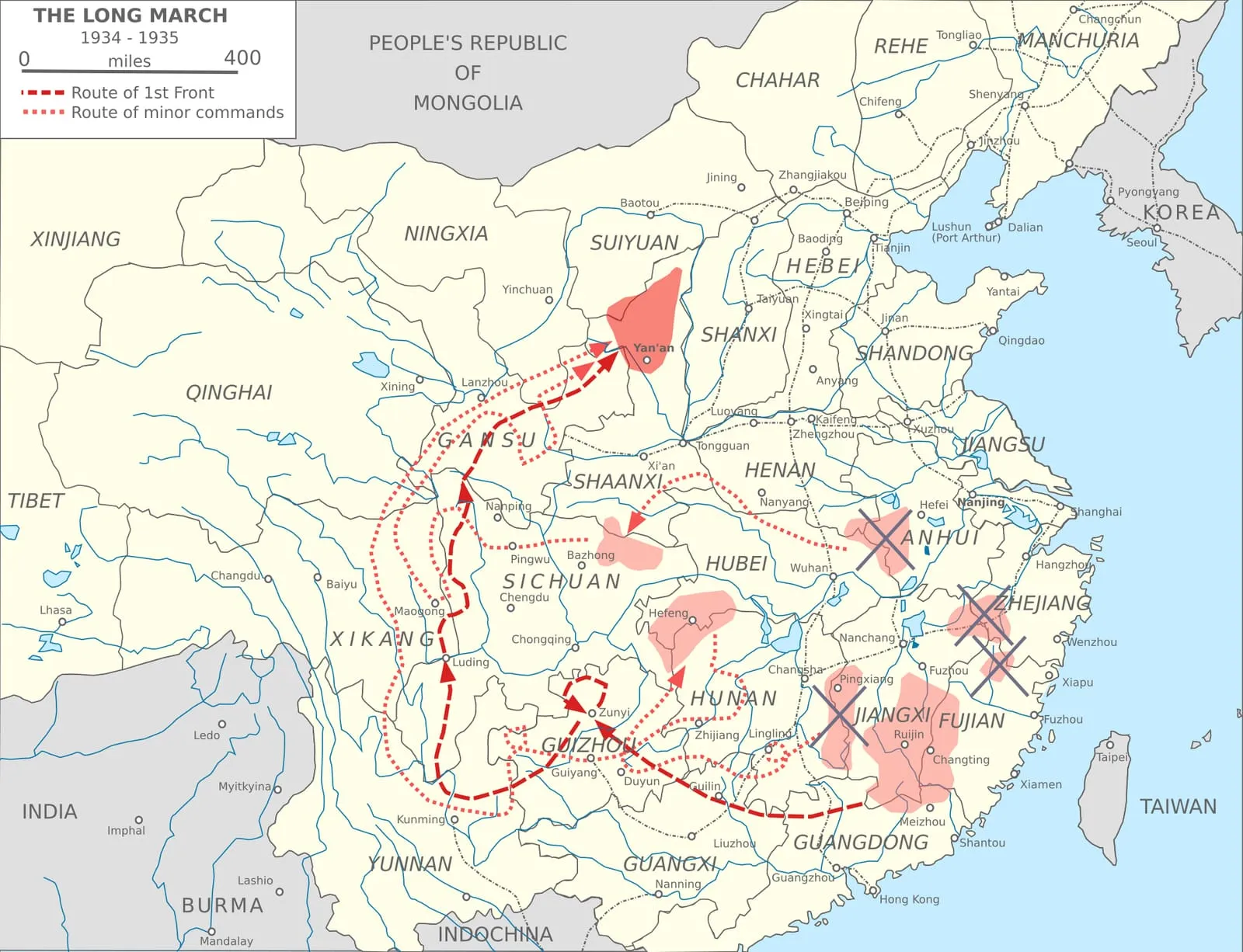
The Long March was the retreat of the main forces of China’s Red Army from their encircled base in Jiangxi province to northern Shaanxi, lasting from October 1934 to October 1935. More than 86,000 men, pursued by the government troops of Chiang Kai-shek and the armies of provincial warlords, passed through eleven provinces, a dozen or more mountain ranges, dozens of rivers and the marshes on the edge of the Tibetan Plateau. A few thousand reached their destination. During the march Mao Zedong took over the leadership of the Chinese Communist Party, and the surviving Communists ended up in the north, where they would soon become the second force of Chinese resistance to Japan alongside the Kuomintang. Militarily, it was a defeat turned into survival. Politically, it became the founding myth of the People’s Republic of China, around which many legends have grown.
Name and dates
The Chinese word changzheng literally means “long expedition”. In 1934 the participants spoke of a “transfer” or a “strategic shift”. Mao first used the name Long March publicly only in December 1935, and Communist historiography settled on the phrase “the 25,000-li Long March” (about 12,500 kilometres). The Kuomintang spoke of “pursuing the bandits” or of their “flight to the west”.
In the narrower sense, the term refers to the march of the main column, the First Front Army, known as the Central Red Army. The march is taken to have begun on 16 October 1934, when the main forces started crossing the river at Yudu and leaving the base. The historiography of the People’s Republic of China often gives 10 October, when the headquarters and central offices left Ruijin, or the evening of 17 October, when the corps crossed the river. It is taken to have ended on 22 October 1935. On 19 October the vanguard reached the small town of Wuqi in northern Shaanxi, on 21 October it beat off pursuing cavalry there, and on 22 October the Politburo declared the march of the Central Red Army complete. Other Communist armies did not finish their own marches until a year later: Chinese historiography regards the Long March as a whole as having ended on 22 October 1936, after three armies joined up in Gansu.
Background
After the Communists were crushed in the cities in 1927 – in the Shanghai massacre and after a series of failed uprisings – their remnants took refuge in the countryside. In the Jinggang Mountains Mao Zedong and Zhu De created the Red Army, and on 7 November 1931 the Chinese Soviet Republic was proclaimed at Ruijin. Chiang Kai-shek, who considered the Communists more dangerous than Japan, waged one encirclement campaign after another against their bases. Even after the Mukden incident and the loss of Manchuria he sent his best divisions against them rather than against the Japanese. The first four campaigns, in 1930–1933, ended in failure.
After the defence of the Great Wall and the Tanggu Truce of May 1933, Chiang concentrated his forces on Jiangxi. The fifth campaign, launched in September 1933, was methodical: government troops advanced a few kilometres at a time, building thousands of small blockhouses behind them and cutting the base off from salt, medicine and goods. The method was associated with Chiang’s German advisers, among them Hans von Seeckt, though Chinese staff officers also helped to develop it. On the Communist side command was then in the hands of Bo Gu, a young Moscow-educated leader, and the Comintern adviser Otto Braun, known as Li De. They sidelined Mao and ordered that every scrap of the republic be held in positional fighting. Once Guangchang fell at the end of April 1934, the fate of the base was sealed. In May the party secretariat secretly decided to lead the main forces out. The breakout was planned by a three-man group: Bo Gu, Braun and Zhou Enlai.
Forces
The 1st Corps (commanded by Lin Biao), the 3rd (Peng Dehuai), the 5th, 8th and 9th Corps and two columns of headquarters staff and central offices left Jiangxi – more than 86,000 men in all, with an enormous baggage train of printing presses, workshop machinery, archives and silver. Zhu De was commander-in-chief, but the real military decisions were taken by Braun and Zhou Enlai. About 16,000 soldiers stayed behind in Jiangxi, many of them wounded, to cover the retreat. Other Communist armies operated separately: Zhang Guotao’s Fourth Front Army in northern Sichuan, the forces of He Long on the Hunan–Hubei border and the 25th Army in central China.
Against them, according to various estimates, the government had mobilised between 700,000 and a million soldiers for the fifth campaign. The pursuit was carried out by the central troops of General Xue Yue and by the provincial armies: the Hunanese under He Jian, the Guangxi army of Bai Chongxi and Li Zongren, the Cantonese under Chen Jitang, and later the troops of Guizhou, Yunnan and Sichuan and the Muslim cavalry of the Ma family in Gansu and Qinghai. The warlords, however, feared Chiang’s central troops more than the Communists and often preferred to let the Red Army through rather than bleed their own units.
The march: leaving Jiangxi and the battle of the Xiang River
From 16 October 1934 the columns crossed the river at Yudu. Thanks to a secret agreement with Chen Jitang, who agreed to let the Communists through his sector of the blockade, the army passed the first line on 21–25 October, the second at the beginning of November and the third, on the Hunan–Guangdong border, in the middle of the month. But it moved very slowly, weighed down by its baggage train, and Chiang had time to work out its direction. Ruijin fell on 10 November.
Chiang set up his fourth line on the Xiang River in northern Guangxi. From 27 November to 1 December 1934 the 1st and 3rd Corps held the crossing between Xing’an and Quanzhou against Hunanese and Guangxi troops while the rest of the army crossed the river under air attack. This was the bloodiest battle of the march. Several rearguard units were wiped out on the eastern bank, and the 8th Corps lost so many men that it was disbanded. After the crossing, according to the most common estimates, just over 30,000 of the more than 86,000 men remained. The losses included the killed and wounded, but also deserters and stragglers, and their proportions cannot be established.
The march: Zunyi and the Chishui River
The original plan was to march north-west into western Hunan to join He Long. Chiang, however, had gathered strong forces there. At a meeting in Tongdao on 12 December Mao persuaded most of the leaders to turn west into weakly defended Guizhou, a decision confirmed a few days later at Liping. At the turn of the year the army crossed the Wu River, and on 7 January 1935 it took Zunyi, the second-largest city in the province.
From 15 to 17 January an enlarged meeting of the Politburo was held there. Bo Gu blamed the defeat on the enemy’s superiority. Zhou Enlai admitted mistakes by the command, while Zhang Wentian and Mao accused Bo Gu and Braun of a “purely defensive line” in Jiangxi and of a panicked flight encumbered by the baggage train. Most of those present backed Mao. The three-man group was dissolved, Mao joined the Standing Committee of the Politburo, and military command passed to Zhou Enlai and Zhu De, with Mao as Zhou’s assistant. In February Zhang Wentian replaced Bo Gu at the head of the party, and in March a new three-man military group was formed: Mao, Zhou and Wang Jiaxiang. Zunyi, then, did not give Mao full power at once, as the official history later claimed, but it marked the beginning of his dominance. Some historians believe that what mattered more than the resolutions was simply the failure of Bo Gu and Braun, who had lost their authority.
The following weeks were the most convoluted part of the march. An attempt to cross the Yangtze into Sichuan to join Zhang Guotao failed after a bloody battle at Tucheng on 28 January. The army crossed the Chishui River four times, circling through northern Guizhou between enemy columns. In February it retook Zunyi and routed two divisions of central troops – its greatest victory of the march. But in mid-March it suffered another defeat at Lubanchang. In early April, when Chiang arrived in Guiyang, the capital of Guizhou, the Communists feinted an attack on the city, and when the Yunnan troops moved to his aid they turned into an exposed Yunnan. Mao’s supporters presented these manoeuvres as a work of genius; critics point out that they cost the army many thousands of men.
The march: the Jinsha and the Luding Bridge
From 1 to 9 May 1935 the army crossed the Jinsha River, the upper course of the Yangtze, at Jiaopingdu in a handful of boats. The pursuers were left on the other side. To the north lay the lands of the Yi people, who were hostile to the Han Chinese. On 22 May Liu Bocheng, commander of the vanguard, swore blood brotherhood with one of the Yi chiefs, which allowed the army to pass without a fight.
The next obstacle was the fast-flowing Dadu River, where a Taiping army had perished in 1863. On 25 May a party of seventeen volunteers crossed by boat at Anshunchang, but there were too few boats for the whole army. The 4th Regiment of the 1st Corps therefore made a forced march of about 120 kilometres upstream to Luding, where a chain bridge from the early eighteenth century spanned the river. On the morning of 29 May twenty-two volunteers crossed on the chains, from which the defenders had removed some of the planks, and with the help of units that had crossed earlier took the bridge and the town.
The storming of the Luding Bridge became the most famous episode of the Long March, described by the American journalist Edgar Snow in his book Red Star Over China (1937) and retold in Chinese textbooks and films. Its course, however, is disputed. The bridge was defended by a single regiment of the provincial troops of the Sichuan warlord Liu Wenhui, poorly armed and reluctant to fight. According to participants’ accounts, nobody was killed on the bridge itself. Zbigniew Brzeziński recalled that Deng Xiaoping told him it had been “a very easy operation”, which propaganda had needed to dramatise. Jung Chang and Jon Halliday, in their biography of Mao, claim that there was no fighting at the bridge at all. Most historians reject this extreme view but agree that resistance was much weaker than the legend holds.
The march: the snow mountains and the quarrel with Zhang Guotao
In June the army crossed a pass in the Jiajin Mountains at an altitude of about 4,000 metres, in summer uniforms, without supplies and without experience of high mountains. Many soldiers, worn out by hunger and disease, died of cold or fell into ravines. On 12 June, near Dawei, the vanguard met units of Zhang Guotao’s Fourth Front Army. Zhang had brought, according to various estimates, about 80,000 men in good condition, whereas only some ten to twenty thousand remained of Mao’s column. Zhang, one of the party’s founders, considered that the leadership was rightly his.
At a meeting in Lianghekou on 26 June a march north was agreed, but the dispute went on. Zhang demanded posts for his people and in July became chief political commissar of the Red Army. The two armies were merged and reorganised into two columns. The right column, with Mao and the party leadership, crossed the marshy grasslands of Zoigê on the Sichuan–Gansu border at the end of August. For almost a week the soldiers trudged through bogs with no roads or shelter, eating grass and leather belts, and many drowned in the marshes or died of hunger and disease. After emerging from the marshes the right column routed a division of Hu Zongnan’s central troops at Baozuo.
Zhang Guotao’s left column did not come. Zhang wanted to go south, not north. On the night of 9–10 September Mao and his people secretly broke away from the Fourth Army units and set off north with the 1st and 3rd Corps. It was the most serious split in the party’s history. In October Zhang proclaimed himself head of his own Central Committee.
The march: on to Shaanxi
On 12 September at Ejie the remnants of the First Army were formed into the Shaanxi–Gansu Detachment, some 7,000–8,000 strong, with Peng Dehuai as commander and Mao as commissar. On 17 September the detachment took the Lazikou Pass, defended by Gansu troops. In the small town of Hadapu the leaders learned from Kuomintang newspapers that Liu Zhidan’s Communist base was operating in northern Shaanxi, and they made it their goal. After breaking through a blockade on the Wei River and crossing the Liupan Mountains, where Mao wrote one of his well-known poems, the detachment entered Wuqi on 19 October 1935. There it beat off the cavalry pursuing it, and on 22 October the Politburo declared the march over. At the beginning of November the newcomers joined the local forces and Xu Haidong’s 25th Army, which had arrived from Henan back in September.
The other armies
The Long March did not end for everyone in October 1935. Zhang Guotao’s Fourth Army went south, lost a heavy battle against Sichuan and central troops at Baizhangguan in November 1935 and withdrew into the Tibetan mountains of Kham. The forces of He Long and Ren Bishi set out from Hunan on 19 November 1935 and, after a hard march through Yunnan and the mountains of Tibet, joined Zhang at Garzê in July 1936, forming the Second Front Army. Under pressure from the Comintern, Zhang dissolved his Central Committee and moved north. Chinese historiography regards the junction of the three armies at Huining and Jiangtaibao in Gansu in October 1936 as the final end of the Long March. Part of the Fourth Army, the so-called Western Army, sent across the Yellow River, was almost completely destroyed by the Muslim cavalry of the Ma family at the beginning of 1937. Zhang Guotao never again threatened Mao’s position, and in 1938 he went over to the Kuomintang.
Losses
There are no precise figures. Of the more than 86,000 men who left Jiangxi in October 1934, between about 4,000 and just under 8,000 reached northern Shaanxi, according to various estimates – and the Shaanxi–Gansu Detachment also included many men recruited along the way. The heaviest losses came in the battle of the Xiang River. Many soldiers were killed in combat or died of hunger, cold and disease in the mountains and marshes; many deserted or stayed behind in villages. Chinese party sources state that more than 400 commanders of battalion level and above were killed during the march. The Fourth and Second Armies also suffered heavy losses. Nobody has totalled the losses of the government and provincial troops.
The march also had a cost for the civilian population. The army took food and, under the slogan of “striking at the local tyrants”, confiscated the property of landlords and wealthier peasants, killing some of them. In the parts of Jiangxi that were left behind, the return of the government authorities brought reprisals against those who had worked with the Communists. Among those who died was the former party leader Qu Qiubai, executed by firing squad in June 1935.
Legend and controversy
The distance claimed by the Communists (25,000 li, about 12,500 kilometres) is an exaggeration for the First Army. The British researchers Ed Jocelyn and Andrew McEwen, who walked the route in 2002–2003, put it at about 6,000 kilometres, and Chinese historians at 9,000–10,000. Mao’s role at Zunyi and at the Luding Bridge was also exaggerated. Jung Chang and Jon Halliday further claim that Chiang Kai-shek deliberately let the Communists escape in order to bring his troops into the western provinces and to get back his son, Chiang Ching-kuo, who was being held in the USSR. Most historians do not accept this thesis, although they agree that Chiang used the pursuit to bring the warlords of Guizhou, Yunnan and Sichuan under his control.
Significance
Militarily, the Long March was a defeat for the Communists: they lost their base, their state and most of their army. But they saved their leadership and their most experienced commanders, and during the march Mao Zedong began to take over a leadership he would not relinquish until his death in 1976. The participants included future marshals and leaders of the People’s Republic of China, among them Zhu De, Zhou Enlai, Lin Biao, Peng Dehuai, Liu Bocheng and Deng Xiaoping.
For the road to the Second World War in Asia, what mattered most was where the Communists ended up. In northern Shaanxi they faced the Northeastern Army of Zhang Xueliang, which the Japanese had driven out of Manchuria. In November 1935 they routed one of its divisions, but they soon began secret talks with its commanders under the slogan “Chinese do not fight Chinese”. In December 1935, in line with the Comintern’s new course, the party proclaimed a policy of an anti-Japanese national front. In December 1936 Zhang Xueliang detained Chiang in Xi’an and forced him to end the civil war. When the war with Japan broke out in July 1937, the Red Army formally became part of the government army as the Eighth Route Army and waged a guerrilla war behind Japanese lines, building up its strength from a few tens of thousands to nearly a million men by 1945. The pursuit of the Communists, in turn, allowed Chiang to bring central troops into Sichuan, which in 1938–1945, with the provisional capital at Chongqing, served as China’s rear base in the war against Japan. In this way the retreat from Jiangxi shaped both the course of that war and the civil war that followed it.