Indonesia
Sukarno
Leader of the Indonesian National Party (1927–1929), chairman of the Central Advisory Council under the Japanese occupation (1943–1945), President of Indonesia (1945–1967)
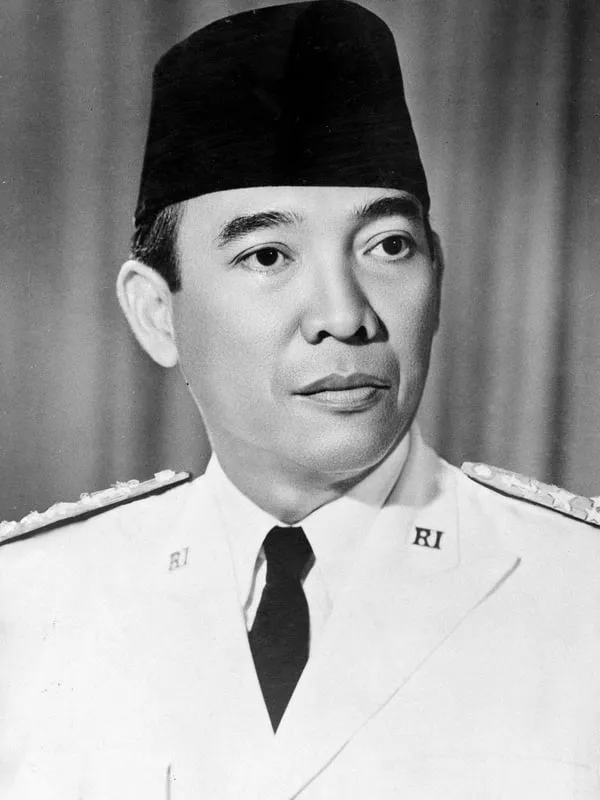
- Born:
- 6 June 1901, Surabaya (Dutch East Indies)
- Died:
- 21 June 1970, Jakarta (Indonesia)
- Author:
- Łukasz
- Photo:
- Onbekend/Anonymous, domena publiczna, Wikimedia Commons

Sukarno was the leader of the Indonesian national movement and, from 1945 to 1967, the first President of Indonesia. An engineer by training and a brilliant orator, in the 1920s he founded the first party to make full independence for the Dutch East Indies its goal, for which the Dutch kept him in prison and exile for more than a decade. The Japanese occupation of 1942–1945 gave him a platform but also entangled him in collaboration with the occupier, including the recruitment of forced labourers. On 17 August 1945, two days after Japan’s surrender, he and Mohammad Hatta proclaimed Indonesia’s independence, opening a four-year struggle against the returning Dutch. He later ruled in an increasingly authoritarian manner until, after the events of 1965, power passed from him to General Suharto.
Childhood and education (1901–1926)
He was born on 6 June 1901 in Surabaya in eastern Java. His father, Raden Soekemi Sosrodihardjo, was a Javanese primary-school teacher from the lesser nobility; his mother, Ida Ayu Nyoman Rai, came from Bali. The boy was named Kusno; because he was often ill, his parents, in keeping with Javanese custom, changed his name to Sukarno. Like many Javanese he used only one name, which in Dutch spelling was written Soekarno. He spent his childhood in Mojokerto and with his grandparents in Tulungagung.
Thanks to his knowledge of Dutch he gained a place at the elite HBS secondary school in Surabaya. From 1916 he lived there in the house of Omar Said Tjokroaminoto, the leader of Sarekat Islam, the first mass political organisation of Indonesians. Through him he met activists of every persuasion, from Muslim reformers to communists, and learned the art of addressing a crowd; he also married Tjokroaminoto’s daughter Oetari. In 1921 he began studying at the Technical College in Bandung, one of the first institutions of higher education in the colony, and in 1926 he graduated as a civil engineer. Before that he had divorced Oetari and married Inggit Garnasih, an older woman who had been the wife of his landlord in Bandung; Inggit divorced her husband in order to marry him in 1923.
The National Party, prison and exile (1926–1942)
In Bandung Sukarno ran an architectural practice, but he devoted more and more of his time to politics. In 1926 he published the essay “Nationalism, Islam and Marxism”, arguing that these three currents should work together against colonialism. On 4 July 1927, with friends from a student debating club, he founded an organisation soon renamed the Indonesian National Party (PNI). The party demanded full independence and refused to cooperate with Dutch institutions. Within two years it had some 10,000 members, and its leader had become the best-known orator of the national movement.
The colonial authorities regarded him as a threat. On 29 December 1929 Sukarno was arrested in Yogyakarta, and in 1930 he stood trial in Bandung. His defence speech, later published as “Indonesia Accuses”, was an indictment of the colonial system and circulated throughout the archipelago. He was sentenced to four years in prison but, under the pressure of protests, including in the Netherlands, was released in the last days of 1931. The PNI had meanwhile dissolved itself, and the movement split into two currents: Sukarno joined the mass party Partindo, while Hatta and Sutan Syahrir built a smaller cadre organisation.
On 1 August 1933 Sukarno was arrested again and this time exiled without trial by decision of the Governor-General. From 1934 he lived in the small town of Ende on the island of Flores, where he wrote plays for a local troupe, and in 1938 he was moved to Bengkulu on Sumatra. There he taught at a school of the Muslim organisation Muhammadiyah and met a pupil, Fatmawati, whom he married in 1943. Hatta and Syahrir spent the same years in the Boven-Digoel camp in New Guinea and on the island of Banda. When the Pacific War broke out, the most important leaders of the national movement were thus cut off from politics.
Under the Japanese occupation (1942–1945)
In January 1942 Japan began the invasion of the Dutch East Indies. As the Japanese approached Sumatra, the Dutch took Sukarno from Bengkulu towards Padang, intending to evacuate him from the island, but in the confusion they left him behind. After the fall of Java in March 1942 Japanese officers approached him, and that summer the occupation authorities brought him to Java. There, together with Hatta, whom the Dutch had earlier brought back from exile, he agreed to cooperate with the occupier. Both hoped that in this way they could protect the population and lay the foundations of a future state. According to later accounts by those involved, Syahrir stayed in the background at the time and kept in touch with the underground opposition.
The Japanese 16th Army of Hitoshi Imamura and his successors needed Sukarno to mobilise the population of Java. In March 1943 he became head of the Centre of People’s Power (Putera), which he led together with Hatta, the educator Ki Hadjar Dewantara and the Muslim cleric Mas Mansur, and in October 1943 he became chairman of the Central Advisory Council attached to the Japanese administration. In 1944 Putera was replaced by the Jawa Hōkōkai (Java Service Association), more tightly controlled by the Japanese, in which Sukarno was the principal Indonesian leader. He spoke freely on the radio and at rallies across the island; in his speeches he praised Japan and “Greater East Asia”, but at the same time, for the first time in history, the idea of Indonesia as a single nation reached millions of listeners. He also supported the creation in October 1943 of the volunteer army PETA, which later became one of the nuclei of the republic’s armed forces. In November 1943 he visited Tokyo, where he was received by Emperor Hirohito.
The heaviest burden of this collaboration was Sukarno’s part in recruiting romusha, forced labourers sent to construction sites and mines on Java and throughout South-East Asia. Their number is put at several hundred thousand – according to various estimates between 200,000 and 500,000 from Java alone – and many of them never returned. Sukarno posed for propaganda photographs among the volunteers and urged people to sign up for work. In his autobiography, written down in 1965 by the American journalist Cindy Adams, he admitted that it was he who had sent these people to their deaths, and defended himself by saying that this was the price of winning independence. Historians judge this role differently: some stress its moral weight, others point out that the occupation administration would have carried out the recruitment anyway and that Sukarno used his position to build the national movement.
When the tide of war turned, Japan began making promises. On 7 September 1944 Prime Minister Kuniaki Koiso announced independence for the East Indies “in the future”, and in 1945 the occupation authorities set up the Investigating Committee for Preparatory Work for Independence. At its session on 1 June 1945 Sukarno gave a speech setting out five principles of the future state, called the Pancasila: national unity, humanitarianism and international cooperation, democracy based on deliberation and consensus, social justice, and belief in God. The Pancasila was meant to reconcile the Muslim majority with Christians, Hindus and secular nationalists, and it remains the official ideological foundation of Indonesia to this day.
The proclamation of independence (August 1945)
On 7 August 1945, the day after the atomic bombing of Hiroshima, the Japanese agreed to the creation of the Preparatory Committee for Indonesian Independence with Sukarno as chairman. Sukarno, Hatta and the physician Radjiman Wedyodiningrat flew to Dalat in Indochina, where on 12 August Field Marshal Hisaichi Terauchi, commander of the Japanese forces in South-East Asia, told them that independence would soon be granted. They returned to Jakarta on 14 August, and the next day news arrived of Japan’s surrender.
Young activists of the national movement, the so-called pemuda, demanded an immediate proclamation, without the participation or consent of the Japanese. Sukarno and Hatta hesitated: they feared a clash with the still-armed Japanese army and wanted to act through the Preparatory Committee. On the morning of 16 August a group of pemuda took both leaders to Rengasdengklok near Jakarta to force a decision. In the evening they returned to the city, and on the night of 16–17 August, in the residence of Rear Admiral Tadashi Maeda, the Japanese navy’s liaison officer – who, according to those present, made his house available and did not interfere with the discussions – they drafted the short text of the proclamation. The 16th Army command refused its consent but did not intervene.
On 17 August 1945, at around 10 a.m., Sukarno read the proclamation in front of his house at 56 Pegangsaan Timur Street in Jakarta, before a few hundred people. He signed it “on behalf of the Indonesian people” together with Hatta. A red-and-white flag sewn by Fatmawati was raised. The next day the Preparatory Committee adopted a provisional constitution and elected Sukarno president and Hatta vice-president. The proclamation was aimed above all against the return of Dutch rule, which the government in The Hague took for granted.
The national revolution (1945–1949)
The country Sukarno was to govern had neither an army nor recognition. At the end of September 1945 British troops from the command of Louis Mountbatten landed in Jakarta and then in other towns of Java and Sumatra, tasked with disarming the Japanese and freeing the internees; the Dutch administration came back in their wake. Fighting broke out in the autumn, including the bloody Battle of Surabaya in November 1945, and the period of turmoil known as the bersiap also brought killings of Dutch people, Indo-Europeans, Chinese and Indonesians suspected of collaboration. In November 1945 Sukarno accepted a parliamentary government with Syahrir as prime minister, himself remaining the symbol of the republic; at the beginning of 1946 the authorities moved to Yogyakarta.
The years of the national revolution brought alternating negotiations and fighting: the Linggadjati Agreement (1946–1947), two Dutch offensives, which The Hague called “police actions”, in July 1947 and December 1948, and in 1948 also a communist uprising at Madiun, crushed by the republic’s army. On 19 December 1948 the Dutch took Yogyakarta and interned Sukarno, Hatta and most of the government. Guerrilla warfare continued, however, and pressure from the United States and the UN forced the Netherlands to make concessions. At the Round Table Conference in The Hague the transfer of sovereignty was agreed, and it took place on 27 December 1949. Sukarno became president of the federal United States of Indonesia, which in August 1950 was transformed into the unitary Republic of Indonesia.
From parliamentary democracy to “Guided Democracy” (1950–1965)
In the first years of independence real power lay with changing parliamentary governments, and Sukarno was above all an orator and a symbol of unity. Internationally he became one of the leaders of the countries freeing themselves from colonial rule: in April 1955 he hosted the Asian–African Conference in Bandung, from which the Non-Aligned Movement later grew. At home, however, tensions were mounting: in 1956 Hatta resigned as vice-president, in 1957 martial law was declared, and regional rebellions broke out on Sumatra and Sulawesi (Celebes), covertly backed by the United States. In July 1959 Sukarno dissolved the Constituent Assembly by decree, restored the 1945 constitution and proclaimed “Guided Democracy”, in which he relied on a balance between the army and the Communist Party of Indonesia.
Foreign policy became increasingly confrontational. Under the threat of armed intervention Indonesia forced through the New York Agreement in 1962, under which in 1963 it took over West Irian, the last Dutch possession in the region. From 1963 Sukarno waged the Confrontation with Malaysia, regarding the new federation as a creation of British neo-colonialism, and in January 1965 he withdrew Indonesia from the UN. The economy sank into hyperinflation, and in 1963 the provisional People’s Consultative Assembly proclaimed him president for life.
Fall and death (1965–1970)
On the night of 30 September to 1 October 1965 a group of officers calling themselves the 30 September Movement murdered six generals. The commander of the strategic reserve, General Suharto, crushed the action, and the army blamed the communists; the role of the party itself and what Sukarno knew remain disputed by historians. In the months that followed the army and the militias working with it carried out mass killings of real and alleged communists; the number of victims is most often estimated at between 500,000 and a million. Sukarno was unable to stop them or to rebuild his position. On 11 March 1966 he signed a document handing Suharto full powers to restore order; in March 1967 the People’s Consultative Assembly stripped him of power, and in 1968 Suharto became president.
Sukarno spent his last years under house arrest, first in Bogor and then in Jakarta, cut off from politics and deprived of proper medical care. He died of kidney failure on 21 June 1970 in a military hospital in Jakarta. Against his wishes he was buried not near Bogor but next to his mother in Blitar in eastern Java.
Significance
Sukarno was one of the creators of the modern Indonesian nation: he gave it the Pancasila ideology, a political language and a symbol in the person of the father of the proclamation. His road to independence, however, led through collaboration with the Japanese occupier and responsibility for the recruitment of romusha, and his rule after 1959 ended in economic ruin and the catastrophe of 1965. For the history of the Second World War he is the foremost example of how the Japanese occupation, by breaking the power of the European empires in South-East Asia, hastened the emergence of independent states. Under Suharto his memory was suppressed for years, but in 1986 he and Hatta were recognised as “Proclamation Heroes”, and in 2001–2004 his daughter Megawati Soekarnoputri was President of Indonesia.
Sources
Mentioned in battles
(01)Often appears with
People who appear in the same events.