- Category:
- Politics
- Front:
- Pacific
- Date:
- 15 August 1945
- Author:
- Łukasz
- Tags:
- Japan, Hirohito, nuclear weapons
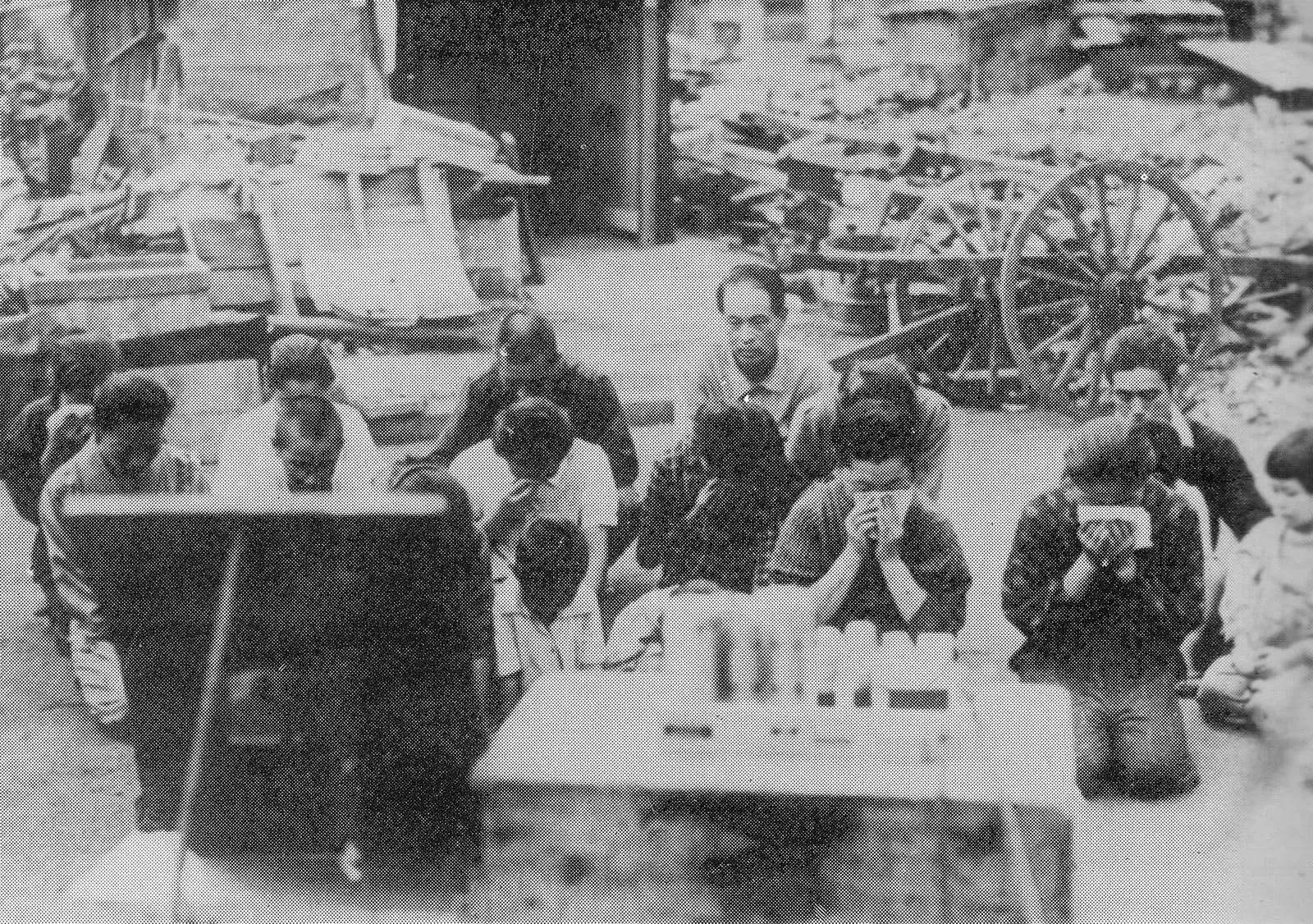
At precisely noon Japanese time on 15 August 1945 an NHK radio announcer asked listeners throughout the country to stand. After the national anthem, played from a gramophone record, came a thin, high-pitched voice that no ordinary Japanese had ever heard before. Emperor Hirohito read out the rescript on the termination of the war. In it he announced that he had ordered the government to inform the United States, Great Britain, China and the Soviet Union that the empire accepted “the provisions of their Joint Declaration” – that is, the Potsdam Declaration. The word “surrender” was not used in the broadcast. The Japanese called it the Gyokuon-hōsō – “the broadcast of the jewelled voice”, meaning the voice of the Emperor.
The address lasted less than five minutes and was a recording made the previous night. Delivered in archaic court language and with poor reception, it was unintelligible to many listeners, so the announcer explained its meaning immediately afterwards. For Japan it marked the end of the war it had been waging in China since 1937 and against the Americans and British since December 1941. Formally the war continued until the instrument of surrender was signed on 2 September, and on the Asian mainland fighting against the Red Army went on. This surrender is often called “unconditional”, although the Emperor’s future remained open – a point that needs qualifying.
From the “sacred decision” to the rescript
After the atomic bombing of Hiroshima on 6 August, the Soviet declaration of war on 8 August and the bombing of Nagasaki on 9 August, the Japanese leadership was still divided. At the meeting in the shelter beneath the palace during the night of 9–10 August the Supreme Council for the Direction of the War split into two equal halves. Prime Minister Kantarō Suzuki asked the Emperor to decide, and Hirohito came out in favour of accepting the Allied terms. On the morning of 10 August the government informed the Allies through Switzerland and Sweden that it accepted the declaration on condition that it did not prejudice the prerogatives of the Emperor as a sovereign ruler.
The reply of Secretary of State James Byrnes, transmitted on 11 August, gave no such guarantee. It stated that from the moment of surrender the authority of the Emperor and the government would be subject to the Supreme Commander of the Allied Powers, and that the ultimate form of government of Japan would be established by the freely expressed will of the Japanese people. The War Minister, General Korechika Anami, and the chiefs of staff demanded further clarification and continued resistance. During the night of 13–14 August American aircraft dropped leaflets over Tokyo carrying the text of the Japanese offer and of the Allied reply. The Lord Keeper of the Privy Seal, Kōichi Kido, noted in his diary that he was horrified at the thought of how the army would react when the content of the negotiations reached the troops. At his urging the Emperor convened another conference that same morning and once again settled the dispute in favour of surrender. He also ordered a rescript to be prepared and agreed to read it himself before the microphone.
According to participants’ accounts, the idea of the Emperor addressing the nation by radio came from the Information Bureau, headed by Hiroshi Shimomura. The text was drafted by the Chief Cabinet Secretary, Hisatsune Sakomizu. He initially intended to write it in modern, comprehensible language but – as he recalled – could not even decide how the Emperor should refer to himself or address his subjects, since he had never done so before. The solemn style of the old edicts was therefore chosen. The draft was polished by the sinologist Mizuho Kawada and the Confucian thinker Masahiro Yasuoka. On the evening of 14 August the cabinet was still arguing over the text. According to Japanese studies, at Anami’s insistence a sentence saying that the war situation was “growing worse day by day” was replaced by a milder one: that it had “developed not necessarily to Japan’s advantage”. The final document, with corrections pasted onto a half-finished original, was signed by the Emperor and countersigned by sixteen members of the cabinet headed by the Prime Minister. The rescript is dated 14 August. Late that evening notification of the acceptance of the Allied terms was conveyed to the Allies through the legations in Bern and Stockholm.
The recording in the palace
The NHK team – according to Japanese sources eight men, including the broadcaster’s president – arrived at the palace on the afternoon of 14 August. The equipment was set up in the Imperial Household Ministry building, and the recording was made on discs each of which held only about three minutes of sound, so the address had to be spread over several discs. Because of the disputes over the text, the recording was put back hour after hour. The Emperor entered the room with the microphone at about 11.25 p.m., during an air-raid alert, in the presence of the Imperial Household Minister and the Grand Chamberlain. The first version proved too quiet, so he himself proposed a second take. In the second his voice was higher and strained, and one conjunction was dropped. According to Shimomura’s recollections, the Emperor wanted to record a third time but was dissuaded. The second version was adopted as the official one and the first kept as a reserve. Work finished at about 1 a.m., and the discs were hidden in a safe in the room of one of the ladies-in-waiting.
A few hours later a group of War Ministry officers who wanted to prevent the surrender killed the commander of the 1st Imperial Guards Division, General Takeshi Mori, and used a forged order to bring Guards troops into the palace. They searched for the recording and also occupied the broadcasting station, but did not find the discs, and towards morning the Eastern District Army command put down the putsch. At dawn on 15 August General Anami committed seppuku in his residence. Both sets of discs were taken from the palace to the studio: according to accounts, one in a lacquered box and the other in a lunch bag.
Noon on 15 August
As early as the 9 p.m. news bulletin on 14 August, the radio announced that the Emperor himself would speak at noon the next day. At 7.21 a.m. the announcer Morio Tateno – the same man who had been threatened with a gun by one of the putschists during the night – repeated the announcement and urged everyone to listen. Electricity was specially supplied to areas that normally had no power during the day, transmitter output was raised from 10 to 60 kW, and public offices, factories, railway stations and post offices were to set up receivers for the public. Publication of newspapers carrying the text of the rescript was held back until after the broadcast, so in many places the paper of 15 August reached readers only in the afternoon. Many people came to listen together dressed in their best clothes.
At noon the announcer Nobukata Wada asked everyone to rise. The head of the Information Bureau, Shimomura, announced that the Emperor himself would proclaim a great edict to his subjects. The anthem “Kimigayo” was played, and then the recording. After it the anthem sounded again, and Wada read the entire rescript once more, this time in an ordinary announcer’s voice, and gave explanations: a statement from the Suzuki government, an account of the conferences of 9 and 14 August, a summary of the exchange of notes with the Allies, and the texts of the Potsdam and Cairo Declarations. The whole broadcast lasted more than half an hour. On shortwave it reached occupied China and South-East Asia, Manchukuo and the Japanese colonies of Korea and Taiwan, while the overseas service, known to the Allies as Radio Tokyo, simultaneously broadcast an English translation read by Tadaichi Hirakawa. It was recorded by American radio monitors, and the full text was printed by the New York Times in its edition of 15 August.
In Washington it was still 11 p.m. on 14 August. President Harry Truman had announced Japan’s acceptance of the surrender terms at 7 p.m. Washington time, four hours before the broadcast. The world therefore knew that the war was over before the Japanese themselves, and the first street celebrations began on the evening of 14 August (American time).
What the Emperor said
The rescript was short and written in classical language full of Chinese expressions unfamiliar to many listeners. The phrases quoted here follow the official English translation of 1945. The Emperor began by stating that after pondering deeply “the general trends of the world” and the condition of the empire, he had decided to effect a settlement of the present situation by resorting to “an extraordinary measure”, and that he had ordered the government to accept the provisions of the powers’ Joint Declaration. He recalled that Japan had declared war on America and Britain out of a desire to ensure its “self-preservation” and “the stabilization of East Asia”, not from any wish to infringe upon the sovereignty of other nations or to seek territorial aggrandisement. Of China, with which Japan had been at war for eight years, he said nothing in this passage.
He then admitted that despite the gallantry of the army and navy, the diligence of officials and the devotion of “our one hundred million people”, the war situation had “developed not necessarily to Japan’s advantage”, while the general trends of the world had turned against it. This sentence, the product of the disputes over the text, later became a byword for courtly understatement. The Emperor went on to say that the enemy had begun to employ “a new and most cruel bomb”, whose destructive power was incalculable and which had taken the lives of many innocents. Continuing the fight, he declared, would result not only in the collapse and obliteration of the Japanese nation but also in the total extinction of human civilisation. The atomic bombs were thus the only concrete reason for surrender named in the broadcast. The rescript said nothing about the Soviet entry into the war; that was mentioned only in a separate rescript to the armed forces of 17 August.
The Emperor expressed his “deepest sense of regret” to the Asian allies who had cooperated with the empire for the “emancipation of East Asia”, and remembered the fallen, their families, the wounded and those who had lost their homes. He declared that the hardships awaiting the nation would be great, but that he had resolved to pave the way for a grand peace for generations to come by “enduring the unendurable” and suffering what could not be suffered. These words, in the original “taegataki o tae, shinobigataki o shinobi”, remain the most frequently quoted part of the recording. Hirohito also announced that he had been able to safeguard the kokutai – the “national polity” with the Emperor at its centre – warned against outbursts of emotion and fratricidal strife that might cost Japan the confidence of the world, and called for all strength to be devoted to “construction for the future”.
The words “surrender” (kōfuku) and “defeat” did not appear in the text. Nor was there any admission of guilt. Many listeners who did not know the content of the Potsdam Declaration did not at first understand whether the Emperor was announcing the end of the war or calling for further resistance. This was settled only by the announcer’s commentary, which explained that Japan had accepted the Allied terms.
Tears, silence and suicides
The French journalist Robert Guillain, who lived through the war in Tokyo, recalled that after the broadcast most people shut themselves away in their homes and workplaces to come to terms in silence with what they had heard. On the gravel plaza in front of the Imperial Palace people gathered, kneeling and weeping. The American historian John W. Dower pointed out that these tears expressed very different emotions: despair, regret, mourning, but also anger at having been deceived, sudden emptiness and a loss of purpose. For many Japanese the dominant feeling was simply relief that the bombing would stop.
Some military men chose death. Besides Anami, who had killed himself before the broadcast, Vice Admiral Matome Ugaki, commander of the Fifth Air Fleet, after listening to the address took off from Ōita airfield with a group of dive bombers on a last suicide flight towards Okinawa and did not return. During the night of 15–16 August Vice Admiral Takijirō Ōnishi, the creator of the kamikaze units, committed seppuku. In the days that followed, members of ultra-nationalist groups took their own lives in Tokyo: according to Japanese sources, on 22 August on Atago Hill ten members of an association that had barricaded itself there after the broadcast died by their own grenades during a police assault, and on 25 August on the Yoyogi parade ground fourteen members of the Daitōjuku organisation committed ritual suicide. There were more such cases, including in front of the palace, but the armed forces as a whole submitted to the Emperor. That was precisely the main purpose of the recording: a government order would not have been enough to make armies of millions lay down their arms; the Emperor’s voice was.
Far from Japan the broadcast resonated differently. In Korea 15 August became the day of liberation from thirty-five years of Japanese rule. Among Japanese settlers in Brazil, the news of the surrender split the community between those who accepted it and the so-called “victors” (kachigumi), who for years dismissed it as enemy propaganda, which led to attacks and killings there.
Suzuki’s resignation and a prince’s government
On the afternoon of 15 August Kantarō Suzuki’s cabinet decided to resign. The 77-year-old admiral, who had taken office in April in order – as he later claimed – to bring the war to an end, considered his mission accomplished. In the evening, after the 7 p.m. news, he addressed the nation on the radio. The departure of the government in which the now-dead Anami had served was also meant to calm the army. On 16 August the Emperor entrusted the task of forming a cabinet to his uncle by marriage, Prince Naruhiko Higashikuni, a general and the husband of a daughter of Emperor Meiji. His government, sworn in on 17 August, was the only one in Japanese history to be headed by a member of the imperial family. Fumimaro Konoe became a minister without portfolio in it. It was believed that only the authority of a prince of the blood would secure the commanders’ obedience while the army was disarmed. Higashikuni stepped down at the beginning of October, when he refused to carry out the occupiers’ first democratising directives.
The Emperor’s voice did not yet mean the end of the fighting. Imperial General Headquarters issued the formal ceasefire order in the following days, and members of the imperial family flew to the headquarters in China, Manchuria and South-East Asia to convey the sovereign’s will in person. In Manchuria, on Sakhalin and in the Kurils the Manchurian operation and the fighting against the Red Army continued for many more days.
“Unconditional”, but with the Emperor
The word “unconditional” needs qualifying. The Potsdam Declaration demanded the unconditional surrender of the Japanese armed forces, not of the state, and did not mention the Emperor at all. On 14 August Japan accepted it without reservation, but only after Byrnes’s reply had implicitly accepted the existence of the Emperor and his authority, henceforth subject to the Allied Supreme Commander. The future of the monarchy was left to the “freely expressed will” of the Japanese. Japan’s leaders judged this enough to preserve the kokutai, and the Emperor said so plainly in his broadcast. The Allies, and Washington in particular, kept a free hand.
The matter was settled over the following months. On 2 September, aboard the battleship Missouri in Tokyo Bay, representatives of the Emperor and the government signed the instrument of surrender. General Douglas MacArthur, Supreme Commander of the occupation forces, concluded that a cooperative Emperor would make the occupation and reforms easier, even though Australia, the USSR, China and part of American opinion demanded that he be put on trial. Hirohito was not indicted before the International Military Tribunal for the Far East, which tried the major war criminals in 1946–1948; according to many historians, including Herbert Bix and John Dower, the prosecution and the defence deliberately avoided lines of inquiry that might have implicated him. On 1 January 1946, in his New Year rescript, the Emperor renounced belief in his own divinity, and the constitution of 1947 made him “the symbol of the State and of the unity of the people”, without political power. He reigned until his death in 1989.
Significance
The broadcast of 15 August was without precedent: never before had a Japanese monarch addressed his subjects directly. It was forced by a situation in which no other authority carried enough weight to order an army of millions, scattered from Manchuria to Indonesia, to lay down its arms. It worked: despite the putsch in the palace and isolated acts of resistance, the armed forces overwhelmingly submitted to the Emperor’s will, which made possible a peaceful occupation of the country without the invasion the Americans had been preparing.
At the same time the broadcast shaped Japan’s post-war memory. It presented the war as a struggle for “self-preservation” and the “emancipation of Asia”, and its end as an act of grace by a monarch wishing to spare his nation and mankind from a new weapon. In Japan 15 August is marked as the day of the end of the war (shūsen), not of defeat. For Koreans it is the day of liberation. For the Allies, who had been celebrating Japan’s surrender since the previous evening, the formal end of the Second World War came only on 2 September 1945.
Sources
Meanwhile
(04)Elsewhere, within a week.
- 16 August 1945 · PolandThe Polish–Soviet border agreementOn 16 August 1945 Poland’s Provisional Government and the USSR signed a Curzon Line border deal, leaving Lwów and Wilno in the USSR, and a reparations pact.
- 19 August 1945 · Far EastCommunist–Nationalist clashes in ChinaIn August 1945 the Kuomintang and the Communists raced to accept the Japanese surrender. At the end of the month the first clashes broke out in Shanxi.
- 20 August 1945 · ScandinaviaThe trial of QuislingOn 20 August 1945 the trial of Vidkun Quisling, charged with treason and complicity in murder, opened in Oslo. On 10 September he was sentenced to death.
- 8 August 1945 · Far EastThe USSR declares war on JapanOn 8 August 1945 Molotov handed Japan's ambassador a declaration of war. A few hours later, on 9 August local time, the Red Army entered Manchuria.
Related events
(04)The same battle, people or subject.
- 16 August 1945 · PacificThe ceasefire orderOn 16 August 1945 Imperial General Headquarters ordered Japanese forces to cease fighting at once. Three princes were sent to the commands overseas.
- 9 August 1945 · PacificThe atomic bombing of NagasakiOn 9 August 1945 the B-29 Bockscar dropped the plutonium bomb Fat Man on Nagasaki. Estimates put the deaths by the end of the year at 40,000–74,000.
- 6 August 1945 · PacificThe atomic bombing of HiroshimaAt 8.15 a.m. on 6 August 1945 the B-29 Enola Gay dropped the uranium bomb Little Boy on Hiroshima – the first nuclear weapon used in war.
- 2 September 1945 · PacificThe Japanese surrender on the “Missouri”On 2 September 1945, in Tokyo Bay, Japan signed the instrument of unconditional surrender aboard USS Missouri. The Second World War was over.