Netherlands
Karel Doorman
Commander of the Royal Netherlands Navy squadron in the East Indies (1940–1942), commander of the ABDA Combined Striking Force (1942), Rear Admiral
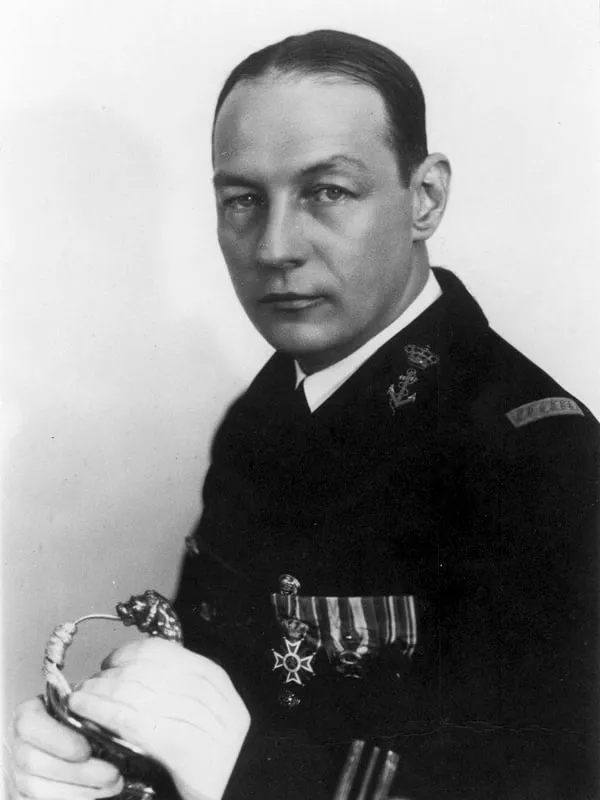
- Born:
- 23 April 1889, Utrecht (Netherlands)
- Died:
- 28 February 1942, Java Sea (Dutch East Indies)
- Author:
- Natalia
- Photo:
- Ministerie van Defensie, CC BY-SA 4.0, Wikimedia Commons

Karel Doorman was a Dutch naval officer who spent most of his career in naval aviation and staff work, yet went down in history for a single, lost battle. In February 1942 he commanded a combined force of Dutch, British, American and Australian warships that was meant to defend the Dutch East Indies against Japanese invasion. On 27 February 1942 he led it into the Battle of the Java Sea, in which the force was shattered and he himself went down with his flagship. In the Netherlands he became the symbol of a navy that fought to the last in a hopeless situation. Historians judge him more cautiously: as a brave and conscientious commander who was given an impossible task and lacked the means to carry it out even in part.
A son of a military family
Karel Willem Frederik Marie Doorman was born on 23 April 1889 in Utrecht, into a Catholic family of professional soldiers. In 1906, together with his brother Lou, two years his junior, he entered the naval officers’ school at Den Helder as a cadet. In 1910 he was commissioned, and almost at once he sailed aboard the coastal defence ship Tromp to the Dutch East Indies, the colony with which he was to be linked for the rest of his life. In 1912–1913 he served in survey ships charting the coastal waters of New Guinea, then one of the least known corners of the archipelago.
At the beginning of 1914 he returned to Europe. In the spring and summer of that year he served in the protected cruiser Noordbrabant, which sailed to the recently created Principality of Albania. Dutch officers were organising an international gendarmerie there, and one of them, Major Lodewijk Thomson, was killed in June 1914 fighting insurgents near Durrës. Noordbrabant brought his body home. A few weeks later the First World War broke out, in which the Netherlands remained neutral.
Naval aviator
Even before the war Doorman had asked to be transferred to the fledgling air service. Permission came in the summer of 1915, and after a rigorous medical examination he was sent to the army flying school at Soesterberg. In 1915 he obtained his civil pilot’s licence and in 1916 his naval pilot’s licence, one of the first naval officers in the Netherlands to do so. From 1917 he was an instructor, first at Soesterberg and from the autumn of 1918 at the new naval air station of De Kooy near Den Helder, which he commanded from 1919 to 1921. For his services to the organisation of the naval air service he was awarded the Order of Orange-Nassau in 1922.
His flying career ended quickly. In early 1919, while skating, Doorman fell through a hole in the ice and badly injured his shoulder, which troubled him for the rest of his life. Budget cuts in naval aviation did the rest. In 1921–1923 he completed the Naval War College in The Hague, where among other things he studied communications between aircraft and ships, which opened the way to staff posts for him. In December 1923 he was posted to the Navy Department in Batavia and sat on committees that were to merge naval aviation with the colonial army’s air arm. The merger never happened, because both sides opposed it.
These years also shaped his family life. In 1919 he married Justine Schermer, with whom he had three children. The marriage broke down in 1934. That same year Doorman married Isabella Heyligers; after his death their son Theo went with his mother to Australia.
Ships and staffs
In 1926, after an eleven-year gap, Doorman returned to a ship for a longer spell, as gunnery officer and then executive officer of the coastal defence ship De Zeven Provinciën. In 1928 he was responsible in The Hague for equipment procurement for naval aviation. In 1932 he received his first independent command, the minelayer Prins van Oranje, followed by the destroyers Witte de With and Evertsen. In the latter, in February 1933, he took part in the operation against mutineers who had seized his former ship, De Zeven Provinciën, in protest at a pay cut. The mutiny, in which both Indonesian and Dutch sailors took part, was ended by a bomb dropped by a naval aircraft, which killed more than twenty men. The affair shook the Netherlands and the colony and long remained a symbol of the tensions in the East Indies.
From 1934 to 1937 Doorman was chief of staff of the naval command at Den Helder. In 1936 he himself asked for command of a cruiser in the East Indies. In 1937, by then a captain, he commanded there in turn the cruisers Sumatra and Java, and in August 1938 he became commander of naval aviation in the colony, based at the Morokrembangan seaplane base near Surabaya. He expanded the fleet of flying boats that were to search for the enemy over the vast waters of the archipelago, and made many inspection tours of the islands.
Squadron commander
When Germany attacked the Netherlands on 10 May 1940 and Queen Wilhelmina and the government moved to London, the East Indies became the most important part of a state that was still at war. On 16 May 1940 Doorman was promoted to rear admiral, and on 13 June, aboard the light cruiser De Ruyter, he took command of the Dutch squadron at Surabaya. For a year and a half his ships guarded the colony’s waters, while in Batavia talks went on with Japan, which was demanding ever greater deliveries of oil. The Dutch conceded little, and in the summer of 1941 they joined the American oil embargo. In August 1941 Doorman was made a Knight of the Order of the Netherlands Lion.
After the attack on Pearl Harbor the Netherlands at once declared itself at war with Japan. Doorman’s ships escorted convoys carrying reinforcements to Singapore, and Dutch submarines attacked Japanese transports off the coast of Malaya. In January 1942, after the Arcadia Conference, the Allied naval forces in the region were placed under the joint ABDA command, with the American Admiral Thomas Hart at their head and General Archibald Wavell as supreme commander. After the Japanese landed on Tarakan and Celebes on 11 January, Doorman was made commander, at the beginning of February, of the Combined Striking Force, made up of ships from four navies that had never trained together and had no common signals.
February 1942
Each of his operations ended in failure, above all for lack of air cover. On 4 February, as he put to sea to intercept a convoy heading for Makassar, Japanese bombers spotted his ships in the Flores Sea (the engagement is also known as the Battle of Makassar Strait) and badly damaged two American cruisers. On 15 February, the day of the surrender of Singapore, he led a stronger force against a convoy bound for Sumatra, but lost the destroyer Van Ghent on the way when she ran onto a reef, and after several hours of air attacks he turned back without having sighted any enemy ships. On the night of 19–20 February, in the Battle of Badung Strait, his ships, thrown into action in several separate groups, failed to stop the landing on Bali and lost the destroyer Piet Hein.
On 12 February command of ABDA’s naval forces passed from Hart to the Dutch Vice Admiral Conrad Helfrich, and at the end of the month Wavell left Java. According to Dutch sources, Doorman voiced doubts to him about the point of the force fighting on and asked whether it would not be better to take the ships out of Java so that they could continue the fight alongside the Allies. Helfrich replied that the fleet was to defend Java to the end, and Doorman, though exhausted and ill, obeyed the order.
On 27 February 1942 his five cruisers and nine destroyers attacked the escort of a Japanese convoy carrying troops to eastern Java. Rear Admiral Takeo Takagi’s Japanese had reconnaissance from seaplanes, better optics and Type 93 torpedoes with a range the Allies had no idea of. In the afternoon the heavy cruiser Exeter was disabled and the destroyers Kortenaer and Electra were sunk. To gather his scattered force, Doorman signalled “All ships follow me”; in the Netherlands it was remembered as “I am attacking, follow me!” (Ik val aan, volg mij), although it was never sent in that form. After dark, losing more destroyers, he went on searching for the transports. Shortly before midnight torpedoes from the cruisers Haguro and Nachi struck Java and De Ruyter. Java sank within a quarter of an hour. The burning De Ruyter stayed afloat for several more hours and sank in the early hours of 28 February. In his last order Doorman told the surviving cruisers Houston and Perth not to pick up survivors but to withdraw to Batavia.
The circumstances of his death have never been established. According to some witnesses he stayed aboard his sinking ship, in keeping with naval tradition; according to others he was seen on one of the life rafts, most of which were never found. Between about 345 and 367 men of De Ruyter’s crew died with him, among them his chief of staff and the ship’s captain, Captain Eugène Lacomblé. Java fell a few days later: on 8 and 9 March the Dutch colonial army capitulated, bringing the campaign in the Dutch East Indies to an end.
Assessment
How Doorman is judged depends on what is expected of him. His critics, especially in English-language writing, fault him for a lack of initiative in the first weeks of February, for dispersing his forces in the Badung Strait, for unclear orders on 27 February and for a night attack without destroyers that led to the loss of two cruisers. They point out that he paid too little attention to communication with the Allied ships and that his force fell apart at the first serious hit. His defenders recall that he commanded a scratch collection of ships from four navies, thrown together in a few weeks, without aircraft, without radar (only Exeter had it), without knowledge of the Japanese torpedoes and under orders to fight regardless of losses. No admiral could have won a battle in those conditions against a fleet that had trained for years in night fighting and held the advantage in the air. Doorman was no great tactician, but he carried out his orders to the end, knowing how slim his chances were.
Remembrance
On 5 June 1942 the Dutch government-in-exile posthumously awarded him the Military William Order, 3rd Class, the highest Dutch military decoration. In 1947 Helfrich presented it to his eldest son aboard the aircraft carrier bearing Doorman’s name, in the presence of Prince Bernhard. According to Polish lists of recipients, in October 1942 Doorman was also posthumously awarded the Silver Cross of the Virtuti Militari.
The Royal Netherlands Navy has named four ships after him: two aircraft carriers, taken over from the Royal Navy in 1946 and 1948 (the second of them was the largest ship in the history of the Dutch fleet), a frigate of 1991 and a joint logistic support ship that entered service in 2015. More than a hundred streets in the Netherlands bear his name, and in the Kloosterkerk in The Hague there is a memorial plaque at which ceremonies are held on the anniversaries of the battle. The wreck of De Ruyter, found by divers in 2002 and recognised as the war grave of her crew and admiral, was almost entirely stripped by illegal salvagers in the years that followed, which caused a loud outcry in the Netherlands when it was discovered in 2016.
In the history of the Second World War Doorman remains a tragic and representative figure. His death closed the first, losing chapter of the war in the Pacific, in which the scattered forces of the European colonial powers and the United States tried in vain to halt the Japanese offensive to the south. From that defeat the Allies drew lessons which, a few months later in the Coral Sea and at Midway, allowed them to fight differently: under a unified command, with air cover and with the reconnaissance that had been lacking in the Java Sea.
Sources
Commanded in battles
(01)Often appears with
People who appear in the same events.