Japan
Takeo Yoshikawa
Naval sub-lieutenant, Naval General Staff intelligence employee (1938–1944), agent at the Honolulu consulate under the name Tadashi Morimura (1941)
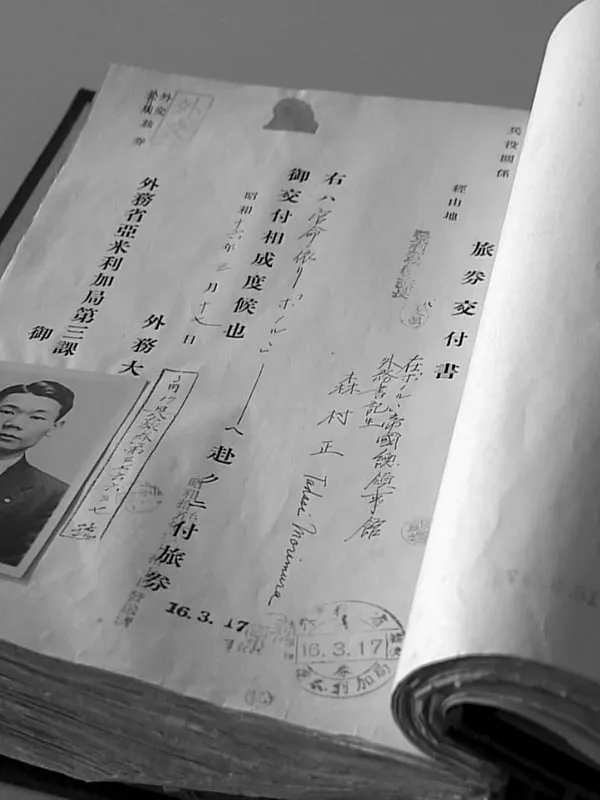
- Born:
- 7 March 1912, Matsuyama (Japan)
- Died:
- 20 February 1993
- Author:
- Łukasz
- Photo:
- 外務省亜米利加局第三課, domena publiczna, Wikimedia Commons

Takeo Yoshikawa was a Japanese naval officer and naval intelligence employee who from March to December 1941, under the assumed name Tadashi Morimura and under cover as a clerk at the Consulate General in Honolulu, watched the American fleet at anchor in Pearl Harbor (PL). His reports on the disposition of ships in the harbour, sent to Tokyo as the consul’s cables, reached the Naval General Staff, which was preparing the strike of 7 December 1941; he sent the last one on the evening before the attack. The Americans intercepted and read these cables but did not grasp their significance in time, and they never unmasked Yoshikawa himself. His story is one of the threads in the dispute over responsibility for the disaster at Pearl Harbor and an example of how much could be achieved by intelligence work carried out almost entirely by open means.
Youth and the navy
He was born on 7 March 1912 in Matsuyama, the capital of Ehime Prefecture on the island of Shikoku, the eldest son of a policeman. According to Japanese biographies he was a sickly child, and his father brought him up strictly, making him exercise a great deal and toughen himself. After secondary school in his home town, in April 1930 he entered the Naval Academy at Etajima, from which he graduated in November 1933 in the 61st class.
As a cadet and young officer he served on the old armoured cruiser Asama and the light cruiser Yura, and in the autumn of 1934 he began a specialist course at the torpedo school (some Western sources speak of flight training). At the beginning of 1935 he fell seriously ill with a stomach complaint and was on sick leave for half a year. In July 1935 he was still promoted to sub-lieutenant, but soon afterwards he was removed from active duty, suspended in 1936 and transferred to the reserve in June 1938. For a graduate of Etajima, brought up in the belief that the fleet was his life, this meant the collapse of his career; according to his recollections he even contemplated suicide at the time.
In naval intelligence
In the same month that he went into the reserve he was taken on as a civilian employee of the Third (Intelligence) Bureau of the Naval General Staff. He worked on the United States Navy, which the Japanese fleet had long regarded as its main future adversary. For almost three years he studied everything that was known about it: the American press and specialist journals, naval yearbooks, reports from naval attachés and information from the crews of merchant ships. He learned to recognise warships by their silhouettes and to know the composition of individual squadrons.
From this period comes an anecdote often repeated in Western accounts: Yoshikawa is said to have intercepted a plain-language message about the departure from Freetown of a troop convoy bound for Britain, passed it on to the German embassy and received a letter of thanks from Adolf Hitler in return. The story has no documentary confirmation and should be treated with caution.
In 1940 Yoshikawa passed an English-language examination at the Foreign Ministry and was formally given a post as a consular service clerk. This was a cover prepared with a specific task in mind. The head of the American section of naval intelligence, Captain Bunjirō Yamaguchi, proposed that he go to the Consulate General in Honolulu. Yoshikawa later recalled that a superior’s “proposal” in the armed forces is in fact an order.
Honolulu
On 27 March 1941 he arrived in Honolulu aboard the liner Nitta Maru with papers in the name of Tadashi Morimura. At the consulate he was listed as a secretary (some American sources call him a vice-consul), and only the Consul General, Nagao Kita, knew of his true role. The American fleet had then been based in Hawaii for less than a year, since February under the command of Admiral Husband Kimmel, while in Japan Admiral Isoroku Yamamoto was preparing a plan for a carrier strike on its base. Yoshikawa knew nothing of this plan.
For eight months he watched the harbour and the airfields of Oʻahu. Most often he did so from the Shunchō-rō, a Japanese teahouse in the Alewa Heights, from whose upper floor the whole Pearl Harbor lagoon could be seen. He drove around the island in taxis and the consulate car, walked the hills above the bay, watched the navy yard from the sugar-cane fields and the harbour from the pier at Pearl City, bought tourist flights over the island and read the local press. He recruited no agents among the roughly 160,000 Hawaiian residents of Japanese descent, whom he did not trust; he relied only on the help of a few consulate employees and drivers. The consulate encrypted his reports in consular codes and sent them to Tokyo under the consul’s name.
From 24 September 1941 Tokyo required his reports to follow a division of Pearl Harbor into five zones, indicating at which wharves ships were berthed and whether they were moored in pairs. The Americans translated this cable on 9 October but attached no great importance to it. From mid-November Yoshikawa reported on the ships in harbour twice a week. At the beginning of November he prepared answers to a detailed questionnaire brought by naval officers disguised as crew members of the ship Taiyō Maru. He sent his last report on 6 December: there were battleships in harbour, but no aircraft carriers and no barrage balloons, and in his opinion the battleships had no anti-torpedo nets.
Internment and return
He learned of the attack on Pearl Harbor on the morning of 7 December at breakfast, when he heard the explosions. Together with the consul he burned the codes and documents before the building was taken over by the police and the FBI. The investigators soon began to suspect him in particular, and some of his colleagues at the consulate, guessing his role, resented him for bringing suspicion upon them. No evidence was found, however. The consulate staff were interned, first in Honolulu and later in camps on the mainland, including in Arizona. In August 1942 Yoshikawa returned to Japan in an exchange of interned diplomats, and the Americans still did not know who “Morimura” had been.
In Japan he went back to work at the Naval General Staff, where he analysed American and Japanese strength. According to Japanese biographies his sober assessments did not fit the optimism prevailing on the staff, and he was viewed with disfavour; in June 1944 he was dismissed from the service. Until the end of the war he worked at plants of the Hitachi concern. Soon after his return from America he married.
After the war
When American troops occupied Japan, Yoshikawa feared being charged with taking part in preparing the attack on Pearl Harbor. According to Western authors he hid in the countryside for a time, passing himself off as a Buddhist monk. According to Japanese sources, however, he agreed, against the advice of his former superior, to answer the questions of Americans compiling the history of the war. In this way he wanted to show that he had spied alone and to lift suspicion from Japanese Americans, who after 1941 had been interned en masse – his case was later cited as a supposed justification for that decision, although he himself stressed that the local Japanese community had been loyal to America.
He told the story of his mission publicly in the article “Top Secret Assignment”, published in December 1960 in the American naval journal Proceedings, and in 1963 he published memoirs in Japan entitled East Wind, Rain (after the code phrase with which Tokyo was to warn its diplomatic posts in the event of a break in relations with America). The book went through further editions and in 2020 was translated into English.
He never received any recognition from the state for his service. In the mid-1950s he opened a sweet shop, which failed when word of his past spread among the neighbours; he was blamed for the war and even – as he said in one interview – for the atomic bomb. He was supported by his wife, who worked as an insurance agent. He died in a care home on 20 February 1993.
Significance
Yoshikawa was neither the author of the plan to attack Pearl Harbor nor even privy to it. Yamamoto’s plan was drawn up without him, and Japanese intelligence had gathered most of what it knew about the habits of the American fleet from open sources before he arrived. His role lay elsewhere: for eight months he supplied the staff with an up-to-date picture of the base, right up to the last hours before the strike, when he confirmed that the battleships were in harbour and the carriers were not. In doing so he acted in a way against which American law offered virtually no protection – he looked at what any tourist could see, only he did it every day and with an expert’s eye.
What the Americans did with his reports proved just as important. The cables from the Honolulu consulate, above all the “bomb plot message” of 24 September, were read in Washington long before the attack, yet no one drew conclusions from them or passed them on to the commanders in Hawaii. That is why Yoshikawa’s name comes up in every discussion of who bears responsibility for the surprise of 7 December 1941 and whether the disaster could have been avoided.
Sources
Mentioned in battles
(01)Often appears with
People who appear in the same events.