Japan
Chūichi Nagumo
Commander of the First Air Fleet (1941–1942) and the Third Fleet (1942), Commander of the Central Pacific Area Fleet (1944), vice admiral, posthumously admiral
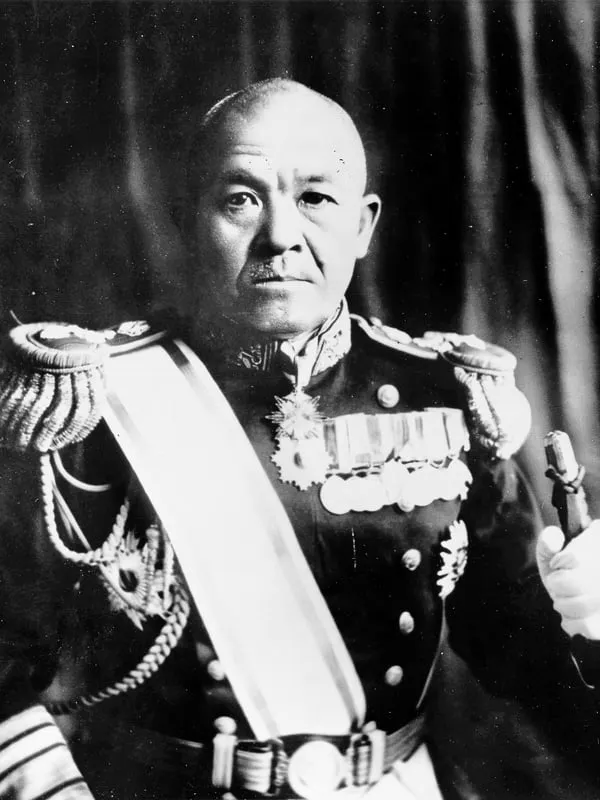
- Born:
- 25 March 1887, Yonezawa, Yamagata Prefecture (Japan)
- Died:
- 6 July 1944, Saipan, Mariana Islands
- Author:
- Natalia
- Photo:
- autor nieznany, domena publiczna, Wikimedia Commons

Chūichi Nagumo commanded the force of six aircraft carriers that attacked the American fleet at Pearl Harbor on 7 December 1941 and, over the following six months, inflicted defeat after defeat on the Allies from Hawaii to the Indian Ocean. Yet he was an admiral of the old school, a specialist in torpedoes and surface ships who did not himself believe in the plan to strike Hawaii and who had received command of the carriers largely by virtue of seniority. His decision not to renew the attack on the dockyard and the fuel tanks after two waves of air strikes remains one of the most debated decisions of the Pacific War. In June 1942 he lost four of those same carriers at Midway, and two years later, while defending Saipan, he took his own life.
A samurai’s son from Yonezawa
He was born on 25 March 1887 in Yonezawa in Yamagata Prefecture, in the north of Honshu, the younger son of a district official descended from the samurai of the old Yonezawa domain. In 1905, during the war with Russia, he entered the Naval Academy at Etajima, graduating in 1908 eighth out of 191 in the 36th class. As a midshipman he served on the cruiser Soya – the former Varyag, captured from the Russians in 1904 – and then on other ships of the fleet.
He specialised in torpedo warfare and destroyer tactics. In December 1917 he received his first independent command, the destroyer Kisaragi. He completed the Naval War College course with distinction in 1920 and was promoted to lieutenant commander. In 1925–1926 he took part in a mission that studied the navies of Western Europe and the United States, and afterwards he commanded gunboats on the rivers of China. In November 1929 he was made captain and given command of the light cruiser Naka.
In the “Fleet Faction”
At the turn of the 1920s and 1930s the Japanese navy split over the disarmament agreements. The so-called Treaty Faction, which included Isoroku Yamamoto among others, held that the limits of the Washington and London treaties protected Japan from an arms race it could not win. The Fleet Faction demanded that Japan break free of them and obtain parity with America and Britain. Nagumo was one of its most vocal officers. According to Japanese biographers, as a section chief in the Naval General Staff from 1931 he clashed sharply with opponents of expanding the staff’s powers, and in 1933 he collected the signatures of ship commanders on a demand that the London Treaty be renounced. Japan renounced the naval treaties in December 1934. The purges that removed many moderates from the navy at that time were attributed in part to men from Nagumo’s circle, although the extent of his influence is disputed.
His career continued. In 1933–1935 he commanded the heavy cruiser Takao and the battleship Yamashiro, and on 15 November 1935 he became a rear admiral. He commanded a cruiser division in Chinese waters, the torpedo school in 1937–1938 and the 3rd Squadron in 1938–1939. On 15 November 1939 he was promoted to vice admiral, and from November 1940 he headed the Naval War College.
Carrier commander
On 10 April 1941 the navy’s six large carriers were concentrated in the newly formed First Air Fleet, and Nagumo was appointed its commander. Seniority decided the matter: Yamamoto, commander of the Combined Fleet, is said to have preferred Vice Admiral Jisaburō Ozawa, an expert in naval aviation. Nagumo was not an airman and, in the words of his colleague Admiral Nishizō Tsukahara, did not understand what carrier aviation could do. He was given Rear Admiral Ryūnosuke Kusaka as chief of staff, and operational planning was largely in the hands of an aviation officer, Lieutenant Commander Minoru Genda, so much so that the fleet was sometimes jokingly called “Genda’s fleet”. According to Genda, however, Nagumo personally helped to train the torpedo crews by demanding precise manoeuvres from the ships’ captains.
When the First Air Fleet was tasked with preparing a strike on Hawaii, Nagumo opposed it. He regarded it as a gamble that might cost the navy the carriers it needed for the operations in the south. At a commanders’ conference in November 1941 he protested that recalling the force at the last moment, should negotiations with the Americans succeed, would be practically impossible; Yamamoto retorted that anyone unable to carry out such an order should resign at once. Nagumo nevertheless carried out his assignment conscientiously. On his own responsibility he had the ships loaded with fuel beyond the regulations so that the force could reach its target.
Pearl Harbor
On 26 November 1941 Nagumo’s force sailed from Hitokappu Bay in the Kuril Islands. According to Kusaka’s memoirs, the admiral confided to him on the way that he regretted not having declined so great a responsibility and that he did not know whether everything would succeed, but that having accepted the task he would do everything to accomplish it. On 2 December he received the signal “Niitakayama nobore 1208” (“Climb Mount Niitaka 1208”), meaning that the war would begin on 8 December, Tokyo time. On the morning of 7 December, Hawaiian time, in heavy seas, his carriers launched two waves totalling some 350 aircraft, which attacked Pearl Harbor. They sank or damaged eight battleships and destroyed nearly two hundred aircraft for the loss of twenty-nine of their own.
After the second wave returned, Nagumo did not renew the attack, although Rear Admiral Tamon Yamaguchi reported that he was ready for another strike. Nagumo judged that the main objective had been achieved, that the defences had stiffened and that the American carriers, absent from the harbour, might be nearby. The force turned back for Japan. The dockyard, the docks and the fuel tanks survived, which critics – later including Yamamoto himself – regarded as a great mistake. Nagumo’s defenders stress that the Combined Fleet’s order spoke of crippling the fleet, not destroying the base; that the Naval General Staff praised him for achieving the objective without losing a ship; and that Yamamoto, knowing Nagumo would not repeat the attack, did not order him to do so. According to Kusaka, Nagumo did not know Yamamoto’s true intention, which was to risk the carriers in order to deal America a decisive blow.
Six months of victories
After Pearl Harbor Nagumo’s carriers were divided: two of them, Sōryū and Hiryū, supported the capture of Wake in the second half of December, and in January 1942 the whole force covered the occupation of Rabaul on New Britain. On 19 February 1942 his aircraft carried out the raid on the Australian port of Darwin, and at the turn of March and April he sortied into the Indian Ocean. He struck Colombo and Trincomalee in Ceylon and sank the carrier Hermes, two heavy cruisers and other ships, while Admiral James Somerville’s British Eastern Fleet withdrew to East Africa. Up to that point Nagumo’s force had not lost a single ship. Japanese sources note, however, that after a series of easy victories fatigue and complacency set in among his staff, and officers of the Combined Fleet staff even demanded that Nagumo and Kusaka be relieved. Yamamoto refused.
Midway
At the beginning of June 1942 Nagumo’s four carriers – Akagi, Kaga, Sōryū and Hiryū – were to destroy the aircraft on Midway Atoll ahead of a landing and to fight the American fleet if it came out to meet them. The Americans, who had broken the Japanese navy’s code, were already waiting for them with three carriers. On 4 June, while the aircraft in the hangars were being rearmed from torpedoes to bombs after the first raid on the atoll, and then back to torpedoes once American ships had been sighted, American dive bombers turned Akagi, Kaga and Sōryū into blazing wrecks within a few minutes. Nagumo did not want to leave his flagship; Kusaka persuaded him to transfer to a cruiser, and the staff officers escaped from the bridge through a window by rope. Late in the afternoon Hiryū was hit as well, and she sank the following morning. The Battle of Midway was the turning point of the Pacific War: Japan lost the initiative, four carriers and many experienced airmen and mechanics.
Last years and death
Yamamoto did not hold Nagumo to account. On 14 July 1942 Nagumo took command of the Third Fleet, which took over the carriers, and led them in the fighting for Guadalcanal: at the Battle of the Eastern Solomons in August and the Battle of the Santa Cruz Islands in October 1942. The Japanese won the latter tactically, but Nagumo himself regarded the loss of experienced airmen as a strategic disaster. In November 1942 he was moved ashore as commander of the Sasebo naval district, and in 1943 of the Kure district. From October 1943 to February 1944 he commanded the First Fleet, which in practice had lost all significance.
On 4 March 1944 he took command of the newly created Central Pacific Area Fleet and the 14th Air Fleet, with headquarters on Saipan in the Marianas. He had few ships and aircraft. On 15 June 1944 the Americans landed on the island, and a few days later the Japanese fleet lost the Battle of the Philippine Sea, leaving the defenders on their own. Driven back, together with the army commander General Yoshitsugu Saitō, into caves in the north of the island, Nagumo took his own life on 6 July 1944 – according to the most often repeated version, with a pistol shot. The next day the remnants of the garrison launched a last, suicidal charge. He was posthumously promoted to admiral. His son Susumu was killed in December 1944 aboard the destroyer Kishinami. Both are buried in the cemetery of the Engaku-ji temple in Kamakura.
Significance
Nagumo went down in history as the commander of both Japan’s greatest naval victory and its greatest naval defeat. At Pearl Harbor and in the Indian Ocean his force showed that concentrated carriers could strike by surprise over thousands of kilometres and destroy fleets in harbour and at sea. At Midway those same carriers, led by the same admiral, were lost in a matter of minutes. Historians judge him in different ways. To some he was a mediocre, cautious commander who did not understand the weapon entrusted to him and squandered the chance to destroy the base at Pearl Harbor. Others point out that he was carrying out orders, operating in a system in which decisions were prepared by the staff, and that responsibility for the Midway plan lay with Yamamoto. His fate captures Japan’s path through this war: from a dazzling beginning owed to surprise to a defeat that neither the carriers nor the courage of their crews could avert.
Sources
Commanded in battles
(04)Mentioned in battles
(05)Often appears with
People who appear in the same events.
On the timeline
(33)1941
1942
January
February
April
- 09
- The attack on TrincomaleeOn 9 April 1942 Nagumo's aircraft bombed the base at Trincomalee, then sank the carrier Hermes and the destroyer HMAS Vampire off the coast of Ceylon.
- Key eventThe fall of BataanOn 9 April 1942 General Edward King surrendered the forces on Bataan against orders. Some 75,000 men went into captivity; only Corregidor still held out.
May
June
- 03
- The attack on Dutch HarborOn 3 and 4 June 1942 aircraft from Ryūjō and Jun'yō bombed Dutch Harbor in the Aleutians, opening the Aleutian campaign alongside Midway.
- The Battle of Midway beginsOn 3 June 1942 a Catalina sighted Japanese transports heading for Midway. B-17s hit no ship, and Nagumo's carriers were still hidden in the fog.