United States
Husband E. Kimmel
Commander-in-Chief, Pacific Fleet and United States Fleet (1941)
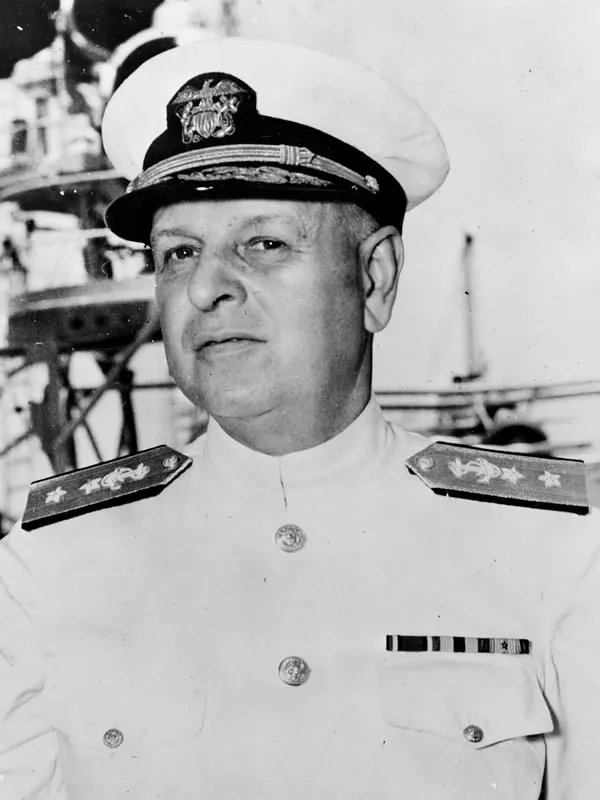
- Born:
- 26 February 1882, Henderson (Kentucky, United States)
- Died:
- 14 May 1968, Groton (Connecticut, United States)
- Author:
- Natalia
- Photo:
- US, Naval History and Heritage Command, domena publiczna, Wikimedia Commons

Husband Edward Kimmel commanded the US Pacific Fleet for just under eleven months, from 1 February to 17 December 1941. He took it over as a rear admiral chosen over the heads of thirty-odd more senior admirals, at a time when President Franklin Delano Roosevelt was keeping the fleet in Hawaii to deter Japan. He lost it after Japanese carriers caught his ships by surprise in Pearl Harbor on 7 December 1941. For the next quarter of a century many Americans saw him as the man to blame for the greatest defeat in the history of their navy, while he himself argued that Washington had withheld from him information that could have prevented the disaster. The dispute over his responsibility has not died down to this day.
Origins and early life
He was born on 26 February 1882 in Henderson, Kentucky. His father, Manning Marius Kimmel, a graduate of the West Point military academy, fought in the Civil War first for the Union and then went over to the Confederate army, which his neighbours supported. His unusual first name, Husband, came from the surname of one of his ancestors, Herman Husband, an eighteenth-century activist from North Carolina. His fellows called him “Kim” and later, because of the similar sound of the names Kimmel and Kemal, also “Mustafa”.
As a boy he dreamed of West Point, but he did not get in and chose the navy instead. In 1904 he graduated from the Naval Academy at Annapolis. William Halsey, the future fleet admiral, was in the same class. Kimmel married Dorothy Kinkaid, sister of the future admiral Thomas Kinkaid. They had three sons.
Naval career
He spent his first years of service in battleships in the Caribbean. In 1907–1909 he sailed in the battleship USS Georgia on the round-the-world cruise of the Great White Fleet, with which President Theodore Roosevelt displayed the strength of the American navy to the world, and to Japan in particular. In April 1914 he took part in the American landing at the Mexican port of Veracruz and was wounded there. In 1915 he served briefly as aide to the Assistant Secretary of the Navy, the young Franklin Roosevelt. A quarter of a century later this acquaintance would matter when a fleet commander was chosen.
He specialised in naval gunnery. During the First World War he was gunnery officer of Battleship Division Nine, which served with the British Grand Fleet as the 6th Battle Squadron. After the war he was executive officer of the battleship USS Arkansas, served in Washington and the Philippines, and commanded two destroyer divisions. In 1926, after completing the senior officers’ course at the Naval War College, he was promoted to captain. He divided the following years between posts in the Navy Department and commands at sea: he led a destroyer squadron and commanded the battleship USS New York.
In 1937 he became a rear admiral. With Cruiser Division Seven he made a diplomatic cruise to South America, and in 1939 he took command of all the cruisers of the Battle Force, the main concentration of the American fleet in the Pacific. He had a reputation as an exceptionally hard-working and demanding officer who found it difficult to delegate and checked the smallest details himself.
Commander of the Pacific Fleet
In May 1940 Roosevelt ordered the main body of the fleet, which had come from California to Hawaii for manoeuvres, to remain at Pearl Harbor as a warning to Japan. The fleet’s commander-in-chief, Admiral James O. Richardson, considered the decision a mistake and argued the point so persistently that the president decided to remove him. In the reorganisation of the navy that divided the single United States Fleet into the Atlantic, Pacific and Asiatic Fleets, the choice fell on Kimmel. On 1 February 1941, aboard the battleship USS Pennsylvania, he took over from Richardson command of the Pacific Fleet and the title of Commander-in-Chief, United States Fleet, and with them the temporary rank of four-star admiral. In doing so he leapfrogged, according to the most commonly cited figure, 32 more senior admirals and became one of the three highest-ranking officers in the navy, alongside the Chief of Naval Operations, Harold Stark, and the commander of the Asiatic Fleet, Thomas C. Hart.
Kimmel did not contest the decision on the base; he simply tried to prepare the fleet for a war he regarded as ever closer. He trained his ships and aircraft, in mid-February issued an order on the security of the fleet in harbour, and on 18 February wrote to Stark that a surprise attack on Pearl Harbor – from the air, by submarines or a combination of the two – was possible and that the fleet was taking steps to minimise the damage. All year he pressed for patrol aircraft, anti-aircraft guns, tankers and men. He had the atolls of Wake and Midway garrisoned by marines. Instead of reinforcements he was weakened: in the spring of 1941, once Washington had decided that in a war Germany would be the main enemy, the carrier Yorktown, three battleships, four light cruisers and a dozen or so destroyers were transferred to the Atlantic. The war plan provided that once war broke out the Pacific Fleet would strike at the Japanese bases in the Marshall Islands, and this was the task for which Kimmel was preparing it.
Responsibility for defending the base itself on land and in the air lay with the army, that is, from 7 February 1941, with the commander of the Hawaiian Department, General Walter Short. The two commanders were on good personal terms, but they had no unified command and did not know exactly what the other was doing. Nor did the decrypted Japanese diplomatic telegrams read in Washington reach Pearl Harbor, and Kimmel, who had several times asked to be kept fully informed, believed he was receiving everything of importance.
7 December 1941
On 27 November 1941 Kimmel received a telegram that Stark called a “war warning”. It named the Philippines, Thailand, the Kra Isthmus and Borneo as likely targets of a Japanese strike. Kimmel concluded that the fleet in harbour was threatened above all by sabotage and submarines. He did not order full long-range air reconnaissance around Hawaii, for which, he maintained, he did not have enough aircraft, and the battleships stayed in port. He sent both of the carriers he had to hand to deliver aircraft to the marines on Wake and Midway.
On the morning of 7 December 1941 aircraft from six Japanese carriers carried out the attack on Pearl Harbor. They sank or damaged eight battleships and many other vessels, destroyed most of the aircraft on the island and killed more than 2,400 Americans. According to his intelligence officer, Edwin Layton, Kimmel watched the raid from the window of his office at the submarine base. A stray machine-gun bullet broke the glass and struck him in the chest without seriously injuring him. “It would have been merciful had it killed me,” he is said to have remarked.
In the days that followed Kimmel prepared an expedition to relieve Wake Island, which was under Japanese attack. He did not have time to carry it out. On 17 December he was relieved, and his interim successor, Vice Admiral William Pye, recalled the force heading to the aid of Wake, which fell on 23 December. On 31 December Admiral Chester Nimitz took command of the Pacific Fleet. Kimmel reverted to his permanent rank of rear admiral.
The inquiries
In December 1941 Roosevelt appointed a commission chaired by Supreme Court Justice Owen Roberts. In its report, published at the end of January 1942, the commission found Kimmel and Short guilty of dereliction of duty for failing to confer with each other and to prepare a defence appropriate to the warnings they had received. The commission was not a court, and the two commanders could not defend themselves before it as they could before a tribunal. Kimmel demanded a court martial that would allow him to present his side of the story in public. In wartime, however, a trial was impossible, because it would have required revealing that the Americans were reading the Japanese codes. Kimmel retired on 1 March 1942.
Subsequent inquiries painted an increasingly complex picture. In 1944 the Navy Court of Inquiry found that Kimmel’s decisions had been sound in the light of what he knew, and blamed Stark for failing to warn him that war was imminent. The Secretary of the Navy, James Forrestal, disagreed with this verdict and concluded that both Kimmel and Stark had failed to show the judgement their positions required. The Joint Congressional Committee, which heard witnesses in 1945–1946, spoke in its majority report of July 1946 of “errors of judgment” rather than dereliction of duty, and also pointed to failings in Washington. Kimmel gave detailed testimony before it.
Last years and the fight over his memory
After leaving the navy he worked for the engineering firm Frederic R. Harris, which carried out contracts for the navy. The war also struck him personally: his son Manning, commander of the submarine USS Robalo, was lost in the summer of 1944 when the boat struck a mine off Palawan. According to accounts gathered after the war, he may have survived the sinking and died in Japanese captivity.
In 1955 Kimmel published his memoirs, Admiral Kimmel’s Story. In them he argued that Washington had kept from him information from decrypted telegrams that would have made it possible to foresee the attack, and suggested that this had been done deliberately so that Japan would fire the first shot and draw the United States into the war. Most historians reject this thesis, popular among Roosevelt’s opponents, holding that the defeat resulted from mistakes and negligence at many levels rather than from a conspiracy. Kimmel died on 14 May 1968 in Groton, Connecticut.
For decades his family campaigned for his admiral’s rank to be restored. Successive presidents refused. A Department of Defense report of 1995 found that other senior officers also bore responsibility for the defeat, but did not exonerate Kimmel. On 25 May 1999 the Senate, by 52 votes to 47, passed a non-binding resolution stating that Kimmel and Short had not been given information available in Washington and calling on the president to restore their full ranks posthumously. Neither Bill Clinton nor his successors did so.
Significance
Kimmel was one of many commanders taken by surprise at the start of the Pacific War: a few hours after Pearl Harbor the Japanese destroyed General Douglas MacArthur’s air force on the ground in the Philippines, even though MacArthur already knew of the attack on Hawaii. But it was Kimmel’s name that became bound up with the symbol of American humiliation. Historians generally agree that he made mistakes – above all in failing to order long-range reconnaissance and to raise the fleet’s readiness after the warning of 27 November – and that the same or greater mistakes were made in Washington. Admiral Nimitz, his successor, said years later that it was “God’s mercy” that the fleet was in harbour on 7 December: had Kimmel known the Japanese were approaching, he would have gone out to meet them with his slow battleships and lost them in deep water together with thousands of men, whereas at Pearl Harbor most of the ships could be raised and rebuilt. Kimmel’s fate shows how the political decision of 1940 to keep the fleet in Hawaii as a warning to Japan turned, in December 1941, into a target for a Japanese strike.
Sources
Commanded in battles
(01)Mentioned in battles
(01)Often appears with
People who appear in the same events.
On the timeline
(13)1941
February
March
October
November
- 26
- Key eventThe Kidō Butai sails for HawaiiOn 26 November 1941 Vice-Admiral Chūichi Nagumo’s six carriers left Hitokappu Bay in the Kurils, sailing under radio silence to strike Pearl Harbor.
- The Hull noteOn 26 November 1941 Cordell Hull handed the Japanese a note demanding withdrawal from China and Indochina. It set no deadline, but Tokyo saw it as an ultimatum.