Greece
Theodoros Pangalos
Minister of War (1922, 1924), commander of the Army of the Evros (1922–1923), prime minister (1925–1926) and dictator of Greece (1926), President of the Republic (1926)
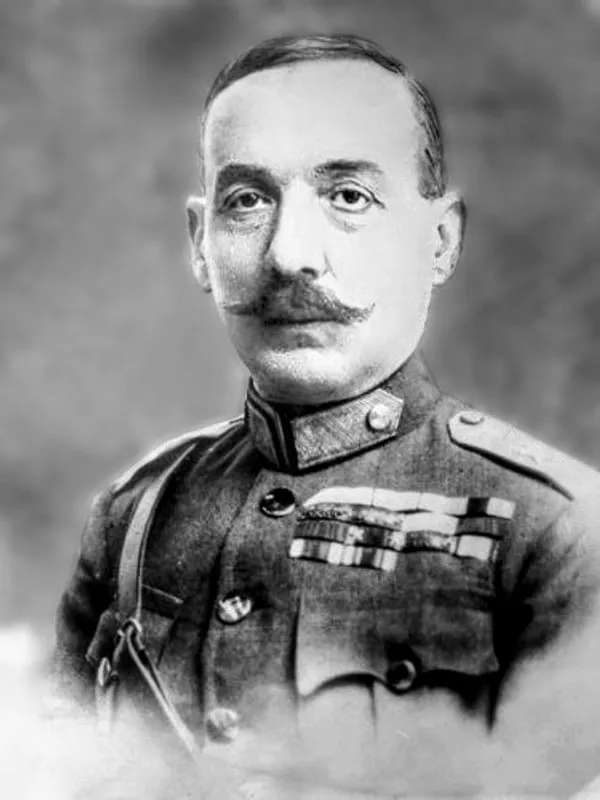
- Born:
- 23 January 1878, Salamis (Kingdom of Greece)
- Died:
- 26 February 1952, Kifisia, near Athens
- Author:
- Natalia
- Photo:
- autor nieznany, domena publiczna, Wikimedia Commons

Theodoros Pangalos was one of the officers who, for three decades – from the Goudi coup of 1909 to the Metaxas dictatorship – time and again decided the course of Greek politics. A French-trained staff officer, an ardent supporter of Eleftherios Venizelos and an enemy of the monarchy, in 1922 he was among the most implacable advocates of the trial that sent six politicians and generals, blamed for the defeat in Asia Minor, to their deaths. He then rebuilt the shattered army on the Evros, and the threat it posed helped Greek diplomacy at Lausanne. In June 1925 he overthrew the government, in January 1926 he proclaimed himself dictator, and in April he had himself elected president. His rule, marked by censorship, internal exile and a quarrel with Bulgaria, ended after fourteen months in yet another coup. He admired Mussolini, and during the German occupation he helped from behind the scenes to create collaborationist units. His short-lived dictatorship foreshadowed the one under which Greece entered the Second World War.
Youth and the Military League
He was born on 23 January 1878 (11 January in the Julian calendar, which Greece used until 1923) on the island of Salamis near Piraeus. His father, Dimitrios, was a doctor and member of parliament; his mother came from an Arvanite family from Eleusis, descendants of a hero of the War of Independence. Theodoros wanted to become a naval officer but was not accepted. He studied medicine for two years and then entered the Evelpidon military academy in Athens. He graduated in 1900 at the top of his class and was commissioned a second lieutenant of infantry. Like many young officers, he blamed the defeat in the war with Turkey in 1897, which he had watched as a cadet, on the politicians and on Crown Prince Constantine.
This resentment drew him into politics. According to his memoirs, in October 1908 a group of officers met at his house and founded the Military League, a secret organisation demanding reform of the army and the state. In August 1909 Pangalos freed imprisoned conspirators by force, and the next day the League carried out the coup at the Goudi barracks outside Athens. The officers soon brought the Cretan politician Eleftherios Venizelos to Athens, and in 1910 he became prime minister. From then on Pangalos was one of his most loyal men in the army.
The Balkan Wars and the Schism
In 1911 he was sent to study at the École supérieure de guerre in Paris. In the First Balkan War he fought at Yenidje Vardar and entered Salonika; in the Second his unit was the first to enter Sidirokastro. In the autumn of 1913 he returned to his studies in Paris, which were interrupted by the Great War. In Greece the conflict between Venizelos and King Constantine I, known as the National Schism, then broke out. In 1916 Pangalos went over to the Venizelist Provisional Government of National Defence in Salonika, which brought part of Greece into the war on the side of the Entente. After the king was driven into exile in 1917 he became head of the personnel department of the Ministry of War and ruthlessly purged the army of royalists. In 1918 he fought on the Salonika front, and at the end of the year he became army chief of staff.
In May 1919, after the landing at Smyrna, he arrived in Asia Minor as chief of staff of the high command. He clashed with the High Commissioner, Aristeidis Stergiadis, who wanted to keep the military out of the administration. When the royalists won the elections of November 1920 and Constantine returned to the throne, Pangalos, like many Venizelist officers, was removed from the army. He watched the defeat of August 1922 from afar, from his family home in Eleusis.
The revolution of 1922 and the Army of the Evros
In September 1922, when the troops evacuated from Anatolia mutinied on the islands of Chios and Lesbos, Pangalos organised a committee of officers in Athens which took control of the city before the leaders of the revolution, Colonels Nikolaos Plastiras and Stylianos Gonatas, arrived by sea. He chaired the commission of inquiry that blamed the catastrophe on former prime ministers and ministers and on the last commander-in-chief, General Georgios Hatzianestis, and according to Greek historians it was largely his pressure that brought them before a court martial. At the end of November 1922 he became Minister of War. The six condemned men were shot at Goudi on 28 November. To the end of his life Pangalos maintained that they had been “necessary sacrifices on the altar of the fatherland”.
In December he took command of the army on the Evros, or Maritsa. He restored order in the demoralised force with iron discipline, threatening to shoot anyone caught stealing equipment, and within a few months turned it into an army ready to fight. In the spring of 1923, when compensation was being disputed at the conference in Lausanne, this army was an important argument for Venizelos: the Turks knew that Pangalos could march on Adrianople. The general himself wanted war and the recovery of Eastern Thrace, and regarded the Treaty of Lausanne as an unnecessary capitulation. When he began conferring with other generals against the government, Plastiras forced him to resign.
Politician and conspirator
In October 1923 he helped to suppress the royalist coup attempt of Generals Leonardopoulos and Gargalidis, and in December he was elected to the constituent assembly for Salonika. He campaigned for the removal of the king. After the republic was proclaimed in March 1924 he served as Minister of Public Order and then as Minister of War in the government of Alexandros Papanastasiou. Republican governments, however, were weak and short-lived, and Pangalos said ever more openly that the country needed a strong hand. At the end of 1924 he took control of the so-called Republican Battalions, a group of conspiring officers, and began preparing a coup. When the Minister of War asked him outright whether he was planning one, he is said to have replied: “Of course. Do you think I am afraid of you?”
On the night of 24–25 June 1925 his men, backed by the fleet, seized Athens and Salonika. The government of Andreas Michalakopoulos stepped down without a fight, and President Pavlos Kountouriotis appointed Pangalos prime minister. The assembly gave him a vote of confidence, but in September he dissolved it by decree. He ruled as a “constitutional dictator”: he persecuted the opposition press, exiled communists and opponents to the islands, had corrupt officials hanged, and the police measured the length of women’s skirts. In October 1925, after an exchange of fire on the frontier, he sent troops into Bulgaria. The League of Nations forced him to withdraw and imposed compensation on Greece, but at home the episode made him more popular.
Dictator and president
On 3 January 1926 he proclaimed himself dictator and took over all legislative power. He banished his rivals – General Georgios Kondylis and the former prime ministers Papanastasiou and Kafantaris – to Santorini, and tried to patch up the financial crisis with a forced loan, ordering large banknotes to be cut in half. In April 1926, after Kountouriotis stepped down, he organised a presidential election from which his only rival withdrew, and received about 93 per cent of the vote. On 18 April he was sworn in as president while remaining prime minister. He moved into the former royal palace and awarded himself the Grand Cross of the Order of the Redeemer.
In foreign policy he admired Benito Mussolini, even though Italy had only recently bombarded and occupied Corfu. He sought closer ties with Rome, ordered weapons from Italy and dreamed of revenge on Turkey, but Mussolini had no intention of committing himself seriously. Pangalos’s regime, lacking the support of any party and with dwindling backing in the army, was tottering from the spring. The agreement with Yugoslavia of 17 August 1926, which gave it extensive rights in Salonika, was regarded by the army as treason. On 22 August Kondylis carried out a coup. Pangalos, who was on holiday on the island of Spetses, tried to escape aboard the torpedo boat Pergamos, but the destroyer Leon, sent in pursuit, forced the vessel to surrender.
Prison and occupation
He spent almost two years in custody without trial, partly in the Izzeddin fortress on Crete. The Venizelos government released him in July 1928, but in the years that followed Pangalos remained in trouble with the law. In 1930 the Senate sentenced him to two years in prison for granting a casino concession in Eleusis to a businessman friend, and in October that year he was arrested together with several dozen officers on charges of conspiring against Venizelos, who was then reconciling with Turkey in Ankara. He never returned to power. He stood unsuccessfully in elections, wrote for newspapers, and watched from the sidelines as the monarchy returned in 1935 and, in August 1936, General Ioannis Metaxas established his dictatorship.
The war gave him one more chance. According to German documents cited by Greek historians, during the Greco-Italian War he was in contact with the German legation in Athens and proposed forming a pro-German government that would make peace with Italy. After the Germans occupied Greece in the spring of 1941 they considered him as prime minister, but chose General Georgios Tsolakoglou. In 1943 Pangalos and officers from his circle played an important, if behind-the-scenes, part in creating the Security Battalions, collaborationist units that fought alongside the Germans against the communist resistance. He held no formal post in them himself, but made sure that his men occupied the key positions. The British historian Mark Mazower writes that Pangalos saw the battalions as a weapon against the communists and at the same time against the return of the king, and that he was closely linked to SS-Standartenführer Walter Blume, the most brutal of the SS commanders in Greece, who in the summer of 1944 pressed for Pangalos to be appointed prime minister of a collaborationist government.
After the liberation, in October 1944, the government of Georgios Papandreou ordered his arrest. In August 1945 he was charged with collaboration, but in September the court dropped the case. In 1950 he stood unsuccessfully for parliament on the list of Napoleon Zervas’s party. He died on 26 February 1952 in Kifisia near Athens (some sources give 27 February). His grandson, also named Theodoros Pangalos, was Greek foreign minister in 1996–1999 and deputy prime minister in 2009–2012.
Significance
Pangalos was a typical representative of the generation of Greek officers for whom the army was not only an instrument of the state but also its guardian and arbiter. Venizelos made use of them in 1909 and 1916; the revolution of 1922 gave them power over the life and death of politicians; and Pangalos drew the conclusion that he could rule on his own. His dictatorship was inept and brief, but it accustomed the Greeks to the idea that parliamentary government could be suspended by decree, and showed how easy it was to stage a coup. The coups that followed, from Kondylis’s in 1926 to the restoration of the monarchy in 1935, opened the way for Metaxas, whose regime was leading Greece when Italy attacked in 1940.
His fate during the occupation shows where that road led: the former republican hero who wanted to rule like Mussolini ended up as the patron of collaborationist units fighting their own compatriots under German supervision. The Security Battalions and their part in the war against the left-wing resistance became one of the causes of the Greek Civil War, which broke out soon after the liberation.
Sources
Often appears with
People who appear in the same events.