Greece
Constantine I of Greece
Crown Prince and commander-in-chief in the wars of 1897 and 1912–1913, King of Greece (1913–1917 and 1920–1922)
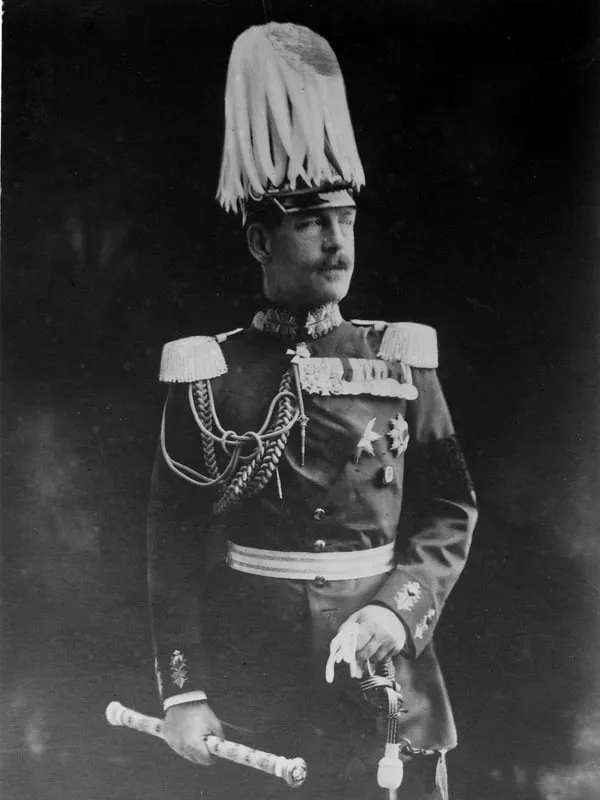
- Born:
- 2 August 1868, Athens (Kingdom of Greece)
- Died:
- 11 January 1923, Palermo (Italy)
- Author:
- Natalia
- Photo:
- George Grantham Bain Collection, domena publiczna, Wikimedia Commons

Constantine I was twice King of Greece, in 1913–1917 and 1920–1922, and his life sums up the whole drama of modern Greece at the turn of the century: from the humiliating defeat by Turkey in 1897, through the triumphs of the Balkan Wars, to the catastrophe in Asia Minor in 1922. A soldier educated in Germany and brother-in-law of Kaiser Wilhelm II, he insisted on neutrality during the Great War, which led to open conflict with the prime minister, Eleftherios Venizelos. This feud, which the Greeks call the National Schism, split the country into two hostile camps for a quarter of a century. On returning to the throne in 1920, Constantine took over the war with Turkey that his opponent had begun, and lost it. The defeat, the loss of Smyrna and the exodus of more than a million Greeks from Anatolia were at the same time the birth of the new Turkey of Mustafa Kemal, one of the states that in 1939 would approach the war on their own terms.
Crown Prince
He was born in Athens on 2 August 1868 (21 July in the Julian calendar, then in use in Greece), the eldest son of King George I, a Danish prince of the Glücksburg dynasty, and Olga Constantinovna, a Russian grand duchess. He was the first heir to the throne born in Greece, and many Greeks read his name as an omen: Constantine had been the name of the founder of Constantinople and of the last Byzantine emperor, and recovering the old capital was the dream of Greek nationalism, the so-called Great Idea (Megali Idea). He bore the title Duke of Sparta.
After studying at the military academy in Athens he went to Germany. He served in the Prussian Guard in Berlin and also studied political science at Heidelberg and Leipzig. German drill and German military thinking shaped him for life. On 27 October 1889 in Athens he married Sophia, daughter of Emperor Frederick III and sister of Wilhelm II. They had six children, among them three future kings of Greece: George II, Alexander and Paul. In 1896 the prince headed the organising committee of the first modern Olympic Games in Athens, which won him popularity.
The defeat of 1897 and the Goudi coup
A year later that popularity evaporated. In the Greco-Turkish War of 1897, triggered by a crisis on Crete, Constantine commanded the army in Thessaly. Within about a month the Ottoman army had driven the Greeks back, and the peace cost Greece border adjustments and an indemnity whose repayment was supervised by an international financial commission. Public opinion blamed the Crown Prince and his brothers. Although he was soon restored to command, officers hostile to the court did not forget the defeat.
In August 1909 the Military League carried out the so-called Goudi coup, and one of its demands was the removal of the princes from the army. Constantine had to give up his military posts. Paradoxically, it was Venizelos – the politician from Crete whom the League had brought in and who became prime minister in 1910 – who restored him. In 1911 he appointed the prince Inspector-General of the Army. For several years the two worked together on reforming the army, with the help of French and British missions, as the Balkans moved towards war.
The Balkan Wars
In the First Balkan War in October 1912 Constantine commanded the Army of Thessaly. After the victory at Sarantaporo he wanted to march west towards Monastir, but Venizelos pressed him to beat the Bulgarians in the race for Salonika and, in a sharply worded telegram, all but ordered him to do so. The army turned east, defeated the Turks at Yenidje (Giannitsa), and on 8 November 1912 (26 October in the Julian calendar, the feast of St Demetrius, the city’s patron saint) the Turkish garrison of Salonika surrendered to the Greeks, a few hours before the Bulgarians arrived. In the winter Constantine took over the front in Epirus; in March 1913, after breaking through the Bizani fortifications, he captured Ioannina.
On 18 March 1913 his father was shot dead while out walking in Salonika by an assassin, Alexandros Schinas. Constantine became king at the height of his glory. In the summer of 1913, in the Second Balkan War, he defeated Greece’s former ally Bulgaria at Kilkis and Lachanas, and his army reached the Kresna Gorge. The Peace of Bucharest gave Greece southern Macedonia with Kavala, Epirus and Crete; the country’s territory almost doubled. The Greeks called the king the “Bulgar-slayer”, and Venizelos himself proposed that he be given a field marshal’s baton.
It was then, too, that the first friction with the Entente appeared. In September 1913 Wilhelm II made his brother-in-law a field marshal of the German army, and in a speech in Berlin Constantine attributed the Greek victories to the German school of warfare. This caused outrage in France, whose mission was training the Greek army.
Neutrality and the National Schism
When the Great War broke out in 1914, Constantine rejected the Kaiser’s request that Greece side with the Central Powers, but he would not join the Entente either. He believed Greece was weak, its fleet and ports at the mercy of the Royal Navy, and he considered the German army invincible. Venizelos was convinced the Entente would win and hoped for a reward in Asia Minor. In March 1915 the king and the general staff, where the tone was set by Colonel Ioannis Metaxas, rejected Greek participation in the Dardanelles expedition, and Venizelos resigned. In the spring of 1915 the king fell seriously ill with pleurisy and came close to death, which only sharpened the crisis.
Venizelos won the June elections, but in the autumn, as Bulgaria mobilised against Serbia, he allowed the British and French to land at Salonika in order to support the Serbs from there. The king regarded this as a violation of neutrality and in October 1915 dismissed him again; the Venizelists boycotted the December elections. The Salonika front took shape in the north, and Greece became the battleground of someone else’s war. In May 1916 the royal government handed Fort Rupel over to the Bulgarians and Germans without a fight, and in September the entire IV Corps at Kavala surrendered to the Germans and was interned at Görlitz. To supporters of the Entente this was proof of treachery.
In August 1916 Venizelist officers seized power in Salonika, and Venizelos soon headed a provisional government there which declared war on Bulgaria and Germany. Greece now had two governments. On 1 December 1916 French and British sailors marched into Athens to force the surrender of weapons, and fighting broke out with the army and royalist militia. After their withdrawal, violence was unleashed against Venizelists in Athens, and the Entente responded with a naval blockade of royalist Greece that brought famine.
In June 1917 the French High Commissioner, Célestin Jonnart, demanded the king’s departure in the name of the powers. Constantine left the country in mid-June, travelling via Italy to Switzerland, but did not sign a formal abdication. He passed the throne to his second son, Alexander, because the Entente would not accept the Crown Prince George, who, like his father, had been educated in Germany. Venizelos returned to Athens, and at the end of June 1917 Greece entered the war on the side of the Entente. The king’s supporters were purged from the army and the administration, and some were sent into internal exile.
Return
Exile in Switzerland lasted more than three years. During that time Venizelos reaped the fruits of victory: in May 1919, with the consent of the powers meeting in Paris, Greek troops landed at Smyrna, and the Treaty of Sèvres of August 1920 gave Greece Eastern Thrace and the administration of Smyrna. Then chance changed the course of history. In October 1920 the young King Alexander was bitten by a pet monkey in the palace gardens at Tatoi; on 25 October he died of blood poisoning.
In the elections of 14 November 1920 war-weary voters turned Venizelos out of power, and he lost his own seat. The government of the united royalist opposition held a plebiscite in December in which, according to the official results, some 99 per cent of those voting supported Constantine’s return. On 19 December 1920 the king returned to Athens, greeted by crowds. The powers reacted coolly: even before the plebiscite France and Britain had announced that the restoration of the wartime “traitor” would end their financial aid, and they did not recognise the king. France, followed by Italy, began coming to terms with Kemal’s government in Ankara. Greece went to war in Anatolia isolated, and its only serious advocate was the British prime minister, David Lloyd George.
The war in Anatolia
The new authorities removed the Venizelist commanders and gave the Army of Asia Minor to General Anastasios Papoulas. The government of Dimitrios Gounaris decided that the only road to a lasting peace was to smash Kemal’s forces. The first offensives, at the beginning of 1921, broke down at İnönü. In June 1921 Constantine sailed to Smyrna to assume supreme command, at least formally, and to raise the army’s morale; he was the first Christian king in Anatolia since the Crusades, as the press of the day liked to point out. In July the army defeated the Turks in the Battle of Kütahya–Eskişehir, and the Turks fell back beyond the Sakarya river. At the end of July a council of war at Kütahya, attended by the king, Gounaris and Papoulas, decided to press on towards Ankara.
It was a mistake that sealed the fate of the Greco-Turkish War. Exhausted by its march across the salt steppes, the army attacked for three weeks in the Battle of the Sakarya (August–September 1921), until in mid-September the command ordered a retreat to the Eskişehir–Afyon line. The king, in poor health, returned to Greece. The front froze for a year; Greece had neither money nor allies, and in August 1922 Kemal went over to the offensive. Papoulas’s successor, Georgios Hatzianestis, was unable to repel it; the front broke at Dumlupınar, and on 9 September the Turks entered Smyrna, which burned a few days later.
Second abdication and death
At the end of September 1922 the troops withdrawn to the islands of Chios and Lesbos mutinied. A revolutionary committee led by Colonels Nikolaos Plastiras and Stylianos Gonatas demanded the resignation of the king and the government. On 27 September 1922 Constantine abdicated, this time formally, in favour of his eldest son, George II, and soon left for Italy. The revolutionaries put on trial the politicians and commanders blamed for the defeat; in the Trial of the Six, three former prime ministers including Gounaris, two ministers and General Hatzianestis were sentenced to death and shot on 28 November 1922. The king’s brother, Prince Andrew, father of the future Prince Philip of Britain, escaped execution only thanks to British intervention.
Constantine died of a heart attack in Palermo on 11 January 1923. He did not live to see the Treaty of Lausanne, which in July 1923 confirmed Turkey’s victory, or the population exchange that ended nearly three thousand years of Greek presence in Asia Minor. He was buried in Naples; only in 1936, after the restoration of the monarchy, were his remains brought back to the royal burial ground at Tatoi near Athens.
Legacy
Constantine still divides Greeks today, just as he divided them in his lifetime. To royalists he was the victorious commander of the Balkan Wars, who rightly sought to spare his country from fighting someone else’s war and was overthrown by foreigners. To Venizelists he was a Germanophile who sacrificed the national interest to dynastic sympathies and then squandered Venizelos’s gains. Historians point out that his neutrality stemmed from an assessment of the balance of forces rather than from sympathy for Germany, and that responsibility for the catastrophe of 1922 lay with everyone who sent the army deep into Anatolia – Venizelos and his successors alike.
The most lasting consequence of his reign was the National Schism. The division between Venizelists and royalists outlived him by well over a decade: each side in turn purged the army of its opponents’ officers, Greece went through a series of coups, proclaimed a republic in 1924 and in 1935 restored the monarchy of George II. In 1936 the king entrusted power to Metaxas, Constantine’s former chief of staff, who ruled as a dictator. It was this regime, which grew out of the royalist camp, that in October 1940 answered Mussolini’s ultimatum with “Ochi” (No) and drew Greece into the Second World War. On the other side of the Aegean, Constantine’s defeat contributed to the victory of Kemal, who built a secular Turkish republic upon it – a republic that in 1939 managed to stay neutral.
Sources
Commanded in battles
(01)Often appears with
People who appear in the same events.