Greece
Georgios Tsolakoglou
Commander of III Corps and of the Army of Western Macedonia (1940–1941), prime minister of the collaborationist government of occupied Greece (1941–1942)
- Born:
- 1886, Rendina (Kingdom of Greece)
- Died:
- 22 May 1948, Athens
- Author:
- Łukasz
- Photo:
- autor nieznany, domena publiczna, Wikimedia Commons

Georgios Tsolakoglou was one of the best Greek generals of the war with Italy and the first collaborationist prime minister of occupied Greece. A professional infantry officer and a veteran of the Balkan Wars, the First World War and the war in Asia Minor, in November 1940 he commanded III Corps, which threw the Italians back in western Macedonia and captured the Albanian town of Korçë. Five months later, when German armoured columns had cut off the Greek army fighting in Albania, on 20 April 1941 he pushed his superior aside and, without the consent of the government or the commander-in-chief, surrendered that army to the Germans – to the Germans alone, not to the Italians. Ten days later he became prime minister of a government formed under occupation. He governed for a year and a half, through a great famine that he was powerless to stop. After the liberation he was sentenced to death, and he died in prison. Greeks still argue over whether he was a traitor or a man who, in a hopeless situation, saved the army from annihilation.
An officer from Thessaly
He was born in April 1886 in the village of Rendina in the Agrafa mountains of western Thessaly, in what is now the regional unit of Karditsa. Thessaly had then belonged to the Kingdom of Greece for only five years. According to English-language biographies his family was of Aromanian origin. He joined the army as a private and then attended the school for non-commissioned officers, which he left on 7 July 1912 as a second lieutenant of infantry. He was posted to the 4th Infantry Regiment in Larissa.
Within a few months he was at war. In the Balkan Wars of 1912–1913 he fought the Turks at Elassona and Sarantaporo and at Giannitsa on the road to Salonika, and then the Bulgarians at Lachanas, at Demir Hisar (Sidirokastro) and at Gorna Dzhumaya. During the First World War he served on the Struma front in Macedonia. In 1919 he took part in the expedition of the Greek corps that supported the French intervention in Ukraine, and then in the war with Turkey in Asia Minor. There he commanded a battalion of evzones, and in August 1922, during the Turkish offensive, he was chief of staff of the 4th Division. In the retreat after the defeat he marched with the column of General Nikolaos Trikoupis, and towards the end, before Smyrna, he went over to General Frangou’s group, which managed to reach the coast.
A general of the Albanian war
Between the wars Tsolakoglou was promoted steadily: to lieutenant colonel in 1923, to colonel in 1925, and in 1935 he became a general. He commanded a division and the Evelpidon officer school (the Hellenic Army Academy) in Athens, and from 1938 the troops on Crete. When war broke out in Europe he took command of III Corps in Western Macedonia.
When Italy attacked Greece on 28 October 1940, his corps faced Korçë. Tsolakoglou was one of the generals who wanted to act quickly. In the very first days of November his units were already crossing the Albanian border on raids, and on 6 November he put forward a plan for a general offensive. The attack of III Corps began on 14 November without an artillery preparation, in order to surprise the Italians, and after a week of heavy fighting in the Morava and Ivan mountains it led to the capture of Korçë on 22 November. Greek studies credit this success in part to a manoeuvre he carried out despite the hesitation of his superiors. It was one of the first great defeats suffered by the Axis powers in this war. Later, in December, Tsolakoglou and his superior, General Ioannis Pitsikas, pressed the commander-in-chief, General Alexandros Papagos, in vain to strike at once at the Klisura pass.
At the beginning of March 1941 Tsolakoglou took command of the Army of Western Macedonia, which held the northern part of the front in Albania. According to Greek sources, at a conference of generals in Athens before the Italian spring offensive he argued for continuing the fight even if the Germans attacked.
The capitulation
When Germany attacked Greece on 6 April 1941, the army in Albania, some fifteen divisions strong, was caught in a trap. The order to withdraw came only on 12 April, after the Germans had entered Salonika and broken through the defences at Vevi. The retreat of the infantry divisions across the Pindus mountains, under air attack and pressed by the Italians, turned into disintegration. On 17 April Tsolakoglou’s army was redesignated III Corps and placed under Pitsikas, commander of the Army of Epirus. The corps commanders and Spyridon, the metropolitan of Ioannina, urged Pitsikas to surrender the army to the Germans before it fell apart completely or into Italian hands. Pitsikas refused, and in Athens, after the suicide of Prime Minister Koryzis on 18 April, no one was willing to take a decision.
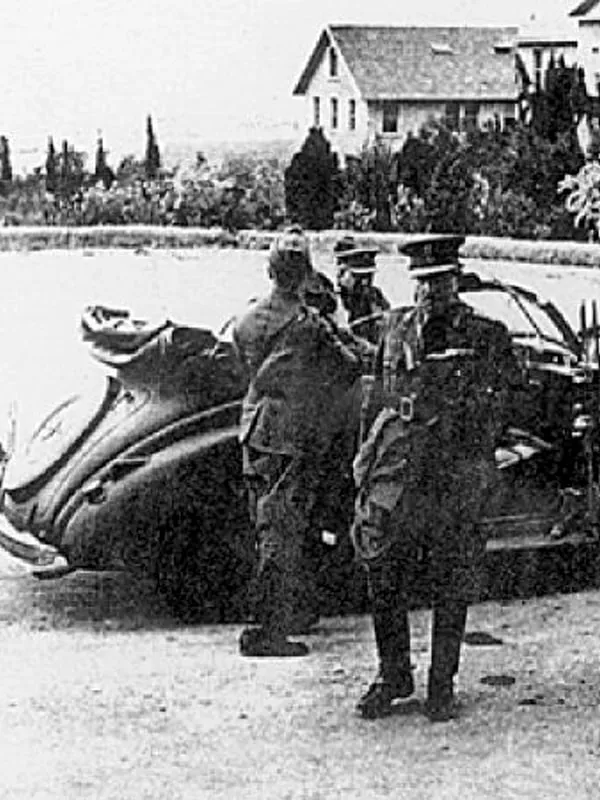
On 20 April, Orthodox Easter Sunday, Tsolakoglou, backed by the commanders of I and II Corps, pushed Pitsikas aside and that evening, in the village of Votonosi near Metsovo, signed an armistice protocol with Josef Dietrich, commander of the SS brigade Leibstandarte Adolf Hitler. He did so against the orders of Papagos, who on hearing of it ordered him to be removed from command and the fight to go on. On 21 April at Larissa he had to sign a new and harsher instrument of capitulation imposed by Field Marshal Wilhelm List, and on 23 April in Salonika, at the demand of Mussolini, a third, this time also to the Italians. The Greek soldiers were not sent to prisoner-of-war camps but dispersed to their homes.
In his memoirs Tsolakoglou wrote that he had faced a “historic dilemma”: to allow the fighting to go on and a “holocaust” to follow, or to yield to the pleas of the army’s commanders and take upon himself the initiative of capitulation. He claimed that he did not regret what he had done – on the contrary, he was proud of it.
Prime minister under occupation
Even before the Germans entered Athens, on 26 April, Tsolakoglou wrote a letter to Adolf Hitler proposing a government made up of senior officers. Hitler, who wanted to move his troops east as quickly as possible and leave day-to-day administration to the Greeks, accepted the offer. According to some historians he called the letter “a godsend”. The Germans occupied Athens on 27 April, and on 30 April Tsolakoglou was sworn in as prime minister. Archbishop Chrysanthus of Athens refused to administer the oath, maintaining that Greece already had a lawful government, which was then on Crete. The cabinet included the generals who had brought about the capitulation together with Tsolakoglou, Panagiotis Demestichas and Georgios Bakos, and the physician Konstantinos Logothetopoulos became deputy prime minister. The British press at once dubbed Tsolakoglou “the Greek Quisling”. The occupiers had also considered the former dictator Theodoros Pangalos, but chose the general who had delivered them the army’s capitulation.
The government of the Hellenic State, as the country was now called, had little power. Real authority lay with the Reich and Italian plenipotentiaries and with the commanders of the three occupying armies. Tsolakoglou, convinced that the Greeks would accept defeat at the hands of the Germans but would not bear rule by the Italians whom they themselves had beaten, asked Hitler to have Germany occupy the country alone. Hitler refused, as the alliance with Mussolini mattered more to him, and from June 1941 most of Greece was occupied by the Italians. Bulgaria took eastern Macedonia and Thrace and began expelling Greeks from there, and the prime minister could do no more than write fruitless protests. In the summer of 1942, touring the north of the country, he assured refugees that Hitler “will not let us lose even a scrap of land”, and ended his speeches with a cheer for a “greater Greece”.
The hardest trial was the famine. The occupiers requisitioned food, the economy collapsed and the British blockade cut off grain imports. In the winter of 1941–1942 people died of hunger in the streets of Athens and Piraeus. In May 1941 the government set up special courts empowered to sentence to death profiteers who hoarded food, but this did not stop the black market. The Great Famine cost, by various estimates, up to 300,000 lives, and the helplessness of a government that had promised to shield the Greeks from the effects of occupation stripped it of what authority it had left. According to English-language studies, Tsolakoglou and Bakos also tried to raise an SS unit of Greek volunteers to fight the Soviet Union, but nothing came of the plan.
By the end of 1942 both the Germans and the Italians had come to regard him as troublesome, because he demanded for Greece the status of a partner rather than a subordinate satellite. After unsuccessful talks on Greek finances in Berlin in September and in Rome in October 1942, and under pressure from pre-war politicians, he resigned on 2 December 1942, officially on grounds of ill health. He was succeeded by Logothetopoulos.
Trial and death
After the liberation of Greece in the autumn of 1944 Tsolakoglou was arrested and held in the Averof prison in Athens. He was tried by the Special Court for collaborators set up by the government of Nikolaos Plastiras. He was charged with having capitulated “in the open field” before his troops had done everything that a soldier’s duty required of them, and then with collaborating with the occupier as prime minister. The trial lasted from 21 February to 31 May 1945 and ended in a death sentence. The same court, however, recognising his “brilliant war record” in the war with Italy, recommended clemency. In August 1945 the sentence was commuted to life imprisonment.
In prison he fell ill with leukaemia. He spent the last year of his life in a military hospital in Athens, where he died on 22 May 1948, stripped of his pension and destitute. He was buried in a small family ceremony in the First Cemetery of Athens. His memoirs were published in 1959.
Significance
Tsolakoglou is a double-edged figure in Greek history. As commander of III Corps he had a share in the greatest Greek victory of the war, and his decision of 20 April 1941, though taken against orders, spared the cut-off army a hopeless fight and captivity: the soldiers went home, and many of them later swelled the ranks of the resistance. Yet the same decision ended organised resistance on the mainland, hastened the British evacuation and handed the Germans a ready partner for forming a government. As prime minister he was helpless before the occupiers, and in Greece his name became a byword for collaboration. The government he created was the first link in the chain of occupation authorities that in later years, under the premiership of Ioannis Rallis, raised the Security Battalions to fight the partisans – a legacy that cast a shadow over the whole of the country’s post-war history.
Sources
Mentioned in battles
(02)Often appears with
People who appear in the same events.