Greece
Ioannis Metaxas
Deputy Chief of the Greek Army General Staff (1915–1917), Prime Minister of Greece (1936–1941), dictator as founder of the 4th of August Regime (1936–1941)
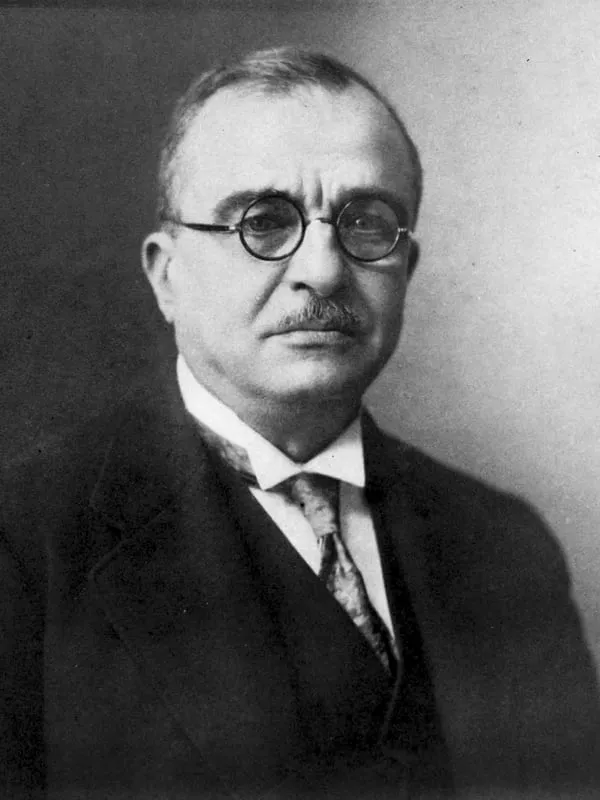
- Born:
- 24 April 1871, Vathy, Ithaca (Kingdom of Greece)
- Died:
- 29 January 1941, Kifisia, near Athens
- Author:
- Natalia
- Photo:
- The Archaeological Society at Athens / εν Aθήναις Aρχαιολογική Eταιρεία, 1937, domena publiczna, Wikimedia Commons

Ioannis Metaxas was one of the most contradictory figures of modern Greece. A staff officer trained in Berlin and regarded as the ablest strategist of the Greek army during the Balkan Wars, he remained all his life a loyal monarchist and an opponent of parliamentary government. In the First World War he sided with King Constantine I against Eleftherios Venizelos, for which he paid with exile and a death sentence passed in his absence. Between the wars he was a second-rank politician, leader of a small party, until in 1936 King George II entrusted him with the government. On 4 August 1936 Metaxas suspended the constitution and established a dictatorship modelled in its outward forms on Fascist Italy. Yet it was Italy that he would have to fight: on 28 October 1940 he rejected the ultimatum of Benito Mussolini and took Greece into the Second World War on Britain’s side. He died three months later, at a moment when the Greek army stood deep inside Albania. The dictator who had imprisoned his opponents became, in Greek memory, a symbol of national resistance.
Youth and Berlin
He was born on 24 April 1871 (12 April according to the Julian calendar then in use in Greece) in Vathy, the main town of the island of Ithaca in the Ionian Sea. He came from an old landed family from neighbouring Kefalonia, which had been inscribed in the Golden Book of the Ionian nobility in Venetian times and used the title of count. His father was a civil servant, the prefect of Ithaca. In 1879 the family moved to Kefalonia, where Ioannis went to school in Argostoli. In 1885, at the age of fourteen, he entered the Evelpidon military academy in Athens, from which he graduated in 1890 as a second lieutenant of engineers.
He received his baptism of fire in the Greco-Turkish War of 1897, which went badly for Greece, on the staff of the commander-in-chief, Crown Prince Constantine. The prince noticed the able, slightly built officer and from then on was his patron. Thanks to him Metaxas studied at the War Academy in Berlin from 1899 to 1903. His German instructors rated him outstanding, and one of them called him “the little Moltke”. His time in Germany made him an admirer of Prussian discipline and of a state in which the chancellor answered to the monarch rather than to parliament. In the diary he kept throughout his adult life he wrote in 1900 that he had no other ambition than to serve the king and the crown prince, and that he found any opposition to the king repugnant.
Strategist of the Balkan Wars
On his return in 1904 Metaxas joined the newly created general staff corps and took part in the modernisation of the army. He viewed the Goudi military coup of 1909, directed among other things against the king’s sons holding command posts, with distaste. Even so, Venizelos, who in 1910 became prime minister and minister for military affairs, made him his aide-de-camp in the hope of improving relations with the court. The collaboration worked well. In 1912 Metaxas negotiated a military convention with Bulgaria in Sofia; during the First Balkan War he worked on the army’s operations staff; he was the military expert of the Greek delegation at the peace conference in London; and in 1913 he settled the military terms of the alliance with Serbia. In the Second Balkan War he was promoted to lieutenant colonel. The Balkan Wars almost doubled Greece’s territory, and Metaxas gained a reputation as the army’s most able planner. By 1914 he was in practice directing the work of the general staff, and in January 1915 he became deputy chief of the general staff.
The National Schism and exile
The outbreak of the First World War put him on the opposite side from Venizelos. The prime minister wanted to enter the war on the side of the Entente, hoping for gains in Asia Minor. In a series of memoranda Metaxas argued that without Romania’s participation and a strong Allied corps in Macedonia, Greece would be beaten by Bulgaria and the Central Powers, and the Greeks of Anatolia would fall victim to Turkish reprisals. When in February 1915 Venizelos offered the Entente a Greek corps for the operation in the Dardanelles, Metaxas resigned in protest. His arguments persuaded the king, who rejected the prime minister’s plan, and Venizelos stepped down. So began the National Schism, which for two decades divided Greece into Venizelists and royalists.
Their opponents accused Constantine and Metaxas of pro-German sympathies. In the spring and summer of 1916 the court allowed German and Bulgarian troops to occupy Fort Rupel and part of eastern Macedonia without a fight, and in Thessaloniki the Venizelists set up their own government, which sided with the Entente. Metaxas then organised royalist reservists’ leagues and was one of the commanders in the clashes in Athens at the beginning of December 1916, when Greek troops and reservists fired on a Franco-British landing party sent to force the surrender of weapons. In June 1917 the Allies forced Constantine to leave the country, Venizelos took over the government of all Greece and declared war on the Central Powers, and Metaxas and other royalist leaders were deported to Corsica. He escaped from there to Sardinia, and from 1919 he lived with his family in Siena. In January 1920 a court in Athens sentenced him to death in absentia for his part in the December events.
He returned home in November 1920, after Venizelos’s electoral defeat and Constantine’s return to the throne. He was given the rank of major general but retired at once, because he opposed continuing the war with Turkey. He believed that Greece had neither the means nor the base to keep an army deep in Anatolia, and several times refused to take command. The catastrophe of 1922 proved him right, but brought him no benefit.
A second-rank politician
After the military revolution of September 1922, which again forced Constantine to abdicate, Metaxas turned to politics. In October 1922 he founded the Freethinkers’ Party (Eleftherofronon), an extreme monarchist group. After the failed royalist coup of October 1923, with which he was connected, he again had to leave the country for a time. When Greece became a republic in 1924, he publicly recognised it and returned home. He outlasted another dictatorship, that of Theodoros Pangalos, and in the 1926 elections his party won almost 16 per cent of the vote and 52 seats. For two years he was minister of communications in a government of national unity. Then the party fell apart, and in subsequent elections it won only a few per cent of the vote.
In the 1930s Metaxas was considered the most intransigent of the royalists. He openly declared that parliamentary government had had its day, and after the failed Venizelist coup of March 1935 he called for a “new order”. In October 1935 General Georgios Kondylis overthrew the government of Panagis Tsaldaris, and a rigged plebiscite restored the monarchy. King George II, Constantine’s son, returned to the country. The elections of January 1936 produced a parliament split almost evenly between Venizelists and monarchists, with the fifteen seats of the Communists holding the balance. Metaxas’s party had a mere seven deputies, but the king was looking for a man who would be loyal to the dynasty and keep the army in check. In March 1936 Metaxas became minister of war and deputy prime minister, and when the prime minister, Konstantinos Demertzis, died suddenly on 13 April, the king entrusted him with the leadership of the government. Parliament gave him a vote of confidence and adjourned for five months, authorising the government to rule by decree.
The 4th of August Regime
In the spring of 1936 a wave of strikes swept the country. In May, in Thessaloniki, police and troops fired on striking tobacco workers, killing a dozen or more people. The trade unions called a general strike for 5 August. The day before, on 4 August 1936, Metaxas, with the king’s consent, declared a state of emergency, dissolved parliament indefinitely and suspended the articles of the constitution guaranteeing civil liberties. He justified this by the threat of a Communist revolution. Thus was born the 4th of August Regime.
The dictatorship dissolved all parties, including Metaxas’s own, banned strikes and introduced a censorship that extended even to the classics, from Thucydides to Plato. The minister of security, Konstantinos Maniadakis, smashed the Communist underground and arrested the party’s leader, Nikos Zachariadis. Political opponents, especially Communists, were exiled to the islands of the Aegean, and public “declarations of repentance” were extracted from those detained. The repression also struck the Slavic-speaking minority in Macedonia and the Albanians in Epirus. The regime was not, however, antisemitic.
Metaxas wanted to be the leader of the nation, not of a party. Propaganda called him “the First Peasant”, “the First Worker” and “the Father of the Nation”, and he himself proclaimed the building of a “Third Hellenic Civilisation”, uniting the legacies of ancient Hellas and Byzantium. From the Fascists he borrowed the Roman salute, and he took as his symbol the Minoan double axe, the labrys. The regime’s only mass organisation was the National Youth Organisation (EON), modelled on the Italian and German youth movements. In 1938 Metaxas also took over the education ministry and had the school textbooks rewritten. At the same time the government carried out a number of social reforms: it introduced the eight-hour working day and a minimum wage, relieved the peasants of debt and created the social insurance institute IKA, which still exists today. Metaxas did not, however, base his rule on a mass movement, as Mussolini did, but on the army and the king. Some historians regard the 4th of August Regime as a variety of fascism, others as a conservative military dictatorship with a fascist façade.
Meanwhile the chief of the army general staff, General Alexandros Papagos, was preparing the armed forces for war. The money went chiefly into fortifications on the Bulgarian border, known as the Metaxas Line, because Bulgaria was regarded as the main enemy. There was not enough time for arms purchases abroad: many orders had not arrived by the time war came.
Between London and Rome
In foreign policy Metaxas, a Germanophile in his youth, pursued a line closer to Britain than appearances suggested. That policy was shaped to a large extent by the Anglophile King George II. Germany was Greece’s biggest trading partner, buying its tobacco and supplying it with arms, but since the Corfu incident of 1923 the Greeks had regarded Italy as their main enemy. Metaxas held to the Balkan Pact and to friendship with Atatürk’s Turkey. After the Munich conference, in October 1938, he proposed an alliance to the British, but London, unwilling to antagonise Mussolini and holding a low opinion of the Greek army, declined.
When the Italians occupied Albania in April 1939, Metaxas summoned the British minister, Michael Palairet, at midnight and told him that Greece would fight to the end if attacked. On 13 April Britain and France announced guarantees for Greece and Romania. In September 1939 Greece declared its neutrality, but in January 1940 it signed a trade agreement with the British under which a large part of its merchant fleet sailed in Britain’s service. After Italy entered the war, Rome unleashed a press campaign against Greece. When on 15 August 1940 an Italian submarine sank the cruiser Elli, Metaxas, though he knew who was responsible, had the attacker described as an “unknown” submarine so as not to give Italy a pretext for war. At the same time he ordered a partial mobilisation. In his diary he noted that Greece would fight first for honour and glory, and only then for victory.
“Alors, c’est la guerre”
Mussolini did not need a pretext. In mid-October he decided to attack Greece. At three o’clock in the morning on 28 October 1940 the Italian minister, Emanuele Grazzi, arrived at Metaxas’s villa in Kifisia and handed him an ultimatum demanding consent to the Italian occupation of unspecified “strategic points” in Greece. Metaxas read it and replied in French: “Alors, c’est la guerre” (“Then it is war”). A few hours later Italy attacked Greece from Albanian territory. Legend credited him with the single word “Ochi” (“No”), which gave its name to a Greek national holiday, but Grazzi himself quoted the French sentence in his memoirs.
He took the decision alone, without consulting anyone, and overnight he gained a popularity he had never enjoyed before. At the cabinet meeting at dawn he made no secret of the fact that Greece faced a hard fight, that the Germans might soon march in, and that the country might lose Macedonia, Epirus and even Athens. On 30 October he told the editors of the Athens newspapers that had he accepted the ultimatum, the schism of 1916 would have been repeated, and Greece would have been dragged into the war anyway, only divided and weakened. He added that he was certain of Britain’s ultimate victory, and that Greece was fighting not for victory but for glory and honour. He also admitted to the journalists that until then he had pursued a policy of neutrality, as King Constantine once had, but that he must now pursue the policy of Venizelos.
War and death
Papagos took over the supreme command, while Metaxas, as prime minister and minister of war, directed the national effort. The Italian offensive stalled in the mountains of Epirus and the Pindus, and in mid-November the Greeks went over to the counter-offensive. On 22 November they took Korçë in Albania, which Athens celebrated as a great victory. Metaxas replied by radio to Mussolini, who had boasted that he would “break the back” of the Greeks. By the end of the year the Greek army had advanced several dozen kilometres into Albania.
The prime minister knew, however, that the real threat was Germany. To unofficial German soundings about peace with Italy he replied that the alliance with Britain was the foundation of his policy. At the same time he did not want to provoke Hitler. When in January 1941 General Archibald Wavell offered to send two or three British divisions to Macedonia, Metaxas refused: such a force could not stop the Germans, but would give them a pretext to attack. He agreed to accept ground troops only once the Germans entered Bulgaria.
Metaxas’s health had been deteriorating since the spring of 1940, and the strain of the war ruined it. In January 1941 he fell ill with acute tonsillitis, which developed into a peritonsillar abscess and blood poisoning. He died on 29 January 1941 at his home in Kifisia, aged 69. Huge crowds attended his funeral. The circumstances of his death at once became the subject of rumour, and German propaganda spread the story that the British had poisoned him. There is no evidence whatever for this.
Metaxas’s successor, Alexandros Koryzis, agreed in February 1941 to accept a British expeditionary force. On 6 April 1941 Germany attacked Greece and Yugoslavia. The Metaxas Line held out for several days but was outflanked, and in the second half of April the Greek army surrendered. Koryzis took his own life on 18 April, before the Germans entered Athens.
Memory
Metaxas left a double legacy. To some he was a dictator who destroyed democracy, imprisoned and tortured his opponents, exiled Communists to the islands and handed the army and the state over to the court. In the view of some historians, by breaking up the parties and repressing the left he also indirectly helped to ensure that during the occupation the Communist-led EAM became the strongest force in the resistance, and that after the war the country plunged into civil war. To others he was a statesman who prepared the army for war and at the decisive moment expressed the will of the whole nation. Until the 1960s the latter view prevailed in Greece. After the fall of the colonels’ junta in 1974, which the left likened to the 4th of August Regime, the image of Metaxas as a Greek fascist took hold.
Whatever the verdict, 28 October remains a national holiday in Greece and Cyprus: Ochi Day. For the history of the Second World War, Metaxas’s refusal had a significance greater than its author: Greece, at the time Britain’s only ally fighting on the European continent, inflicted the first serious land defeat on the Axis powers and forced Hitler into the Balkan campaign of the spring of 1941.
Sources
Commanded in battles
(01)Mentioned in battles
(03)Often appears with
People who appear in the same events.