Hungary
Tibor Szamuely
Bolshevik activist among prisoners of war in Russia (1917–1918), deputy people's commissar for war and people's commissar of the Hungarian Soviet Republic (1919)
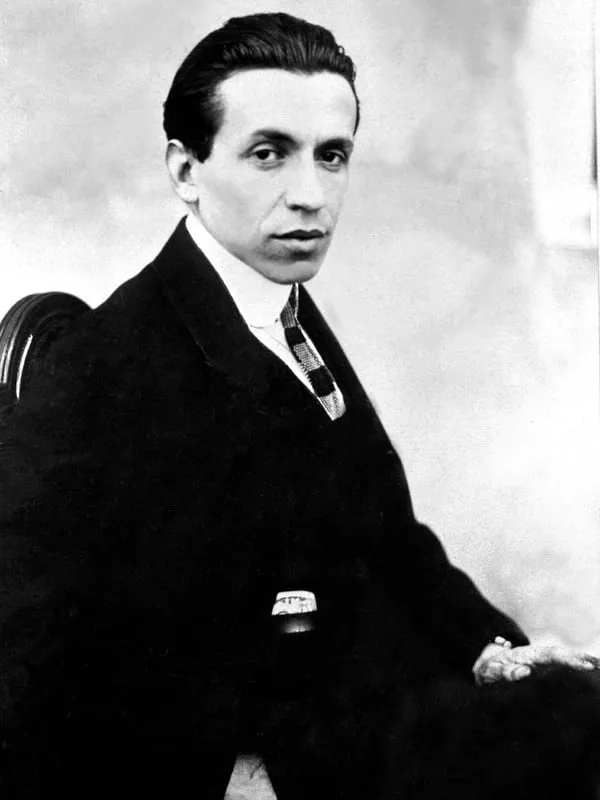
- Born:
- 27 December 1890, Nyíregyháza (Austria-Hungary)
- Died:
- 2 August 1919, Lichtenwörth near Wiener Neustadt (Austria)
- Author:
- Łukasz
- Photo:
- autor nieznany, domena publiczna, Wikimedia Commons

Tibor Szamuely was the most ruthless of the leaders of the Hungarian Soviet Republic. In 1919, at the age of twenty-eight, first as deputy commissar for war and then as a people’s commissar, he travelled the country in an armoured train with a detachment of “Lenin Boys”, dealing with rebellious peasants and alleged counter-revolutionaries. His name became a byword for the Red Terror, and his writings, in which he called for counter-revolution to be drowned in blood, were quoted throughout the interwar years. He did not survive the fall of the republic: on 2 August 1919, detained after crossing the Austrian border illegally, he died from a bullet fired from his own revolver. For the regime of Miklós Horthy he was the embodiment of “Jewish Bolshevism”, used to justify the White Terror and antisemitic policies; for communist Hungary after 1945 he was a hero and martyr of the revolution.
A journalist from Nyíregyháza
He was born on 27 December 1890 in Nyíregyháza, in north-eastern Hungary, into a Jewish merchant family. His father, Lajos Szamueli, dealt in farm produce. Tibor was the eldest of several sons. He finished secondary school in Győr in 1908. He began writing for newspapers early. In a local paper of Szabolcs county he described workers’ conditions; he then worked for the Social Democratic Népszava, where his articles got him into trouble with the law, and for an anticlerical weekly published in Nagyvárad, today’s Oradea. From 1913 he was Népszava’s foreign correspondent. He wrote under the pen name “Tiborcz”. He belonged to the generation of young left-wing intellectuals who before the war gathered around the Social Democratic Party but despised its moderation.
Captivity and revolution in Russia
In 1914 Szamuely was called up into the Austro-Hungarian army. In May 1915 he was taken prisoner by the Russians on the Eastern Front and sent to prisoner-of-war camps in Transbaikalia, near Chita and Dauria. He campaigned for socialism among the prisoners. After the October Revolution he joined the Bolsheviks. From January 1918 he was in Moscow, where together with Béla Kun he led the Hungarian communist group attached to the Bolshevik party and dealt with matters concerning prisoners of war. From April 1918 the two men published the newspaper Szociális Forradalom (“Social Revolution”), aimed at the hundreds of thousands of Hungarian prisoners in Russia. They recruited them into the Red Army and into the international units that fought on the Bolshevik side in the Civil War.
Szamuely stood out for his radicalism. In May 1918 he told the prisoners that whoever did not become a soldier of the revolution, in Russia or at home, was an enemy against whom a merciless struggle had to be waged. Accounts circulated among the Hungarians in Russia that he had had officers shot for opposing recruitment into the Red Army. At the end of 1918, after the collapse of the Habsburg monarchy, he set out westwards. Some biographers state that on the way he stayed in Germany and was in contact with the Spartacists. On 3 January 1919 he reached Budapest and joined the Central Committee of the Party of Communists in Hungary, founded by Kun in November.
At the head of the terror
When, after clashes outside the Népszava offices on 20 February 1919, the police arrested Kun and most of the leadership, Szamuely remained at liberty, ran the party semi-clandestinely and formed armed groups. In February he wrote in the communist paper Vörös Újság words that were quoted for years afterwards as proof of his cruelty: counter-revolutionaries must be struck down wherever they are found, and before they can crush the revolution they must be drowned in their own blood.
After the proclamation of the Soviet Republic on 21 March 1919, Szamuely became one of the two deputies to the People’s Commissar for War, József Pogány. At the beginning of April, when the deputies became full commissars, he joined the Revolutionary Governing Council, and in the following weeks he served, alongside others, as people’s commissar for war and then for education. His real domain, however, was the security of the new regime. On 21 April, as the Romanian army was breaking through the front in Transylvania, a commission was set up to maintain order and combat counter-revolution behind the front, and Szamuely was granted extraordinary powers that allowed him to act without reference to the courts. In his speeches he proclaimed that anyone who opposed the power of the proletariat should hang, and that blood steels the heart and the fist of the proletariat.
Szamuely travelled the country in an armoured train. He was accompanied by a detachment of some two hundred armed men known as the “Lenin Boys” (Lenin-fiúk), under the direct command of József Cserny. Their headquarters in Budapest was the Batthyány Palace. At the beginning of May, after Szolnok had been retaken, Szamuely’s men shot and hanged people accused of collaborating with the Romanians or of counter-revolution in that town and in nearby Abony, often after an “interrogation” lasting a few minutes in a railway carriage. Among those killed in Szolnok was sixteen-year-old Ede Mellinger, who, according to witnesses, told Szamuely that he was not a judge but a beast. In June the Lenin Boys and other units put down peasant revolts in Transdanubia and between the Danube and the Tisza, and after a failed uprising by cadets of the Ludovika Academy in Budapest on 24 June the government announced that it would “drown in blood” the counter-revolution of the bourgeoisie. Victims were often hanged in public, and the perpetrators had themselves photographed beside the bodies.
How many people died at the hands of Szamuely and his subordinates is not known precisely. Present-day historians estimate that the Red Terror of the Soviet Republic as a whole claimed from about 300–400 to almost 600 victims; the upper figure comes from a list compiled in 1922 by a prosecutor of the Horthy regime, which counted every violent death of the period. A large proportion of the victims died during the suppression of revolts led by Szamuely or by men associated with him. His methods provoked opposition from the Social Democrats in the government. As early as the end of April the People’s Commissar Vilmos Böhm ordered the paramilitary units to be disbanded, but the Lenin Boys were merely reorganised several times, and their activities continued until the end of the republic.
The flight to Moscow
In May 1919 Szamuely flew to Soviet Russia by aeroplane, crossing the fronts of the Civil War. In Moscow he met Vladimir Lenin. According to German accounts he took off on 21 May and spoke with Lenin during a parade on 26 May. The next day Lenin wrote a letter to the Hungarian workers in which he urged them to deal mercilessly with the wavering Social Democrats and with the resistance of the “exploiters”, since the dictatorship of the proletariat required the “ruthlessly stern, swift and resolute” use of force. On 31 May Szamuely returned to Budapest with letters and instructions. The journey strengthened his position among the communists, but it alarmed not only the Social Democrats but also Kun himself, who feared a rival.
Flight and death
The republic fell in the war with Romania. After the defeat of the offensive across the Tisza, on 1 August 1919 the Revolutionary Governing Council resigned, and Kun and most of the commissars left by special train for Austria, where they were interned. Szamuely was not on that train. He tried to escape on his own, by car and then with the help of a smuggler. On 2 August he crossed the border illegally near Savanyúkút, today Bad Sauerbrunn in Burgenland, which at that time still belonged to Hungary. Austrian gendarmes detained him at Lichtenwörth near Wiener Neustadt. According to official Austrian and Hungarian statements, during a search he drew a concealed revolver and shot himself in the chest. He died shortly afterwards – according to some sources, in hospital in Wiener Neustadt. Kun’s wife recalled that Szamuely had earlier shown her the hidden weapon and said he would not be taken alive. Some authors, however, including a Hungarian biographical dictionary published in the communist era, maintained that he had been shot.
He was buried in the cemetery at Savanyúkút, but local people protested against the presence of the grave. On 12 August the body was exhumed on the orders of the new Hungarian authorities and then buried in an unmarked place whose exact location has never been established. A few weeks later his brother Zoltán, arrested by the counter-revolutionaries, hanged himself in prison. Cserny, the commander of the Lenin Boys, and a dozen or so of his men were sentenced to death after the fall of the republic and executed in Budapest in December 1919.
Significance
Szamuely did not outlive the Soviet Republic, but his figure weighed on the whole of Hungary’s interwar period. The counter-revolution made him, together with Kun and the head of the political police, Ottó Korvin, the chief symbol of the “rule of the Commune”, and the fact that all three were of Jewish origin was used to identify communism with the Jews. Historians point out that the White Terror of Horthy’s officer detachments was far bloodier than the Red, and that most of its victims were people who had had nothing to do with Szamuely’s terror. The Red Terror nevertheless gave it a convenient justification. For a quarter of a century the memory of Szamuely’s train served the Hungarian right as an argument against any left, and the anti-Jewish laws, from the numerus clausus of 1920 to the laws of 1938–1941, were presented as the nation’s defence against “Jewish Bolshevism”. Nazi propaganda in Germany made eager use of the same image.
After 1945 the roles were reversed. The communist Hungary of Mátyás Rákosi, who in 1919 had sat with Szamuely on the Governing Council, made him a hero and martyr. In 1953 a street in Budapest was named after him, and it kept the name until 1990; in the Soviet Union a ship was named after him. His nephew and namesake, the historian Tibor Szamuely, born in Moscow in 1925, spent a year and a half in a Soviet labour camp in the Rákosi era, and in 1964 settled in Britain, where he became one of the sharpest critics of the Soviet system. Today historians see Szamuely above all as an example of a young revolutionary who learned in the Russian Civil War that violence is an ordinary instrument of politics, and who carried that lesson into Central Europe.
Sources
Often appears with
People who appear in the same events.