Hungary
Mátyás Rákosi
People's Commissar of the Hungarian Soviet Republic (1919), Comintern secretary (1921–1924), general secretary of the Hungarian Communist Party and the Hungarian Working People's Party (1945–1956), Prime Minister of Hungary (1952–1953)
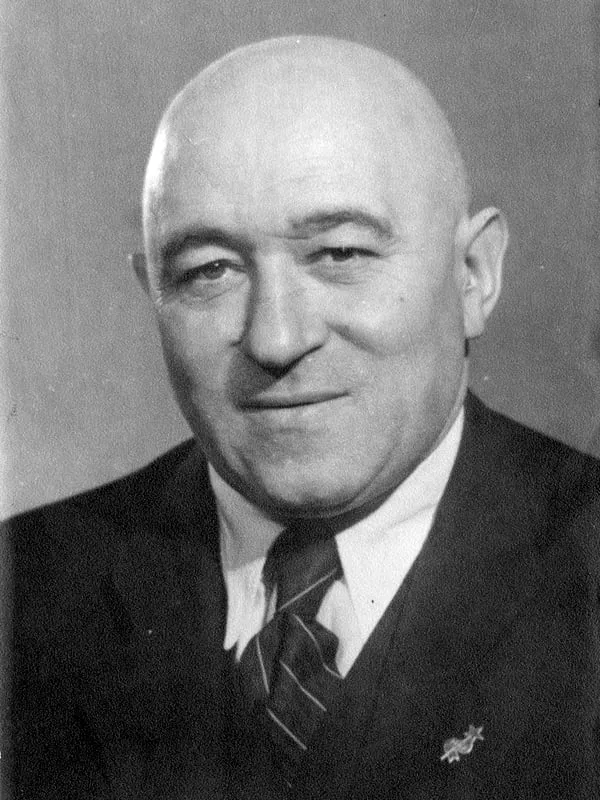
- Born:
- 9 March 1892, Ada (Austria-Hungary, now Serbia)
- Died:
- 5 February 1971, Gorky (USSR, now Nizhny Novgorod)
- Author:
- Łukasz
- Photo:
- autor nieznany, domena publiczna, Wikimedia Commons

Mátyás Rákosi travelled the whole road of Hungarian communism, from its first revolution to its Stalinist fulfilment. In 1919, at the age of twenty-seven, he was one of the people’s commissars of the Hungarian Soviet Republic. After its fall he worked in Moscow for the Comintern, and when he secretly returned to Hungary in 1924 he spent fifteen years in the prisons of Admiral Miklós Horthy. His trials made him a symbol of the international communist movement, and the Hungarian battalion of the International Brigades in Spain bore his name. In 1940, during the pact between Joseph Stalin and Hitler, Moscow exchanged him for the banners of the Hungarian revolution of 1849. He returned home in 1945 in the wake of the Red Army and within a few years destroyed the opposition with “salami tactics”, then ruled Hungary as “Stalin’s best Hungarian disciple” amid terror, show trials and a personality cult. His rule was one of the causes of the 1956 uprising. He died in exile in the USSR, cast aside by the same Soviet patrons who had raised him to power.
Early years
He was born Mátyás Rosenfeld on 9 March 1892 in the small town of Ada on the Tisza, in Bács-Bodrog county, now in Serbian Vojvodina. He was one of the nine children of a Jewish merchant, József Rosenfeld, and Cecília Léderer. In 1904 the family changed its name to the Hungarian Rákosi. Mátyás went to school in Sopron and in 1905–1910 to a modern secondary school (reáliskola) in Szeged, where one of his teachers was the poet Mihály Babits. He then studied at the Oriental Academy of Commerce in Budapest and went abroad on scholarships for practical training in Hamburg (1912) and London (1913). He knew several languages, which later proved very useful to him. In 1910 he joined the Social Democratic Party of Hungary and was active in the Galileo Circle, an association of radical, anti-militarist students.
Captivity and the Soviet Republic
During the First World War he served in the Austro-Hungarian army on the Eastern Front, and in 1915 was taken prisoner by the Russians. He spent three years in prisoner-of-war camps in the Far East. Unlike Béla Kun or Tibor Szamuely, he played no major role among the communists in Russia. In 1918 he got out of the camp, returned home via Petrograd with one of the transports of prisoners, and avoided being sent to the Italian front. In the autumn he joined the Party of Communists in Hungary, founded by Kun in November.
On 21 March 1919, when the Social Democrats merged with the communists and proclaimed the Soviet Republic, Rákosi became one of the deputy people’s commissars for trade. The document appointing the government misspelt his name as “Rákossy”, because most of the Social Democrats did not know him. From 3 April he was one of the people’s commissars for social production, responsible for nationalised industry. He belonged to the party’s radical wing. At the end of July, in the last days of the republic, he took command of the Red Guard, which kept order in the capital and suppressed resistance to the new regime. After defeat in the war with Romania and the resignation of the Soviet government on 1 August, Rákosi fled to Austria on 2 August. Together with the other commissars he was interned, among other places in Karlstein Castle.
The Comintern
In May 1920 he reached Soviet Russia via Vienna. He was one of the first to give Vladimir Lenin a personal account of the Hungarian revolution, and in the summer he twice addressed the Second Congress of the Communist International, which had been founded in Moscow a year earlier. The Comintern sent him to Germany, Austria and Czechoslovakia. In January 1921 he attended, as its envoy, the congress of the Italian Socialist Party at Livorno, which ended in a split and the founding of the Communist Party. From 1921 to 1924 he was one of the secretaries of the Executive Committee of the Comintern.
In December 1924, on the Comintern’s instructions, he returned illegally to Hungary to rebuild the shattered Communist Party. On 22 September 1925 the police arrested him. At his trial in July and August 1926 he was sentenced to eight and a half years in prison for subversive activity. As his sentence was coming to an end, the authorities put him on trial a second time, now for his actions in 1919, including shared responsibility for killings during the Red Terror. The trial, held from 21 January to 4 February 1935, was followed by the whole of Europe, and the communist movement campaigned in his defence. He was sentenced to life imprisonment. He was held in the Csillag prison in Szeged.
The name of the imprisoned Rákosi became a rallying cry of the communist movement. In April 1937 Hungarian volunteers in Spain formed a battalion named after him, which fought in the International Brigades at Huesca and on the Ebro. One of the battalion’s political commissars was László Rajk, whom Rákosi sent to the gallows twelve years later.
Exchange and war
In 1939 Hungary and the USSR restored diplomatic relations, and after the conclusion of the Molotov–Ribbentrop Pact Moscow and Budapest, both then on good terms with Berlin, settled old outstanding matters. On 30 October 1940 Rákosi was conditionally released from prison, and on 2 November he left for the Soviet Union. In return Moscow gave Hungary the banners of the Hungarian army from the revolution of 1848–1849, captured by tsarist troops after the surrender at Világos in 1849. On 7 November 1940 Rákosi stood beside Stalin on the reviewing stand during the parade in Red Square.
During the war he led the Hungarian communists in exile in Moscow and belonged to the leadership of the Comintern until its dissolution in 1943. He supervised propaganda aimed at Hungary, including the broadcasts of Kossuth Radio, in which the communists called on Hungarians to break with Germany. In June 1941 Hungary joined Germany’s war against the USSR, and in January 1943 the Hungarian Second Army was destroyed on the Don. In 1942 Rákosi married Feodora Kornilova. When the Red Army entered Hungary in 1944, the communists in Moscow prepared to take power. Rákosi returned home on 30 January 1945, to Debrecen, seat of the provisional government, while the siege of Budapest was still going on.
Dictator
In February 1945 Rákosi became head of the Hungarian Communist Party as its general secretary, and from 1945 to 1952 he was deputy prime minister. In the free elections of November 1945 the communists won only about 17 per cent of the vote, while the Independent Smallholders’ Party took a majority. Relying on the presence of Soviet troops and on communist control of the political police, Rákosi systematically destroyed his opponents, cutting off successive “slices” of the opposition in what came to be called salami tactics. Smallholder leaders were accused of conspiracy, arrested or forced to emigrate. In the largely rigged elections of August 1947 the communists won about 22 per cent of the vote and became the strongest party. On 14 June 1948 they absorbed the Social Democrats to form the Hungarian Working People’s Party, and in 1949 a new constitution made Hungary a people’s republic on the Soviet model.
The years 1949–1953 were the period of the harshest terror in Hungary. In February 1949 the primate, Cardinal József Mindszenty, was sentenced to life imprisonment, and in the autumn a show trial sentenced to death Rajk, the former minister of the interior and of foreign affairs, accused of spying for Yugoslavia and the West. He was executed on 15 October 1949. The trial was part of Stalin’s campaign against Josip Broz Tito, and Rákosi personally oversaw its preparation. The ÁVH political police arrested tens of thousands of people; in 1951 thousands of families deemed “class enemies” were deported from Budapest; the countryside was forced into collectivisation; and the courts handed down several hundred death sentences. Rákosi surrounded himself with a cult modelled on Stalin’s, and from 14 August 1952 he was also prime minister.
Fall and exile
Stalin’s death in March 1953 shook his position. In June he was summoned to Moscow, where the new Soviet leaders accused him of having brought the country to the brink of disaster. On 4 July 1953 the reformer Imre Nagy became prime minister, while Rákosi kept his post as party leader. In 1955 he still managed to bring Nagy down, but after Khrushchev’s secret speech of February 1956 condemning Stalin’s crimes his days were numbered. On 18 July 1956, under pressure from Moscow’s emissaries, the Central Committee removed him as first secretary, officially on grounds of ill health. He was replaced by Ernő Gerő, and Rákosi left for the USSR. Three months later the Hungarian Uprising broke out and was crushed by Soviet troops.
Hungary’s new leader, János Kádár, held Rákosi’s rule and personality cult to be the main cause of the “counter-revolution” and would not let him return. Rákosi lived in various cities of the Soviet Union – Krasnodar, Tokmok in Kirghizia and Arzamas – under surveillance and forgotten. In 1962 he was expelled from the party. In 1970 he was offered a return on condition that he renounce politics, but he refused. He died on 5 February 1971 in Gorky, now Nizhny Novgorod. His ashes were quietly buried in Budapest, in the Farkasréti Cemetery, under his initials alone, so that the grave would not become a target for revenge.
Significance
Rákosi’s life links Hungary’s first communist revolution with its second. In 1919 he was one of the younger commissars of a republic that fell after 133 days, leaving behind a fear of Bolshevism on which the Horthy regime built its legitimacy. Rákosi’s trial in 1935 gave that regime an opportunity to recall the “crimes of the Commune”, and the Comintern an opportunity to turn Horthy’s prisoner into a martyr of anti-fascism. His exchange for the banners of 1849 during the Hitler–Stalin pact shows, in turn, how in 1939–1941 the two dictators and their allies could strike bargains at the expense of ideology.
When Rákosi returned home in 1945, he had drawn a single lesson from the experience of 1919: this time the communists could not share power and could not allow themselves to be overthrown. Hungary, which Horthy had led into the war on Hitler’s side, paid for it not only with the defeat on the Don and the devastation of the country, but also by ending up in the Soviet sphere of influence. Rákosi was the instrument of this change. His Stalinist dictatorship of 1948–1956 was one of the most far-reaching consequences of the Second World War for Hungary, and the 1956 uprising it provoked was one of the most important crises of the Cold War.
Sources
Often appears with
People who appear in the same events.