Russia
Zinovy Rozhestvensky
Chief of the Main Naval Staff (1903–1906), commander of the Second Pacific Squadron (1904–1905), vice admiral
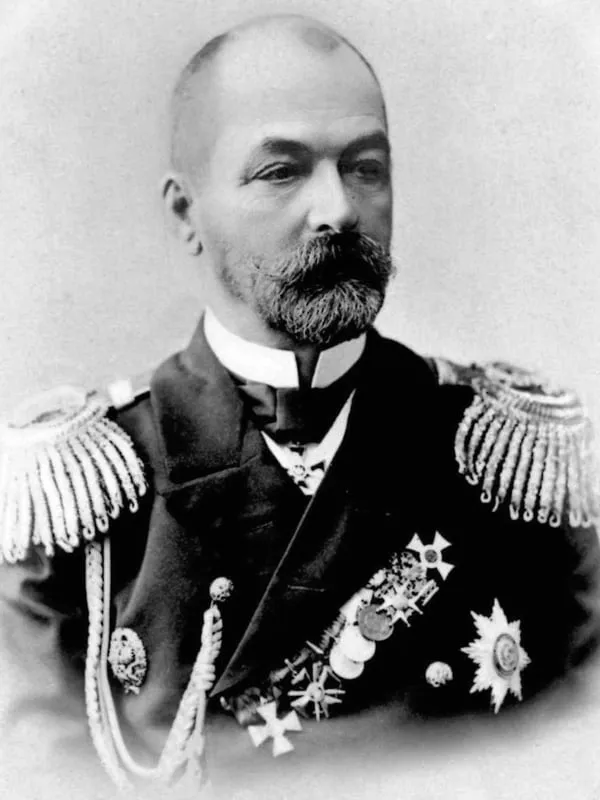
- Born:
- 11 November 1848, St Petersburg
- Died:
- 14 January 1909, St Petersburg
- Author:
- Natalia
- Photo:
- autor nieznany, domena publiczna, Wikimedia Commons

Zinovy Rozhestvensky was the admiral whose name became for ever linked with Tsushima. In October 1904 he led out of the Baltic a squadron made up of new, untried battleships and old vessels with untrained crews, and for seven months he took it around Africa and across the Indian Ocean to the Far East, without bases of his own along the way, in one of the longest voyages ever made by a steam fleet. On 27 May 1905, in the Korea Strait, his path was barred by the Combined Fleet of Heihachirō Tōgō, which destroyed the Russian squadron in less than a day. The badly wounded admiral was taken prisoner by the Japanese. Tsushima decided the outcome of the Russo-Japanese War, gave Japan command of the seas of the Far East and became the model on which the Japanese navy prepared for war with America over the following decades.
Early life and the war with Turkey
He was born in St Petersburg on 11 November 1848 (30 October in the Julian calendar), the son of a military doctor, although some Russian biographers state that the family came from Smolensk Governorate. He graduated from the Naval Cadet Corps in 1868, and in 1873 from the Mikhailovsky Artillery Academy as a specialist in naval artillery. He was fluent in English and French. One of his first superiors described him as “terribly nervous, but brave and a very good seaman”.
In 1876 he was transferred to the Black Sea Fleet, where he prepared the artillery for the coming war with Turkey. In the Russo-Turkish War he served on the armed steamer Vesta, which on 23 July 1877 (11 July in the Julian calendar) fought a battle lasting several hours with the Turkish ironclad Fethi Bülend. Rozhestvensky, who took over command of the guns after the death of the artillery officer, was awarded the Order of St George, 4th Class, and promoted for the action. The Vesta’s captain presented the engagement as a victory in which the Russian steamer had seriously damaged the ironclad and forced it to flee. After the war Rozhestvensky revealed in the press that in reality the Vesta had been fleeing from a much stronger opponent, and that its shells had done the enemy little harm. This frankness did not harm his career.
Bulgaria, London and the court
In 1883–1885 Rozhestvensky was seconded to the newly created Principality of Bulgaria, where he directed the building of the Bulgarian naval flotilla and commanded the yacht of Prince Alexander of Battenberg. He drew up the first Bulgarian naval regulations and a plan for the defence of the coast. On his return he served on ships of the Baltic and Pacific fleets, and in 1891–1893 he was naval attaché in London, where he came to know the Royal Navy well. In 1894–1895 he commanded the cruiser Vladimir Monomakh in the Mediterranean squadron of Admiral Stepan Makarov, with which he sailed to the Far East when tension with Japan mounted after the First Sino-Japanese War.
In 1898 Rozhestvensky became a rear admiral and commander of the Baltic Fleet’s gunnery training detachment. He won renown in 1900 for the salvage of the coastal defence battleship General-Admiral Apraksin, which had run aground on the rocks off the island of Gogland in the Gulf of Finland. The radio telegraph of the inventor Alexander Popov was used for the first time in practice to communicate with the shore. In 1902 the naval review that Rozhestvensky staged at Reval (Tallinn) for the meeting between Nicholas II and Wilhelm II delighted both emperors. The Tsar took him into his suite and in 1903 entrusted him with the post of Chief of the Main Naval Staff. Rozhestvensky was an advocate of a fleet of great battleships and of the decisive naval battle. His plans to strengthen the forces in the Pacific had not been carried out by the time war broke out.
Halfway around the world
When Japan attacked Port Arthur in February 1904 and Makarov was killed in April, the Russian high command decided to send ships of the Baltic Fleet to the Far East as the Second Pacific Squadron, which together with the squadron at Port Arthur was to regain command of the sea. Command was given to Rozhestvensky. The squadron comprised four new battleships of the Borodino class, some of them barely completed, older battleships, cruisers, destroyers and auxiliary vessels. According to the memoirs of Grand Duke Alexander Mikhailovich, the admiral admitted in private that he had no chance of victory, but that public opinion demanded action and he was ready to sacrifice himself.
On 15 October 1904 the squadron left Libau (Liepāja). As early as the night of 21–22 October in the North Sea, amid rumours of Japanese torpedo boats lying in wait in European waters, Russian ships opened fire on British fishing trawlers from Hull. Two fishermen were killed and a third died later. Shells also struck the Russian cruiser Aurora. The Dogger Bank incident brought Russia and Britain to the brink of war. The Royal Navy prepared for action, and British cruisers shadowed the Russians across the Bay of Biscay. The matter was referred to an international commission of inquiry in Paris, which in February 1905 criticised Rozhestvensky for opening fire but acknowledged that once he realised the mistake he had tried to stop the shooting. Russia paid compensation.
At Tangier the squadron divided. The new battleships under Rozhestvensky’s command sailed around Africa, while the older and smaller ships went through the Suez Canal. Britain, Japan’s ally, put pressure on France and other states not to admit the Russians to their ports, so coal had to be loaded from German colliers on the open sea or in roadsteads, in the tropical heat. In Madagascar, where the two halves met in the roadstead of Nosy Be, the squadron received the news of the fall of Port Arthur. The purpose of the expedition had ceased to exist, but St Petersburg ordered it to sail on and sent after it a further detachment of old ships under Rear Admiral Nikolai Nebogatov, which Rozhestvensky regarded as ballast. After two months at anchor the squadron crossed the Indian Ocean and in April reached the coast of French Indochina, where Nebogatov joined it in May.
Rozhestvensky was a despotic, hot-tempered and distrustful commander. He berated officers in front of their crews, did not share his plans with them and held no councils of war. During the voyage his ships did little gunnery practice, partly for lack of practice ammunition, and the squadron’s station-keeping left much to be desired. The crews, worn down by the tropical heat, coaling and idleness, lost heart. At the same time, simply bringing such a heterogeneous fleet to the other side of the world without losing a single ship was a feat that not even his critics deny him.
Tsushima
There were several routes from Indochina to Vladivostok. Rozhestvensky chose the shortest, through the Korea Strait, where Tōgō was waiting for him. On the morning of 27 May 1905 the squadron was spotted by a Japanese armed merchant cruiser, and in the afternoon battle was joined. Tōgō executed a turn that placed his line across the Russian column and concentrated his fire on the Russian flagships. Rozhestvensky’s flagship, the new battleship Knyaz Suvorov, was quickly reduced to a burning wreck, and the admiral himself was wounded several times, finally seriously in the head. After some tens of minutes of fighting the squadron had lost all direction. The unconscious admiral was transferred to the destroyer Buiny and then to the Bedovy (PL), which tried to reach Vladivostok. On 28 May the crew of the Bedovy, overtaken by Japanese destroyers, surrendered without a fight, and Rozhestvensky was taken prisoner. That same day Nebogatov, surrounded by the Japanese fleet, surrendered what was left of the main force.
The Battle of Tsushima was the most one-sided major naval battle of the battleship era. The Russians lost all their battleships, sunk or captured, more than 5,000 killed and some 6,000 taken prisoner. Only a cruiser and two destroyers reached Vladivostok. The Japanese lost three torpedo boats and just over a hundred killed. Rozhestvensky was treated in hospital at Sasebo, where Tōgō visited him and consoled him with the words that defeat is the lot of the soldier and there is nothing shameful in it if one has done one’s duty. The defeat persuaded the Tsar to accept the mediation of President Theodore Roosevelt, and on 5 September 1905 Russia signed the Treaty of Portsmouth.
Trial and final years
At the end of November 1905 Rozhestvensky left Japan and returned to St Petersburg via Vladivostok, which was in the grip of revolutionary unrest, and the Trans-Siberian Railway. At first he kept his post as Chief of the Main Naval Staff, but the press laid the whole blame for the defeat on him, and in February 1906 he resigned. He demanded to be put on trial himself. In the summer of 1906 a naval court at Kronstadt tried him and the officers who had surrendered the Bedovy. Rozhestvensky took responsibility on himself, defended his subordinates, especially the sailors, and is said to have demanded the death penalty for himself. The court acquitted him, ruling that, being badly wounded and unconscious, he could not be held responsible for the surrender of the ship, and sentenced several officers of his staff and the destroyer’s captain to death. At the end of the year, in a separate trial, Nebogatov and several of his ship commanders were also sentenced to death. The Tsar commuted all these sentences to terms of fortress imprisonment.
He spent his last years in seclusion in St Petersburg. In a letter from this time he wrote that had he possessed even a spark of civic courage, he would have cried out to the whole world not to send the last forces of the fleet to destruction, but that spark had been lacking. He died suddenly on New Year’s night 1909 – 14 January in the Gregorian calendar (1 January in the Julian) – and was buried in the Tikhvin Cemetery of the Alexander Nevsky Lavra. His grave was destroyed after the revolution.
Significance
In Russia Rozhestvensky became a symbol of the incompetence of the tsarist high command. The image of a despot who cowed his subordinates and thoughtlessly led the fleet to the slaughter was fixed above all by the novel Tsushima by Aleksey Novikov-Priboy, a participant in the battle, published in the 1930s and read by whole generations in the Soviet Union. Some historians defend him, pointing out that he was given an impossible task and that his squadron, with its obsolete ships and untrained crews, stood no chance against the rested and experienced Japanese fleet.
Tsushima’s significance reached far beyond the war of 1905. Russia lost most of its fleet and for years ceased to count at sea, while Japan became the world’s third naval power. The Japanese navy took the victory at Tsushima as its model and for the following decades prepared for a single great, decisive battle with the American fleet. In December 1941 the same “Z” flag under which Tōgō had fought Rozhestvensky was hoisted on the mast of the carrier leading the attack on Pearl Harbor, and in 1945 Joseph Stalin, announcing victory over Japan, recalled the defeat of 1904 and 1905 as a stain on the country’s honour that the Soviet Union had at last wiped away.