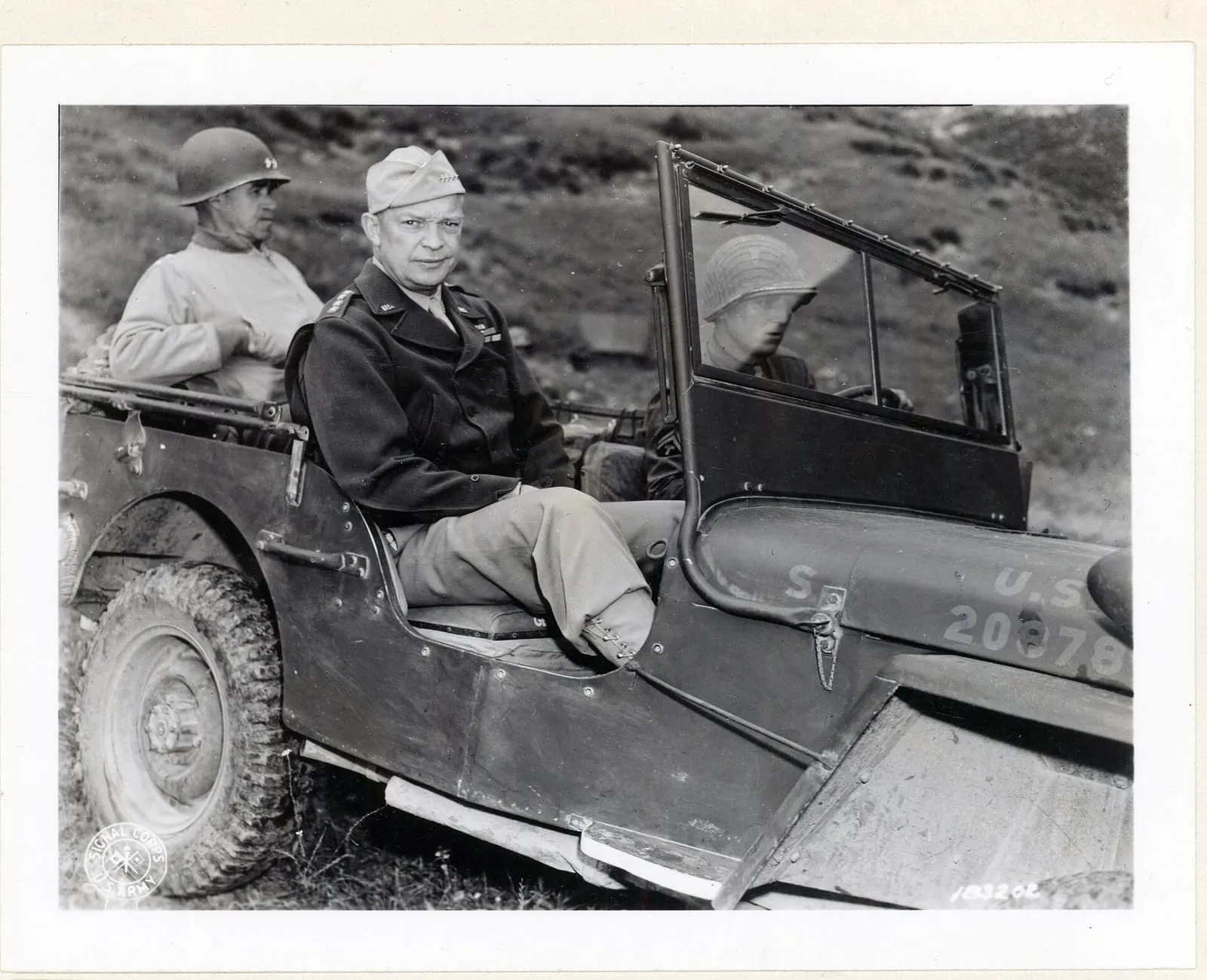
On Christmas Eve 1943 President Franklin Delano Roosevelt gave one of his fireside chats on the radio, devoted to the conferences in Cairo and Tehran. Midway through came the sentence that journalists, staff officers and – as it turned out – Stalin too had been waiting for: the commander who would lead the great assault on Germany from the west would be General Dwight Eisenhower. It put an end to months of speculation that the invasion of France would be commanded by the US Army Chief of Staff, General George Marshall. The decision had been taken on 5 December in Cairo, and Eisenhower himself had learned of it on 7 December in Tunis; on 24 December it became public.
War chronologies record the event twice: under 24 December, that Eisenhower “became Supreme Allied Commander in Europe”, and under 27 December, that he “was officially appointed head of Operation Overlord”. Both formulations need qualifying. The appointment was officially announced on 24 December, and the sources record no separate act dated 27 December; Eisenhower received his formal directive from the Chiefs of Staff only on 12 February 1944. His title, moreover, was Supreme Commander, Allied Expeditionary Force. “Supreme Allied Commander Europe” is the name of a later NATO post, which Eisenhower was the first to hold, in 1951.
Who would lead Overlord
From the spring of 1943 the plan for a cross-Channel invasion had been prepared in London by the Anglo-American staff of General Frederick Morgan, known as COSSAC after the title of its head – Chief of Staff to the Supreme Allied Commander, a commander who did not yet exist. The plan, named Overlord, was approved in August at the Quebec Conference. There, too, Winston Churchill, who had earlier promised command of the invasion to the Chief of the Imperial General Staff, General Alan Brooke, agreed that since American troops would predominate in the operation, an American should command it. Brooke took this as one of the greatest disappointments of his life.
Throughout the autumn almost everyone was convinced that the American would be Marshall. He had the backing of the Secretary of War, Henry Stimson, who believed that only Marshall’s authority could keep the British committed to the invasion. At the end of November Roosevelt told Eisenhower that history remembers field commanders, not chiefs of staff, and that Marshall had earned a great command in the field. Eisenhower therefore expected to return to Washington to replace Marshall as Army Chief of Staff, and through his own chief of staff, General Walter Bedell Smith, let it be known that he would rather command an army group under Marshall than sit behind a desk in the Pentagon.
As early as the summer General Morgan had been pressing for a commander to be appointed at once, since without someone in authority it was hard to obtain men, ships and landing craft. Roosevelt kept putting off the decision, explaining to the British in October that announcing a name would betray Allied intentions to the enemy.
Stalin’s question and the decision in Cairo
It was Joseph Stalin who forced the pace. At the Tehran Conference on 29 November he asked bluntly who would command Operation Overlord. When told that no commander had yet been appointed, he replied that in that case nothing would come of the operation: a chief of staff planning the invasion was not enough, and a newly appointed commander might reject everything prepared before him. According to the memoirs of Admiral William Leahy, Roosevelt then whispered to him that “that old Bolshevik” was trying to make him give a name he did not yet know himself. The next day the President promised that the choice would be made within three or four days, soon after his return to Cairo.
Even before Tehran the American Chiefs of Staff had proposed that a single commander should direct all Allied forces fighting Germany in the west – in France, in the Mediterranean and in the strategic air offensive. The British rejected this as an “entirely new experiment” that would merely add an unnecessary link to the chain of command. Once that idea had fallen, command of Overlord would mean Marshall leaving the meetings of the Combined Anglo-American Chiefs of Staff, where he defended the American position, and giving up his role as intermediary between the President, Congress and the commanders in the Pacific. Roosevelt was less and less willing to lose him. Eisenhower, on the other hand, had made a good impression on the assembled Chiefs of Staff in Cairo, had three great landings behind him – in North Africa, Sicily and Italy – and enjoyed the full confidence of the British.
During the second part of the Cairo Conference, on 4 December, the President sent Harry Hopkins to ask Marshall which post he would prefer. Marshall replied that he would accept whatever the President decided. On Sunday 5 December Roosevelt asked him in person and heard the same answer. He then said – according to Marshall’s own account, quoted by Robert Sherwood – that he feared he could not sleep at night with Marshall out of the country. That day he chose Eisenhower. The following day Marshall himself wrote out, for the President’s signature, the message to Stalin announcing that the immediate appointment of General Eisenhower to command Operation Overlord had been decided upon. He later sent the draft, bearing Roosevelt’s signature, to Eisenhower as a keepsake.
It was also settled in Cairo that after Eisenhower’s departure command of all Allied forces in the Mediterranean would pass to the British general Henry Maitland Wilson, until then Commander-in-Chief in the Middle East.
“Well, Ike, you are going to command Overlord”
Eisenhower learned of it all in a rather unexpected way. On the morning of 7 December he received a puzzling message from Marshall: the Chief of Staff asked for his proposals on how the administration and supply of American troops in the Mediterranean should be organised “in view of the imminent appointment of a British officer as your successor”. Marshall evidently assumed that Eisenhower already knew. That same day Roosevelt, on his way back from Cairo, landed at an airfield near Tunis. Eisenhower went to meet him and got into his car. According to his memoir Crusade in Europe, the President said almost at once: “Well, Ike, you are going to command Overlord.” Eisenhower replied that he understood how hard a decision the President must have had to make and hoped he would not disappoint him.
For the next two weeks the appointment remained secret. Eisenhower continued to direct the fighting in Italy, where the Allies were bogged down in mud and rain in front of the German Gustav Line, and prepared to hand over command to Wilson. Churchill, who had fallen ill with pneumonia after Tehran and was recovering at Carthage near Tunis, agreed the remaining names with London and Washington.
The Christmas Eve broadcast
On the afternoon of 24 December Roosevelt addressed the nation from his family home at Hyde Park. It was a fireside chat – one of the radio talks in which, since 1933, he had spoken to Americans as if to neighbours round the table. This time he described his journey to Cairo and Tehran: his meeting with Chiang Kai-shek; the fact that – to use, as he put it, a “somewhat ungrammatical” colloquialism – he had “got along fine” with Stalin; and the agreement on the great assault on Germany. The Red Army would keep up its offensive in the east, the forces in Italy would press from the south, and “the encirclement will be complete” when powerful American and British forces struck from other directions.
“The commander selected to lead the combined attack from these other points is General Dwight D. Eisenhower,” the President announced. He justified the choice by saying that Eisenhower had performed “brilliantly” in Africa, Sicily and Italy and knew from experience how to coordinate air, sea and land operations; all three services were to come under his orders. In the same sentence Roosevelt added that General Carl Spaatz would take command of all American strategic bombing operations against Germany. Eisenhower, he went on, was handing over the Mediterranean command to a British officer whose name Churchill was announcing at that moment, and the names of the American and British commanders serving under the two new supreme commanders would be made known “within a few days”. The broadcast ended with a Christmas greeting to the more than ten million Americans in uniform, 3.8 million of whom were already serving overseas.
The new command structure
The same day Churchill announced the other half of the changes. General Wilson became Supreme Allied Commander in the Mediterranean; General Harold Alexander continued to command the Allied armies in Italy. The Prime Minister also announced that General Bernard Law Montgomery, commander of the British Eighth Army, would take over from General Bernard Paget the 21st Army Group – the British formation being prepared for the invasion. On 24 December General Oliver Leese was ordered to succeed him at the head of the Eighth Army; Montgomery took leave of his soldiers at the end of December, and Leese assumed command at the turn of the year.
In the weeks that followed the remaining posts were filled. Eisenhower’s deputy was Air Chief Marshal Arthur Tedder, with whom he had worked in the Mediterranean and whom he wanted at his side as his chief airman. Choosing a British airman as deputy was deliberate: air power was to play an enormous part in the invasion, and the dispute over who should control the strategic bombers had already surfaced when the Allied Expeditionary Air Force of Air Chief Marshal Trafford Leigh-Mallory was created. The naval forces of the invasion were to be commanded by Admiral Bertram Ramsay, organiser of the Dunkirk evacuation, and the US First Army by General Omar Bradley, whose troops, shipped across the Atlantic, were already assembling in England – like the corps that had arrived there in mid-December. Wilson’s deputy was the American General Jacob Devers, until then commander of US forces in Europe, and command of the Mediterranean air forces went to General Ira Eaker, previously commander of the US Eighth Air Force in England. As his chief of staff Eisenhower kept his loyal Bedell Smith – although Churchill would have preferred to leave him in Algiers as Wilson’s deputy – and General Morgan, author of the original plan, became Smith’s deputy.
Under 27 December the chronologies note that Eisenhower was “officially appointed head of Operation Overlord”. No separate act of that date is known. The public announcement came on Christmas Eve, and the further steps were spread over the following weeks: on 8 January 1944 Wilson took over command in Algiers; in mid-January Eisenhower flew to London; on 12 February the Combined Chiefs of Staff issued him his formal directive; and on 13 February his headquarters was set up – SHAEF, Supreme Headquarters Allied Expeditionary Force, which absorbed the COSSAC staff. The directive instructed him to enter the continent of Europe and, together with the other United Nations, to undertake operations aimed at the heart of Germany and the destruction of her armed forces.
Last days in the Mediterranean
Eisenhower spent the end of December in Algiers, settling the affairs of his existing command. Towards the end of the month he met General Charles de Gaulle, who had recently become sole president of the French Committee of National Liberation. After months of mistrust between the Americans and de Gaulle, the conversation was surprisingly cordial; according to the general’s memoirs, Eisenhower promised that French troops would be the first to enter liberated Paris. At the request of Marshall, who wanted the new commander to discuss the needs of the invasion in Washington and to get at least a little rest, Eisenhower flew to the United States on 1 January 1944, stopping on the way to see the convalescent Churchill in Marrakesh. Until he arrived in London, Montgomery and Bedell Smith were to act on his behalf.
Significance
Eisenhower’s appointment settled the dispute over leadership in the Western coalition and gave Overlord what it had lacked for months: a commander who could demand men, ships and landing craft. The decision also had a political dimension. Supreme command in Europe passed to an American, reflecting the growing preponderance of American forces; in return the British received the Mediterranean command and all three service commands in the invasion itself – land, sea and air. Stalin, for his part, received proof that the promise made at Tehran was serious.
The new command’s first decisions came quickly. Montgomery read the COSSAC plan in Marrakesh at the turn of the year and judged it too weak. At a conference in London on 21 January 1944, now chaired by Eisenhower, the landing was enlarged from three to five divisions on a wider stretch of the Normandy coast, and to obtain additional landing craft the date was moved from May to early June. On the other side of the Channel, meanwhile, preparations for the defence were being directed by Field Marshal Erwin Rommel, who since December had been inspecting the fortifications of the Atlantic Wall.
On the evening of 4 June and the morning of 5 June 1944 Eisenhower took the decision to launch the invasion, and on 6 June the Allies landed in Normandy. As Supreme Commander he directed the campaign through France, Belgium and the Netherlands until the surrender of Germany, which was signed at his headquarters in Reims on 7 May 1945. Marshall, who had given up a field command, remained Army Chief of Staff until the end of the war and was one of the chief architects of victory; for his plan for the reconstruction of Europe he later received the Nobel Peace Prize. Eisenhower – chosen in December 1943 above all because Roosevelt did not want to part with Marshall – became the first Supreme Allied Commander of NATO forces in Europe in 1951, and President of the United States in 1953.
Sources
Meanwhile
(04)Elsewhere, within a week.
- 26 December 1943 · PacificThe landing at Cape GloucesterOn 26 December 1943 the US 1st Marine Division landed at Cape Gloucester on New Britain. On 30 December the Marines took the Japanese airfield.
- 28 December 1943 · PacificThe Chinese in the Hukawng ValleyOn 28 December 1943 three battalions of the Chinese 38th Division attacked the Japanese at Yupbang Ga in Burma's Hukawng Valley. Stilwell's offensive was on.
- 29 December 1943 · PacificThe Andamans for Azad HindOn 29 December 1943 Subhas Chandra Bose reached Port Blair in the Andamans, which Japan had handed to his Azad Hind government. Real power stayed Japanese.
- 30 December 1943 · PacificThe end of Japanese raids on CalcuttaWar chronologies end the Japanese raids on Calcutta on 30 December 1943. The last big one was the daylight attack on Kidderpore docks on 5 December.
Related events
(04)The same battle, people or subject.
- 16 January 1944 · Western FrontEisenhower in LondonOn 16 January 1944 General Eisenhower, newly arrived in London, took command of US forces in Europe (ETOUSA) while building SHAEF, the invasion staff.
- 30 April 1944 · Western FrontPreparations for D-DayBy late April 1944 southern England was a vast camp. The Allies massed troops, landing craft and artificial harbours and fooled the Germans with a ghost army.
- 14 February 1944 · Western FrontSHAEF and the Overlord planOn 12 February 1944 the Allied chiefs of staff gave Eisenhower his directive for invading Europe; on 13–14 February his headquarters, SHAEF, was set up.
- 6 June 1944 · Western FrontD-Day: the Normandy landingsOn 6 June 1944 some 156,000 Allied troops landed in Normandy by sea and air. Five beachheads were taken, but Caen remained in German hands.