- Category:
- Military operations
- Front:
- Central and Eastern Europe
- Date:
- 29 August 1944
- Author:
- Natalia
- Tags:
- Slovakia, resistance, Third Reich, Jozef Tiso
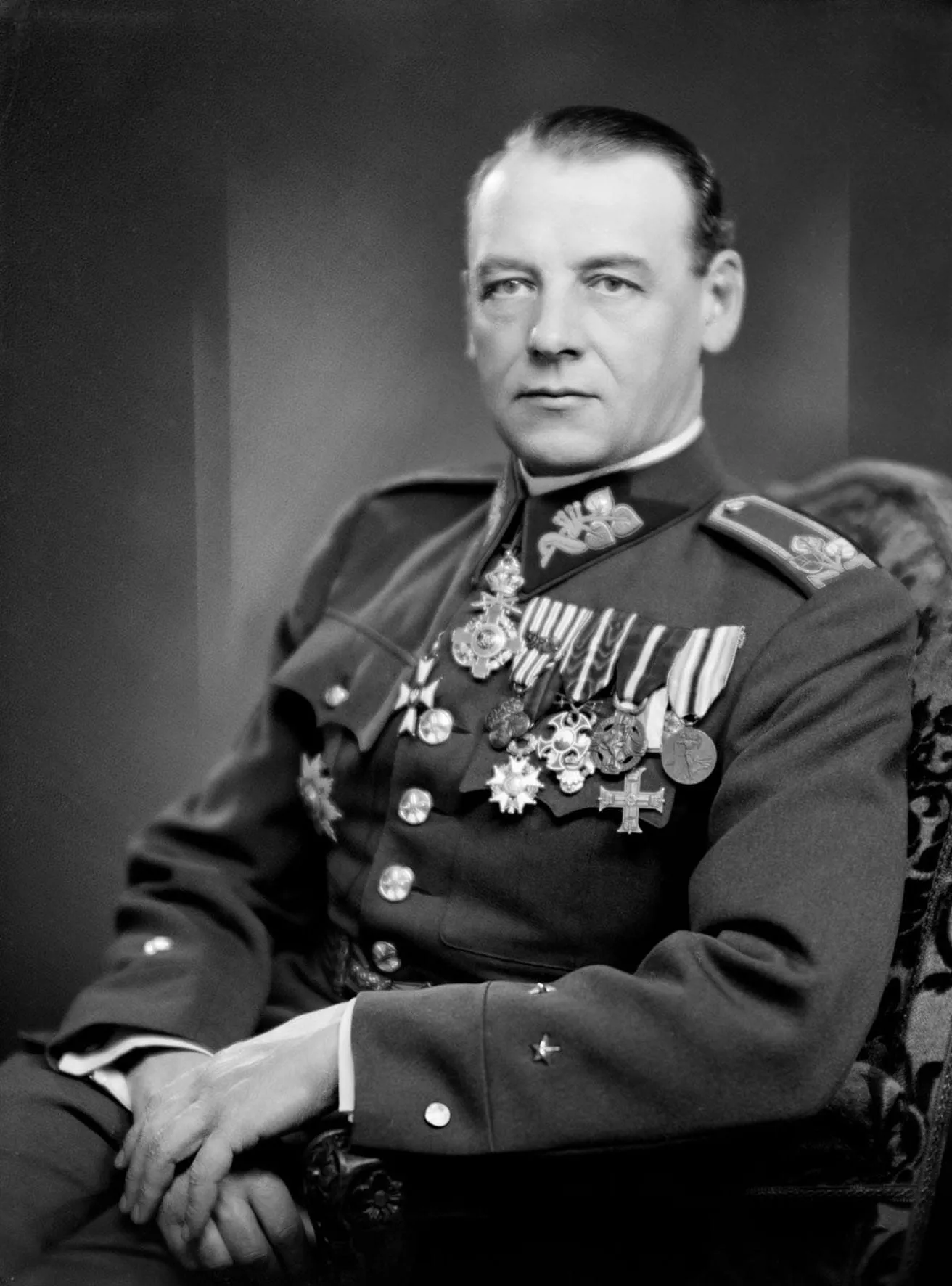
On the evening of 29 August 1944 the prearranged signal went out from the Land Forces Command in Banská Bystrica to the garrisons of the Slovak army: units were to resist the German troops entering Slovakia. So began the Slovak National Uprising – an armed rising prepared for months by the clandestine Slovak National Council and a group of officers around Lieutenant Colonel Ján Golian, but launched earlier than planned and in far worse conditions. The uprising against the Germans and the regime of President Jozef Tiso covered central Slovakia and lasted as an organised struggle by regular troops until the end of October 1944; in the west and east of the country the Germans disarmed most Slovak units within the first few days.
The Slovak state in the fifth year of the war
The Slovak Republic had been proclaimed on 14 March 1939 at Hitler’s behest, on the eve of the Wehrmacht’s occupation of Bohemia and Moravia, and the Treaty of Protection of 23 March 1939 gave the Reich control over its foreign and military policy as well as a “protected zone” in the west of the country. The priest Jozef Tiso, President of the state from October 1939, and his government went along with Germany in everything: Slovak divisions entered Poland in September 1939, in June 1941 Slovakia declared war on the USSR, and in 1942 the authorities in Bratislava themselves organised the deportation of some 58,000 Jews to the German death camps.
Until 1944, however, the country, which lived off production for the Reich, was relatively calm and prosperous compared with occupied Europe, and outside the protected zone no significant German forces were stationed on its territory. Decay was spreading in the army. After the defeat at Stalingrad Slovak soldiers on the Eastern Front began going over to the Soviet side in large numbers, and in the autumn of 1943 two large-scale desertions convinced the Germans that Slovak units were unfit for combat in the east. The officer corps, largely drawn from the former Czechoslovak army, was for the most part pro-Western and kept its distance from both the regime and communism.
In the summer of 1944 the Red Army reached the foothills of the Carpathians. The Lwów–Sandomierz offensive had pushed the front west of Lwów (Lviv), and from the north-east the Slovak border was now little more than a hundred kilometres away. Part of the Slovak army had been concentrated in the east of the country: the two best-equipped infantry divisions, some 24,000–25,000 men in all, formed the so-called East Slovak Army under General Augustín Malár. The Defence Minister, General Ferdinand Čatloš, had his own designs for it: he expected that at the right moment it would open the Carpathian passes to the Russians, while he himself would take power and bring the country over to the Allied side. The conspirators pinned their hopes on the same divisions.
The Slovak National Council and the Military Centre
For a long time the opposition to the regime was divided. The communists, banned since 1938 and the most harshly persecuted, changed their position on Slovak statehood in line with Moscow; the civic camp – above all the Agrarians, mostly Protestants – and circles loyal to the Czechoslovak government-in-exile in London wanted Czechoslovakia restored, but not as the centralised republic of before 1938. Agreement was reached only once the course of the war had made it inevitable and President Edvard Beneš had signed the Czechoslovak-Soviet Treaty of Friendship and Mutual Assistance in Moscow in December 1943. That same month representatives of both camps concluded the so-called Christmas Agreement and set up the clandestine Slovak National Council. Its members included the communists Gustáv Husák, Ladislav Novomeský and Karol Šmidke and the Agrarian Ján Ursíny (PL). Its programme called for the overthrow of the Tiso regime, the fight against Germany and the restoration of Czechoslovakia as a republic of the Czech and Slovak nations with equal rights, in close association with the Soviet Union.
Without the army an uprising had no chance, and in the army the conspiracy had a man in a key post. Since January 1944 Lieutenant Colonel Ján Golian had been chief of staff of the Land Forces Command in Banská Bystrica; in March Beneš entrusted him with directing the military preparations in Slovakia. On 27 April 1944 a clandestine Military Centre was set up under Golian, subordinate to the Slovak National Council. The plan envisaged two scenarios. In the more favourable one, the uprising would break out in concert with the approaching Red Army: the East Slovak Army would open the Carpathian passes and the whole country would go over to the Allies. If the Germans forestalled the conspirators and began to occupy Slovakia, the army was to resist and defend itself in the mountainous triangle of Banská Bystrica, Brezno and Zvolen, where units, weapons and supplies were being concentrated under various pretexts.
An understanding with Moscow was crucial. On 4 August 1944 Šmidke and Captain Mikuláš Ferjenčík flew to Ukraine with the plans for the uprising (and with a memorandum from Čatloš); they were questioned at the headquarters of a Soviet front and then in Moscow, but received no answer about Soviet intentions. The London government, too, remained in the dark for weeks about how the Kremlin viewed the Slovak plans. Meanwhile, since 1 August, the Warsaw Uprising had been under way – launched as Soviet troops were approaching Praga on the Warsaw side of the Vistula, and left without their help in the weeks that followed.
The partisans, Martin and the German decision
In the event, it was others who decided the timing. Since the spring of 1944, under an agreement between the Czechoslovak communist leader in Moscow, Klement Gottwald, and Nikita Khrushchev, the partisan movement in Slovakia had been subordinated to the Ukrainian Staff of the Partisan Movement (PL) in Kiev. From the end of July Soviet organising groups were dropped into the Slovak mountains; the first, during the night of 25–26 July, was led by Lieutenant Pyotr Velichko. The units were joined by deserters, escaped Soviet prisoners of war, Jews in hiding and opponents of the regime. Historians’ estimates of the partisans’ numbers vary widely – from around 2,000 when the uprising broke out to 12,000–18,000 at its peak. The units blew up bridges and railway lines, raided police posts and offices, and also attacked local Germans and officials of the regime, despite warnings from the Slovak National Council and the Military Centre that this would bring on an occupation before the army was ready. On 9 August the authorities in Bratislava ordered an operation against the partisans, and on 12 August they declared a state of emergency.
Feelings were inflamed by the coup in Romania of 23 August, after which Bucharest broke with the Reich. In Berlin there were fears that the example would spread. On 27 August partisans, called in by the commander of the local garrison, occupied Ružomberok with its armaments works. The same day in Martin Velichko’s detachment, together with soldiers of the local garrison, stopped a train carrying a German military mission returning from Romania. The next day, 28 August, the detainees were shot in the barracks by Slovak soldiers – according to most accounts at the partisans’ demand, in circumstances that have never been fully explained. Sources give between 22 and more than 30 dead; according to some of them, women and children were among the victims.
The Martin incident settled the matter. The German minister in Bratislava, Hanns Ludin, who as late as 27 August had withdrawn an earlier request for troops, now, on Joachim von Ribbentrop’s instructions, demanded formal consent from the Slovak authorities for the Wehrmacht to move in. After some hesitation Tiso gave it; Slovak sources date the government’s consent to 28 August. German preparations had in any case been under way for several days regardless, and on 1 August, by Hitler’s order, the divisions of the East Slovak Army had been placed under the German Army Group North Ukraine. On 29 August the first hastily formed German battle groups crossed the Slovak borders. In the evening Čatloš, on Tiso’s instructions, announced on Bratislava radio that the government had called in German troops to fight the partisans and that the army was not to resist them.
The evening of 29 August
Golian had heard nothing from Šmidke or from Moscow, and his plan had assumed an entirely different situation. The choice, however, was simple: either the army fought, or it would be disarmed unit by unit. Soon after Čatloš’s broadcast – at around 8 p.m., according to the version accepted in the historiography – the Military Centre telephoned the garrisons with the code phrase for the start of the uprising (“Začnite s vysťahovaním”, “Begin the move”) and the order to resist the Germans. The uprising therefore began not at a moment of the conspirators’ choosing but as a response to the German invasion, and in the scenario they had considered the worse of the two.
In central Slovakia most garrisons obeyed the order. Within a few days the insurgents controlled an area of some 20,000–22,000 square kilometres with a population of around 1.7 million, with Banská Bystrica as the seat of authority and the Tri Duby airfield near Zvolen. On the advice of the London government, on 30 August the command announced that its units were part of the armed forces of Czechoslovakia; in time they took the name 1st Czechoslovak Army in Slovakia. On 1 September in Banská Bystrica the Slovak National Council declared that it was assuming power in Slovakia and proclaimed the restoration of Czechoslovakia. The insurgents detained the army’s commander-in-chief, General Jozef Turanec; a few days later Čatloš made his way to Banská Bystrica and placed himself at their disposal, after which both men were handed over to the Soviets. After the mobilisation declared on 5 September the insurgent army numbered, by various calculations, 46,000–47,000 men, and later up to 60,000, although many of them lacked weapons. Partisan units operated alongside it.
In the west and east of the country the plan failed. The strong garrisons of Bratislava and Nitra did not join the uprising; from western Slovakia only the garrison of Trnava, 3,000–4,000 men according to various sources, went over to the insurgents as a whole. The heaviest blow fell in the east. General Malár was in Bratislava during the decisive hours, and on 30 August he called on the soldiers over the radio to stay in their barracks because “our time has not yet come”. Deprived of their commander and of clear orders, both divisions of the East Slovak Army had been disarmed by 31 August by the Germans, who had been preparing the operation for several days. Some of the soldiers were interned, others went home or joined the partisans; an estimated 2,000 or so reached the insurgents in central Slovakia. Stocks of weapons and equipment fell into German hands, and above all the Carpathian passes that this army was supposed to open to the Russians. With that the uprising’s main hope – a swift link-up with the Red Army – collapsed.
Two months of fighting
The Germans expected to deal with Slovakia within a few days. From 1 September operations outside the eastern part of the country were directed, as “German General in Slovakia”, by SS-Obergruppenführer Gottlob Berger, who initially had fewer than 9,000 men in improvised battle groups. As early as the approaches to Žilina the attack was halted by Slovak resistance, and the insurgents even managed to retake several places, including Telgárt in the east (3–5 September). On 14 September Berger was replaced by SS-Obergruppenführer Hermann Höfle, who brought in reinforcements – an estimated 48,000–50,000 men in all, including SS units – and methodically tightened the ring. The government in Bratislava remained loyal to the Reich: on 5 September Prime Minister Vojtech Tuka was replaced by Štefan Tiso, and units of the Hlinka Guard took part in suppressing the uprising.
Help from outside did come, but it was limited and too late. The Red Army changed its plans and on 8 September launched the East Carpathian offensive, in which troops of Marshal Ivan Konev’s 1st Ukrainian Front, together with General Ludvík Svoboda’s I Czechoslovak Army Corps, fought their way through the Dukla Pass, which was now defended not by the Slovak divisions but by the Germans. The pass was taken only on 6 October, at the cost of heavy losses, and no link-up with the insurgents was achieved. A Czechoslovak fighter regiment and the 2nd Czechoslovak Independent Parachute Brigade were flown in to Tri Duby airfield, but the brigade arrived piecemeal over several weeks. On 7 September Great Britain and the United States recognised the insurgents as a force fighting the Germans and warned the Reich against reprisals; the USSR made a similar declaration later. Direct Western support was limited to a few flights by American bombers carrying supplies and liaison missions, and on 22 September the American command judged wider assistance to be impracticable. The German historian Wolfgang Venohr judged Allied support for the uprising to have been as negligible as in the case of Warsaw.
Alongside the Slovaks, members of several dozen nationalities fought in the uprising, among them several thousand Soviet citizens, Czechs, Hungarians, Frenchmen and an estimated 250 or so Poles. Jews held a special place: for them, after the deportations of 1942, the uprising was also a fight for survival. According to research by Slovak historians more than 1,500 Jews took part in it, including a unit made up of former inmates of the labour camp at Nováky, as well as parachutists from Palestine sent in by the British.
Defeat and reprisals
On 7 October command of the insurgent army was taken over by Major General Rudolf Viest, who had arrived from London, and Golian, who had been promoted to brigadier general on 5 September, became his deputy. By then the insurgent territory had shrunk to around 7,000 square kilometres. After the Arrow Cross seized power in Hungary in mid-October, the Germans were able to strike from the south as well. The offensive began on 18 October; among the units taking part were Oskar Dirlewanger’s SS brigade, previously used in Warsaw, and the 18th SS Division “Horst Wessel”. On 27 October the Germans took Banská Bystrica. At a final meeting in Donovaly the command and representatives of the Slovak National Council decided to switch to guerrilla warfare; organised resistance by regular troops ceased in the last days of October and the first days of November. Golian and Viest fell into German hands on 3 November and, taken to the Reich, most probably died in 1945 in the Flossenbürg camp. On 30 October Jozef Tiso celebrated a Mass of thanksgiving in Banská Bystrica and decorated the German soldiers who had crushed the uprising.
Insurgent losses in the fighting are usually estimated at several thousand soldiers and partisans killed; the number of German dead has still not been reliably established. The reprisals claimed far more victims. The German Einsatzgruppe H, brought into Slovakia and supported by Hlinka Guard units, murdered captured insurgents, partisans, Jews and Roma. The largest executions took place between November 1944 and February 1945 at Kremnička near Banská Bystrica, where 747 people were killed, most of them Jews, and at Nemecká, where the bodies were burned in lime kilns and where historians put the number of victims at several hundred – around 900 according to some research. According to the calculations of the Museum of the Slovak National Uprising, between September 1944 and April 1945 more than 5,000 people were murdered in Slovakia and buried in more than 200 mass graves, and around a hundred villages were burned or partly destroyed. After the uprising was crushed, the deportations of Slovak Jews resumed: through the camp at Sereď, run by Alois Brunner, some 13,000–14,000 people, by various calculations, were deported to the camps or murdered on the spot. Local Germans also fell victim to violence: in the areas held by the insurgents, partisans and soldiers killed an estimated one thousand to fifteen hundred civilians, mainly of German nationality; in the largest execution, at Sklené on 21 September, 187 men were killed.
The uprising’s place in the war
The Slovak National Uprising was, together with the Warsaw Uprising, the largest armed rising against the Germans in Central Europe in the summer of 1944, and one of the largest anywhere in the Europe occupied by or subordinated to the Reich. It was born of the same situation in which Romania changed sides and Hungary would soon try to: the Red Army stood at the borders, and states and societies bound to the Reich were looking for a way out of a war they were losing. Unlike in Romania, the Slovak conspirators did not manage to bring the whole country over to the other side. The Germans disarmed the most important divisions before they could play their allotted role, and the uprising – launched under the pressure of a premature German intervention for which the partisans’ action at Martin had opened the way – was confined to the mountains of central Slovakia.
Militarily the uprising was defeated, but for two months it tied down tens of thousands of German troops and hampered communications behind the Carpathian front. Its political consequences proved more important. Slovakia, created in 1939 at Hitler’s will and ruled to the end by Tiso as his ally, could point after the war to the uprising as proof that its society had taken a stand against the Reich; the Slovak National Council became the basis of the new authority in a country liberated by the Red Army and Czechoslovak units between the autumn of 1944 and the spring of 1945. The joint struggle of communists and democrats strengthened above all the communists, however, who seized power in the whole of Czechoslovakia in 1948 and then for decades subordinated the memory of the uprising to their own interpretation, playing down the role of the army and the democratic camp. Assessments of the uprising still divide Slovaks – for some it is the most important act of resistance in the nation’s history, while for those who uphold the tradition of Tiso’s state it was a revolt against their own state. 29 August is today a national holiday in Slovakia.
Sources
Meanwhile
(04)Elsewhere, within a week.
- 31 August 1944 · PoliticsThe Provisional Government in ParisAt the end of August 1944 the Provisional Government of the French Republic moved from Algiers to Paris and took over the administration of liberated France.
- 31 August 1944 · Eastern FrontThe Red Army in BucharestOn 31 August 1944 troops of the 2nd Ukrainian Front entered Bucharest. The city was already clear of Germans, and Romania was still awaiting an armistice.
- 26 August 1944 · Western FrontThe parade on the Champs-ÉlyséesOn 26 August 1944 de Gaulle walked down the Champs-Élysées amid crowds of Parisians. Shots rang out on the Place de la Concorde and in Notre-Dame.
- 1 September 1944 · Western FrontThe Canadians in DieppeOn 1 September 1944 the 2nd Canadian Division entered Dieppe unopposed, scene of its bloody defeat two years earlier. The Germans had left the day before.
Related events
(04)The same battle, people or subject.
- 4 September 1944 · ScandinaviaThe ceasefire between Finland and the USSROn 4 September 1944 the Finns ceased fire along the whole front. The Red Army fired on until 5 September, and a Finnish delegation set off for Moscow.
- 7 August 1944 · Crimes and repressionThe trial of the 20 July plottersOn 7 August 1944 the first 20 July conspirators stood before Roland Freisler's People's Court. All eight were hanged at Plötzensee on 8 August.
- 4 April 1945 · Central and Eastern EuropeThe capture of BratislavaOn 4 April 1945 troops of the 2nd Ukrainian Front took Bratislava. Tiso's government had already fled to Austria; the Slovak State ceased to exist.
- 2 October 1944 · PolandThe surrender of the Warsaw UprisingOn 2 October 1944 an agreement ending the Warsaw Uprising was signed at Ożarów. The Home Army received combatant rights; the city's people were expelled.