Germany
Joachim von Ribbentrop
Hitler's Commissioner for Disarmament (1934–1936), Ambassador in London (1936–1938), Foreign Minister of the Third Reich (1938–1945)
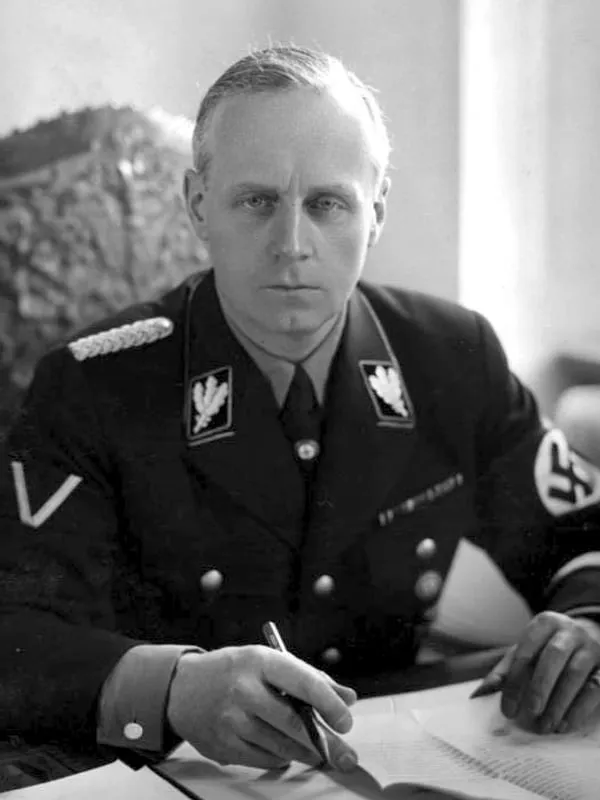
- Born:
- 30 April 1893, Wesel (Rhineland, Kingdom of Prussia)
- Died:
- 16 October 1946, Nuremberg
- Author:
- Natalia
- Photo:
- autor nieznany, domena publiczna, Wikimedia Commons

Joachim von Ribbentrop was a wine merchant who, thanks to his languages, his worldly manners and his boundless devotion to Adolf Hitler, became the most important diplomat of the Third Reich. In January 1933 the talks that opened Hitler’s way to the chancellorship were held in his Berlin villa. As special envoy he concluded the naval agreement with Britain in 1935 and the Anti-Comintern Pact with Japan in 1936. As ambassador in London he failed to win the British over and became their implacable enemy. As foreign minister from 1938 he pushed for war, pressed Germany’s demands on Poland over Gdańsk (Danzig), and on 23 August 1939 in Moscow signed the pact with Vyacheslav Molotov that sealed Poland’s fate. The ministry under his command took part in deporting Jews to their deaths. The Nuremberg tribunal sentenced him to death, and on 16 October 1946 he was the first of the defendants to go to the gallows.
Youth and war
He was born on 30 April 1893 in Wesel on the Rhine, the son of a Prussian officer, Richard Ribbentrop. His mother died of tuberculosis in 1902. He spent his childhood in garrison towns, from 1904 in Metz in Lorraine, where he learned to speak fluent French. He was a good sportsman and violinist but a poor pupil. In 1908 his father left the army and moved with the family to Arosa in Switzerland, where the children were taught by private tutors. Joachim then spent a year in England, and in 1910 he left for Canada. He worked in a bank in Montreal and on bridge and railway construction, briefly as a journalist in the United States, and finally set up a small firm in Ottawa importing German wines. He spoke fluent English and French, a rarity in Hitler’s later circle.
When war broke out in August 1914, Canada, as part of the British Empire, became enemy territory for a German. Ribbentrop made his way to the neutral United States and from there by ship to Rotterdam. In Germany he joined the 12th Hussar Regiment. He fought on both the Eastern and Western Fronts, was wounded, and received the Iron Cross First Class and the rank of lieutenant. In 1918 he served in Constantinople with the German military mission to the Ottoman Empire. There he met Franz von Papen, an acquaintance that would prove enormously important fourteen years later.
The merchant of Dahlem
After the war he went into the wine and spirits trade. In 1920 he married Anna Elisabeth (Annelies) Henkell, daughter of the owner of a famous sparkling wine house in Wiesbaden. They had five children. His own import firm made him a wealthy man. In 1925 he had himself adopted by a distant relative, Gertrud von Ribbentrop, and from then on used the noble “von”, for which he paid her an annuity for years. Later his Nazi rivals sneered that he had bought his name and married his fortune. In their elegant villa in the Berlin district of Dahlem the Ribbentrops entertained financiers, aristocrats and industrialists, among them many Jews with whom Ribbentrop did business. Those who knew him in the 1920s noticed neither any interest in politics nor any anti-Semitism. They recalled rather a dislike of communism and admiration for Gustav Stresemann.
He joined the NSDAP only on 1 May 1932, when the party was rapidly gaining strength. That summer his old comrade-in-arms Papen, then chancellor, asked him to act as intermediary in talks with Hitler. His real moment came in January 1933. After Papen and Hitler met secretly in Cologne on 4 January, further talks were held in Ribbentrop’s villa. On 22 January they were joined there by the president’s son, Oskar von Hindenburg, and the head of the presidential office, Otto Meissner. Papen then gave up his ambition of returning to the chancellorship and promised to win Paul von Hindenburg over to Hitler. The government of General Kurt von Schleicher fell, and on 30 January 1933 Hitler became chancellor.
Hitler’s envoy
Ribbentrop had hoped to become foreign minister, but the post remained with the conservative diplomat Konstantin von Neurath. Hitler, who distrusted professional diplomats, was nonetheless glad to listen to a man who knew the world and always told him what he wanted to hear. One of his associates recalled that when Hitler said “grey”, Ribbentrop said “black, black, black”. In May 1933 Ribbentrop became an honorary SS officer, in November a member of the Reichstag, and in 1934 the government’s commissioner for disarmament. His task was to persuade foreign governments that Germany wanted arms limitation while ensuring that no binding agreement was ever reached. The Ribbentrop Bureau, founded in April 1934 and later known as the Dienststelle Ribbentrop, was housed on the Wilhelmstrasse opposite the Foreign Ministry and served as the party’s rival to the professional diplomatic service.
His first great success was the Anglo-German Naval Agreement. In June 1935, by then ambassador extraordinary and plenipotentiary, Ribbentrop opened the talks in London with an ultimatum: either the British accepted a permanent ratio of 35 to 100 between the two fleets, or the delegation would leave. To the astonishment of Neurath, who had been counting on his humiliation, the British gave way, and on 18 June Ribbentrop and the Foreign Secretary, Samuel Hoare, exchanged notes. Hitler called it the happiest day of his life. Ribbentrop also organised visits by German, British and French war veterans, intended to convince Western opinion that the new Germany wanted peace.
At the same time he pursued a rapprochement with Japan, against the wishes of the Foreign Ministry and the army, which favoured co-operation with China. Together with the Japanese military attaché in Berlin, Hiroshi Ōshima, he prepared the Anti-Comintern Pact, signed on 25 November 1936. Publicly it was an agreement to combat the Communist International jointly. In a secret protocol each side undertook that, in the event of an unprovoked attack or threat of attack by the USSR on the other, it would take no steps that would ease the Soviet Union’s position, and that the two parties would consult. The pact contained no obligation to wage war together. In 1937 Italy joined it.
Ambassador in London
In August 1936 Hitler appointed him ambassador to Britain with the task of negotiating an alliance. On 30 October 1936 Ribbentrop presented his credentials to King Edward VIII. Convinced that the king could direct foreign policy and was well disposed towards Germany, during the abdication crisis he reported to Berlin on an anti-German conspiracy and predicted civil war in England. His time in London was a string of gaffes. In February 1937 he greeted King George VI with the Nazi salute. He spent most of his time in Berlin at Hitler’s side, neglecting the day-to-day business of the embassy. The satirical magazine Punch called him “the Wandering Aryan”, and London society nicknamed him “Brickendrop”, from the English idiom “to drop a brick”, meaning to commit a gaffe. His reports drew on conversations with pro-German aristocrats such as Lord Londonderry and misled Hitler about the British mood.
Once it became clear that Britain would not conclude an alliance on German terms, Ribbentrop turned from would-be friend into its bitter enemy. According to Winston Churchill’s memoirs, in 1937 the ambassador explained to him in front of a map that Germany needed living space in the east, and when Churchill refused to support this, replied that in that case war was inevitable. At the beginning of 1938, in a memorandum for Hitler, Ribbentrop argued that Britain was Germany’s most dangerous adversary and that a system of alliances had to be built against it.
Foreign Minister
On 4 February 1938, in the reshuffle that followed the affair that removed the war minister, Werner von Blomberg, and the Commander-in-Chief of the Army, Werner von Fritsch, Hitler appointed Ribbentrop foreign minister in place of Neurath. At the secret conference in the Reich Chancellery in November 1937 Neurath, Blomberg and Fritsch had warned of the risk of war. Ribbentrop had no such doubts. He reoriented Far Eastern policy: Germany recognised Manchukuo, stopped arms deliveries to China and recalled the German military advisers to Chiang Kai-shek. He took part in Hitler’s meeting with the Austrian chancellor Kurt Schuschnigg at Berchtesgaden in February 1938, which preceded the Anschluss. During the Sudeten crisis he was among those who wanted war with Czechoslovakia. According to his associates, he regarded the Munich Agreement as a mistake because it had deprived Germany of a war. On 2 November 1938, together with the Italian foreign minister Galeazzo Ciano, he announced the First Vienna Award, which gave Hungary the southern parts of Slovakia and Carpathian Ruthenia.
For Poland, Ribbentrop became the face of German demands. On 24 October 1938 at Berchtesgaden he put to Ambassador Józef Lipski a proposal for a “general settlement”: the incorporation of the Free City of Danzig into the Reich, an extraterritorial motorway and railway line across Polish Pomerania, and Poland’s accession to the Anti-Comintern Pact, in return for an extension of the declaration of non-aggression and a guarantee of frontiers. The foreign minister, Józef Beck, refused. Ribbentrop renewed the demands during a visit to Warsaw at the end of January 1939, again to no avail. In March 1939 he helped Hitler destroy Czecho-Slovakia: he pressed the Slovaks to declare independence, and on the night of 14–15 March, together with Hitler and Hermann Göring, he browbeat President Emil Hácha into accepting a German protectorate. A few days later an ultimatum forced Lithuania to cede Klaipėda (Memel). On 21 and 26 March, in stormy talks with Lipski, he renewed the demands on Poland, threatening that a Polish move into Gdańsk would mean war. After the British guarantee to Poland, Germany renounced the 1934 declaration on 28 April.
On 22 May 1939 Ribbentrop and Ciano signed the Pact of Steel, the alliance between Germany and Italy, in Berlin. Ribbentrop assured the Italians that there would be no war for several years, yet on 11 August at Salzburg he told an astonished Ciano that Germany wanted war with Poland. From the beginning of 1939 he had also been the leading advocate of an understanding with the USSR. On 23 August 1939 he flew to Moscow and that same day, in the presence of Joseph Stalin, signed a non-aggression pact with Molotov. Its secret protocol divided Poland, Finland, the Baltic states and Bessarabia into German and Soviet spheres of influence. Ribbentrop assured Hitler that, faced with such a pact, Britain and France would not honour their obligations to Poland. On the night of 30–31 August he read out to the British ambassador, Nevile Henderson, Germany’s “final proposals” to Poland, but refused to hand over their text. Poland’s supposed rejection of proposals it had never officially received served as the pretext for the attack of 1 September 1939. On 28 September in Moscow Ribbentrop and Molotov signed the Boundary and Friendship Treaty, which fixed the partition of occupied Poland.
War
In the first years of the war Ribbentrop worked to win over allies and neutrals. On 30 August 1940 he announced the Second Vienna Award, which gave northern Transylvania to Hungary. On 27 September 1940 he signed the Tripartite Pact with Ciano and the Japanese ambassador, having prepared it in talks with the Japanese foreign minister, Yōsuke Matsuoka. In November 1940, during Molotov’s visit to Berlin, he tried in vain to draw the USSR into the Axis bloc against Britain. He was reluctant to attack the Soviet Union in 1941, but once Hitler had made his decision he fell into line. In the autumn of 1941 he encouraged Japan to go to war with the United States, and on 11 December 1941 he handed Germany’s declaration of war to the American chargé d’affaires.
Under his direction the Foreign Ministry was complicit in the Holocaust. Ribbentrop entrusted Jewish affairs to his protégé Martin Luther, who represented the ministry at the Wannsee Conference in January 1942. German diplomats pressed the governments of allied and occupied states to hand over their Jews and helped to organise deportations from France, Slovakia, Italy, the Balkans and, in 1944, Hungary. In April 1943, at a meeting with the Regent of Hungary, Miklós Horthy, Ribbentrop declared, according to the minutes, that the Jews must either be exterminated or put in concentration camps. The German representatives in occupied Denmark and the embassy in Paris also answered to him, and he met the Vichy prime minister, Pierre Laval, to extract further concessions.
As Germany lost the war and more and more states broke off relations with it, the minister’s importance dwindled. Hitler avoided him, and his old comrades openly despised him. According to witnesses, on the day of the attempt on Hitler’s life, 20 July 1944, Göring called him a “dirty little champagne salesman” in front of others. Hitler’s political testament of 29 April 1945 had no place for him: Arthur Seyss-Inquart was named as his successor.
Trial and execution
After the surrender Ribbentrop hid in Hamburg under an assumed name. He was arrested on 14 June 1945. Before the International Military Tribunal at Nuremberg he argued in his defence that all decisions had been taken by Hitler and that he himself had believed Hitler’s assurances of peace. The tribunal rejected this line of defence, finding that Ribbentrop had taken part in planning the Anschluss, the destruction of Czechoslovakia and the attack on Poland, and that the diplomatic service under his command had assisted in the deportation of Jews. On 1 October 1946 he was found guilty on all four counts – conspiracy, crimes against peace, war crimes and crimes against humanity – and sentenced to death. Because Göring had committed suicide on the eve of the execution, Ribbentrop was the first of the condemned to mount the gallows, on the night of 16 October 1946. In his last words he wished Germany unity and called for understanding between East and West.
Significance
Ribbentrop was not the architect of Hitler’s foreign policy, but its most zealous executor and amplifier. A merchant who had bought himself a title and owed his career solely to his leader’s favour, he brought to diplomacy brutality, contempt for his counterparts and blind faith in Hitler’s predictions. His most fateful error was the conviction, which he shared with Hitler in the summer of 1939, that Britain and France would not fight for Poland. On the other hand, it was he who concluded the two agreements that did most to smooth Hitler’s road to war: the naval agreement, which broke the solidarity of the victors of 1919, and the pact with Moscow, which secured Germany’s rear in the east and handed half of Poland to Stalin. For Poles, Ribbentrop’s name, coupled with Molotov’s, became a symbol of the fourth partition.
Sources
Mentioned in battles
(08)Often appears with
People who appear in the same events.
On the timeline
(132)The 40 most important of 132 events. All tagged “Joachim von Ribbentrop” (5) →