Czechoslovakia
Edvard Beneš
Foreign Minister of Czechoslovakia (1918–1935), Prime Minister (1921–1922), President of Czechoslovakia (1935–1938, in exile 1940–1945, 1945–1948)
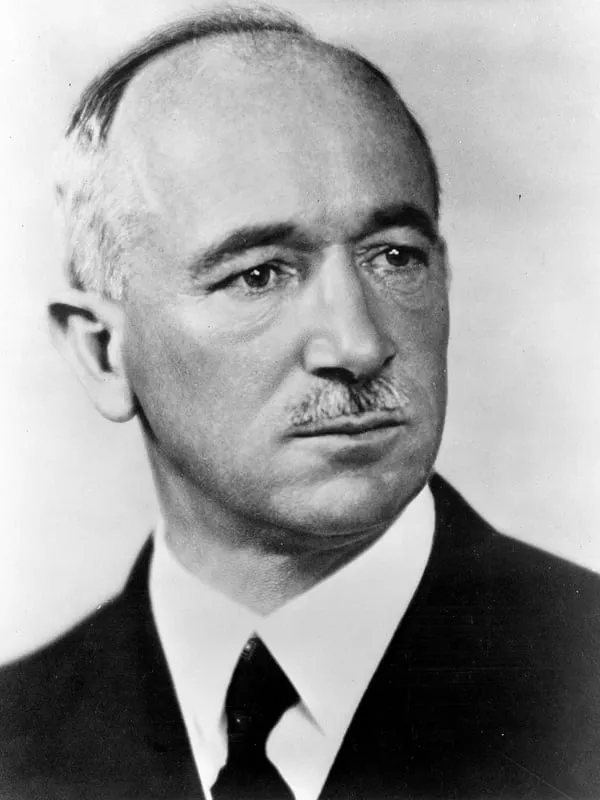
- Born:
- 28 May 1884, Kožlany (Bohemia, Austria-Hungary)
- Died:
- 3 September 1948, Sezimovo Ústí (Czechoslovakia)
- Author:
- Łukasz
- Photo:
- Office of War Information, domena publiczna, Wikimedia Commons

Edvard Beneš was, alongside Tomáš Masaryk, the creator and symbol of Czechoslovakia. For seventeen years he directed its foreign policy, building a system of alliances with France, the states of the Little Entente and later the Soviet Union that was meant to protect a small, multinational state against German and Hungarian revisionism. In 1938, as president, he had to watch that system collapse within a few weeks while the great powers at Munich decided his country’s fate without him. During the war he led the Czechoslovak exiles from London and secured the restoration of the state within its pre-Munich borders, but at the price of binding it to Stalin and of expelling three million Germans. In February 1948, gravely ill, he gave way to the communists. For Czechs he is one of the most important and most disputed figures in their history; for Poles, throughout the interwar years, he personified Prague’s hostile policy over Cieszyn Silesia.
A farmer’s son from Kožlany
He was born on 28 May 1884 in the small town of Kožlany in western Bohemia, the youngest of the ten children of the farmer Matěj Beneš. He grew up in Prague, where in 1896–1904 he attended the grammar school in Vinohrady, played football for Slavia and wrote for the Social Democratic press. He studied philosophy at the Czech university in Prague and then in Paris, at the Sorbonne and the École libre des sciences politiques. In 1908 he defended a doctorate in Dijon on the Austrian problem and the Czech question. France became his second spiritual home, while Germany aroused his dislike. In 1909 he married Anna Vlčková, who at his request took the name Hana (PL). He taught at the Prague commercial academy and, after his habilitation in 1912, sociology at the university. Under the influence of Professor Masaryk he became involved in politics.
Exile and independence
After the outbreak of war Beneš became one of the organisers of the clandestine independence movement in Bohemia, known as the Maffie, and the link with Masaryk, who had gone abroad. On 1 September 1915, facing arrest, he himself crossed the border illegally and made his way to Paris. Together with Masaryk and the Slovak astronomer and airman Milan Rastislav Štefánik he founded the Czechoslovak National Council, of which he was secretary-general. He set out to convince Western politicians and journalists that Austria-Hungary had to be broken up and that the Czechs and Slovaks deserved a state of their own. The trump card of this diplomacy was the Czechoslovak Legion, made up of prisoners of war and émigrés, which fought in Russia, France and Italy. In 1918 the powers recognised the National Council as the future government, and on 28 October 1918 independence was proclaimed in Prague. Beneš, aged 34, became Foreign Minister.
At the Paris Peace Conference he skilfully defended the historic borders of Bohemia, including the German borderland, and obtained for Slovakia a frontier on the Danube, with a large Hungarian minority. At the same time he assured the powers that Czechoslovakia would be a kind of Switzerland that respected minority rights. The dispute with Poland over Cieszyn Silesia, which in January 1919 had led to a brief Polish–Czechoslovak war, he settled in his favour in the summer of 1920. As the Red Army advanced on Warsaw, the Polish government agreed at the Spa Conference to arbitration by the powers instead of a plebiscite, and on 28 July 1920 the Conference of Ambassadors awarded Czechoslovakia the western part of the region, inhabited mostly by Poles, together with the Karviná coalfield and the Košice–Bohumín railway. In Poland this was called exploiting Poland’s tragedy, and Beneš was not forgiven for it right up to 1938.
Foreign Minister
Beneš directed Czechoslovakia’s diplomacy in ten successive governments and in 1921–1922 was also Prime Minister. He belonged to the Czechoslovak National Social Party, a left-wing, democratic party that had nothing in common with the Nazis but its name. His policy rested on three pillars. The first was the Little Entente, a network of alliances with Yugoslavia and Romania concluded in 1920–1921 and directed against Hungarian revisionism and a Habsburg restoration. The second was France, with which Czechoslovakia concluded an alliance in 1924 and a treaty of guarantee at Locarno in 1925, alongside the Locarno Treaties. The third was the League of Nations, in which Beneš was one of the best-known figures: co-author of the Geneva Protocol of 1924, a member of the Council for many years and, in 1935, President of the Assembly. Relations with Poland remained cool. Beneš regarded it as an unstable state and did not want to be drawn into its disputes with Germany and Russia, while in Warsaw, especially in the circle of Józef Piłsudski and Józef Beck, he was seen as an adversary.
After Hitler came to power Beneš looked for new support. On 16 May 1935 Czechoslovakia concluded a mutual assistance treaty with the Soviet Union, two weeks after a similar Franco-Soviet treaty. Under an attached protocol, however, Soviet assistance was to apply only if France had first come to Czechoslovakia’s aid. In 1938 this proviso proved decisive.
President
When the ailing Masaryk stepped down, the National Assembly elected Beneš president on 18 December 1935. He took office at a moment when Konrad Henlein’s Sudeten German Party had won the votes of two-thirds of the country’s Germans, and Germany was rearming and had remilitarised the Rhineland. Beneš expanded the army and the border fortifications, but he was late in deciding on concessions to the German minority. After the Anschluss of Austria in March 1938 his country found itself in German pincers. Henlein, on Hitler’s instructions, made unacceptable demands, while Britain and France pressed Prague to give way. In May Beneš ordered a partial mobilisation, in the summer he received the British mediator Lord Runciman, and at the beginning of September he put forward the “Fourth Plan”, which met almost all the Henleinists’ demands. They, however, broke off the talks. In mid-September Beneš secretly sounded out Paris, through the minister Jaromír Nečas, on whether the crisis could be ended by ceding a few thousand square kilometres of the borderland to Germany combined with the transfer of some of the Germans. This proposal, revealed only years later, shows that he himself was prepared for limited territorial concessions.
On 21 September, under the threat that France and Britain would leave Czechoslovakia to its fate, the government accepted their plan to cede to Germany the districts with a German majority. When Hitler raised his demands at Godesberg, Beneš proclaimed general mobilisation on 23 September, and an army of more than a million men stood ready to fight. On 30 September, however, Czechoslovakia was presented with the finished Munich Agreement, signed without its participation by Germany, Britain, France and Italy. Beneš concluded that fighting alone, against Germany and perhaps Poland and Hungary, would lead to the slaughter of the nation, and together with the government he accepted the diktat. That same evening Poland delivered an ultimatum over Zaolzie (the Trans-Olza area). The president, under pressure from Berlin, resigned on 5 October, and on 22 October he flew to London with his wife. The generals who had wanted to fight never forgave him this decision, and the argument over whether Czechoslovakia should have defended itself continues in the Czech Republic to this day.
Exile
The British government required Beneš to refrain from political activity in London. In February 1939 he went to the United States, where he lectured at the University of Chicago. There he received the news of the German occupation of Prague on 15 March 1939 and the creation of the Protectorate of Bohemia and Moravia. Beneš sent protests to the governments of the great powers and from then on treated his resignation as forced and invalid. In July he returned to London. After the outbreak of war he set up the Czechoslovak National Committee, which in July 1940 became a government-in-exile with Beneš as president. Britain recognised it first provisionally and then, on 18 July 1941, together with the Soviet Union, fully. Beneš sought to have the powers declare the Munich Agreement void from the outset. The British did so in August 1942, and General de Gaulle’s Free French in September of that year.
In November 1940 Beneš signed with the Polish government-in-exile of General Władysław Sikorski a declaration on a future Polish–Czechoslovak confederation, and in January 1942 its outline principles. The talks, however, became bogged down in the dispute over Zaolzie and in the mistrust of Beneš, who was increasingly staking everything on Moscow. When Stalin made it known that he did not want a federation, Beneš abandoned the project.
Wishing to show the Allies that the Czechs were fighting, the government-in-exile prepared in England an assassination of the Deputy Reich Protector, Reinhard Heydrich. Beneš personally backed the operation despite warnings from the resistance at home about reprisals. On 27 May 1942 the parachutists Jozef Gabčík and Jan Kubiš mortally wounded Heydrich in Prague. He died on 4 June, and the Germans responded with a terror in which thousands of people were killed and the village of Lidice was razed to the ground.
Between London and Moscow
Beneš believed that after the war the Soviet Union would become the guarantor of Czechoslovakia’s security against Germany and that the Soviet system would gradually become more democratic. On 12 December 1943 in Moscow he signed a treaty of friendship and post-war cooperation with Stalin, against British suggestions that he should not anticipate inter-Allied arrangements. He agreed to the incorporation of Subcarpathian Ruthenia into the USSR, which was sealed in 1945. In exile he also formed a plan to remove most of the Sudeten Germans from Czechoslovakia after the war, since he held them collectively guilty of the break-up of the state in 1938. The Allies accepted this intention.
In March 1945 Beneš flew via Moscow to the liberated territory of Slovakia. In Košice he appointed a National Front government in which the communists took the key ministries and the Prime Minister was the left-wing Social Democrat Zdeněk Fierlinger. On 16 May 1945 he returned to Prague, welcomed by crowds. On 28 October 1945 the Provisional National Assembly confirmed him in office, and on 19 June 1946 he was re-elected president.
The expulsion of the Germans
Under the so-called Beneš decrees, issued by the president and the government from 1940 onwards, Germans and Hungarians, with the exception of recognised anti-fascists, were stripped of citizenship and their property was confiscated. In May 1945 Beneš spoke of the need to “liquidate” the German problem once and for all. In the spring and summer of that year, before the Potsdam Conference, the so-called wild expulsions took place, accompanied by crimes such as the Brno death march and the massacre at Ústí nad Labem. In 1945–1946 some three million Germans were removed from Czechoslovakia as part of the post-war expulsion of Germans from Central Europe. A joint commission of Czech and German historians estimates the number of deaths during the expulsion at between 15,000 and 30,000; the higher estimates in older German publications are not borne out by research. The decrees remain a matter of dispute between the Czech Republic and Germany and Austria.
February 1948
In the election of May 1946 Klement Gottwald’s communists won 38 per cent of the vote, and Gottwald became Prime Minister. Beneš, seriously ill after strokes in 1944–1945 and 1947, hoped that democracy could be preserved in alliance with Moscow. When in July 1947 Stalin forced Prague to reject the Marshall Plan, he spoke of a “second Munich”. On 20 February 1948 twelve non-communist ministers resigned in protest against the communists’ takeover of the police, counting on the president to refuse their resignations and bring about early elections. The communists brought the workers’ militias and demonstrators out onto the streets, and on 25 February Beneš, isolated and fearing civil war and Soviet intervention, accepted the resignations and approved Gottwald’s new government. On 10 March 1948 the Foreign Minister, Jan Masaryk, was found dead beneath a window of the ministry. Beneš refused to sign the new, communist constitution and resigned on 7 June 1948. He died on 3 September 1948 at his villa in Sezimovo Ústí and was buried there.
Assessment
Beneš was an outstanding diplomat but, as his critics said, more a tactician than a strategist: he believed in treaties, the League of Nations and the loyalty of allies more than they deserved. When France failed him in 1938, and when in 1948 it became clear that Stalin had no intention of respecting Czechoslovak democracy, he twice gave way without a fight. His defenders stress that at Munich he saved the nation from slaughter, and that during the war he achieved the restoration of the state and the annulment of the Munich diktat. His critics charge that he neglected the minorities question, did not fight in 1938, opened the way to power for the communists after the war and bears responsibility for the brutal expulsion of the Germans. In the history of the road to the Second World War he remains above all the leader of a small state sacrificed by the great powers in the hope of a peace that never came.
Sources
Mentioned in battles
(01)Often appears with
People who appear in the same events.