- Category:
- Military operations
- Front:
- Western Front
- Date:
- 28 March 1942
- Author:
- Łukasz
- Tags:
- United Kingdom, Royal Navy, Kriegsmarine, France
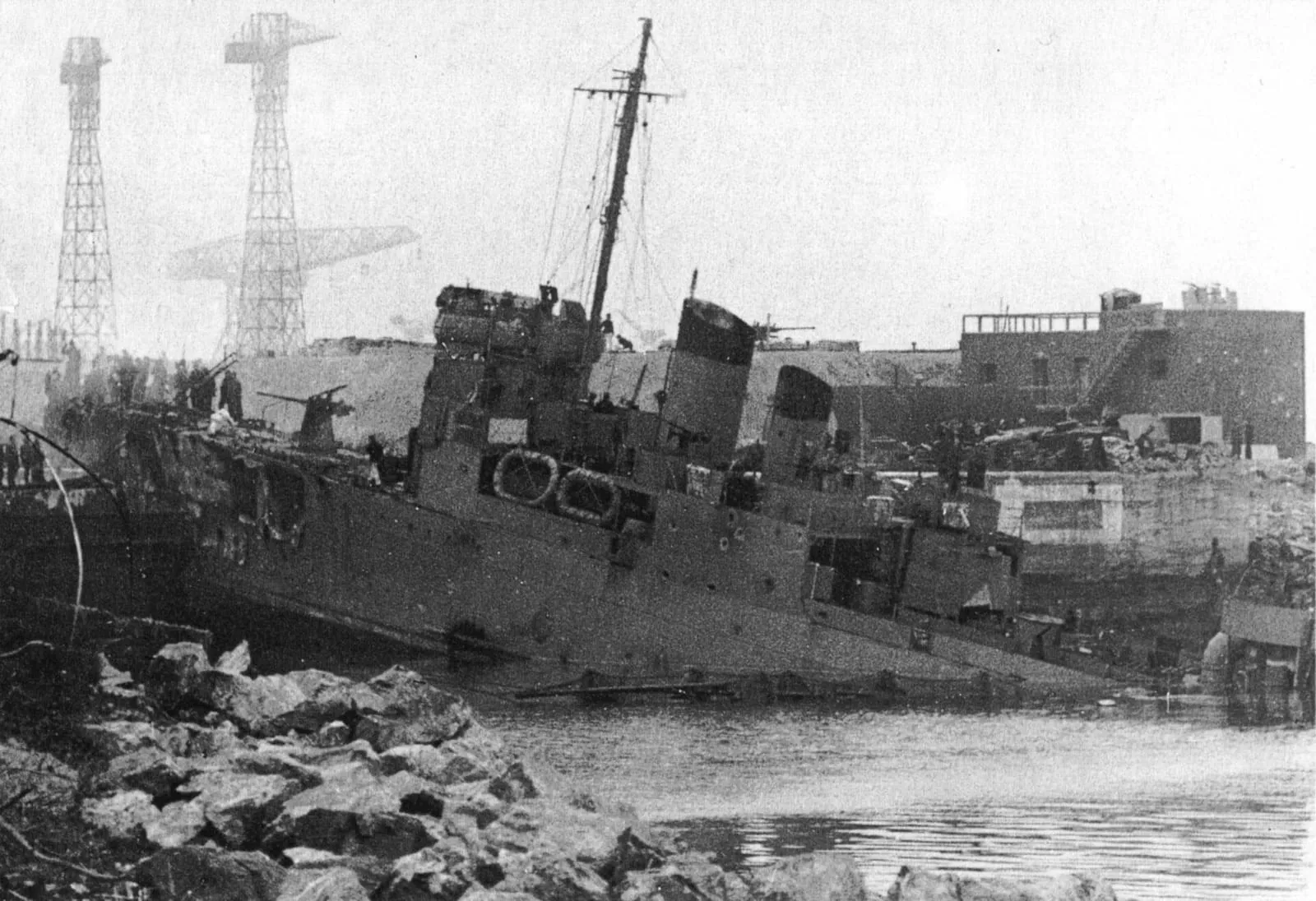
At 1.34 a.m. on 28 March 1942 the old British destroyer Campbeltown, driving forward at close to 20 knots under fire from every side, broke through an anti-torpedo net and drove her bows into the gate of the largest dry dock on the Atlantic coast, the Normandie dock at St Nazaire. In her bows, encased in concrete, lay more than four tons of explosives with delayed-action fuses. Commandos landed from the destroyer and from several wooden motor launches, and in less than two hours they blew up the pumping house and the machinery that worked the dock gates. Most of the launches, however, burned in the Loire estuary, and the men left ashore had no way of getting back. In the morning, when the fighting was over and German soldiers and officers were walking along the quay and over the deck of the wreck, the charge in Campbeltown’s bows exploded and tore the dock gate apart. The dock remained out of action until the end of the war. The St Nazaire raid, Operation Chariot, cost the lives of 169 British servicemen, and 215 were taken prisoner. The British regarded it as the boldest commando operation of the whole war and awarded its participants five Victoria Crosses.
A dock for the Tirpitz
At the beginning of 1942 the Admiralty’s greatest worry was the German battleship Tirpitz, sister ship of the Bismarck, sunk in May 1941. In January the ship, now ready for operations, moved from the Baltic to Norway and anchored in a fjord near Trondheim. From there she could attack the Arctic convoys to the USSR or, like the Bismarck before her, try to break out into the Atlantic and strike at the shipping between America and Britain. The reality of the threat was shown on 6–9 March 1942, when the Tirpitz put to sea in search of convoy PQ 12. She did not find the convoy, and an attack by Fairey Albacore torpedo bombers from the carrier Victorious missed. A few weeks earlier, in Operation Cerberus, the Germans had taken the Scharnhorst, Gneisenau and Prinz Eugen through the English Channel, which further shook British confidence in their ability to keep watch over the enemy’s big ships.
A ship of the Tirpitz’s size, however, needed a base on the Atlantic. If damaged in battle, she would have to return to a port with a dock able to take her, and on the whole coast of occupied France there was only one such dock: the Louis Joubert lock, known as the Normandie dock, at St Nazaire. It had been built at the turn of the 1920s and 1930s for the great liner Normandie, constructed at the local Penhoët shipyard; the same ship, taken over by the Americans and being converted into a troopship, burned in New York in February 1942. The dock was about 350 metres long and was then the largest dry dock in the world. It was for St Nazaire that the damaged Bismarck had been heading in May 1941 when the British fleet caught her. British planners drew a simple conclusion: if the dock ceased to exist, the German command would not risk sending the Tirpitz into the Atlantic, because there would be nowhere to repair her.
St Nazaire was at the same time one of the most heavily defended ports on the west coast of France. Since 1940 the Germans had established a U-boat base there, from which the 6th and 7th U-boat Flotillas operated, and concrete submarine pens had been built over the harbour basin. The port lay a few kilometres up the estuary of the Loire, approached by a single dredged channel under the guns of the coastal batteries. According to British studies, there were some 5,000 German troops in the area of the town, and the approaches were defended by several dozen coastal guns, from 75 mm pieces to 280 mm railway guns, and by more than 40 anti-aircraft guns with searchlights, some of them on the roofs of the U-boat pens. The British knew the town from June 1940, when the Lancastria, with thousands of evacuated troops on board, had been sunk off the Loire estuary.
A destroyer as a bomb
Bombing the dock from the air was out of the question. The RAF did not then have the accuracy needed to destroy so small and massive a target, and a raid on a port in the middle of a town would have killed many French people. Warships could not approach several kilometres upriver unnoticed. That left a raid. It was taken up by Combined Operations Headquarters under Louis Mountbatten, which after the Vågsøy raid in December 1941 was looking for a target for an even bolder operation. At the end of January 1942 Mountbatten instructed a team under Captain John Hughes-Hallett to draw up a plan. Nature provided the key: at the end of March there would be an exceptionally high spring tide, on which a light ship could cross the shallows of the estuary at night, away from the guarded channel.
The original idea envisaged two destroyers, but the Admiralty was unwilling to sacrifice a modern ship. In the end it provided one old one: HMS Campbeltown, formerly the American USS Buchanan, a destroyer of 1919 and one of the fifty handed over to Britain under the destroyers-for-bases agreement. The operation was approved on 3 March 1942. Within a few days the dockyard workers had changed the destroyer beyond recognition. Most of her armament was removed, internal fittings were stripped out to reduce her draught, the bridge was armoured and the deck was lined with plates to protect the commandos. Of her four funnels two remained, cut at a slant so that from a distance she would resemble a German torpedo boat. In the bows, just behind the point where she was to strike the gate, 24 depth charges, about 4.5 tons of explosive, were placed in a steel tank filled with concrete. Time fuses were to detonate the charge several hours after the ramming, when the raiders would already be on their way home.
The naval force was commanded by Commander Robert Ryder, who sailed in the motor gunboat MGB 314, the headquarters ship. Campbeltown was commanded by Lieutenant Commander Stephen Beattie. The raid was also allotted the motor torpedo boat MTB 74 and sixteen wooden Fairmile B motor launches (MLs), petrol-driven and carrying extra fuel tanks on deck, which increased their range but made them extremely flammable. Some carried commandos; others were armed with torpedoes to fight ships in the estuary. Two Hunt-class destroyers, Tynedale and Atherstone, provided escort on the passage, and the submarine Sturgeon was to wait at the entrance to the estuary as a navigational beacon.
The land forces were commanded by Lieutenant Colonel Charles Newman of No. 2 Commando, which provided the largest contingent; the rest of the more than 260 commandos came from several other Commando units. Most of them were demolition parties armed only with pistols and explosive charges, covered by assault groups with Thompson sub-machine guns. Each party was assigned a single target: the dock pumping house, the gate winding house, bridges, locks, gun positions. The commandos rehearsed in, among other places, the docks at Southampton and Cardiff, learning to destroy machinery in the dark. The plan provided for the whole action ashore to last no more than two hours, after which the commandos and Campbeltown’s crew would board the launches at the quay known as the Old Mole and get away. The commanders knew that the chances of returning were slim, and told the men so.
Night in the Loire estuary
The force sailed from Falmouth in Cornwall on the afternoon of 26 March 1942, taking a roundabout route through the Bay of Biscay and posing as an anti-submarine flotilla. On the morning of 27 March Tynedale came upon a surfaced U-boat and opened fire on it; the submarine dived, and its report, according to British studies, spoke of several destroyers heading west, which only misled the Germans. On the way the British also stopped two French trawlers, took off their crews and sank them so that nobody could give away their position. In the evening the force turned towards the Loire estuary, and Campbeltown hoisted the German ensign.
A diversionary air raid intended to distract the defenders failed. Some 60 Whitley and Wellington bombers arrived over St Nazaire before midnight, but the town was covered by cloud, and Winston Churchill had stipulated that only clearly visible military targets were to be bombed so as not to kill French civilians. Only a handful of aircraft dropped their bombs. The aircraft circling over the port and hardly bombing at all aroused the suspicions of the commander of the port’s anti-aircraft defences, Kapitän zur See Karl-Conrad Mecke. Before 1 a.m. he ordered the searchlights to be switched off, firing to cease and the crews to stand to, expecting a landing.
At 12.30 a.m. on 28 March the force crossed the shallows; Campbeltown twice scraped the bottom, but each time got free. At 1.22 a.m., a few minutes from the target, searchlights on both banks lit up the ships. The signallers in MGB 314 answered the challenge with German recognition signals, captured, according to British studies, during the Vågsøy raid, and signalled that the ships were under fire from their own side. In this way they gained several priceless minutes. At 1.28 a.m. the Germans opened fire from every position. Beattie had the German ensign hauled down and the British White Ensign run up. Campbeltown gathered speed; the helmsmen on the bridge were killed or wounded one after another, and the ship, blinded by the searchlights, passed the end of the Old Mole, cut through the anti-torpedo net and at 1.34 a.m., three minutes behind schedule, struck the outer gate of the dock. The force of the impact drove her about 10 metres into it, crushing her bows back as far as the place where the charge was hidden.
The fight ashore
Several dozen commandos under Major William Copland landed from the destroyer. The assault groups destroyed the anti-aircraft positions on the roof of the pumping house and seized the bridge by which the demolition parties were to withdraw. The demolition teams blew up the winding house that moved the gates and the machinery of the pumping house that emptied the dock. This part of the task was carried out in full, although one of the parties lost almost half its men.
Things went worse on the river. The wooden launches, sailing in two columns alongside the destroyer, had no protection at all, and their petrol caught fire at the first hits. Most of them turned into blazing wrecks before they reached the quay. Only one launch put commandos ashore at the Old Mole, and likewise only one at the old entrance to the harbour basin. The water around the launches burned with spilt petrol, and the survivors swimming in it were raked by fire from the shore. Of the dozen or more launches that entered the estuary, three returned to England under their own power; several others, damaged, were scuttled at sea after their men had been taken off by the escorting destroyers. MTB 74 fired two delayed-action torpedoes at the gates of the old entrance to the basin, then turned back to rescue survivors and was herself sunk. MGB 314, with Ryder on board, engaged the German positions from mid-river until he was sure that Campbeltown was firmly lodged in the gate. As she withdrew, the gunboat came under fire from heavy guns; at her forward gun Able Seaman William Savage was killed, later awarded a posthumous Victoria Cross. Out at sea the launch ML 306 was intercepted by the German torpedo boat Jaguar. Sergeant Thomas Durrant of No. 1 Commando, wounded several times, kept firing his machine gun at the torpedo boat’s bridge until the launch was captured. He died of his wounds, and according to British accounts the recommendation for his posthumous Victoria Cross was supported by the commander of the Jaguar.
Newman went ashore among the first, although as overall commander he did not have to. When it became clear that there were no boats, he gathered about a hundred surviving commandos and decided to fight his way through the town inland and from there to Spain. He reportedly gave three orders: to do everything possible to get back to England; not to surrender until their ammunition was gone; and if possible not to surrender at all. Under machine-gun fire the commandos crossed a bridge in the old town and scattered into the streets of the new. By morning almost all of them had been surrounded, and when their ammunition ran out they surrendered. Five, with French help, made their way through Spain to Gibraltar and returned to England.
The explosion
In the morning the wreck of Campbeltown, wedged in the gate, seemed to the Germans merely an awkward obstacle. Officers and soldiers went on board to inspect the ship whose bows had come to rest on the gate; onlookers gathered on the quay. The fuses worked later than planned. The charge exploded on the morning of 28 March, according to most studies at about 10.30–10.35, according to some accounts around noon. The explosion blew the gate off its runners, water from the estuary surged into the dock and swept away the two tankers lying in it, and the men on board and near the ship were torn to pieces. A story later circulated among the British prisoners about Beattie, who was being interrogated at that very moment by a German officer assuring him that the damage to the gate would be easy to repair. At that instant the building was shaken by the explosion.
Two days later, on the afternoon of 30 March, MTB 74’s torpedoes exploded at the old entrance to the basin. Panic broke out in the port. German sentries, convinced that commandos were hiding in the town or that an uprising had broken out, opened fire, including on workers of the Organisation Todt, whose uniforms they mistook for British ones, and on local people. According to French and German studies, 16 French civilians were killed and about 30 wounded. The Germans then searched the town house by house.
The balance
The destruction of the dock was complete. The Germans tried to repair it, but the Normandie dock was unusable until the end of the war and was brought back into service only in 1947 or 1948, depending on the source. Contrary to what is sometimes repeated, however, the port of St Nazaire was not “completely destroyed”: the raid did not touch the concrete pens, and the U-boat base went on operating until the end of the war, the garrison of the St Nazaire fortress surrendering only in May 1945.
The price was high. 611 men took part in the raid (some sources give 612 or 622). 169 were killed, 105 sailors and 64 commandos (some sources give 168), and 215 were taken prisoner. About 228 men returned to England, including the five who escaped through Spain. The popular claim that the raid cost “two-thirds” of the participants is therefore true only in the sense that almost two-thirds of them were killed or captured; roughly one in three was killed. The dead were buried in the cemetery at La Baule-Escoublac, and the prisoners were taken to a camp at Rennes. German losses are less well known. British studies speak of more than 360 killed, most of them in the explosion of Campbeltown; according to other calculations about 40 Germans were killed in the night fighting and the explosion killed about 250 soldiers and civilians.
89 decorations were awarded for the raid, including five Victoria Crosses: to Ryder, to Newman and to Beattie, who was then a prisoner, and posthumously to Savage and Durrant. Mountbatten called the operation a brilliant attack by a handful of men who had achieved what even the heaviest bombing could not have ensured. C. E. Lucas Phillips’s book of 1958 fixed on it the name The Greatest Raid of All, by which it is still known in Britain today.
Place in the war
The raid was one of the few pieces of British news in the spring of 1942 that gave cause for cheer. It came after the fall of Singapore, after the humiliation in the Channel and at a time when U-boats were sinking ships off the coast of America. It showed that Britain could attack a heavily defended point in occupied Europe, and that the commandos were no longer just an instrument of small-scale raids on the Norwegian coast, as on the Lofoten Islands. The following night Bomber Command carried out the raid on Lübeck and burned a large part of its medieval old town.
For Adolf Hitler the raid was proof that the coast was dangerously exposed. A few days earlier, on 23 March, he had issued Directive No. 40 on coastal defence, and according to some studies, after the raid he dismissed General Carl Hilpert, chief of staff to Gerd von Rundstedt’s Commander-in-Chief West. The Germans began to fortify the ports more strongly, and in August 1942 Hitler demanded the construction of thousands of concrete bunkers from Norway to Spain, which gave rise to the Atlantic Wall in its mature form. Further commando raids led Hitler in October 1942 to issue the Commando Order, which ordered captured participants in such operations to be killed; among its victims were the men of Operation Frankton in the Gironde estuary in December 1942. The prisoners from St Nazaire, captured earlier, survived the war in the camps.
The Tirpitz never went out into the Atlantic. For years she lay in Norwegian fjords, tying down considerable Home Fleet forces, until British bombers sank her in November 1944 in Operation Catechism. Historians debate how far the raid contributed to this: Grand Admiral Erich Raeder and the naval command were in any case constrained by Hitler’s caution after the loss of the Bismarck and by the shortage of fuel. What is certain is that after 28 March 1942 a sortie by the Tirpitz into the Atlantic would have meant a voyage with no repair port on that side of Europe, and the German navy never took that risk. Combined Operations Headquarters drew conclusions from the success at St Nazaire that proved too optimistic: in August 1942 the much larger landing at Dieppe ended in a bloody defeat.
Sources
Meanwhile
(04)Elsewhere, within a week.
- 26 March 1942 · Crimes and repressionThe star on the doors of Jewish homesIn spring 1942 the Gestapo ordered Jews in the Reich to mark their front doors with a paper Star of David. In Berlin the order applied from 26 March 1942.
- 1 April 1942 · DiplomacyThe Pacific War CouncilOn 1 April 1942 the Pacific War Council met at the White House. Roosevelt heard out the allies fighting Japan there, but decisions were taken elsewhere.
- 2 April 1942 · PacificThe Japanese on the north coast of New GuineaFrom 1 April 1942 the Japanese took the ports of Dutch New Guinea unopposed, from Fakfak and Babo to Hollandia. On 8 April they landed on Manus.
- 22 March 1942 · MediterraneanThe Second Battle of SirteOn 22 March 1942 Vian's cruisers and destroyers used smoke screens to keep the battleship Littorio off a Malta convoy. Axis aircraft then sank the ships.
Related events
(04)The same battle, people or subject.
- 11 February 1942 · Western FrontThe Channel Dash (Operation Cerberus)On the night of 11–12 February 1942 Scharnhorst, Gneisenau and Prinz Eugen left Brest and broke through the English Channel by day to German ports.
- 27 June 1942 · AtlanticConvoy PQ 17 sails from IcelandOn 27 June 1942 convoy PQ 17 sailed from Iceland for the USSR – 35 ships carrying equipment for the Red Army, covered by British and American warships.
- 1 February 1942 · MediterraneanThe front at GazalaIn early February 1942 Eighth Army stood on the Gazala–Bir Hakeim line, 60 km west of Tobruk. Rommel, out of fuel, halted near Timimi and Mechili.
- 9 November 1941 · MediterraneanThe Battle of the Duisburg convoyOn the night of 8–9 November 1941 Force K from Malta sank all seven ships of the Duisburg convoy and the destroyer Fulmine without losing a ship.