- Category:
- Military operations
- Front:
- Atlantic
- Date:
- 27 May 1941
- Author:
- Natalia
- Battle:
- Operation Rheinübung
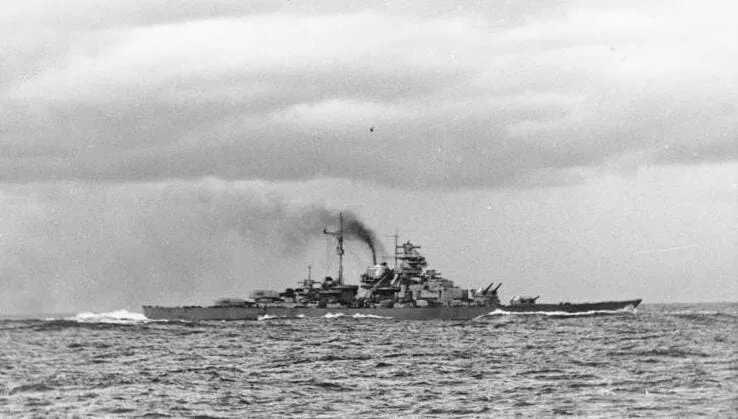
On the morning of 27 May 1941, some 550 kilometres west of Brest, the British battleships King George V and Rodney, helped by two heavy cruisers, destroyed in less than two hours the German battleship Bismarck, the most powerful ship of the Kriegsmarine. Three days earlier Bismarck had sunk the battlecruiser Hood, the pride of the Royal Navy, in the Denmark Strait, and from that moment dozens of British warships had been hunting her. Her fate was sealed on the evening of 26 May: Fairey Swordfish torpedo bombers from the aircraft carrier Ark Royal hit the battleship in the stern and jammed her rudders when she was less than a day’s steaming from the safe waters off the French coast. The next morning the ships of Admiral John Tovey’s Home Fleet turned her into a blazing wreck. She sank at about 10.40 a.m., her ensign still flying. Of the more than 2,200 men aboard, among them the Fleet Commander, Admiral Günther Lütjens, 114 survived according to the most commonly cited figures.
It is often written that after her rudders were damaged Bismarck was forced into an “endless series of circles”. That is a simplification. Immediately after the torpedo hit the ship did indeed turn a full circle, because her rudders had jammed in a turn to port. Later the crew kept her on a more or less steady course by varying the revolutions of the propellers, but the battleship could not turn away from the wind and steamed slowly north-westwards, straight towards the British battleships, instead of east towards France. Her course was unsteady and unpredictable, which hampered her gunnery in the morning battle, but she was not running in circles.
After the sinking of Hood
Bismarck and the heavy cruiser Prinz Eugen had left Gotenhafen (Gdynia) – the cruiser on the evening of 18 May and the battleship at about 2 a.m. on 19 May – in order to break out into the Atlantic through the Denmark Strait and destroy Allied convoys, in accordance with the plan of Grand Admiral Erich Raeder. In the action of 24 May Prince of Wales, before withdrawing, hit Bismarck with three shells. One pierced the bow: between 1,000 and 2,000 tons of water poured into the hull, and the ship trailed a slick of oil and lost access to part of her fuel. Lütjens abandoned the raid and decided to make for Saint-Nazaire, the only Atlantic port with a dry dock able to take so large a ship. That evening he detached Prinz Eugen to operate on her own.
The British threw into the pursuit six battleships and battlecruisers, two aircraft carriers, thirteen cruisers and more than twenty destroyers. Old battleships and cruisers were detached from convoys, Rodney turned back from her voyage to a refit in Boston, and from Gibraltar Vice-Admiral James Somerville’s Force H set out northwards with Ark Royal, the battlecruiser Renown and the light cruiser Sheffield. In the summer of 1940 this force had covered the first ferrying of fighters to Malta. Around midnight on 24–25 May nine Swordfish from the aircraft carrier Victorious scored one hit, but the torpedo exploded against the side armour. At about 3 a.m. on 25 May Bismarck took advantage of the zigzagging of the cruisers shadowing her and broke radar contact. Lütjens, unaware of this, sent long radio messages. The British took bearings on them, but on King George V the bearings were plotted wrongly, and for several hours Tovey led the fleet north-east in the belief that the German was heading home. By the time the error came to light, and a Luftwaffe signal decrypted at Bletchley Park confirmed that the battleship was bound for France, Bismarck had a clear lead over her pursuers.
The Catalina and Ark Royal’s Swordfish
On the morning of 26 May Consolidated PBY Catalina flying boats of RAF Coastal Command took off from Lough Erne in Northern Ireland to search for her. They flew over neutral Ireland, along a corridor over County Donegal to which the government in Dublin had quietly agreed. At 10.30 a.m. the crew of a Catalina of No. 209 Squadron sighted Bismarck some 690 nautical miles north-west of Brest. The aircraft was commanded by the Briton Dennis Briggs, but at the controls at that moment was the second pilot, Leonard B. Smith, an ensign of the still neutral United States Navy, one of the American “observers” training the British on the new aircraft. Soon afterwards reconnaissance Swordfish from Ark Royal also found the battleship.
Tovey’s battleships, however, were too far away, some ships had to turn back to refuel, and by the next day Bismarck would be under the cover of German aircraft and submarines. Renown was too weak to face her alone. The only chance lay with the torpedo aircraft from Ark Royal. Somerville sent the cruiser Sheffield ahead to shadow the battleship at close range, but the message about this did not reach the carrier. The first wave of fifteen Swordfish, which took off after 2.50 p.m. in appalling weather, found a ship by radar about 20 miles from the expected position and attacked it through the clouds. It was Sheffield. The airmen dropped eleven torpedoes. Some exploded on hitting the water or in the wake, because their magnetic pistols failed, and the cruiser dodged the rest. According to Tovey’s report, Sheffield showed great restraint and did not fire a single shot in return.
The mistake proved a useful lesson. For the second attack the torpedoes were fitted with contact pistols and set to run shallower. At about 7.10 p.m. fifteen Swordfish took off from the pitching deck, most of them the same aircraft that had only just returned. They were led by Lieutenant Commander Trevenen Coode. This time the aircraft first found Sheffield, which directed them to the target. A cold front hung over Bismarck, with a dense layer of cloud from about 200 metres up to several kilometres, so the formation broke up and the aircraft attacked singly and in pairs, from different directions, for about half an hour from around 8.50 p.m. The battleship fired at them even with her main armament, but not a single Swordfish was shot down.
Two torpedoes hit. The first struck amidships and did no serious damage. The second exploded in the stern on the port side, close to the rudders. It flooded the steering gear compartment, and both rudders jammed at 12 degrees to port. According to later findings this torpedo was most probably dropped by Sub-Lieutenant John Moffat of No. 818 Squadron, although in the chaos of the attack this cannot be established with complete certainty. The ship first turned a full circle and then, as Tovey noted, could not keep away from the wind, which providentially was blowing from the north-west.
The night of 26–27 May
Aboard Bismarck attempts were made all night to free the rudders. Divers could not reach the flooded compartment in the heavy sea. One rudder was got working, but the other remained jammed, and this did not change the ship’s situation. Lütjens rejected the idea of blowing the rudder off with an explosive charge, since the blast might destroy the propellers. The battleship, steered by varying the revolutions of her three propellers, crawled into the wind at about 10 knots. Before midnight Lütjens signalled to headquarters: “Ship unmanoeuvrable. We will fight to the last shell. Long live the Führer.” During the night a telegram arrived from Adolf Hitler thanking the crew. Survivors recalled that the mood on board was depressed.
Just after the air attack Bismarck also fired on Sheffield. Shell splinters killed three men on the cruiser, and Sheffield withdrew behind a smokescreen and lost contact. Before 10 p.m., however, she directed to the battleship the 4th Destroyer Flotilla of Captain Philip Vian, detached earlier from the troop convoy WS-8B: Cossack, Sikh, Zulu, Maori and the Polish ORP Piorun. At 10.38 p.m. Piorun, under Commander Eugeniusz Pławski, was the first to make contact with Bismarck, reportedly signalling “I am a Pole”. For nearly an hour she stayed close to the battleship, which straddled her with several salvoes from its main armament; she herself fired several salvoes from her 120 mm guns, and then lost contact in the darkness. The other destroyers made torpedo attacks all night in the gale and the dark. They fired sixteen torpedoes, most probably without a single hit, but they kept contact, illuminated the battleship with star shell at Tovey’s request and gave her crew not a moment’s rest. Towards dawn the Germans tried to send an Arado Ar 196 seaplane to France with the ship’s log and film of the battle with Hood, but the catapult had been damaged by a shell from Prince of Wales. The aircraft was pushed over the side.
Tovey had decided against attacking at nightfall, amid squalls and with the positions of his own ships uncertain, and chose to wait for full daylight. He ran the risk that Bismarck would slip away, but the exhaustion of the German crew worked in his favour.
The last battle
On the morning of 27 May a gale was blowing from the north-west, force 8 on the Beaufort scale, the sky was overcast and there were passing showers. Tovey, who after the fate of Hood was keeping Renown out of the action, decided to approach from the west-north-west, almost head on to the enemy, so as to present a difficult target and quickly close to a range at which hits were certain. He also hoped, as he wrote, that the sight of two battleships bearing straight down on the Germans would shake the nerves of their rangefinder operators.
At 8.43 a.m. lookouts on King George V sighted Bismarck at a range of about 25,000 yards (some 23 km). Four minutes later Rodney opened fire with her 16-inch (406 mm) guns, followed by King George V with her 14-inch (356 mm) guns. Bismarck replied at 8.50 a.m., aiming at Rodney, and straddled her with her second salvo. The unsteerable ship, rolling in the waves and yawing first one way and then the other, was a very poor gun platform. The heavy cruisers joined the action: Norfolk, which had been shadowing Bismarck since the Denmark Strait, and from the other side Dorsetshire, which on her own initiative had left a convoy from Freetown and steamed hundreds of miles to reach the battle in time.
At about 9.02 a.m. a shell from Rodney struck Bismarck’s forward superstructure. It destroyed the main fire-control position and, according to survivors, killed most of the officers on the bridge, probably including Lütjens and the ship’s captain, Kapitän zur See Ernst Lindemann. Other survivors, however, claimed to have seen Lindemann on deck at the very moment she sank. Further hits put both forward main-armament turrets out of action. Control of the after turrets’ fire was taken over from the after position by Kapitänleutnant Burkard von Müllenheim-Rechberg, the most senior of the officers who survived, but after three salvoes that position too was wrecked. At about 9.31 a.m. the last turret fell silent. From then on Bismarck could no longer return fire.
The British kept firing. Rodney closed to less than 3 kilometres, virtually point-blank range for guns of that calibre, and pounded the battleship salvo after salvo, also firing torpedoes. King George V stayed further off so that her shells would plunge steeply and pierce the deck. By 10 a.m. the two battleships had fired more than 700 main-armament shells, and the four ships together some 2,800 shells of various calibres, of which an estimated 400 or so hit. Bismarck was ablaze from stem to stern, listing to port and settling by the stern. Tovey noted that men were jumping into the water, preferring death in the stormy sea to the terrible effects of the British fire. The British did not cease fire, because the ensign was still flying on the German ship and no one had signalled surrender.
At about 10.15–10.20 a.m. Tovey broke off the action. King George V and Rodney had only enough fuel left to get home, and the admiral expected attacks by the Luftwaffe and by submarines. He was certain that Bismarck would not reach any port and would sink within a few hours, and that further shelling would do little to hasten her end. He ordered the ships that still had torpedoes to finish off the wreck. Dorsetshire had anticipated the order: she fired two torpedoes into the starboard side, one of which hit, and then, having steamed round the battleship, another into the port side. Bismarck capsized to port and sank stern first. British reports give the time as 10.37 a.m. and the position as 48°09′ N, 16°07′ W; other studies give 10.40 a.m.
Sunk or scuttled?
Who finally sent Bismarck to the bottom has been disputed for decades. The German survivors unanimously maintained that the ship was scuttled by her own crew. At about 9.30 a.m. the first officer, Fregattenkapitän Hans Oels, who had taken command after the bridge was destroyed, gave orders to abandon ship, open the watertight doors and prepare scuttling charges. Kapitänleutnant (Ing.) Gerhard Junack, the most senior of the surviving engineer officers, set them off in the engine room with a nine-minute delay and led his men up on deck. Oels was killed moments later by a shell from King George V. The British, on the other hand, maintained for years that the battleship had been sunk by their torpedoes.
The wreck, found in June 1989 by the American oceanographer Robert Ballard at a depth of about 4.7 kilometres, did not settle the dispute entirely. Ballard found no sign that the main armour belt had been pierced below the waterline, nor the crushing of the hull typical of ships that go down with compartments still unflooded, and he took this as confirmation of the accounts of scuttling. Later expeditions, including those of David Mearns and James Cameron in 2001–2002, disagreed about the origin of the tears in the hull. Today most researchers take an intermediate position: gunfire and torpedoes had damaged the ship so badly that she would have sunk within a few hours anyway, and scuttling merely hastened her end.
Survivors and losses
An estimated 800 to 1,000 men ended up in the water. Dorsetshire and the destroyer Maori lowered ropes and began hauling survivors aboard, but at 11.40 a.m. lookouts on the cruiser spotted what they took to be a submarine’s periscope, and both ships steamed away, leaving hundreds of men in the sea. Dorsetshire picked up 85 Germans and Maori 25. One of them died of his wounds the next day. On the evening of 27 May the submarine U-74 picked up three sailors from a rubber dinghy, and the next day the German weather ship Sachsenwald rescued two more from a raft. The most commonly cited number of survivors is 114 (115 picked up, of whom one died), and of the dead more than 2,000 – most often about 2,100 according to various tallies. Besides her regular crew, the ship was carrying the Fleet Commander’s staff, prize crews and war correspondents, more than 2,200 men in all.
British losses in the last days of the pursuit were small: three men killed on Sheffield, a few airmen, and light damage to Rodney, mainly from the blast of her own guns. On 28 May German bombers sank the destroyer Mashona off the west coast of Ireland as she was returning with her tanks almost empty; 46 of her crew were killed.
Reactions
The news reached London while Winston Churchill was speaking in the House of Commons about the situation on Crete, where heavy fighting against German paratroopers had been going on for a week. The Prime Minister first announced that the battle with Bismarck was in progress and its outcome not yet known. Shortly afterwards he was handed a note, and Churchill, interrupting the debate, told the House that the German battleship had been sunk. After the spring defeats in the Balkans and North Africa it was a victory that was especially needed. The Admiralty thanked in particular the naval airmen of Victorious and Ark Royal, without whom, it acknowledged, the object might not have been achieved. In his report Tovey paid tribute to the enemy: Bismarck had put up “a most gallant fight against impossible odds, worthy of the old days of the Imperial German Navy, and she went down with her colours flying”. For this victory he was made a Knight Commander of the Order of the British Empire in the autumn of 1941.
In Germany Naval Group West went on sending signals to Bismarck for several hours, until Reuters reported that the ship had sunk. The loss of the newest battleship with more than two thousand sailors, only a few days after the triumphant announcements of the sinking of Hood, was a heavy blow for Hitler. Prinz Eugen, which after parting from Bismarck had not sunk a single ship and had then suffered engine trouble, put into Brest on 1 June.
Place in the war
The sinking of Bismarck closed the period in which the Germans tried to wage war on shipping in the Atlantic with large surface warships. As recently as March 1941 the battleships Scharnhorst and Gneisenau had sunk or captured 22 ships in a two-month raid. After May there were no more such sorties. Hitler reserved to himself the approval of every sortie by heavy ships, thereby taking away Raeder’s freedom to dispose of them. Her sister ship Tirpitz, commissioned in February 1941, spent the rest of the war in Norwegian fjords as a “fleet in being”, tying down a considerable part of the British fleet by her mere presence, and the ships based at Brest broke through the English Channel back to Germany in February 1942. The whole burden of the war in the Atlantic passed to Karl Dönitz’s submarines. In June, moreover, the British rounded up most of the German tankers stationed in the Atlantic to supply the raiders.
The pursuit also showed how war at sea was changing. Bismarck was stopped not by battleships but by obsolete biplanes from a carrier, guided by a flying boat and a radar-equipped cruiser, with the help of radio interception and the cryptologists of Bletchley Park. Six months later Japanese aircraft sank off the coast of Malaya Prince of Wales, the first battleship to have fired on Bismarck, together with the battlecruiser Repulse, and the sinking by aircraft of battleships at sea and fully ready for action became an accepted fact. For the British, however, the victory of 27 May was above all a matter of morale: it avenged Hood and, in the darkest period of the spring of 1941, in the week of defeat on Crete, proved that the Royal Navy still ruled the Atlantic. For the Polish Navy, Piorun’s part in the chase remained one of the brightest pages of the war.
Sources
Meanwhile
(04)Elsewhere, within a week.
- 28 May 1941 · BalkansThe evacuation from CreteOn 28 May 1941 the Royal Navy began taking the defeated garrison off Crete. By 1 June it had lifted some 17,000 men, losing ships and almost 2,000 sailors.
- 23 May 1941 · Middle EastDirective No. 30On 23 May 1941 Hitler’s Directive No. 30 named the Arab freedom movement a natural ally against England and granted Iraq modest aid. It came too late.
- 31 May 1941 · Western FrontThe bombing of DublinDuring the night of 30–31 May 1941 four German bombs fell on Dublin. In North Strand 28 people were killed and some 300 houses were destroyed or damaged.
- 31 May 1941 · Middle EastBaghdad surrendersOn 31 May 1941 an armistice ending the Anglo-Iraqi War was signed outside Baghdad. Rashid Ali and the Mufti had fled to Iran; the Regent returned on 1 June.
Related events
(04)The same battle, people or subject.
- 9 May 1941 · AtlanticThe capture of U-110On 9 May 1941 the escort of convoy OB 318 forced U-110 to the surface. The British boarded her and carried off an Enigma machine and secret cipher documents.
- 24 February 1941 · AtlanticAttacks on convoys OB 288 and OB 290In the last week of February 1941 U-boats and Fw 200 Condors shattered three convoys sailing from Liverpool to America, sinking more than 20 ships.
- 21 May 1941 · AtlanticThe sinking of the Robin MoorOn 21 May 1941 U-69 stopped and sank the American freighter Robin Moor far from the war routes. Her survivors spent almost three weeks in the lifeboats.
- 4 September 1941 · AtlanticThe USS Greer incidentOn 4 September 1941 U-652 fired torpedoes at the US destroyer Greer, which had been tracking it for hours. Both missed, and Roosevelt called it piracy.