- Category:
- Military operations
- Front:
- Western Front
- Date:
- 7 March 1945
- Author:
- Natalia
- Battle:
- The Rhine crossings
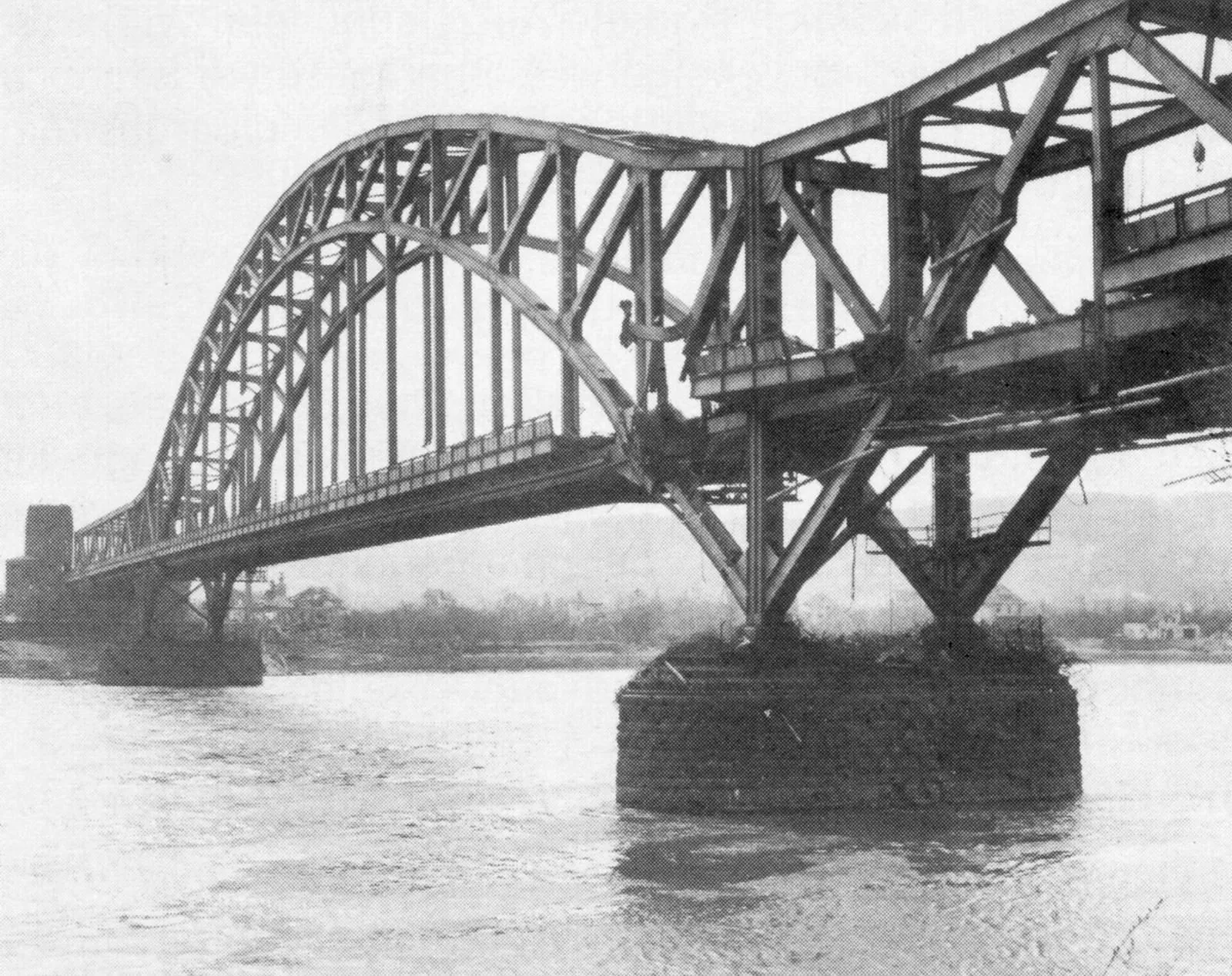
On the afternoon of 7 March 1945, at about one o’clock, soldiers of the US 9th Armored Division looking down from the hills above the Rhine saw something nobody had expected: the Ludendorff railway bridge at Remagen was still standing. The Germans had blown every other bridge on the middle and lower Rhine as soon as the Allies drew near the river. A few minutes after four, Lieutenant Karl Timmermann’s platoon was already running across the planks laid over the tracks, under machine-gun fire from the far bank, while in the tunnel beneath the Erpeler Ley crag German engineers were frantically trying to detonate charges that refused to go off.
The capture of the bridge at Remagen was one of the most famous strokes of luck of the war. For centuries the Rhine had been regarded as Germany’s natural moat; Hitler assumed it would hold the Allies for many weeks. Instead the US First Army found itself on the east bank two weeks before Field Marshal Montgomery’s carefully prepared crossing of the lower Rhine. The bridge survived another ten days – it collapsed on 17 March – but the bridgehead it had covered survived and became one of the gateways into the heart of the Reich.
To the Rhine
At the beginning of 1945 the Western Front still ran more or less along the border of the Reich. The German offensive in the Ardennes had failed, and on 16 January the US First and Third Armies linked up at Houffalize, closing the Bulge. In the south the Colmar Pocket was eliminated on 9 February. In the north the British and Canadians had been fighting their way through the Reichswald towards the lower Rhine since 8 February, and on 23 February the US Ninth Army attacked across the Roer in Operation Grenade. After the bloody months in the Hürtgen Forest and the capture of Aachen in the autumn of 1944, the American armies were at last breaking out into the open Rhineland.
The plan of the Supreme Commander, General Dwight Eisenhower, was for the entire west bank of the Rhine to be cleared of German forces first, and only then for the river to be crossed. The main blow was to be delivered by Bernard Montgomery’s 21st Army Group at Wesel, after weeks of preparation and with an airborne landing. In the meantime General Omar Bradley’s US 12th Army Group was to reach the river on the middle sector. Eisenhower had, however, left a standing order: any unit that found an intact bridge was to exploit it to the full and seize a bridgehead.
Bradley launched Operation Lumberjack on 1 March. Its aim was to destroy the German forces between Cologne and the Moselle: General Courtney Hodges’s First Army was to reach the Rhine at Cologne and Bonn and then wheel south-east to meet General George Patton’s Third Army, advancing through the Eifel towards Koblenz. German resistance weakened by the day. While there was still time, Adolf Hitler had forbidden the Commander-in-Chief West, Field Marshal Gerd von Rundstedt, to withdraw his forces behind the Rhine; the units that were to defend the left bank were bled white, short of fuel and being destroyed piecemeal.
Cologne
The most visible success of the first days of March was Cologne. The popular version of this day says that the First Army “also took Cologne” – in fact the city was taken over several days, and on 7 March the mopping-up was merely being completed. The work was done by General Joseph Lawton Collins’s VII Corps, which, having crossed the Erft, entered the city on 5 March with the 3rd Armored Division and the 104th Infantry Division. Resistance was scattered: the defenders were mainly soldiers from shattered divisions, Volkssturm men and policemen. On 6 March, in front of the cathedral, an American M26 Pershing tank fought a duel with a German Panther that was filmed by war correspondents. That same day the Germans blew up the last railway bridge in the city, the Hohenzollernbrücke.
According to American military historians, by 7 March the whole of the left-bank part of the city was in the hands of VII Corps. Cologne, one of the most frequently bombed cities of the Reich, lay in ruins: of more than 750,000 pre-war inhabitants, only a few tens of thousands are estimated to have remained in the left-bank districts. The right-bank districts, including Deutz, remained in German hands until April, when the Ruhr Pocket was already collapsing. The capture of Cologne was thus an important, symbolic stage in the advance to the Rhine, but not a crossing of the river – that came only at Remagen.
The Ludendorff Bridge
The bridge at Remagen, about 20 kilometres upstream from Bonn, had been built in 1916–1919, largely by Russian prisoners of war, to improve the supply of the Western Front during the First World War. It was named after General Erich Ludendorff, who had championed its construction. The steel arch structure, more than 300 metres long, carried two railway tracks and footways; stone towers stood on both banks, and on the east bank the line entered a tunnel cut beneath the steep basalt crag of the Erpeler Ley, which rises above the village of Erpel.
The bridge was prepared for demolition. After an American bomb had struck the explosive chamber of the Mülheim bridge in Cologne in October 1944 and destroyed it prematurely, the German command ordered that charges on the Rhine bridges be laid only at the last moment and that demolition be decided on the basis of a written order. This regulation, intended to protect the bridges from accidental destruction, contributed to disaster on 7 March.
The defence of the crossing was weak. Captain Willi Bratge, the bridge commandant, had 36 convalescents under his command; the engineer company responsible for the charges was commanded by Captain Karl Friesenhahn. In addition there were Hitler Youth boys, Volkssturm men and anti-aircraft crews – some of the guns had in fact been taken away the previous day for the defence of Koblenz. General Gustav-Adolf von Zangen, commander of the Fifteenth Army, warned that the Americans might reach the Rhine precisely at Sinzig and Remagen, but the commander of Army Group B, Field Marshal Walter Model, did not believe anyone would try to cross the river where the east bank rose like a sheer wall. At about 11.15 a.m. on 7 March Major Hans Scheller, adjutant of LXVII Corps, arrived in Remagen with orders to take command – without the promised battalion of reinforcements. Meanwhile a tide of retreating soldiers, vehicles, refugees and cattle was pouring through Remagen and onto the bridge.
The seventh of March
On the morning of 7 March Combat Command B of the 9th Armored Division, under Brigadier General William Hoge, part of General John Millikin’s III Corps, was advancing towards the Rhine down the valley of the Ahr. Lieutenant Colonel Leonard Engeman’s leading task force – A Company of the 27th Armored Infantry Battalion and tanks of the 14th Tank Battalion, including the new heavy Pershings – was to take Remagen. At about 1 p.m. scouts came out onto a hill above the town and saw below them the bridge still standing, crowded with fleeing Germans. Engeman hesitated, but Hoge, who arrived on the spot, ordered him to enter the town at once and try to seize the crossing.
A Company had been commanded since the previous evening by Lieutenant Karl Timmermann, the son of an American soldier and a German mother, born in Frankfurt am Main. His men passed through Remagen and at about 3 p.m. reached the bridge approach. On the far side the Germans set off a charge in a cutting on the approach to the bridge, blowing a huge crater in the embankment that was meant to stop the tanks. Bratge – as later accounts present it – pressed for the bridge to be blown as soon as possible, but he needed a written order from Scheller, who delayed in order to get as many men and as much equipment as possible across to the east bank. When the order was at last given, Friesenhahn turned the handle of the electric detonator in the tunnel – and nothing happened. The circuit had most probably been cut by shellfire.
Corporal Anton Faust volunteered, ran out under fire and lit the fuse of the emergency charge by hand. At about 3.50 p.m. there was an explosion; the bridge rose in a cloud of smoke and settled back onto its piers. Only the charge at one of the piers on the eastern side had exploded, tearing up the deck and some of the girders, but the structure held. According to German participants, a weaker industrial explosive had been used in place of the military explosive, which had not been delivered in time; another part of the charges did not go off. Why has never been fully established.
Timmermann led his men onto the bridge under covering fire from the tanks, which were shooting at the towers and positions on the far bank. Lieutenant Hugh Mott’s engineers tore out wires and threw charges into the river, not knowing whether the Germans might set them off at any moment. The first American on the east bank – according to most accounts – was Sergeant Alexander Drabik, who ran across the bridge with his squad; Timmermann was the first officer. Soldiers from Sergeant Emmett Burrows’s platoon climbed the Erpeler Ley, while others seized the mouth of the tunnel; the Germans sheltering inside, among them Bratge and Friesenhahn, were taken prisoner in the evening. Before that Scheller had managed to slip out of the tunnel and ride off on a bicycle – in order, as he claimed, to report the situation to his superiors.
Hoge had no orders to take the bridge; his combat command should have turned south towards the Ahr. On his own responsibility he sent further units across to the other bank before the commander of the 9th Armored Division, General John Leonard, and Millikin had approved his decision. Had the bridge collapsed with soldiers on it, he could have faced a court martial.
The bridgehead
The news reached 12th Army Group headquarters in the evening. Bradley grasped its importance immediately; the head of the operations division of Eisenhower’s staff, General Harold Bull, who was with him, was sceptical – a crossing at Remagen “didn’t fit the plan”. Bradley telephoned Eisenhower, who ordered him to push as many forces across the Rhine as necessary and to hold the bridgehead. In his memoirs Eisenhower described it as one of those bright opportunities of war which, seized quickly and firmly, produce incalculable results; the bridge was also said to be “worth its weight in gold” – words attributed to Eisenhower.
During the night engineers filled in the crater on the approach and patched up the deck. By the evening of 8 March more than 8,000 men were on the far bank. Hoge’s combat command was joined by the 78th, 9th and 99th Infantry Divisions, and later by further units of III Corps and then of V and VII Corps. The railway bridge, weakened by the explosion, was unfit for heavy traffic, and the roads on both banks were narrow and winding. The engineers put ferries and amphibious vehicles into service, and on 10–11 March they opened two tactical bridges: a treadway bridge on steel pontoons between Remagen and Erpel and a heavy pontoon bridge between Kripp and Linz. The Ludendorff Bridge was closed for repairs on 12 March.
Eisenhower, however, did not want Remagen to change his plan. The bridgehead was to tie down German forces and draw them away from the lower Rhine, but its expansion was limited to five divisions, and Hodges was instructed to advance about a thousand yards a day. The bridgehead grew slowly, amid heavy fighting against hastily assembled German units under General Fritz Bayerlein – among them the 11th and 9th Panzer Divisions and the remnants of the Panzer Lehr Division – in the wooded hills on the edge of the Westerwald. On 9 March soldiers of the 1st Infantry Division took Bonn on the left bank of the river, and on 11 March Linz am Rhein was taken within the bridgehead.
Attempts to destroy the bridge
The Germans tried to destroy the bridge by every means at their disposal. It was shelled by artillery, including the heavy self-propelled mortar Karl, which after fourteen missed shots had to be sent away for repair. The Luftwaffe threw its last reserves into the attacks, including Arado Ar 234 jet bombers and Messerschmitt Me 262 fighter-bombers. The Americans assembled around the crossing the strongest anti-aircraft defence they had deployed in Europe; by their count, between 7 and 17 March they shot down 109 of the 367 aircraft sent against the bridge and probably destroyed a further 36. No air attack succeeded in hitting the bridge effectively.
On 14 March Hitler also ordered the use of V-2 rockets. On 17 March an SS battery fired eleven rockets at the bridge from the area of Hellendoorn in the Netherlands, some 200 kilometres away. It was the only use of this weapon against a tactical target; the missiles fell within a radius of several kilometres, and one destroyed a house in Remagen, killing several soldiers and civilians. The last attempt was made by frogmen with explosive charges sent by Otto Skorzeny; before they set off the bridge had already collapsed, so on the night of 17–18 March seven saboteurs swam against the pontoon bridge at Linz. The Americans, who had stretched nets and booms across the river, spotted them with British Canal Defence Light searchlights; four died (two of them from hypothermia) and three were captured.
The drumhead court
Hitler took the loss of the bridge with fury. He regarded it as treason and demanded that the guilty be punished. He sent to Army Group B Generalleutnant Rudolf Hübner, a devoted Nazi from the Eastern Front, to preside over a specially created “Flying Special Court Martial West” (Fliegendes Sonder-Standgericht West). According to accounts of the proceedings, Hübner, who was not a lawyer, acted as both prosecutor and judge, and brushed aside the provisions of military criminal law put before him, declaring that Hitler’s authority was all he needed.
Captain Bratge, who was in American captivity, was sentenced to death in absentia. Major Scheller, who had taken command at Remagen a few hours before the attack, and Lieutenant Karl Heinz Peters, commander of a battery of experimental anti-aircraft rocket launchers that had become stranded on the west bank, were sentenced after brief hearings and shot in a forest in the Westerwald. On 17 March the same court, after a twenty-minute session, sentenced Majors Herbert Strobel and August Kraft, the engineer officers responsible for that stretch of the Rhine; they were executed the same day. A notice signed by Model and the new Commander-in-Chief West was circulated to all units as a warning. Historians agree in regarding these verdicts as an act of revenge and intimidation rather than of justice: most of those condemned had no real influence over the fate of the bridge.
Rundstedt, too, fell victim to Remagen. On 10 March Hitler dismissed him for the last time as Commander-in-Chief West and brought in Field Marshal Albert Kesselring from Italy. Kesselring was supposed to stop the Allies on the Rhine; he had neither the men, nor the fuel, nor the aircraft to do so.
The fall of the bridge
The Ludendorff Bridge, weakened by the explosion of 7 March, by shellfire, near misses from bombs and the vibration of heavy equipment, had been under repair by American engineers since 12 March. On 17 March at about 3 p.m., with several hundred men working on it, the structure suddenly shuddered and plunged into the Rhine. Several dozen American engineers were killed (between 28 and 33, according to various sources), and many others were injured. By then, however, the disaster had no decisive bearing on the course of the operation: the bridgehead was being supplied by the tactical bridges and ferries.
That same day Hodges relieved the commander of III Corps, Millikin, with whose performance he had long been dissatisfied, and replaced him with General James Van Fleet. By 24 March more than 125,000 men in six divisions were on the east bank, and the bridgehead was about 40 kilometres long, from near Bonn almost to Koblenz, and 10–15 kilometres deep.
Significance
Remagen did not immediately change Eisenhower’s plan. The main crossing of the Rhine was still to take place in the north: on 10 March the last German troops evacuated the Wesel bridgehead, ending the fighting on the left bank of the lower Rhine, and Montgomery was preparing a crossing for 23 and 24 March involving two airborne divisions. In the south Patton, having driven into the Saar and the Palatinate, crossed the Rhine at Oppenheim on the night of 22–23 March. The Remagen bridgehead did, however, tie down substantial German forces that were then missing elsewhere, and it gave the Americans a ready-made springboard.
On 25 March the First Army broke out of the bridgehead and drove east and then north towards the Ruhr. On 1 April its units met the Ninth Army, advancing from the Wesel bridgehead, at Lippstadt, trapping Model’s Army Group B in a pocket; more than 300,000 soldiers were taken prisoner there in April. Remagen thus opened the way to one of the largest encirclements of the war in the West. Some participants and historians believed that the capture of the bridge shortened the war by weeks or even months; such judgements are hard to verify, but there is no doubt that it hastened the collapse of the Reich’s defence in the West.
It also had a psychological dimension. The American press stressed that this was the first crossing of the Rhine in battle by a foreign army since Napoleonic times, and Hitler, who regarded the river as a mythical frontier, had to admit that he could not stop the enemy on it. For the Germans the execution of the officers was a sign that in its final months the regime would turn its terror against its own soldiers too; for the Americans the “miracle of Remagen” became a legend, immortalised in the 1969 film The Bridge at Remagen.
The bridge was never rebuilt. Its stone towers still stand on the west bank, where a Peace Museum was opened in 1980, and the tunnel beneath the Erpeler Ley houses an arts space. The ruins recall the day on which a handful of soldiers, one general’s decision and a few charges that failed to explode settled one of the most important crossings of the Second World War.
Sources
Meanwhile
(04)Elsewhere, within a week.
- 9 March 1945 · PacificThe Tokyo raid of 9–10 MarchOn the night of 9–10 March 1945, 279 B-29s firebombed eastern Tokyo. The firestorm killed 80,000–100,000 people – the deadliest air raid in history.
- 9 March 1945 · PacificThe Japanese coup in IndochinaOn 9 March 1945 the Japanese overthrew the French administration of Indochina and disarmed its army. On 11 March Emperor Bảo Đại proclaimed Vietnam independent.
- 10 March 1945 · Military operationsFu-Go balloons over HanfordOn 10 March 1945 a Japanese Fu-Go balloon fell on a high-voltage line in Washington State, briefly shutting down the Hanford plutonium reactors.
- 3 March 1945 · ScandinaviaFinland declares war on GermanyOn 3 March 1945 Paasikivi’s government recorded that Finland had been at war with Germany since 15 September 1944. There was no formal declaration of war.
Related events
(04)The same battle, people or subject.
- 22 March 1945 · Western FrontThe crossing at OppenheimOn the night of 22–23 March 1945 infantry of Patton's Third Army quietly crossed the Rhine in boats at Nierstein and Oppenheim, with no artillery preparation.
- 20 March 1945 · Western FrontThe capture of MainzOn 20 March 1945 infantry of Patton’s Third Army reached the hills above Mainz. The ruined city fell on 22 March as German defence west of the Rhine collapsed.
- 29 March 1945 · Western FrontThe capture of Frankfurt am MainOn 29 March 1945 Third Army troops completed the capture of ruined Frankfurt am Main. From their Rhine bridgeheads the Allies were driving deep into Germany.
- 23 March 1945 · Western FrontOperation PlunderOn the night of 23–24 March 1945 Montgomery's 21st Army Group forced the lower Rhine at Rees and Wesel. Germany was now under attack from almost every side.