1944: The fighting for the Baltic states
Baltic offensive (1944)
- Dates:
- 14 September – 24 November 1944
- Front:
- Eastern Front
- Location:
- Estonia, Latvia and Lithuania: from the Gulf of Finland and Lake Peipus through Tartu, Valga, Sigulda and Riga to Šiauliai, Palanga and Klaipėda, and the islands of the West Estonian Archipelago (Vormsi, Muhu, Hiiumaa, Saaremaa)On the battle map →
- Sides:
- Soviet UnionAleksandr Vasilevsky, Leonid Govorov, Ivan Maslennikov, Andrei Yeremenko, Ivan BagramyanNazi GermanyFerdinand Schörner
- Result:
- A decisive Soviet victory. The Red Army occupied the whole of Estonia including its islands, Lithuania and most of Latvia with Riga (13–15 October), and by reaching the sea near Palanga on 10 October it cut Army Group North off from East Prussia. The German forces trapped in Courland and in the Klaipėda bridgehead held out into 1945. The Baltic states came under Soviet rule once again.
- Author:
- Łukasz
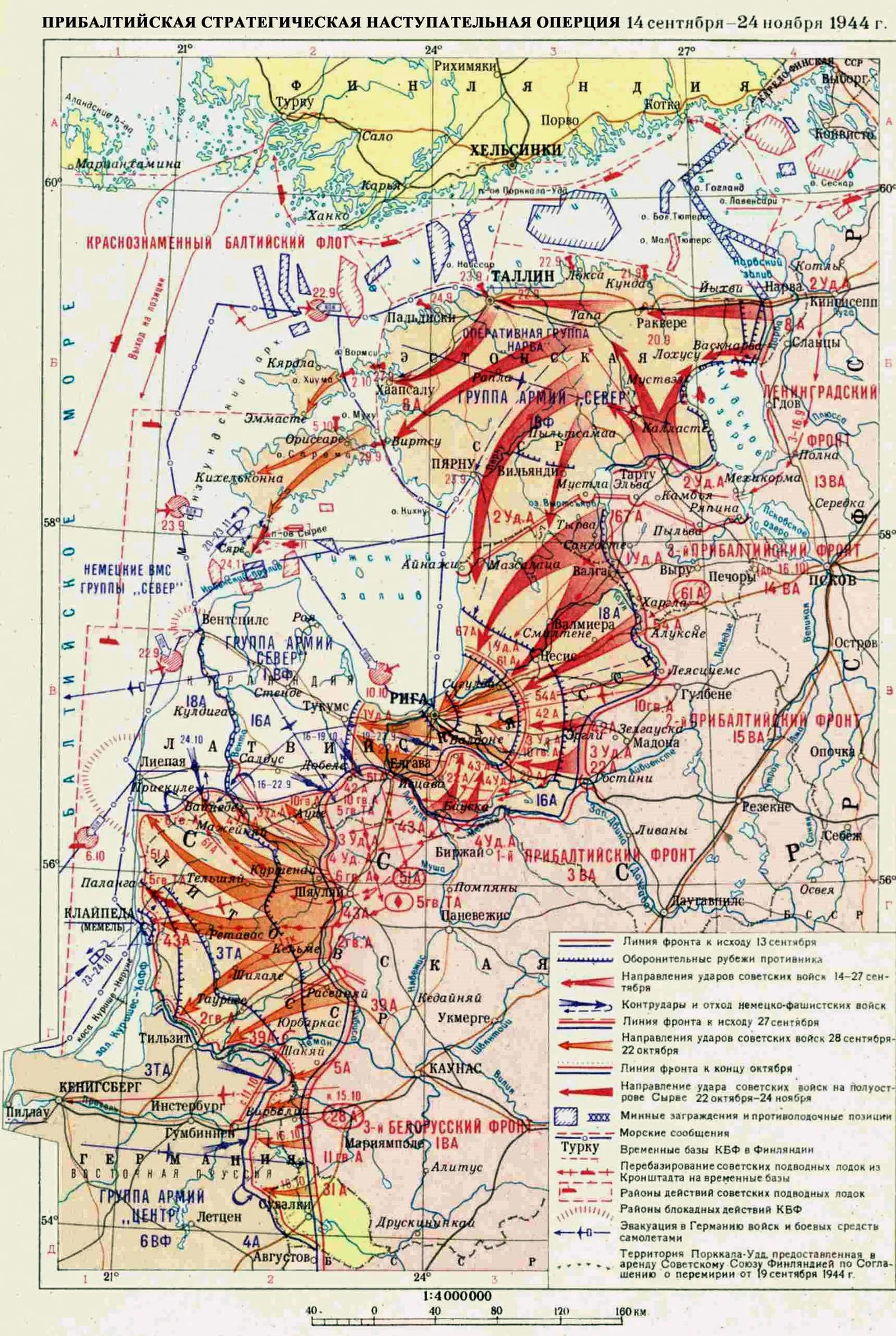
The Baltic offensive of 1944 (in Soviet and Russian literature Прибалтийская стратегическая наступательная операция, the Baltic Strategic Offensive Operation; in Polish literature the Baltic operation) was a series of operations in which, in the autumn of 1944, four fronts of the Red Army and the Baltic Fleet struck the German Army Group North in Estonia, Latvia and Lithuania. Within ten weeks the Germans lost Tallinn, Riga, the islands at the entrance to the Gulf of Riga and the entire Lithuanian coast apart from Klaipėda (Memel). Two German armies, cut off from East Prussia, were trapped on the Courland peninsula, where they survived until the end of the war in Europe. For Estonians, Latvians and Lithuanians this meant the end of the German occupation and the beginning of the second Soviet occupation – after that of 1940–1941 – and, for tens of thousands of them, flight from their homeland.
Name and dates
Soviet military historiography treats the offensive as a single strategic operation, begun on 14 September and ended on 24 November 1944, made up of four front operations. These were:
- the Riga operation (14 September – 22 October), conducted by the 1st, 2nd and 3rd Baltic Fronts, whose aim was to smash the German Sixteenth and Eighteenth Armies and take the Latvian capital; some accounts end it on 24 October;
- the Tallinn operation (17–26 September), in which the Leningrad Front drove the Germans out of mainland Estonia;
- the Moonsund operation (27 September – 24 November), the landings on the islands of the West Estonian Archipelago, from Vormsi to the Sõrve peninsula on Saaremaa;
- the Memel operation (Klaipėda, 5–22 October), in which the 1st Baltic Front broke through to the sea and cut Army Group North off from the rest of the front.
The starting date is not in doubt: at dawn on 14 September the three Baltic fronts simultaneously opened their attack in the direction of Riga. In line with the Soviet division, the end is set at 24 November, when the last German units left the Sõrve peninsula on Saaremaa. Some Western studies also include the fighting in Courland, but that lasted until May 1945 and forms a separate chapter of the war. The German side had no single name for this fighting; it used the codenames of its own operations, such as Cäsar (the counter-attack of 16–21 September) and Aster (the evacuation of Estonia, 17–26 September), and called the fighting around Klaipėda and in Courland the successive battles of Courland.
Background
The Baltic states between two occupations
Estonia, Latvia and Lithuania lost their independence in June 1940, when the Red Army marched in after ultimatums from Moscow, and in August that year the USSR formally annexed them. The year of Sovietisation ended with the mass deportations of June 1941, which remained in the memory of all three nations the most painful experience of that period. A few days later the Wehrmacht attacked: Riga fell on 1 July 1941 and Tallinn at the end of August. The Baltic states were incorporated into the Reichskommissariat Ostland. The German occupation brought the murder of almost the entire Jewish community of Lithuania and Latvia, and of the Estonian Jews who had not managed to flee in 1941; from 1943 it also brought forced-labour camps, to which Jews were brought from the ghettos of Wilno (Vilnius), Kaunas and Riga. Nor did the Germans restore the independence for which some of the Balts had hoped; instead, from 1943, they drafted more and more men into Waffen-SS formations and auxiliary units.
Throughout 1942–1943 the front of Army Group North stood far to the east, near Leningrad and on the Volkhov. Only the winter offensive of 1944 pushed the Germans back to the Panther Line, which ran along the Narva, through Lake Peipus and further south past Pskov. In the Battle of Narva, Estonian conscripts, mobilised after Jüri Uluots’s appeal of February 1944, and Waffen-SS volunteers from several countries held off the attacks of the Leningrad Front for half a year. In the summer of 1944 the front held on the Sinimäed hills, on the so-called Tannenberg Line.
Summer 1944 – the breach in the south
The fate of the Baltic states, however, was decided by what happened further south. In June and July 1944 Operation Bagration shattered Army Group Centre and opened the Red Army’s road through Lithuania. Wilno fell on 13 July, Kaunas on 1 August, and in mid-August Soviet troops reached the border of East Prussia. The 1st Baltic Front of General of the Army Ivan Bagramyan took Šiauliai on 27 July, and on 31 July its 3rd Guards Mechanised Corps reached the Gulf of Riga near Tukums. For several weeks Army Group North was cut off. A German counter-attack in mid-August (Operation Doppelkopf) retook Tukums and restored a narrow corridor a few dozen kilometres wide along the coast, but failed to recover Šiauliai.
At the end of July command of Army Group North passed to Colonel General Ferdinand Schörner, a man devoted to Hitler and known for his ruthless discipline. Ivan Maslennikov’s 3rd Baltic Front took Pskov on 23 July and Tartu on 25 August, cutting the Panther Line south of Lake Peipus. At the same time, in Estonia, Jüri Uluots called on his compatriots to defend the country, hoping it could be held until the question of the Baltic states came before a peace conference.
The plans of both sides
In September the position of Army Group North was extremely dangerous. Its two armies – the Sixteenth and the Eighteenth – and Army Detachment Narwa held an arc of front from the Gulf of Finland to the area of Šiauliai, linked to the rest of the Reich only by the coastal strip between Riga and Klaipėda. When Finland broke with Germany on 2 September and ceased fire on 4 September, the main political argument for holding Estonia collapsed. The Chief of the Army General Staff, Heinz Guderian, concluded that the Baltic states could not be held and ordered an evacuation plan to be prepared. Hitler refused. He feared the effect of a retreat on Sweden and on the Finns’ attitude, and the Kriegsmarine command under Grand Admiral Karl Dönitz stressed the importance of the eastern Baltic for U-boat training, for the shipping of Swedish iron ore and for the Estonian oil shale from which fuel was produced. According to German documents cited by Estonian historians, Guderian’s staff nevertheless quietly began preparations. Only on 15 September, after the Soviet offensive had already begun, did Schörner demand permission to abandon mainland Estonia, and on 16 September he flew to see Hitler about it; according to some studies the Army High Command issued the order for Operation Aster that same day.
The Soviet plan, prepared under the supervision of Marshal Aleksandr Vasilevsky, who coordinated the operations of the Baltic fronts on behalf of the Stavka, provided for two main thrusts. The three Baltic fronts – Bagramyan’s 1st Baltic Front, the 2nd Baltic Front of General of the Army Andrei Yeremenko and Maslennikov’s 3rd Baltic Front – were to strike concentrically at Riga, split the German grouping and destroy it piecemeal. The Leningrad Front of Marshal Leonid Govorov, supported by the fleet, was to drive the Germans out of Estonia. To this end, at the beginning of September, the Stavka moved the 2nd Shock Army from Narva to the Emajõgi river near Tartu; its units were ferried by boat and ferry across the narrow Lämmijärv strait between Lake Peipus and Lake Pskov.
According to Soviet studies, some 900,000 soldiers, more than 17,000 guns and mortars, more than 3,000 tanks and self-propelled guns and about 2,600 aircraft initially took part in the offensive. The Russian compilation of losses edited by Grigori Krivosheev gives about 1.55 million soldiers for the whole operation, including units committed later. The same Soviet sources estimated the German forces at about 730,000 men and more than a thousand tanks, but these figures also include rear services and auxiliary formations. The Soviet superiority in manpower was not overwhelming; what proved decisive was its superiority in artillery, armour and aircraft, and the ability to choose where to strike.
Course of the battle
The drive on Riga (14–27 September)
The offensive opened on 14 September along a front several hundred kilometres long, from Lake Võrtsjärv in Estonia to the area of Bauska in Latvia. The 1st Baltic Front made the fastest progress, attacking from the south, from the direction of Lithuania, where Riga was closest. On the first day its 43rd Army and 4th Shock Army broke through the defences on a sector some 25 kilometres wide and, according to Soviet studies, penetrated to a depth of more than 10 kilometres (the American historian Earl Ziemke writes of about 6 kilometres). On 16 September the leading units reached Baldone, and motorised detachments came out on the Daugava; according to various studies they were 25 to 30 kilometres from Riga. The Germans brought panzer divisions into the area and halted the advance. At the same time, on 16 September, the German XXXIX Panzer Corps, from the Third Panzer Army temporarily subordinated to Army Group North, struck from the west at Bagramyan’s forward grouping south of Riga (Operation Cäsar). It was meant to smash that grouping and straighten the front between Riga and Šiauliai, which would have widened the corridor linking Army Group North with East Prussia. Like Doppelkopf in August, the attack bogged down after a few kilometres against the deeply echeloned Soviet defence; the Germans went over to the defensive around 19–21 September.
North of the Daugava the 2nd and 3rd Baltic Fronts met much stiffer resistance. The terrain – forests, marshes, lakes and a sparse road network – favoured the defence, and the Germans had prepared several successive belts of fortifications in front of Riga. In the first days both fronts advanced only a few kilometres a day. On 19 September the 3rd Baltic Front took the railway junction at Valga on the Estonian–Latvian border, and after the German withdrawal from Estonia its troops moved along the coast towards Pärnu and further south. At the end of September both fronts reached the Sigulda line, an arc of fortifications running a few dozen kilometres east and north-east of Riga, and there they became bogged down in gruelling fighting.
The drive on Riga proved costly and slow. On 24 September the Stavka decided to shift the main effort from the Riga axis to the Memel axis. The 1st Baltic Front was to regroup its armies in secret more than a hundred kilometres to the west, to the Šiauliai area, and from there strike towards the sea at the weakest point of the German front.
The Tallinn operation and the evacuation of Estonia (17–26 September)
On the morning of 17 September, after a heavy artillery preparation, General Ivan Fedyuninsky’s 2nd Shock Army forced the Emajõgi east of Tartu. The German II Army Corps defending the river, weakened by earlier fighting, could not hold it for long; its remnants fell back to the west and south-west. Army Detachment Narwa began its withdrawal in accordance with the Aster plan: on the night of 18/19 September the troops left their positions on the Sinimäed hills and on the Narva, covered by units composed largely of Estonians. The main forces marched through Viljandi and Pärnu to Latvia, while some headed for the ports. The Soviet 8th Army set off in pursuit on 19 September, and on 20 September its units took Rakvere and linked up with the 2nd Shock Army.
In these days Estonian formations fought on both sides. The 8th Estonian Rifle Corps, formed in the USSR from Estonians evacuated or mobilised in 1941, marched in the ranks of the 8th Army. On the German side fought the remnants of the 20th Waffen Grenadier Division of the SS (1st Estonian), frontier defence regiments and Omakaitse home-guard units. On 21 September at Porkuni units of the Soviet Estonian corps surrounded and destroyed a column of Estonians withdrawing from Sinimäed. According to some accounts about 500 of them were killed and about 700 taken prisoner; Estonian historians also write of the victors killing prisoners and wounded. Estonian fought Estonian at Avinurme as well.
On 18 September an underground government came into the open in Tallinn, headed on behalf of the ailing Uluots – the prime minister acting as president – by Deputy Prime Minister Otto Tief. In those days the Estonian flag was raised on the Tall Hermann tower, and the volunteers of Rear Admiral Johan Pitka tried to defend the city and the government. They lacked the strength, however, to stand up to either army. On 22 September troops of the Leningrad Front entered Tallinn, which the Germans had abandoned that same morning after destroying the port installations. Pärnu fell on 23 September, and by 26 September Soviet troops had occupied the whole of mainland Estonia.
The German evacuation went more smoothly than either side had expected. According to figures cited by Estonian historians, some 50,000 soldiers, 20,000 civilians and a thousand prisoners were taken out of Estonia within a few days, most of the soldiers by sea. Soviet aircraft attacked the convoys; on 22 September in the Baltic they sank the hospital ship Moero, on which, according to the same sources, more than 600 people died, including refugees and wounded. The retreat also left a trail of crimes. On 19 September, at the Klooga camp near Tallinn, the SS and formations under its command shot the prisoners, the vast majority of them Jews from the Wilno and Kaunas ghettos, and burned their bodies on pyres. Estimates of the number of victims vary from several hundred to about 2,000; a few dozen people who managed to hide lived to see liberation.
The Memel operation – Army Group North cut off (5–22 October)
The regrouping of the 1st Baltic Front took about ten days. Bagramyan’s armies moved by night, and dummy positions and radio traffic were left in their old positions near Riga to deceive German intelligence. On 5 October the front struck from the area west of Šiauliai at a thinly held sector of General Erhard Raus’s Third Panzer Army. The German defence collapsed on the very first day, and General Vasily Volsky’s 5th Guards Tank Army poured into the breach. Along the way the tank columns overran the headquarters of the Third Panzer Army; Raus and his officers had to fight their way through to Klaipėda. On 10 October Soviet units reached the Baltic north of Klaipėda, near Palanga, and the 43rd Army reached it south of the city. The Red Army’s 16th Lithuanian Rifle Division also took part in the fighting. On the southern wing the 39th Army of the 3rd Belorussian Front advanced towards the Neman and Tilsit.
This time Army Group North was cut off for good. According to various tallies, between twenty-odd and more than thirty divisions found themselves on the northern side of the Soviet wedge, in western Latvia. Klaipėda itself, defended by the German XXVIII Army Corps, withstood a siege, supplied by the Kriegsmarine and supported by naval gunfire. By 22 October Soviet troops had occupied almost the whole Lithuanian coast; only the Klaipėda bridgehead and the Curonian Spit remained in German hands.
The fall of Riga (6–22 October)
The thrust towards Klaipėda also sealed the fate of Riga. From 6 October the Germans began withdrawing troops from the area of the city across the Daugava and further west into Courland; Hitler formally agreed to the abandonment of Riga a few days later. The 2nd and 3rd Baltic Fronts went over to the pursuit, breaking through successive defence lines. On 13 October units of the 3rd Baltic Front occupied the greater part of Riga, lying on the right bank of the Daugava, and on 15 October, after forcing the river, the districts on the left bank as well. The Germans blew up the bridges over the Daugava as they withdrew. A Latvian rifle corps of the Red Army took part in the fighting for the city, a fact that Soviet propaganda made a particular point of highlighting. By 22 October the front had come to a halt on a line running from the shore of the Gulf of Riga between Riga and Tukums to the Baltic coast south of Liepāja; behind it, on the Courland peninsula, the German Sixteenth and Eighteenth Armies were shut in.
The island landings (27 September – 24 November)
The last part of the offensive was the capture of the West Estonian Archipelago, which closes the entrance to the Gulf of Riga and commands the routes to the Gulf of Finland. The operation was conducted by the 8th Army, including the 8th Estonian Rifle Corps, and the 109th Rifle Corps, supported by the ships and aircraft of Admiral Vladimir Tributs’s Baltic Fleet. The Soviet command used rapid successive landings, giving the defenders no time to fortify the next islands. Vormsi was taken on 27–28 September. On 29 September infantry landed at Kuivastu on Muhu, partly in American DUKW amphibious trucks supplied under Lend-Lease, and the island was taken by 1 October. The Germans withdrew from Muhu and Hiiumaa, which was taken on 2–3 October, to the largest island, Saaremaa, blowing up behind them the causeway linking it to Muhu.
On Saaremaa Soviet units advanced rapidly into the interior of the island. The German 23rd Infantry Division and reinforcements brought in by sea fell back, fought a bloody night action at Tehumardi on the way, and around 8 October shut themselves into the narrow Sõrve peninsula at the south-western tip of the island, which was barred by lines of fortifications partly built by the Red Army itself in 1941. There the Soviet attack stalled for six weeks. Only at the end of November, in defiance of Hitler’s explicit order to fight to the last man, did Schörner order the evacuation of the peninsula by sea. The last German units left Sõrve on the night of 23/24 November. Soviet sources spoke of 7,000 German soldiers killed and 700 taken prisoner on the islands; these figures are not confirmed by German sources.
Courland
After the fall of Riga the Red Army tried to eliminate the grouping trapped in Courland in a single sweep. Attacks from mid-October and again from the end of that month, directed mainly towards Liepāja, brought small gains at heavy cost. The front in western Latvia stabilised. The Chief of the General Staff, Guderian, repeatedly demanded that the troops be evacuated from Courland for the defence of the Reich, but Hitler, backed by Dönitz, refused. He believed that the bridgehead tied down large Soviet forces, protected shipping in the Baltic and could serve as a base for future offensives. By the end of the war only some of the divisions had been shipped out.
The Balts on both sides of the front and the flight of the population
For Estonians, Latvians and Lithuanians the autumn offensive was a war fought by two foreign armies, in whose ranks their own countrymen also fought. On the German side served the Estonian 20th Waffen Grenadier Division of the SS, the Latvian 15th and 19th Waffen Grenadier Divisions of the SS (the Latvian Legion), police battalions, frontier defence regiments and home-guard units. Most of these soldiers had joined them through the conscription the Germans announced in 1943 and 1944; some fought in the conviction that they were defending their country against the return of Soviet rule. On the Soviet side fought the 8th Estonian Rifle Corps, the 130th Latvian Rifle Corps and the 16th Lithuanian Rifle Division, formed from people evacuated in 1941, men mobilised in the USSR and prisoners of war, and from the autumn of 1944 replenished with men called up in the newly occupied territories. Clashes of Balt against Balt, such as the one at Porkuni, remain in these nations’ memory one of the most painful chapters of the war. After the Red Army arrived, many former soldiers of the German formations and men evading the Soviet draft went into hiding in the forests; from them grew the post-war armed underground known as the Forest Brothers.
The approach of the front set off a mass flight of the civilian population, who remembered the deportations of 1941. Estonians fled west by sea – on evacuation ships to Germany, or in cutters and fishing boats across the Baltic to Sweden. According to the most frequently cited estimates, some 70,000–80,000 people left the country in the autumn of 1944, including almost the entire Swedish minority of the coast and islands. According to estimates by Latvian historians, about 150,000 people left Latvia via Courland and the ports of Liepāja and Ventspils, and several tens of thousands left Lithuania. Many of them died at sea or in air raids on German cities; most of the survivors did not return after the war and settled in Sweden, the United States, Canada and Australia. The émigré organisations they founded kept the cause of Baltic independence alive for half a century.
Losses
According to Krivosheev’s compilation, the Soviet fronts lost 61,468 soldiers killed, missing and dead from other causes and 218,622 wounded and sick in the Baltic offensive – about 280,000 men in all. Soviet studies stated that the Germans lost more than 200,000 soldiers, including about 33,500 prisoners, and that 26 divisions of Army Group North were destroyed; these are Soviet figures not confirmed by German sources, and there is no reliable German tally of losses for the whole autumn campaign in the Baltic states. The number of civilian victims remains unknown: those killed in the fighting and air raids, those murdered by the retreating Germans and by the arriving Soviet security organs, and those drowned while fleeing across the Baltic.
Significance
The Baltic offensive ended the German occupation of Estonia, Latvia and Lithuania, which had lasted since 1941, and brought about their reincorporation into the USSR. For Moscow this was the restoration of the borders of June 1941; for the Western powers it was a de facto situation that most of them never formally recognised. The Otto Tief government was unable to evacuate and ceased to exist, and most of its members fell into the hands of the NKVD; from then on the continuity of the state was represented by émigré diplomatic missions and the Estonian government-in-exile. The return of Soviet rule was followed by arrests, conscription into the Red Army, a struggle against the Forest Brothers that lasted until the early 1950s, and another great deportation in March 1949, which broke rural resistance to collectivisation.
Militarily, the operation cut Army Group North off from the rest of the front. Renamed Army Group Courland in January 1945, it held out in the Courland Pocket, beating off successive Soviet offensives (historians usually distinguish six), and capitulated only after Germany’s surrender, on 8–9 May 1945. According to various sources, between about 135,000 and about 190,000 German soldiers were taken prisoner there, and nearly 200,000 including Latvians. The Germans abandoned the Klaipėda bridgehead in January 1945. The stubborn retention of Courland, against Guderian’s advice, deprived the Reich of twenty-odd divisions that it sorely lacked in 1945 on the Vistula, the Oder and in East Prussia. The 1st Baltic Front’s breakthrough to the sea and the 3rd Belorussian Front’s attack in October 1944 also carried the fighting onto East Prussian territory for the first time, heralding the winter offensive of 1945. The Baltic states regained their independence only in 1990–1991, invoking the continuity of statehood, which in Estonia came to be symbolised by Tief’s government of September 1944.