Germany
Heinz Guderian
Commander of XIX Corps (1939–1940) and Panzer Group 2 (1941), Inspector General of Armoured Troops (1943–1945), acting Chief of the Army General Staff (OKH) (1944–1945)
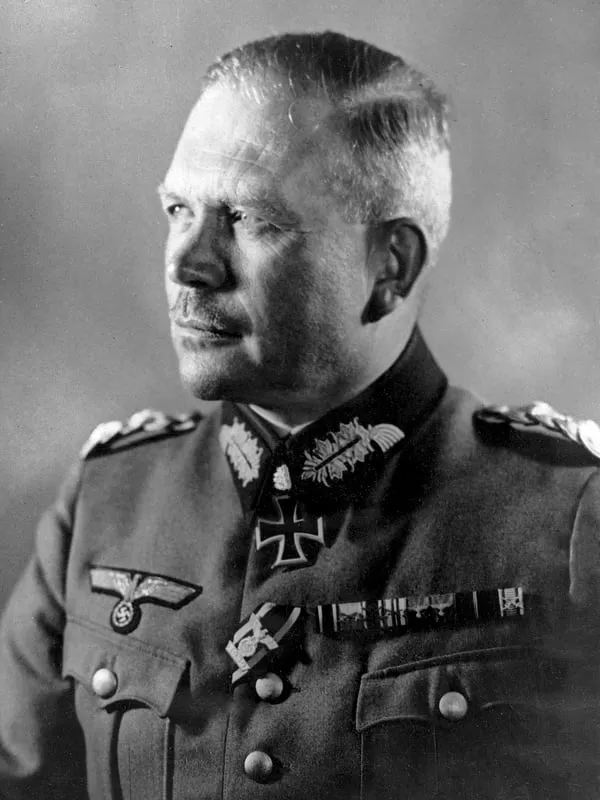
- Born:
- 17 June 1888, Chełmno (Kulm), West Prussia (German Empire)
- Died:
- 14 May 1954, Schwangau (Bavaria)
- Author:
- Natalia
- Photo:
- autor nieznany, domena publiczna, Wikimedia Commons

Heinz Guderian was a German general and theorist of armoured warfare, the best known of the commanders who led German tanks against Poland, France and the Soviet Union in 1939–1941. He was not the sole creator of the German armoured forces that he made himself out to be after the war, but he was their loudest advocate and one of their most effective commanders. In September 1939 his corps cut through the Polish Corridor, pushed through Wizna and took Brest, where Guderian, together with a Soviet kombrig, took the salute at a march-past when the city was handed over to the Red Army. In May 1940 his tanks broke through the front at Sedan, and in 1941 they reached the approaches to Moscow. Towards the end of the war, as Chief of the Army General Staff, he was Hitler’s closest adviser on the Eastern Front. After the war, despite evidence of his share of responsibility for crimes, he never stood trial, and in his memoirs he created the image of an apolitical professional – an image that historians have long since challenged.
Early years and the First World War
Heinz Wilhelm Guderian was born on 17 June 1888 in Chełmno (Kulm) in West Prussia, the son of a Prussian officer, Friedrich Guderian, and Clara, née Kirchhoff. The family had roots around Bydgoszcz and Tuchola, and his grandparents owned an estate at Wielka Klonia in the Tuchola Forest. He spent his childhood in the garrisons where his father served. From 1901 he attended the cadet schools at Karlsruhe and Gross-Lichterfelde near Berlin. In 1907 he joined the 10th Hanoverian Jäger Battalion, commanded by his father, as an officer cadet, and in January 1908 he was commissioned as a second lieutenant. In 1913 he married Margarete Goerne. They had two sons, Heinz Günther and Kurt, both later officers in the armoured forces.
Before the war Guderian underwent training with a telegraph battalion, and in the autumn of 1913 he began his studies at the War Academy in Berlin. The outbreak of war cut them short. For most of the First World War he was a signals officer: he commanded a radio station, and in 1915–1916 he ran radio intercept for the 4th Army. He fought on the Marne and at Verdun, was promoted to captain in November 1915 and also served briefly as an infantry battalion commander. In February 1918 he was posted to the General Staff. He ended the war as an operations officer in occupied Italy. His experience with radio communications was later to be fundamental to his ideas: Guderian understood that fast armoured formations could be led only if the commander was in constant contact with his tanks.
After the war: the eastern border and the Reichswehr
Like most Prussian officers, Guderian regarded the armistice and the Treaty of Versailles as a humiliation. He was especially pained by the transfer of West Prussia, with his native Chełmno, to Poland. In letters to his wife in 1919 he wrote of the Poles with contempt, as “poor, dirty, incompetent” and “treacherous”. In 1919 he served on the staff of Grenzschutz Ost, which coordinated the volunteer units on the eastern border, and in the summer with the Iron Division fighting in Latvia.
He was accepted into Hans von Seeckt’s 100,000-strong Reichswehr. The turning point in his career came in 1922, when he was posted to the Inspectorate of Motor Transport Troops. There he studied the use of motor transport and read the works of the British writers J.F.C. Fuller, Basil Liddell Hart and Percy Hobart, as well as Germans such as the tank veteran Ernst Volckheim. From 1924 he taught military history and tactics in Stettin; in 1927, as a major, he moved to the Truppenamt, the camouflaged general staff, and from 1928 he taught tank tactics. He knew from reports the conclusions of the trials carried out as part of the secret cooperation with the Red Army, including those at the Kama tank school near Kazan. He drove a tank himself for the first time only in the summer of 1929, in Sweden.
In 1930 he took command of the 3rd Prussian Motor Transport Battalion, with which he practised cooperation between motorcyclists, armoured cars and dummy tanks. In 1931 he became chief of staff to the Inspector of Motorised Troops, General Oswald Lutz. The Lutz–Guderian partnership became the driving force behind the building of the German armoured arm: Lutz worked within the army’s structures, while Guderian was its public advocate, polemicist and organiser. Historians stress that many other officers, such as Walther Nehring and Hermann Breith, played a large part in this work, and that it was Lutz who first set out the basic principles for the employment of armoured formations in official documents.
Creator of the armoured forces
After Adolf Hitler came to power, the expansion of the army accelerated. According to Guderian’s memoirs, after a demonstration of motorised units at Kummersdorf Hitler exclaimed: “That’s what I need!” In July 1934 Guderian became chief of staff of the new Armoured Troops Command. In October 1935 the first three panzer divisions were formed, and Guderian, then a colonel, took command of the 2nd Panzer Division in Würzburg. In 1936 he was promoted to Generalmajor. He argued that tanks should operate in large, self-contained panzer divisions with their own motorised infantry, artillery, engineers and signals, rather than being parcelled out among the infantry. He clashed over this with the Chief of the General Staff, Ludwig Beck, and with the army leadership, which preferred more cautious solutions.
At Lutz’s request he wrote, in 1937, the book Achtung – Panzer!, a combination of a history of armoured warfare, a technical analysis and a political programme for expanding the armoured arm. The book became a bestseller. In it Guderian warned that the Russians had built a powerful armoured force and that the “eastern question” would confront Germany in a more serious form than ever before.
In February 1938, during the Blomberg–Fritsch affair, when Hitler removed Werner von Blomberg and Werner von Fritsch and got rid of many inconvenient generals, Lutz was sent into retirement, while Guderian was promoted to Generalleutnant and given command of XVI Corps. In March 1938 he led the motorised units into Austria during the Anschluss. The march on Vienna exposed all the weaknesses of the young arm: the tanks ran short of fuel, many vehicles broke down, and had it come to fighting the corps would have been of little value. Guderian stood beside Hitler in Linz as he addressed the crowds. In the autumn of 1938 his XVI Corps occupied the Sudetenland, ceded to Germany under the Munich Agreement. In November 1938 he became a General der Panzertruppe and Chief of Mobile Troops, responsible for the training and organisation of all armoured and motorised units. In the last year before the war he was an increasingly frequent guest of Hitler’s, at dinners and at the opera.
The September Campaign
In August 1939 Guderian took command of the newly formed XIX Corps, part of General Günther von Kluge’s 4th Army in Fedor von Bock’s Army Group North. Under Case White the corps, with the 3rd Panzer Division and the 2nd and 20th Motorised Divisions, was to cut across Gdańsk Pomerania and link the Reich with East Prussia. On 1 September it set off through the Tuchola Forest. Guderian led the corps from the front, from an armoured command vehicle fitted with a radio, which became his trademark. He admitted that a night march in fog, during which they suffered “serious losses”, also had a personal purpose: he wanted to see his grandparents’ “liberated” estate at Wielka Klonia. By 5 September the fighting in the Corridor was over, and Guderian was showing Hitler and Heinrich Himmler around the battlefield.
The corps was then moved through East Prussia to the eastern flank of the front. Reinforced with the 10th Panzer Division, from 7 to 10 September it fought to break through the positions at Wizna, where Captain Władysław Raginis with a handful of men held up the German advance for three days. According to Polish accounts, the Germans threatened to shoot the soldiers they had captured unless the last bunkers surrendered. The corps then drove south, far behind the backs of the Polish armies, and on 14 September reached Brest. From 14 to 17 September the fortress was defended by the troops of Brigadier General Konstanty Plisowski, who withdrew across the Bug on the night of 16–17 September. On the morning of 17 September, the day of the Soviet invasion, the Germans took the citadel. According to German figures, the corps covered some 330 kilometres in Poland in little more than a fortnight.
Brest lay in the Soviet sphere of influence. On 22 September Guderian handed the city over to Kombrig Semyon Krivoshein’s 29th Light Tank Brigade. The two commanders stood together on the reviewing stand as the German units left the city, and at the end the swastika flag was replaced by the Soviet one. On 27 October 1939 Guderian received the Knight’s Cross of the Iron Cross. During the campaign the Wehrmacht committed crimes against prisoners and civilians. Guderian’s corps had withdrawn before the SS and police began their mass operations in the occupied territories, but the general knew about the killings and the ghettos, including from his son. There is no trace of any protest by him.
Sedan and the French campaign
In the winter of 1939–1940 Guderian backed the plan of his fellow War Academy graduate Erich von Manstein to make the main thrust against France through the Ardennes, and gave his assurance that tanks could get through the wooded hills. His XIX Corps, with the 1st, 2nd and 10th Panzer Divisions, spearheaded the attack within Ewald von Kleist’s panzer group. On the afternoon of 13 May 1940, after a massive Luftwaffe bombardment, his infantry crossed the Meuse at Sedan and broke through the French defences. Against the orders of his superiors, who feared for his exposed flanks, Guderian pressed on westwards. On 17 May Kleist relieved him of command, but after the intervention of Gerd von Rundstedt and Wilhelm List Guderian was granted permission for a “reconnaissance in force” and drove on. On 20 May his tanks reached the Channel near Abbeville, cutting off the Allied forces in Belgium. He was then given a panzer group bearing his own name, and in June he led it into the rear of the Maginot Line, as far as the Swiss border. On 19 July 1940 he was promoted to Colonel General. The French campaign became the model of what the press called blitzkrieg, although its success owed as much to Allied mistakes as to the strength of the German tanks.
War against the USSR
Before Operation Barbarossa Guderian, who in 1937 had warned of Russia’s might, accepted the official thesis of a “preventive” war and the idea of a struggle against “Jewish Bolshevism”. On 22 June 1941 his Panzer Group 2, part of Bock’s Army Group Centre, crossed the Bug at Brest, where in September 1939 he had handed the city over to the Red Army. Together with Hermann Hoth’s panzer group it closed the pocket at Minsk and then at Smolensk. His soldiers called him “Fast Heinz” (Schneller Heinz). In July he received the Oak Leaves to the Knight’s Cross. In August the Chief of the Army General Staff, Franz Halder, sent him to Hitler to win him over to a march on Moscow, but Guderian unexpectedly backed the dictator’s plan: a turn south, into the rear of the Soviet armies around Kiev. The Kiev encirclement, completed in September, was the Germans’ greatest victory of that war, but it wore the panzer group out.
In October the 2nd Panzer Army, as it had been renamed, attacked from the south towards Oryol and Tula as part of the Battle of Moscow. At Mtsensk Soviet T-34s inflicted heavy losses on it. The advance on Tula bogged down in frost and mud. When the Soviet counter-offensive began in early December, Guderian withdrew in defiance of Hitler’s orders “not to retreat a single step”, and quarrelled with the new commander of Army Group Centre, Günther von Kluge. On 25 December 1941 he was dismissed and transferred to the reserve.
Guderian’s memoirs pass over in silence the crimes committed by his troops. The documents show that the Commissar Order was carried out in the divisions of Panzer Group 2 and that reprisals were taken against the civilian population. One of his corps commanders, General Joachim Lemelsen, stated that the order to shoot commissars had been passed on by Guderian, and a report by the panzer group at the beginning of August recorded that 170 commissars had been “disposed of”.
Inspector General and Chief of Staff
After the defeat at Stalingrad Hitler brought Guderian back into service. On 1 March 1943 he appointed him Inspector General of Armoured Troops. Guderian worked with the Armaments Minister, Albert Speer, pressed for the production of the proven PzKpfw IV alongside the new Panthers and Tigers, and for the rebuilding of shattered divisions. He opposed the offensive at Kursk. By his own account he asked Hitler why Germany should attack in the east at all that year, and the dictator admitted that whenever he thought of the attack “his stomach turned over”. The Battle of Kursk destroyed the armoured forces that had been so laboriously rebuilt. That same year Guderian accepted from Hitler the estate of Deipenhof (Głębokie) in the Warthegau, covering some 800–950 hectares, whose Polish owners had previously been expelled. He had earlier sought a much larger property. He also drew a special monthly allowance of 2,000 Reichsmarks from Hitler’s fund. In his memoirs he presented the estate as an ordinary retirement gift.
The conspirators preparing to assassinate Hitler made contact with Guderian. He did not join them, but neither did he betray them. After the 20 July plot of 1944, on 21 July Hitler appointed him acting Chief of the General Staff of the Army (OKH). Guderian sat on the so-called Court of Honour, which expelled from the army officers suspected of involvement in the plot so that they could be tried before Roland Freisler’s People’s Court. After the war he claimed that the sessions filled him with disgust, but in reality he carried out this task zealously. He issued an order that General Staff officers were to actively support National Socialism and helped to introduce the Nazi salute in the armed forces. As Chief of Staff he was responsible for the Eastern Front during the Warsaw Uprising and did not oppose Hitler’s and Himmler’s orders to destroy Warsaw, nor the crimes committed against its inhabitants. At a Volkssturm rally in November 1944 he spoke of the “95 million National Socialists” who stood behind Hitler.
In the winter of 1944–1945 he demanded in vain that divisions be transferred from the west, from Courland and from Hungary to hold the front on the Vistula. The Soviet January offensive shattered it within days. Turning cities in the east into “fortresses” did not stop the Red Army. After a failed attempt to relieve Küstrin (Kostrzyn) and another quarrel with Hitler, he was sent on leave on 28 March 1945. He was replaced by General Hans Krebs.
After the war and memory
On 10 May 1945 Guderian surrendered with his staff to the Americans. He was interrogated, and at the Nuremberg trials appeared only as a witness. The Americans refused to hand him over to the Soviet Union, and Polish charges, including those concerning the threats at Wizna, did not lead to a trial. He worked with US Army historians and incriminated other generals, which helped him avoid prosecution. On 17 June 1948 he was released. He settled in Schwangau in Bavaria and turned to writing. In the 1950 pamphlet Kann Westeuropa verteidigt werden? (Can Western Europe Be Defended?) he portrayed Hitler’s Germany as Europe’s defender against Bolshevism. In 1951 he published his memoirs, Erinnerungen eines Soldaten (Memories of a Soldier), whose English edition, Panzer Leader, with a foreword by Liddell Hart, became a worldwide bestseller. He died of heart disease on 14 May 1954 in Schwangau. He was buried in Goslar.
Guderian’s memoirs long shaped the image of armoured warfare and of their author. In them he presented himself as the sole creator of the armoured arm, whose vision had been obstructed by conservative generals, and as a soldier who had nothing to do with politics or crimes. Modern historians, among them Russell Hart, have shown that this was one of the pillars of the myth of the “clean Wehrmacht”: Guderian was closer to Nazism and to Hitler than he admitted, and his units took part in the criminal war in the east. His military achievements, however, remain beyond doubt. It was largely thanks to his persistence that Germany entered the war with panzer divisions equipped with radios and capable of fast, independent operations, which in 1939–1941 gave the Wehrmacht an advantage over all its opponents. For Poles he remains above all the general who smashed Polish forces in the September Campaign and who, at Brest, together with a Red Army officer, symbolically sealed the partition of Poland between the two invaders.
Sources
Commanded in battles
(07)- 10 May – 25 June 1940Battle of FranceWestern Front
- 12–15 May 1940Battle of Sedan (1940)Western Front
- 22 June – 9 July 1941Battle of Białystok–MinskEastern Front
- 7 July – 26 September 1941Battle of Kiev (1941)Eastern Front
- 10 July – 10 September 1941Battle of Smolensk (1941)Eastern Front
- 30 September 1941 – 7 January 1942Battle of MoscowEastern Front
- 12 January – 3 February 1945Vistula–Oder offensiveEastern Front
Mentioned in battles
(18)- Invasion of Poland
- Soviet invasion of Poland
- Battle of Kock
- Belgian Campaign
- Battle of Dunkirk
- Operation Barbarossa
- Battle of Rostov (1941)
- Rzhev–Vyazma offensive (1942)
- Battle of Kursk
- Crimean offensive (1944)
- Warsaw Uprising
- Jassy–Kishinev offensive
- Baltic offensive (1944)
- Siege of Budapest
- East Prussian offensive
- Battle of Poznań
- East Pomeranian offensive
- Operation Frühlingserwachen
Often appears with
People who appear in the same events.
On the timeline
(61)The 40 most important of 61 events. All tagged “Heinz Guderian” (11) →
1938
1939
1940
1941
June
July
August
September
October
November
- 28
- The Red Army retakes RostovOn 28 November 1941 the Germans began leaving Rostov under attack by three Soviet armies; next day it was free. Rundstedt fell back to the Mius and was sacked.
- The Germans reach the Moscow–Volga CanalOn the night of 27–28 November 1941 a 7th Panzer Division battlegroup crossed the Moscow Canal at Yakhroma. A 1st Shock Army counter-attack threw it back.