Soviet Union
Aleksandr Vasilevsky
Chief of the General Staff of the Red Army (1942–1945, 1946–1948), commander of the 3rd Belorussian Front (1945), Commander-in-Chief of Soviet Forces in the Far East (1945), Minister of the Armed Forces and Minister of War of the USSR (1949–1953), Marshal of the Soviet Union (from 1943)
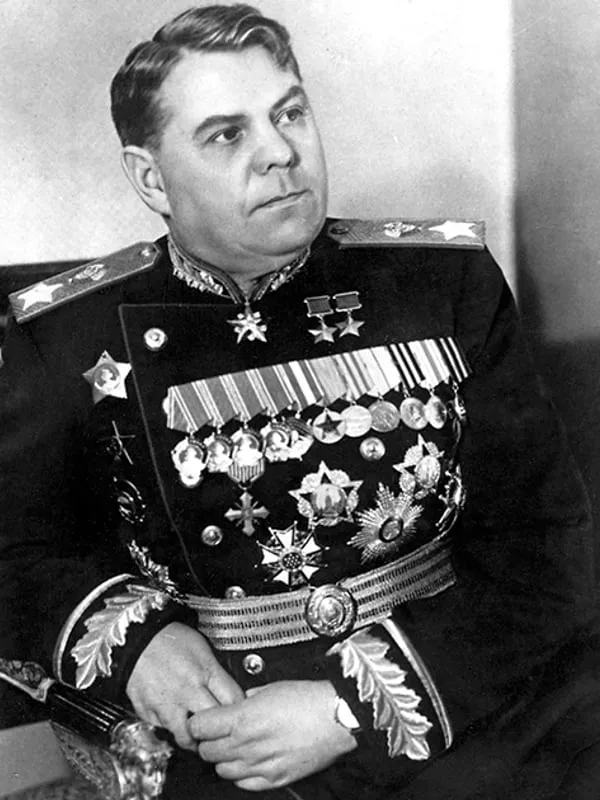
- Born:
- 30 September 1895, Novaya Golchikha, Kostroma Governorate (Russian Empire)
- Died:
- 5 December 1977, Moscow (Soviet Union)
- Author:
- Łukasz
- Photo:
- autor nieznany, CC BY 4.0, Wikimedia Commons

Aleksandr Mikhailovich Vasilevsky was Chief of the General Staff of the Red Army for most of the German-Soviet war and, alongside Georgy Zhukov, Joseph Stalin’s most important military adviser. The son of an Orthodox priest and a former staff captain in the Tsarist army, he rose in the 1930s in the shadow of the Great Purge, which removed his superiors from the army. In 1942, together with Zhukov, he planned Operation Uranus, which encircled the German Sixth Army at Stalingrad, and later he co-ordinated the operations of several fronts at Kursk, in Ukraine, in the Crimea and in Belarus. In the spring of 1945 he took Königsberg, and in the summer he commanded the war against Japan in Manchuria. Unlike Zhukov, he was regarded as calm and tactful, a man who knew how to talk to Stalin so as to push through his own view without an open quarrel. This quality earned him the respect of some, while to others, such as Nikita Khrushchev, it looked like submissiveness.
A priest’s son from Kostroma Governorate
He was born on 30 September 1895 (18 September by the Julian calendar; according to the surviving parish register two days earlier, but he himself gave this date, which he shared with his mother’s birthday) in the village of Novaya Golchikha in Kineshma district, Kostroma Governorate, now within the town of Vichuga in Ivanovo Oblast. He was the fourth of eight children of Mikhail Vasilevsky, a church choirmaster and psalm-reader who from 1897 was priest of the church in the village of Novopokrovskoye, and Nadezhda, née Sokolova, the daughter of a psalm-reader. The family belonged to the Edinoverie – a community of former Old Believers who had accepted the authority of the Orthodox Church. From an early age the children helped their father in the fields. Aleksandr completed the parish school and the church school in Kineshma, and in 1909 entered the theological seminary in Kostroma, which meant great sacrifices for the family. He took part in a seminarists’ strike against the ban on seminary graduates entering universities and was briefly expelled. He had no intention of becoming a priest; he dreamed of working as an agronomist or a land surveyor.
An officer of the Tsarist army
The First World War put an end to these plans. At the beginning of 1915 Vasilevsky passed his final seminary examinations as an external candidate and volunteered for the army. After a four-month accelerated course at the Alekseyevsky Military School in Moscow, he was commissioned as a praporshchik (ensign) in May 1915. In the autumn he was sent to the South-Western Front as a junior officer in the 409th Novokhopyorsk Infantry Regiment. In the spring of 1916 he commanded a company, and in June he took part in the Brusilov Offensive. Because of the heavy losses among officers, by the end of the war he was commanding a battalion and had reached the rank of staff captain. In the summer of 1917 he fought on the Romanian front in the Battle of Mărășești, for which he was decorated.
The news of the October Revolution reached him in Romania. He decided to leave the army and in November 1917 went home on leave. The soldiers of his regiment did elect him as their commander, in accordance with the rules of the time, but the regiment was in a zone subordinate to the Ukrainian Central Rada, so on the advice of the local military authorities he did not return to the front. He worked on his parents’ farm, then as a military training instructor in his district, and from the autumn of 1918 as a teacher in village schools in Tula Governorate.
In the Red Army
In April 1919 he was called up into the Red Army as a so-called voenspets, a former Tsarist officer serving the new regime. He began as an assistant platoon commander in a reserve battalion; soon he was commanding a hundred-strong detachment that backed the forced requisitioning of grain from the peasants in Yefremov district and fought armed bands. During the Civil War, when Denikin’s army was approaching Tula in the autumn of 1919, he commanded a company, a battalion and finally a regiment in the newly formed Tula Rifle Division, which, however, never had to fight on the southern front.
In December 1919 the division was transferred to the Western Front. In the Polish–Soviet War Vasilevsky fought as a deputy regimental commander in the 15th Army and, in the summer of 1920, in the 48th Rifle Division, which garrisoned Wilno and in August fought the Poles in the area of the Białowieża Forest. There he came into conflict with his brigade commander, who for his refusal to carry out an order he considered impossible sent him before a court martial and then demoted him to platoon commander; the divisional commander overturned this decision. After the armistice Vasilevsky took part in the fighting against the units of Stanisław Bułak-Bałachowicz in Belarus and, until the middle of 1921, in operations against armed bands in Smolensk Governorate.
Regimental commander and staff officer
For the next ten years he served in the 48th Tver Rifle Division, commanding in turn all three of its regiments and the divisional school for NCOs. In 1927 he completed the Vystrel courses for the improvement of command personnel. The 144th Rifle Regiment under his command, previously considered the weakest in the division, took first place in the district manoeuvres in 1930. He attracted the attention of one of the leading theorists of Soviet military thought, Vladimir Triandafillov, thanks to whom in 1931 Vasilevsky was posted to the Directorate of Combat Training of the Red Army in Moscow. There he edited a training bulletin and helped to write the instructions on conducting deep battle and on co-operation between infantry, artillery, tanks and aviation – the basic documents of Soviet operational doctrine in the 1930s. In 1934–1936 he directed combat training in the Volga Military District.
In 1936, after the introduction of personal ranks, he became a colonel and entered the General Staff Academy. The academy’s first intake, later dubbed the “marshals’ course”, included many future front commanders. He graduated with distinction in 1937, at the height of the purge in the army, immediately took over a department from its arrested head, and in October 1937 moved to the General Staff. In 1938 he became a Kombrig and took part in the analysis of the fighting at Lake Khasan. He had been a candidate member of the party since 1930 but, because of the party purges, was admitted only in 1938. In questionnaires he wrote that he had no contact with his parents – a priest’s son had to cut himself off from them. According to his memoirs, it was only in 1940 that Stalin, having learned of this, asked him why he did not help his father and encouraged him to renew the ties. Years later Vasilevsky said openly that without the destruction of the command cadres in 1937 Hitler might not have dared to go to war in 1941.
From the Winter War to 22 June 1941
In 1939 Vasilevsky became deputy head of the Operations Directorate of the General Staff. He took part in preparing the first version of the plan for war with Finland, which Stalin rejected, and during the Winter War he stood in for his superiors in Moscow while they were seconded to the front. His memoirs are one of the main sources for the history of those months, including the circumstances in which Semyon Timoshenko took command in Finland. In the spring of 1940 he was among the signatories of the Moscow Peace Treaty, and he then chaired the commission that marked out the new Soviet–Finnish border on the ground. In May 1940 he was promoted to first deputy head of the Operations Directorate and to Komdiv, and in June – after the introduction of general officers’ ranks – to major general. He worked on the plans for the strategic deployment of the Red Army in the event of war with Germany. In November 1940 he accompanied Vyacheslav Molotov on his journey to Berlin as the delegation’s military expert.
Moscow and Kharkiv
On 1 August 1941, in the sixth week of Operation Barbarossa, Vasilevsky became head of the Operations Directorate and deputy to the Chief of the General Staff, Marshal Boris Shaposhnikov, his patron. In the worst days of the Battle of Moscow, when the General Staff was evacuated after the panic in mid-October, he led the operations group of a dozen or so officers left behind in the capital to serve the Stavka. At the end of October he became a lieutenant general. When Shaposhnikov fell ill, Vasilevsky acted in his place from the end of November and did much of the preparation for the December counter-offensive; in January 1942 he signed with Stalin the directive on shock groups.
In the spring of 1942, again standing in for the ailing Shaposhnikov, he became a colonel general. As a representative of the Stavka he was at Demyansk, and in May he tried to persuade Stalin to halt the offensive at Kharkiv when Kleist struck it from the south. Stalin did not listen to him, and Khrushchev later reproached him for not defending his view firmly enough. In June Vasilevsky organised, with Kirill Meretskov, the attempt to extricate the 2nd Shock Army from encirclement on the Volkhov. On 26 June 1942, two days before the start of the German summer offensive, he became Chief of the General Staff, and in October also Deputy People’s Commissar of Defence.
Stalingrad
From July to the end of August 1942 Vasilevsky was on the Stalingrad axis as the Stavka’s representative, taking part in the formation of the Stalingrad Front and in the failed counter-attacks in the great bend of the Don. He was later joined by Zhukov, appointed Deputy Supreme Commander. In September the two of them began preparing the plan for a counter-offensive against the flanks of the Sixth Army, presented to Stalin in its final form on 13 November. While Zhukov took charge of Operation Mars near Rzhev, Vasilevsky co-ordinated on the spot the three fronts that launched Operation Uranus on 19 November and on 23 November closed the ring around Paulus’s forces. He then directed the preparations for reducing the pocket, and in December – against the pleas of Konstantin Rokossovsky, who wanted to use it against the encircled troops – he sent Rodion Malinovsky’s 2nd Guards Army against Erich von Manstein’s relief force. On 18 January 1943 he became a General of the Army, and on 16 February, a mere 29 days later, a Marshal of the Soviet Union.
Marshal
In 1943 he co-ordinated the operations of the Voronezh and Steppe Fronts in the Battle of the Kursk salient, and then in the liberation of the Donbas and left-bank Ukraine. In the spring of 1944 he directed operations in right-bank Ukraine and the Crimea; on 10 April, the day Odessa was taken, he received the second Order of Victory ever awarded. In May, while touring Sevastopol just after its capture, his car ran over a mine; he escaped with a head injury and a cut face. In the summer of 1944, during Operation Bagration, he co-ordinated the 1st Baltic and 3rd Belorussian Fronts, and then the fighting in the Baltic states. On 29 July 1944 he was made a Hero of the Soviet Union. Of the 34 months he spent at the head of the General Staff, he was at the front for more than 20; during that time the duties of chief of staff in Moscow were carried out by General Aleksei Antonov.
In February 1945 he asked to be relieved as Chief of the General Staff. When the commander of the 3rd Belorussian Front, General Ivan Chernyakhovsky, was killed near Pieniężno (Mehlsack) on 18 February, Stalin entrusted his front to Vasilevsky and made him a member of the Stavka. Vasilevsky completed the destruction of the German forces in East Prussia, stormed Königsberg on 6–9 April and at the end of April took the Samland Peninsula with Pillau.
The war against Japan
As early as the summer of 1944 Stalin had told him he would command in the Far East. In 1945 Vasilevsky prepared the plan for the Manchurian operation, and on 5 July he flew into Chita wearing a colonel general’s uniform and carrying papers in the name of “Vasilyev”. On 30 July he became Commander-in-Chief of Soviet Forces in the Far East. On 9 August three fronts – the Trans-Baikal and the 1st and 2nd Far Eastern (the first of the latter under Kirill Meretskov, the second under Maksim Purkayev) – struck the Japanese Kwantung Army in Manchuria, which Japan had held since 1931. In less than two weeks that army was smashed and surrendered. For this campaign Vasilevsky received his second Gold Star of a Hero of the Soviet Union.
After the war
In March 1946 Vasilevsky again became Chief of the General Staff, and in 1949 Minister of the Armed Forces of the USSR (from 1950 the post was called Minister of War). Unlike Zhukov, whom Stalin banished to the provinces after the war, he kept the dictator’s trust until the end of Stalin’s life. He sat in the Supreme Soviet of the USSR, and in 1952 he became a member of the party’s Central Committee. After Stalin’s death in March 1953 he lost the ministry to Nikolai Bulganin and became his first deputy. In March 1956 he was relieved “at his own request”; according to his account, Zhukov, the new Minister of Defence, told him plainly that this was Khrushchev’s demand. For another year he was deputy minister for military science, and in December 1957 he retired on grounds of ill health. From 1959 until his death he belonged to the Group of General Inspectors of the Ministry of Defence, an honorary body for distinguished marshals. In 1956–1958 he chaired the Soviet committee of war veterans.
In 1974 he published his memoirs, A Lifelong Cause (a Polish edition appeared in 1976), one of the most important accounts by Soviet commanders of the work of the Stavka and the General Staff, though, like all memoirs of that era, censored and silent about many defeats. He died in Moscow on 5 December 1977. The urn containing his ashes was immured in the Kremlin Wall in Red Square.
Significance
Vasilevsky belonged to the group of professional staff officers who in 1942–1945 taught the Red Army to plan and conduct large operations involving several fronts. By his own count he was summoned to Stalin nearly two hundred times during the war. Stalingrad was his most important achievement: the Uranus plan, prepared jointly with Zhukov and carried out under his co-ordination, for the first time reversed the roles in the war in the east and became the model for later Soviet encirclement offensives. His career – from seminarist and Tsarist staff captain to marshal and minister – also shows how the purge of 1937 opened the way for the younger officers who later bore the burden of the war. Twice a Hero of the Soviet Union and one of the few twofold holders of the Order of Victory, he also received many foreign decorations, including, in 1946, the Grand Cross of the Virtuti Militari.
Sources
Commanded in battles
(11)- 28 June – 18 November 1942Case BlueEastern Front
- 23 August 1942 – 2 February 1943Battle of StalingradEastern Front
- 19–23 November 1942Operation UranusEastern Front
- 12–23 December 1942Operation Winter StormEastern Front
- 5 July – 23 August 1943Battle of KurskEastern Front
- 26 August – 23 December 1943Battle of the DnieperEastern Front
- 8 April – 12 May 1944Crimean offensive (1944)Eastern Front
- 22 June – 29 August 1944Operation BagrationEastern Front
- 14 September – 24 November 1944Baltic offensive (1944)Eastern Front
- 13 January – 25 April 1945East Prussian offensiveEastern Front
- 9–20 August 1945The Soviet invasion of ManchuriaFar East
Mentioned in battles
(01)Often appears with
People who appear in the same events.