1944: The Red Army’s summer offensive
Operation Bagration
- Dates:
- 22 June – 29 August 1944
- Front:
- Eastern Front
- Location:
- Belarus (Vitebsk, Orsha, Mogilev, Bobruisk, Minsk), Lithuania (Wilno/Vilnius, Kaunas, Šiauliai), the Latvian coast of the Gulf of Riga, and north-eastern and eastern Poland (Grodno, Białystok, Brześć, Lublin) up to the Vistula and the NarewOn the battle map →
- Sides:
- Soviet UnionGeorgy Zhukov, Aleksandr Vasilevsky, Ivan Bagramyan, Ivan Chernyakhovsky, Georgy Zakharov, Konstantin RokossovskyNazi GermanyErnst Busch, Walter Model
- Result:
- A decisive Soviet victory. Army Group Centre lost most of its divisions in the pockets at Vitebsk, Bobruisk and Minsk. The Red Army liberated Belarus, most of Lithuania and eastern Poland, reached the Gulf of Riga, the border of East Prussia, the Narew and the Vistula, and won bridgeheads at Magnuszew and Puławy. German losses are estimated at about 300,000–450,000 men, depending on the source.
- Author:
- Łukasz
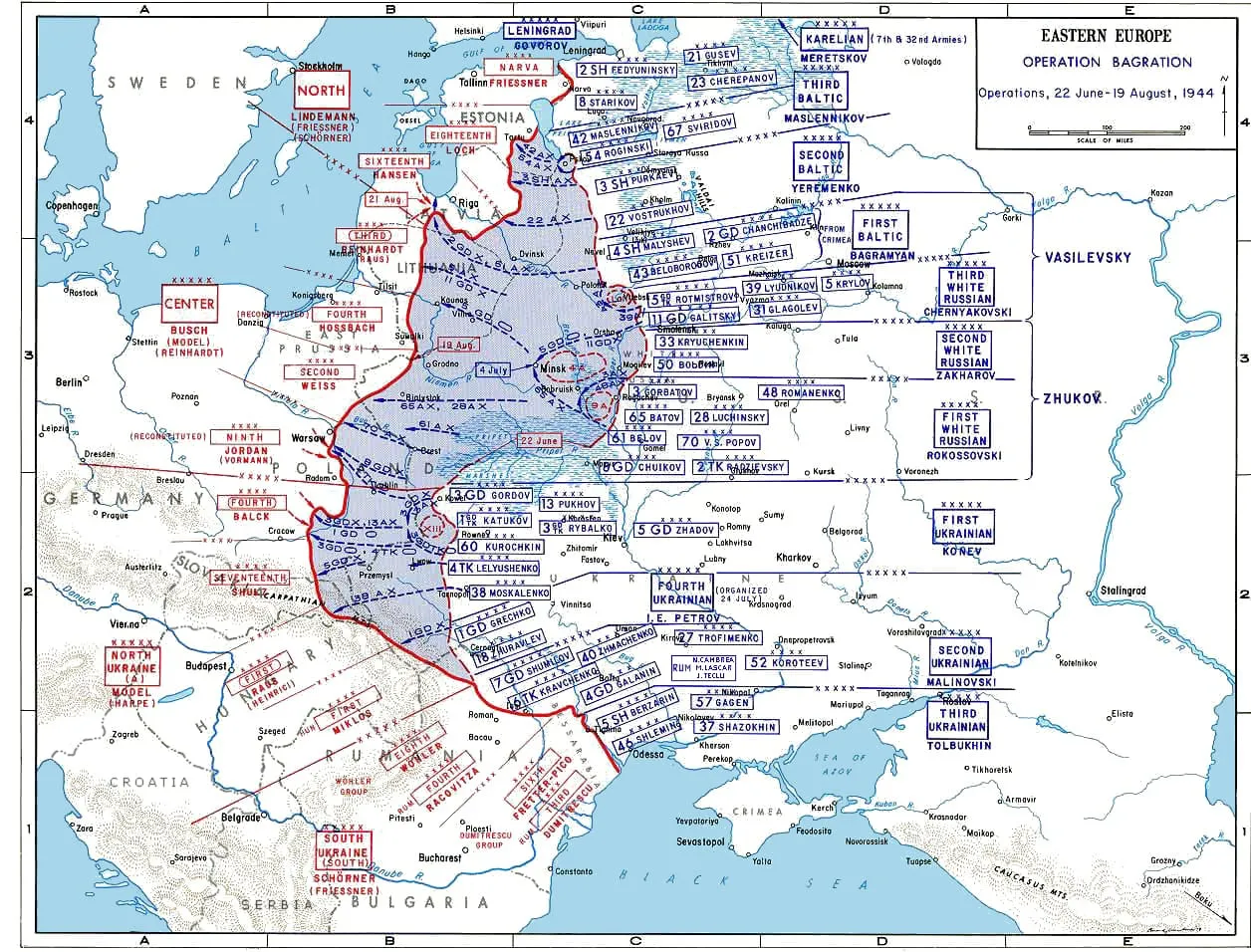
Operation Bagration (Russian Операция «Багратион»), known in Soviet and Russian historiography as the Belorussian Strategic Offensive Operation, was the Red Army’s summer offensive against the German Army Group Centre. It began on 22 June 1944, the third anniversary of Germany’s attack on the Soviet Union, with reconnaissance in force, and the main blows of four fronts fell on the German positions on 23 and 24 June. In less than two weeks the Red Army encircled and destroyed the core of the German forces in Belarus, liberated Minsk on 3 July, and in July and August reached the Gulf of Riga, the border of East Prussia, the Narew and the Vistula.
Many historians regard Bagration as the Wehrmacht’s greatest defeat of the entire war – greater in terms of losses than Stalingrad. The operation was named after Pyotr Bagration, a Georgian prince and Russian general who was mortally wounded at Borodino in 1812. It was fought at the same time as the battle in Normandy and ensured that in the summer of 1944 Germany suffered defeats on both fronts at once.
Name and dates
The codename was given to the operation by Joseph Stalin in May 1944, when he approved the plan. The dates of the operation are given in various ways. The official Soviet chronology, adopted among others by the Russian casualty survey edited by Grigori Krivosheev, covers the period from 23 June to 29 August 1944. The start of the operation can, however, be placed on 22 June, because on that day battalion-sized reconnaissance detachments of the 1st Baltic Front and the 3rd Belorussian Front carried out reconnaissance in force in the Vitebsk sector and broke into the German front line in several places, while near Mogilev Soviet artillery shelled the German positions. The full artillery and infantry assault began on the northern flank and near Mogilev on 23 June, and the 1st Belorussian Front attacked in the Bobruisk direction on 24 June. Some studies end the operation on 31 August, some Western ones on 19 August; the date of 29 August corresponds to the Stavka directive ordering the troops in this direction to go over to the defensive.
The operation had two stages. In the first (23 June – 4 July) the fronts broke through the German defences, destroyed the flanks of Army Group Centre at Vitebsk and Bobruisk, and closed a pocket east of Minsk; in Soviet terminology these were the Vitebsk–Orsha, Mogilev, Bobruisk, Minsk and Polotsk operations. In the second (5 July – 29 August) the Soviet forces pursued the shattered enemy: they liberated Wilno (Vilnius), Grodno, Białystok, Kaunas and Brześć (Brest), while the left wing of the 1st Belorussian Front carried out the Brest–Lublin operation and reached the Vistula. Alongside these operations, but as a separate operation of the 1st Ukrainian Front, the Lwów–Sandomierz offensive was fought from 13 July.
Background
Army Group Centre was the part of the Wehrmacht that had dealt the Red Army its heaviest blows in 1941: it destroyed the Soviet fronts at Białystok and Minsk, took Smolensk and advanced to the gates of Moscow. After its defeat before Moscow in the winter of 1941–1942 it held on to the Rzhev–Vyazma salient, and in 1942 it bloodily repulsed Soviet attacks in the Rzhev–Vyazma offensive and in Operation Mars. Only after the Battle of Kursk, in the autumn of 1943, did it fall back to the west, giving up Smolensk and Gomel. In the spring of 1944 its front formed a great arc bulging eastwards – the so-called “Belorussian balcony” – running from the Polotsk and Vitebsk area through Orsha, Mogilev and Bobruisk to the Pripet Marshes of Polesie.
North and south of this arc the front had moved far to the west. In the winter and spring of 1944 the Red Army pushed Army Group North back from Leningrad to the Narva River and Lake Peipus, and in Ukraine, in the Dnieper–Carpathian offensive, it reached the Carpathians and the Romanian border; as early as January it had crossed Poland’s pre-war border in Volhynia. Army Group Centre, commanded since October 1943 by Field Marshal Ernst Busch, thus had both flanks exposed. In June 1944 it consisted of the Third Panzer Army under General Georg-Hans Reinhardt (the Vitebsk area), the Fourth Army under General Kurt von Tippelskirch (Orsha and Mogilev), the Ninth Army under General Hans Jordan (Bobruisk) and the Second Army in Polesie. The army group’s strength, including rear services, is usually estimated at about 800,000–850,000 men (far fewer were in the front-line divisions themselves), but it was short of tanks and aircraft.
The German command expected the Soviet summer offensive in the south – from Ukraine towards Lublin, Warsaw and the Baltic coast, or into the Balkans. That was where most of the panzer divisions on the Eastern Front were concentrated, in Field Marshal Walter Model’s Army Group North Ukraine. According to the findings of German military historiography (Karl-Heinz Frieser), in the spring Army Group Centre had to hand over to the south a large part of its artillery and tank destroyers and almost all of its tanks, while holding a front more than a thousand kilometres long. Hitler refused to allow the line to be shortened. In an order of 8 March 1944 he introduced the concept of “fortified places” (feste Plätze) – towns that were to be defended to the end, even when encircled. In Belarus, Vitebsk, Orsha, Mogilev and Bobruisk, among others, were declared such “fortresses”, which tied down whole divisions inside them.
Plan and preparations
The decision to make the main thrust in Belarus was taken by the Stavka in the spring of 1944; at the Tehran Conference Stalin had undertaken that the Soviet offensive would coincide with the Western Allies’ invasion of France. The plan was drawn up by the General Staff under the direction of Marshal Aleksandr Vasilevsky and General Aleksei Antonov, discussed at a Stavka conference on 22–23 May (some studies give 20 May), and the directives to the fronts were approved on 30–31 May 1944. A story has become established in the historiography, originating in the memoirs of Marshal Konstantin Rokossovsky, that the commander of the 1st Belorussian Front then defended before Stalin his idea of two simultaneous thrusts on Bobruisk, from the north and from the south; some historians consider the episode embellished.
Four fronts were assigned to the operation. In the north, General of the Army Ivan Bagramyan’s 1st Baltic Front was to outflank Vitebsk from the north-west and Colonel General Ivan Chernyakhovsky’s 3rd Belorussian Front from the south, and the latter was then to strike along the Moscow–Minsk highway through Orsha and Borisov. Colonel General Georgy Zakharov’s 2nd Belorussian Front was to pin down the German Fourth Army with a frontal attack on Mogilev, and General of the Army Rokossovsky’s 1st Belorussian Front was to encircle the Ninth Army at Bobruisk and then advance on Minsk from the south and on Baranovichi. Vasilevsky coordinated the operations of the 1st Baltic and 3rd Belorussian Fronts as the Stavka representative, and Marshal Georgy Zhukov those of the 1st and 2nd Belorussian Fronts. The aim of the first stage was to smash both flanks of the German arc and trap the main forces of Army Group Centre in an encirclement east of Minsk.
The Soviet forces were enormous. According to figures cited in Soviet and Russian literature, at the start of the operation the four fronts numbered about 1.7 million men (with the reserves committed later, Krivosheev gives more than 2.3 million), some 4,000 tanks and self-propelled guns, more than 30,000 guns and mortars, and more than 5,000 aircraft of four air armies, supported by long-range aviation. Tens of thousands of lorries were used to move troops and supplies, a large proportion of them American Studebakers supplied under Lend-Lease.
Deception (maskirovka) played a key role. Regroupings took place at night under strict radio silence; armies and tank corps transferred from Ukraine were for a time left with their radio traffic in their old locations, and a concentration of troops was simulated in the south. German intelligence did detect the build-up opposite Army Group Centre, and some commanders warned of an attack, but the OKH regarded it as a secondary thrust and failed to detect the armoured groupings – above all the 5th Guards Tank Army – at all. As late as 19 June the army group’s command noted a worrying concentration of Soviet aircraft opposite its lines, but in the OKH’s judgement this was no reason to change the disposition of forces.
On the night of 19/20 June 1944 the Soviet partisans went into action in the rear of Army Group Centre. According to Soviet figures, the partisans in Belarus numbered about 140,000. That night, according to German reports cited by Western historians, they laid some 10,500 explosive charges on the railway lines; the Germans defused some of them, but traffic on the main lines – Minsk–Orsha, Molodechno–Polotsk, Minsk–Bobruisk – was paralysed for several days. The action continued the “rail war” of 1943. For almost three years the Germans had fought the partisans with pacification operations in which tens of thousands of Belarusian civilians were killed and hundreds of villages were burned down together with their inhabitants.
Course: breakthrough and pockets (22–29 June)
On 22 June reconnaissance detachments of the 1st Baltic and 3rd Belorussian Fronts attacked the German positions north and south of Vitebsk. On the morning of 23 June, after several hours of artillery and air preparation, the main forces of both fronts went over to the attack, together with the 2nd Belorussian Front near Mogilev; on 24 June the 1st Belorussian Front struck. In several sectors the German front collapsed within the first two days.
At Vitebsk, Bagramyan’s 43rd Army and Chernyakhovsky’s 39th Army bypassed the city from two sides and on 25 June closed the ring around General Friedrich Gollwitzer’s LIII Army Corps (four to five divisions, about 30,000–35,000 men). Hitler agreed to a withdrawal from the “fortress” too late, and on condition that one division be left behind in it; the attempt to break out ended with the corps being destroyed in the forests west of the city. Vitebsk was taken on 26 June, and on 27 June Gollwitzer surrendered with the remnants of his troops. The German Third Panzer Army thus lost half of its strength, and a gap opened in the front line north of the highway, into which the Soviet tank corps poured.
In the Orsha direction the 11th Guards Army and the 31st Army met the stiffest resistance, but the breakthrough in the 5th Army’s sector south of Vitebsk allowed Chernyakhovsky to commit General Nikolai Oslikovsky’s Cavalry-Mechanised Group and then the 5th Guards Tank Army of Marshal of Armoured Troops Pavel Rotmistrov. Orsha fell on 27 June. At Mogilev the 2nd Belorussian Front crossed the Dnieper on 27 June and took the city on 28 June; it had been defended to the end by the 12th Infantry Division, whose commander, General Rudolf Bamler, was taken prisoner. The German Fourth Army, which Hitler and Busch had long forbidden to retreat, began to fall back behind the Dnieper and the Berezina too late – along roads choked with columns and under constant attack from Soviet aircraft.
In the south the 1st Belorussian Front attacked Bobruisk with two groupings. The 3rd Army’s attack from the Dnieper in the Rogachev area stalled on the first day against strong German defences, but further south, through the marshes around Parichi that the Germans considered impassable, General Pavel Batov’s 65th Army and the 28th Army quickly broke through the Ninth Army’s defences. The 1st Guards Tank Corps and General Issa Pliyev’s Cavalry-Mechanised Group drove into the breach. On 27 June both arms of the pincer closed west of Bobruisk, trapping the XXXV Army Corps and the XXXXI Panzer Corps, about 70,000 men in all. Some of them broke out to the north-west towards Osipovichi on 29 June, but most were killed or captured; Bobruisk was taken on 29 June. That same day Rokossovsky was promoted to Marshal of the Soviet Union.
The defeat on both flanks sealed the fate of the army group’s commander. Busch, who had carried out Hitler’s orders and failed to obtain permission to retreat, was dismissed on 28 June. He was replaced by Model, who simultaneously retained command of Army Group North Ukraine. Panzer divisions began to be transferred to Belarus from the northern Ukrainian front, but they arrived piecemeal and could no longer close a gap several hundred kilometres wide.
Course: Minsk and the pocket east of the city (30 June – 11 July)
With both flanks smashed, the Soviet mobile groupings converged on Minsk: from the north-east the 5th Guards Tank Army and the 2nd Guards Tank Corps of the 3rd Belorussian Front, from the south-east the 1st Guards Tank Corps of the 1st Belorussian Front. The crossings over the Berezina at Borisov, where Napoleon’s Grande Armée had crossed in 1812, were captured on 1 July. On 3 July 1944 Soviet troops entered Minsk. The Belarusian capital, occupied since the turn of June and July 1941, was largely destroyed; during the occupation the Germans had murdered tens of thousands of Jews there, from the Minsk Ghetto and deportees from the Reich. Today 3 July is a public holiday in Belarus.
East of Minsk, in the forests between the Berezina and the city, the main forces of the German Fourth Army and the remnants of the Ninth Army were encircled – about 100,000 men, according to various estimates. The encircled columns tried to break out westwards, but without fuel, ammunition or communications they disintegrated into groups which Soviet troops and partisans destroyed over the following week. The fighting in the pocket ended around 11 July; General Vincenz Müller, in command of part of the encircled forces, signed the order for the surrender of the XII Army Corps on 8 July. According to Soviet figures, about 35,000 men were taken prisoner there, and tens of thousands were killed.
The destruction of Army Group Centre was almost complete. According to German findings, of the 47 generals commanding corps and divisions, 31 were killed, went missing or were captured. Within two weeks a gap some 400 kilometres wide had opened in the German front, and Model had nothing with which to close it. At the same time, on 4 July, the 1st Baltic Front took Polotsk, separating Army Group Centre from Army Group North.
Moscow exploited the victory for propaganda. On 17 July 1944 some 57,000 German prisoners, taken mainly near Minsk, were marched through the streets of Moscow, led by more than a dozen generals. This “parade of the defeated” was meant to show the Soviet Union and the world the scale of the Wehrmacht’s defeat, and also to answer doubts in the Western press about Soviet communiqués. After the columns had passed, the streets were washed down by water trucks.
Course: the pursuit into Lithuania, Poland and to the Gulf of Riga (5 July – 29 August)
From 5 July all four fronts were in pursuit. The 3rd Belorussian Front headed for Wilno and Kaunas, the 2nd Belorussian Front for Grodno and Białystok, and the right wing of the 1st Belorussian Front for Baranovichi (taken on 8 July) and Brześć.
At Wilno the Home Army (Armia Krajowa, AK) joined the fighting. As part of Operation Tempest the commander of the AK Wilno District, Lieutenant Colonel Aleksander Krzyżanowski “Wilk”, prepared Operation Ostra Brama – an attempt to liberate the city with his own forces before the Red Army arrived. According to Polish estimates, the AK partisan units in the Wilno and Nowogródek districts numbered about 15,000 men. The attack began at dawn on 7 July, earlier than planned, as Soviet spearheads were already approaching the city; only about 4,000 AK soldiers managed to join the assault, and they suffered heavy losses against the strong German garrison. Wilno, declared a “fortress” by Hitler, was taken by 13 July by troops of the 3rd Belorussian Front – mainly the 5th Army and units of the 5th Guards Tank Army – with the participation of AK units; part of General Rainer Stahel’s German garrison broke out of the encirclement. On 13 July AK soldiers hoisted the Polish flag on the tower on Castle Hill.
The cooperation at Wilno ended tragically for the AK. After the city was taken, the Soviet command ordered the Polish units to leave Wilno; Krzyżanowski sent them to the edge of the Rudniki Forest and opened talks with Chernyakhovsky on arming an infantry division and a cavalry brigade. On 17 July, when he arrived for an agreed meeting, he was arrested by the NKVD at Bogusze together with the officers accompanying him; that same evening, at Wołkorabiszki, at a briefing called by the Soviets, most of the AK commanders were detained, as were representatives of the Government Delegation for Poland. The units in the forest were surrounded and, according to Polish historians, some 5,000–6,000 soldiers were captured and interned. The officers were deported deep into the Soviet Union, the rank and file were held in the camp at Miedniki, and some were forcibly drafted into Soviet units or into Berling’s army. Events took a similar course in the Nowogródek District and – in the second half of July – in Lwów (Lviv), where a separate operation of the 1st Ukrainian Front was already under way.
In the north, after taking Polotsk, the 1st Baltic Front advanced on Daugavpils (Dvinsk) and Šiauliai. On 27 July it took Šiauliai, and the 3rd Guards Mechanised Corps made a raid to the north: on 30 July it took Tukums and on 31 July reached the shore of the Gulf of Riga, cutting Army Group North off from the rest of the front. In mid-August the Germans counter-attacked (Operation Doppelkopf), retook Tukums and restored a narrow corridor along the coast, but the front in Latvia and Lithuania remained exposed and under threat. The 3rd Belorussian Front took Kaunas on 1 August, and in mid-August its units reached the border of East Prussia – for the first time in this war Soviet troops stood on the frontier of the Reich.
The 2nd Belorussian Front took Grodno on 16 July and Białystok on 27 July. By the end of August its troops had reached the Narew and the Biebrza, where they were halted by German resistance on the fortifications covering East Prussia. The armies on both wings of the 1st Belorussian Front (the 28th from the north, the 61st from the east and the 70th from the south) encircled the German forces around Brześć, which was taken on 28 July.
Course: the left wing of the 1st Belorussian Front – Lublin, the Vistula and the approaches to Warsaw
On 18 July the left wing of the 1st Belorussian Front, concentrated around Kowel (Kovel), went over to the attack. The blow of the Brest–Lublin operation fell on the weakened junction between Army Group Centre and Army Group North Ukraine. Soviet troops crossed the Bug, and fighting alongside them was the Polish First Army under General Zygmunt Berling, whose first units crossed the river on 20–22 July. Chełm was taken on 22 July and Lublin on 24 July. On the outskirts of Lublin Soviet troops occupied the hastily abandoned concentration camp at Majdanek – the first large German camp whose infrastructure the liberators found largely intact; photographs and reports of it were soon carried by the world’s press. In July and August the AK units of the Lublin region, which had supported the fighting against the Germans as part of Tempest, were disarmed and their commanders arrested.
The march on Lublin was bound up with political decisions. On 21 July the Polish Committee of National Liberation (PKWN) was set up in Moscow – a centre of power subordinate to Moscow and in competition with the Polish government in London. Its manifesto, dated 22 July at Chełm, was broadcast by radio from Moscow, and at the end of July the committee moved to Lublin. Stalin treated it as the nucleus of a future Polish government and refused to recognise the activities of the Polish Underground State in the territories occupied by the Red Army.
The armoured spearheads of the 1st Belorussian Front reached the Vistula at the end of July. The 69th Army seized a bridgehead near Puławy, and General Vasily Chuikov’s 8th Guards Army crossed the river at Magnuszew on 1 August; in August heavy fighting raged to hold the Warka–Magnuszew bridgehead (PL), in which from 9 August the 1st Armoured Brigade “Heroes of Westerplatte” also took part (the Battle of Studzianki). At the turn of July and August units of the Polish First Army tried to force the Vistula near Dęblin and Puławy, suffering losses.
At the same time the 2nd Tank Army, advancing north from Lublin, reached the approaches to Praga, Warsaw’s right-bank district, on 31 July. Between 30 July and 5 August German panzer divisions brought up by Model counter-attacked it around Radzymin, Wołomin and Okuniew and destroyed one of its tank corps. On 1 August 1944 the Warsaw Uprising broke out, planned by the AK High Command in the belief that the Red Army would enter the city any day. The question of the Soviet attitude to the uprising – how far the halt before Warsaw resulted from the exhaustion of the troops and the German counter-attack, and how far from a political decision by Stalin – is among the most disputed in the historiography. What is certain is that in August Stalin refused Allied aircraft supplying the insurgents permission to land at Soviet airfields, and that the front’s troops made a renewed attempt to take Praga only in September.
On 29 August the Stavka ordered the fronts in the western direction to go over to the defensive. Operation Bagration was deemed to be over.
Losses
Exact German losses are unknown, because the reporting system of many divisions broke down during the catastrophe, and estimates differ depending on the period and method adopted. The most frequently cited figures fall in the range of about 300,000–450,000 killed, wounded, missing and captured. Karl-Heinz Frieser, in the German history of the war published by the Military History Research Office (MGFA), working from the ten-day reports, calculates the losses of Army Group Centre from 22 June to 31 August 1944 at about 400,000 men, including more than 260,000 missing – most of them killed or captured. Some estimates exceed 500,000. According to German figures, several dozen divisions were destroyed or disbanded; the destruction of forces in June and July alone was greater than at Stalingrad.
Soviet losses were also very heavy. According to Krivosheev’s tally, between 23 June and 29 August 1944 the troops of the four fronts lost 178,507 killed and missing and 587,308 wounded and sick; including the Polish First Army, the figures are about 180,000 and 591,000 respectively. According to the same data, almost 3,000 tanks and self-propelled guns, about 2,400 guns and more than 800 aircraft were lost. The losses of some armies, such as the 3rd Army at Rogachev and the 49th Army at Mogilev, were very heavy in the very first days of the attack.
The losses among the civilian population in the combat zone cannot be counted precisely. Belarus, across which the front passed in 1941 and again in 1944, was among the countries most devastated in the entire war: during the occupation, according to historians’ estimates, one in four or even one in three of its inhabitants died, including almost the entire Jewish population. The retreating Germans deported people for forced labour, burned villages, and destroyed factories, bridges and railway lines.
Significance
Operation Bagration was the Red Army’s greatest victory of the entire war and one of the fastest pursuits on the Eastern Front. In two months Soviet forces advanced 500–600 kilometres westwards, liberated Belarus, most of Lithuania and the eastern lands of Poland, and destroyed the grouping that for three years had formed the backbone of the German defence on the Moscow axis. For the first time the Soviet command made full use of deception, cooperation with the partisans and deep operations by mobile forces – in line with the theory developed in the 1930s by Tukhachevsky and his associates.
The disaster in Belarus coincided with the invasion of Normandy and with the Soviet offensive against Finland on the Karelian Isthmus. Germany no longer had the reserves to patch the front in the east and in the west at the same time. The diversion of panzer divisions from near Lwów and from Romania to Belarus eased the Red Army’s subsequent offensives: the Lwów–Sandomierz offensive in July and the Jassy–Kishinev offensive in August, which led Romania to change sides. In the Reich, the sense of catastrophe in the east and the landings in the west hastened the conspirators’ decision to attempt to assassinate Hitler on 20 July.
For Poland the consequences of the operation proved both momentous and ambiguous. The Red Army drove the Germans out of Wilno, Grodno, Białystok, Brześć and Lublin, but at the same time the NKVD disarmed AK units that had fought the Germans as part of Tempest, and the PKWN, subordinate to Moscow, began to operate in Lublin. Soviet troops reached the Vistula just as the Warsaw Uprising broke out on 1 August, and remained on the bridgeheads at Magnuszew, Puławy and Sandomierz until January 1945. From these bridgeheads the Vistula–Oder offensive was launched in January 1945, and from the line of the Narew and the East Prussian border the attack on East Prussia. Army Group North, cut off on the Baltic, ended up in the Courland Pocket, where it held out until Germany’s surrender in May 1945.