1944: The fighting for the Baltic states
Battle of Narva (1944)
- Dates:
- 2 February – 10 August 1944
- Front:
- Eastern Front
- Location:
- The Narva isthmus between the Gulf of Finland and Lake Peipus: the towns of Narva and Ivangorod, the bridgeheads on the west bank of the Narva River, the marshes near Krivasoo and Auvere, and the Sinimäed Hills (north-eastern Estonia)On the battle map →
- Sides:
- Soviet UnionLeonid Govorov, Ivan Fedyuninsky, Ivan MaslennikovNazi GermanyJohannes Frießner, Felix Steiner, Anton Grasser
- Result:
- A German defensive victory, bought at the cost of Narva's destruction. The Leningrad Front failed to break through the isthmus either in winter and spring or in July and August 1944; it took the city itself (26 July) but was halted on the Tannenberg Line in the Sinimäed Hills. The Germans abandoned these positions only on 18 September 1944, when the Soviet offensive in Latvia and southern Estonia threatened to cut off their forces.
- Author:
- Łukasz
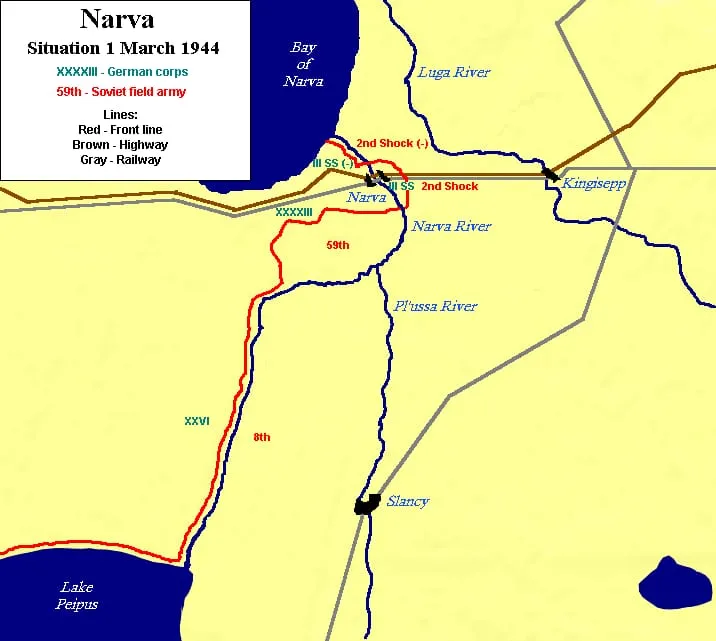
The Battle of Narva (Estonian Narva lahingud, German Schlacht um Narva, Russian Битва за Нарву) was a series of engagements fought from February to August 1944 for a narrow isthmus in north-eastern Estonia, between the Gulf of Finland and Lake Peipus. After the lifting of the blockade of Leningrad, the troops of the Leningrad Front reached the Narva River – the former Estonian–Soviet border – at the beginning of February and tried to push on into the country without pausing. A German army group, reinforced by volunteers from Western Europe and by Estonian conscripts, nevertheless held the isthmus for more than six months. In the process the town of Narva, one of the finest Baroque towns on the Baltic, was reduced to rubble.
Name and dates
The battle was not a single operation but a collective name for several successive engagements. Estonian and Western historiography usually divides it into two parts: the fighting for the Narva bridgehead (February – July 1944) and the battle on the Tannenberg Line in the Sinimäed Hills (late July – August 1944). Soviet and Russian literature describes the same events as separate operations: the final stage of the Leningrad–Novgorod offensive (including the Kingisepp–Gdov operation), the failed February and March attacks, which were long passed over in silence, and the victorious Narva operation of 24–30 July 1944, after which – according to this narrative – the front simply “stabilised”.
The battle is taken to have begun on 2 February 1944, when the leading units of the Soviet 2nd Shock Army crossed the Narva and seized the first bridgeheads on its west bank (some sources give 3 February, when the main forces of the corps reached the river). It is taken to have ended on 10 August 1944, when Marshal Leonid Govorov called off the last attack on the Sinimäed Hills. The front then stood there for more than another month, until the German withdrawal on 18 September.
Background
From Leningrad to Narva
In January 1944 General of the Army Leonid Govorov’s Leningrad Front and the Volkhov Front struck the German Eighteenth Army, which had held Leningrad in its grip since the autumn of 1941. Within a few days the Leningrad–Novgorod offensive had shattered the German positions near Krasnoye Selo, Ropsha and Novgorod, and on 27 January the city was able to celebrate the end of the blockade. Army Group North fell back westwards; its commander, Georg von Küchler, wanted to base his defence on a prepared line at once, but Hitler would not agree to a retreat and at the end of January replaced him with Colonel General Walter Model. Model, who enjoyed more of Hitler’s confidence, carried out in practice exactly what his predecessor had asked for: he withdrew the troops to a new position, leaving a strong bridgehead on the east bank of the Narva at Ivangorod.
That position was the northern section of the Panther Line (German Panther-Stellung), fortifications built from the autumn of 1943 running from the Gulf of Finland along the Narva, across Lake Peipus and past Pskov to the south. At Narva in February 1944 it was only partly finished, but the terrain favoured the defenders. Between the sea and Lake Peipus the land narrows to a strip some 45 kilometres wide, cut by the river, covered in forest and broken up by extensive marshes. The only roads able to carry the traffic of large armies – the highway and railway from Narva to Tallinn – ran along the coast a few kilometres behind the front line. The town itself, with its medieval castle facing the fortress of Ivangorod, commanded the crossings.
What was at stake
For both sides the isthmus meant far more than a piece of land. Breaking through it would open the Red Army’s way along the coast to Tallinn and on into the Baltic states, into the rear of the whole of Army Group North. The Soviet Baltic Fleet of Admiral Vladimir Tributs, bottled up by mines and nets in the eastern part of the Gulf of Finland, would be able to break out into the open Baltic, and Estonian airfields and ports could be used to attack Finland. Moscow expected that the loss of Estonia would force the Finns out of the Continuation War. Stalin ordered Govorov to take Narva by 17 February 1944 at the latest – “for both military and political reasons”.
The Germans defended the isthmus for the same reasons in reverse. Losing northern Estonia would mean the end of their control of the Gulf of Finland and a threat to shipping in the Baltic, including the transport of Swedish iron ore and U-boat training, as well as the loss of the oil-shale processing plants around Kohtla-Järve, which supplied fuel to the Kriegsmarine. The German command also knew that Finland was holding peace talks with the USSR and that holding the front at Narva was the best argument against its leaving the war – Marshal Mannerheim repeatedly gave the Germans to understand that a withdrawal from Estonia would force the Finns to make peace on any terms.
Estonia between two occupations
The front entered a country that had already lived through two occupations in four years. In 1939 Estonia had been forced to admit Soviet garrisons onto its territory, in June 1940 the Red Army occupied the whole country, and in August the USSR annexed it. President Konstantin Päts and Commander-in-Chief Johan Laidoner were deported into the interior of the USSR, and in June 1941 the deportations affected some 10,000 inhabitants. The Germans, who in the summer of 1941 drove the Red Army out of Estonia, did not restore its independence: the country became part of the Reichskommissariat Ostland, and local administration was entrusted to Hjalmar Mäe’s Self-Administration. The German occupation brought the murder of the Estonian Jews who had not managed to flee, and of thousands of real and supposed communists.
With the Red Army at the border, the occupiers announced at the turn of January and February 1944 a general call-up of men born in 1904–1923. Earlier appeals for “volunteers” and partial call-ups had yielded meagre results, and the former prime minister Jüri Uluots had until then advised his compatriots against serving the Germans. This time he changed his position: in a radio address on 7 February he urged men to report, arguing that armed Estonians on their own soil could have a significance “much wider” than he was able to say in public. For him and for the underground National Committee of the Estonian Republic, the aim was to prevent the return of Soviet rule and to see out the end of the war with an army of their own. About 38,000 men answered the call. They were formed into border guard regiments and replacement battalions for the 20th Waffen Grenadier Division of the SS (1st Estonian), formally part of the Waffen-SS although made up largely of conscripts. At the same time, on the other side of the front, stood the Soviet 8th Estonian Rifle Corps, formed from Estonians mobilised into or evacuated to the USSR in 1941. Estonians thus fought at Narva on both sides, often not by their own choice.
Opposing forces
On the Soviet side the main burden of the fighting fell on Lieutenant General Ivan Fedyuninsky’s 2nd Shock Army, operating north of Narva and in the isthmus itself; at the end of February it was joined by General Ivan Korovnikov’s 59th Army, and in March by General Filipp Starikov’s 8th Army, both directed at the bridgehead south of the town. In March Colonel General Ivan Maslennikov, previously commander of the 42nd Army, became deputy commander of the Leningrad Front, and from 21 April he commanded the new 3rd Baltic Front south of Lake Peipus. The exact strength of the Soviet forces has never been disclosed; the Estonian historian Hannes Walter put it at around 200,000 men at the time of greatest concentration in the spring of 1944, when the Narva isthmus was one of the most densely manned sectors of the entire Eastern Front. At the start of the July offensive, according to the same sources, the Leningrad Front had assembled some 137,000 troops at Narva, several hundred tanks and self-propelled guns, and more than 800 aircraft.
On the German side the defence was first taken over by a group under General of Infantry Otto Sponheimer, formed around the headquarters of LIV Army Corps. In February (on the 2nd according to some sources, the 23rd according to others) it was taken over by General of Infantry Johannes Frießner; the formation was initially known as Group Sponheimer or Army Group Frießner, and on 23 February it was named Army Detachment Narwa (Armeeabteilung Narwa; some German studies give 2 February as the date of its creation). Facing the town and the Ivangorod bridgehead stood SS-Obergruppenführer Felix Steiner’s III SS Panzer Corps, south of the town XLIII Army Corps, and along the Narva as far as Lake Peipus General Anton Grasser’s XXVI Army Corps. Reinforcements were rushed to the isthmus: the Feldherrnhalle Panzergrenadier Division, flown in via Tartu, the 214th Infantry Division from Norway, the improvised Gnesen Regiment made up of replacement units from occupied Poland, and the Tiger heavy tanks of the 502nd Heavy Panzer Battalion. According to German figures, on 1 March 1944 the group numbered about 123,500 men.
Course of the battle: the fighting for the bridgeheads (February – April 1944)
Bridgeheads on the Narva
On 1 February 1944 the 109th Rifle Corps of the 2nd Shock Army took Kingisepp on the Luga, the last sizeable town before Narva. The Germans fell back to the river, evacuating the civilian population of Narva itself. As early as 2 February the leading Soviet units crossed the ice to the west bank and seized several bridgeheads north and south of the town. The most dangerous for the defenders proved to be the bridgehead in the waterlogged ground near Krivasoo, south of Narva: around 7 February the Soviet troops had widened it enough to cut, for a time, the Narva–Tallinn railway in the rear of III SS Panzer Corps. Govorov’s plan – to encircle the defenders of Narva and Ivangorod with thrusts from the bridgeheads – came close to success, but the Germans managed to plug the gap with hastily assembled reinforcements, an increasing share of whom were newly mobilised Estonians.
The Leningrad Front also tried to outflank the isthmus. In mid-February Soviet units crossed the ice of Lake Peipus some 120 kilometres south of Narva and seized a bridgehead near the village of Meerapalu. By chance an Estonian battalion on its way to Narva happened to be in the area; together with a German infantry battalion and with air support, it eliminated the bridgehead on 15–16 February. On the night of 14 February the Baltic Fleet landed a seaborne force at Mereküla, a dozen or so kilometres west of Narva, in the rear of III SS Panzer Corps. Some 500 men of a naval infantry brigade were to cut the highway and the railway and attack the defenders from behind, but the landing received no support from the front and within a few dozen hours was almost completely wiped out; few of its members made it back to their own lines.
The February and March offensives
On 15 February General Nikolai Simoniak’s 30th Guards Rifle Corps and the 124th Rifle Corps attacked from the bridgeheads to widen them and close off Narva from the west. The attack went on intermittently until 28 February and collapsed after heavy losses. Stalin’s deadline passed, and on 22 February the Stavka issued a new and even more ambitious order: to break through the defences at Narva, strike towards Pärnu, clear Estonia and advance on through Latvia towards East Prussia. Three days earlier, on 19 February, Alexandra Kollontai had handed Paasikivi the Soviet peace terms in Stockholm. The Leningrad Front received reinforcements – the 59th Army and then the 8th Army – and by March the Narva isthmus was one of the most heavily manned sectors of the Eastern Front.
The Germans were reinforcing too. The 45th and 46th SS Grenadier Regiments (1st and 2nd Estonian) arrived at Narva and, together with units of the Nordland Division, eliminated the bridgeheads north of the town by 6 March. In the south the 59th Army attacked westwards from the Krivasoo bridgehead on 1 March and surrounded the strongpoints of the 214th Infantry Division and two Estonian eastern battalions. Their resistance gave the German command time to bring up reserves, and the attack was halted after four days.
On 6 March Soviet aircraft bombed Narva. The town, from which the inhabitants had already been removed, burned almost entirely; the Baroque Old Town, which had survived the Swedish and Russian wars, was ruined. Two days later, after a massive artillery preparation, the 30th Guards Rifle Corps attacked the Ivangorod bridgehead, held by units of Nordland and the Nederland Brigade, while north of the town fighting went on to re-establish the bridgeheads that had been eliminated. Both attacks were repulsed. On the evening and night of 9 March Soviet long-range bombers attacked Tallinn: much of the city burned, including the historic Estonia Theatre, and according to an official report of the time 757 people were killed, 586 of them civilians (other tallies give around 500 civilian dead); some 25,000 people were left homeless. The raids also hit Tartu, Jõhvi and other towns. According to Estonian historians they were meant to break the will to resist, but they had the opposite effect – strengthening opposition to the return of Soviet rule.
The last of the great winter offensives, fought from 18 to 24 March, concentrated on the Krivasoo bridgehead and Auvere station, where on 17 March the Tigers of the 502nd Battalion had stopped the Soviet tanks. After a week of heavy fighting the 8th and 59th Armies went over to the defensive.
Strachwitz’s counter-attacks and the spring lull
The halting of the Soviet attacks allowed the Germans to seize the initiative. The battle group of Generalmajor Hyazinth Strachwitz, a tank commander known as the “Panzer Count”, smashed a Soviet wedge at the western end of the Krivasoo bridgehead on 26 March and cut off its eastern end on 6 April. An attempt to eliminate the whole bridgehead failed – the spring thaw turned the marshes into terrain impassable for heavy tanks. By the end of April both sides were exhausted. The Soviet bridgehead on the west bank near Krivasoo survived, but until the end of July relative calm reigned on the isthmus, broken by shelling, raids and air attacks. Finland, which had held talks with the USSR in March, judged the Soviet terms unacceptable in April and broke off negotiations – German commanders regarded this as the political fruit of the defence of Narva.
Course of the battle: the fall of Narva and the Tannenberg Line (July – August 1944)
The withdrawal from Narva
In the summer the situation changed fundamentally. In June the Leningrad Front attacked the Finns on the Karelian Isthmus (the Vyborg–Petrozavodsk offensive), and Operation Bagration shattered the German Army Group Centre. Army Group North had to give up division after division to threatened sectors, and far fewer troops remained at Narva than in the spring. At the beginning of July Frießner took command of the whole of Army Group North (at the end of July Hitler swapped him in that post with Ferdinand Schörner, commander of Army Group South Ukraine), and on 3 July General of Infantry Anton Grasser took over Army Detachment Narwa. Short of troops, Frießner ordered a new, shorter position to be prepared – the Tannenberg Line (Tannenbergstellung) on the three Sinimäed Hills (Estonian for “Blue Hills”) near Vaivara, about 16 kilometres west of Narva. The withdrawal was to be carried out in secret, before the enemy realised what was happening.
The Leningrad Front, unaware of the German plans, was meanwhile preparing the Narva operation: the 8th Army was to strike north-westwards from the Krivasoo bridgehead, and the 2nd Shock Army across the river north of the town, the two groupings meeting in the rear of the defenders. According to Estonian estimates the Russians had roughly a fourfold superiority over their opponent in men and equipment. On 24 July, after a heavy artillery preparation, the 8th Army attacked near Auvere, but an Estonian battalion and the 44th Infantry Regiment (made up of soldiers from East Prussia) beat off the attack. During the night of 24–25 July the Nordland Division and the Nederland Brigade quietly abandoned the Ivangorod bridgehead. On the morning of 25 July the 2nd Shock Army, supported by artillery and ships of the Baltic Fleet, forced the Narva north of the town and tried to cut the highway in the rear of the withdrawing units; it was stopped by an Estonian battalion holding the line of retreat. The Dutch 48th SS Panzergrenadier Regiment “General Seyffardt”, which had not managed to disengage, was surrounded and almost completely destroyed. On 26 July Soviet troops entered the abandoned ruins of Narva.
The battle of the Sinimäed Hills
The Tannenberg Line rested on three low, wooded hills running inland from the coast: the eastern one, known as Orphanage Hill (Estonian Lastekodumägi), the central one, Grenadier Hill (Grenaderimägi), and the western one, Tower Hill (Tornimägi). Although none rose more than a few dozen metres above the surrounding country, they dominated the flat isthmus and the road to Tallinn. They were held by Steiner’s III SS Panzer Corps with the remnants of the Nordland Division and the Nederland Brigade, regiments of the Estonian division, a battalion of Flemish volunteers from the Langemarck Brigade, and Wehrmacht units.
As early as 26 and 27 July Soviet rifle divisions took part of Orphanage Hill, from which they were driven out during the night by a company of the Danish SS regiment Danmark. A night counter-attack by an Estonian battalion and the Nordland reconnaissance battalion on 27–28 July broke down under the fire of Soviet tanks. The climax of the battle came on 29 July: after a hurricane bombardment, assault units took Orphanage Hill and broke onto Grenadier Hill, while Soviet tanks bypassed them and reached Tower Hill. Steiner threw his last seven tanks into a counter-attack, which took the Soviet armour by surprise, and an improvised battle group under the Estonian Waffen-SS officer Paul Maitla recaptured Grenadier Hill. Both Soviet armies suffered enormous losses in those days, and their tank regiments were practically destroyed.
The Stavka nevertheless demanded that Group Narwa be smashed and Rakvere taken by 7 August. The replenished armies kept attacking, again and again, with the same methods and in the same places, but they could not break the defence on the hills. On 10 August Govorov, a Marshal of the Soviet Union since June, called off the offensive. The front on the isthmus froze for another five weeks.
Losses
The losses in the Battle of Narva are among the most disputed on the entire Eastern Front. The Soviet authorities never published figures for the battle as a whole, and the failed winter and spring attacks were passed over in silence for decades. According to an aggregate compilation by the Russian military historian Grigori Krivosheev, the Leningrad Front lost 665,827 men in the whole of 1944, including 145,102 killed, missing and captured – but these figures also cover the Leningrad–Novgorod offensive, the fighting near Pskov and the offensive against Finland, so Narva cannot be separated out from them. The Estonian historian and politician Mart Laar estimated Soviet losses at Narva at around 100,000 killed and missing and around 370,000 wounded and sick; these calculations, based on the number of divisions engaged and on comparisons, are regarded by many researchers as inflated and in any case have no foundation in complete archival data. All that is certain is that the Soviet attacks, launched again and again in the same places, through marshes and against prepared positions, cost a great deal of blood.
German losses are better documented. According to reports, Army Detachment Narwa lost 23,963 men killed, wounded and missing in February 1944 alone, and more than 34,000 more by the end of July. On this basis Estonian and German authors estimate total losses on the German side (including Estonian units and foreign volunteers) at around 14,000 killed and missing and around 54,000 wounded and sick. The Estonian regiments and the volunteer units from Denmark, Norway, the Netherlands and Flanders suffered particularly heavily. Most of Narva’s civilian population had been evacuated beforehand, but the town ceased to exist: only a handful of buildings of the historic Old Town survived. The Soviet air raids on Tallinn, Tartu and other Estonian towns also claimed civilian lives.
Significance
The Battle of Narva was one of the few occasions in 1944 when the Wehrmacht managed to hold up the Red Army for a long time. Stalin’s plan to recover Estonia quickly and use it as a base for strikes against Finland and towards East Prussia failed – the front at Narva held for more than seven months. Some historians, particularly Finnish and Estonian ones, believe that the prolonged defence of the isthmus spared Finland landings and air raids from Estonian bases and allowed it to negotiate an armistice rather than a capitulation in the summer of 1944.
For Estonia itself, however, the battle made only a brief difference. In September 1944 Finland left the war, and the Soviet offensive in the Baltic states threatened to cut off Army Group North. During the night of 17–18 September 1944 Group Narwa quietly abandoned the Tannenberg Line; the Russians noticed only several hours later. That same day in Tallinn, activists gathered around Uluots proclaimed the government of Otto Tief, hoping to repeat the scenario of 1918, but on 22 September the Red Army entered the capital, and by the end of November it had occupied the whole of Estonia, islands included. Some Estonian soldiers left with the Germans, others were discharged; many of them later ended up in the Gulag or in the units of the Forest Brothers, who went on fighting Soviet rule after the war. The remnants of Army Group North were cut off in Courland.
After the war Narva was not rebuilt in its old form – most of the ruins of the Old Town were cleared, and the town was resettled mainly by newcomers from other parts of the USSR. Memory of the battle remains divided: for Soviet and Russian historiography it was a stage in the liberation of Estonia; for many Estonians it was a desperate defence against the return of the occupation of 1940–1941, fought nonetheless in German uniforms, including in the ranks of the Waffen-SS – a formation declared a criminal organisation at Nuremberg, with the exception of those conscripted into it by force. These two perspectives still clash today in disputes over how the fighting in the Sinimäed Hills should be commemorated.