United Kingdom
Andrew Cunningham
Commander-in-Chief, Mediterranean Fleet (1939–1942, 1943), Allied Naval Commander for Operation Torch (1942), First Sea Lord (1943–1946), Admiral of the Fleet
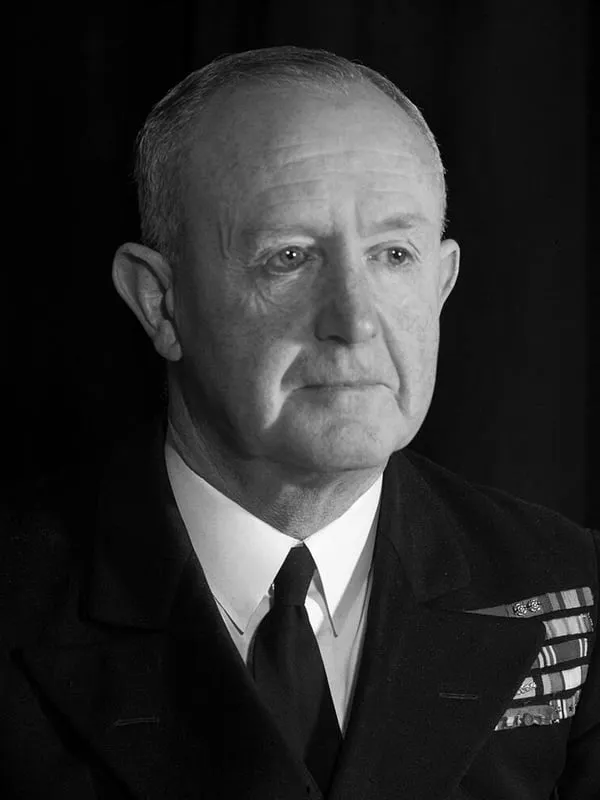
- Born:
- 7 January 1883, Rathmines, near Dublin (Ireland)
- Died:
- 12 June 1963, London (United Kingdom)
- Author:
- Łukasz
- Photo:
- autor nieznany, domena publiczna, Wikimedia Commons

Sir Andrew Browne Cunningham, known in the navy by his initials as “ABC”, was the most famous British admiral of the Second World War. From June 1939 to the spring of 1942 he commanded the Mediterranean Fleet, which, after Italy entered the war in June 1940, faced a more numerous Italian navy and air force. Under his command carrier aircraft crippled the Italian battleships at Taranto, and in the night action off Cape Matapan the fleet sank three Italian heavy cruisers. It was his ships that covered the convoys to besieged Malta and evacuated the troops from Greece and Crete, paying for it with heavy losses to German aircraft. Later he commanded the naval forces in the landings in North Africa and Sicily, received the surrender of the Italian fleet at Malta, and from October 1943, as First Sea Lord, directed the whole Royal Navy until the end of the war. He was an aggressive, demanding commander who was hugely popular with his sailors, and his decisions during the evacuation of Crete have become part of the legend of the Royal Navy.
The son of a Dublin professor
He was born on 7 January 1883 in Rathmines, on the outskirts of Dublin, the third of five children of Daniel John Cunningham, professor of anatomy at Trinity College, and Elizabeth, née Browne. The family was Scottish, and both his grandfathers were clergymen. His younger brother was Alan Cunningham, who in the Second World War was a general commanding in East Africa and North Africa. Andrew was educated in Dublin and at the Edinburgh Academy in Edinburgh. When he was ten, his father asked him by telegram whether he would like to join the navy. According to his memoirs, he replied: “Yes, I should like to be an admiral.” The family had no naval tradition. The boy went to a preparatory school at Stubbington, and in January 1897 he joined the training ship Britannia at Dartmouth as a cadet (Britannia Royal Naval College). One of his term-mates was James Somerville, later commander of Force H at Gibraltar.
As a midshipman in the cruiser Doris he was in South Africa when the Second Boer War broke out. In 1900 he volunteered for the naval brigade fighting ashore and took part in the fighting at Pretoria and Diamond Hill. He then served in a succession of ships, was promoted to lieutenant in 1904, and in 1908 received his first independent command: the small torpedo boat No. 14. From then on, for more than twenty years, he was above all a destroyer officer.
The destroyer Scorpion
In 1911 he took command of the destroyer HMS Scorpion and commanded her without a break for seven years. In August 1914 Scorpion took part in the unsuccessful pursuit of the German battlecruiser Goeben and the cruiser Breslau, which escaped to Constantinople and helped bring Turkey into the war. In 1915 Cunningham fought in the Dardanelles campaign, covering minesweepers and landings at Gallipoli. He was promoted to commander and awarded the Distinguished Service Order (DSO). For many months after that he escorted convoys in the Mediterranean. In 1918 he moved to Vice-Admiral Roger Keyes’s Dover Patrol as captain of the destroyer Termagant, earning a bar to his DSO. In the Mediterranean he became convinced that he knew it as few others did. “I probably knew the Mediterranean as well as any naval officer of my generation,” he wrote years later.
In 1919 he commanded the destroyer Seafire in the Baltic, in the squadron of Rear Admiral Walter Cowan, which was supporting the Baltic states in their struggle for independence. During the Latvian War of Independence he several times stood up to German volunteer units trying to seize control of Latvia, keeping a cool head that Cowan praised in his reports. He received a second bar to his DSO and, at the end of 1919, promotion to captain. Cowan became his model of a commander.
Between the wars
In the 1920s Cunningham commanded destroyer flotillas and the base in the Firth of Forth, and in 1926–1928 he was Cowan’s flag captain and chief of staff on the North America and West Indies Station in Bermuda. In 1929 he completed the course at the Imperial Defence College and married Nona Byatt. The marriage remained childless. Only then, after years in small ships, did he get his first big ship, the battleship Rodney, followed by command of the naval barracks at Chatham. These were the years when the great powers were limiting their fleets under the Washington Treaty and the London Naval Treaty, and the Royal Navy was economising on everything.
In September 1932 he became a rear admiral, and from the beginning of 1934 he commanded the destroyers of the Mediterranean Fleet. With them he practised squadron manoeuvring and night fighting, which in the 1940s would give him the edge over the Italians. During the crisis that followed the Italian invasion of Ethiopia the fleet prepared for a possible war with Italy. In 1936 he was promoted to vice admiral, and in 1937, after his predecessor fell ill, he took over the Battlecruiser Squadron with his flag in Hood and became second-in-command of the Mediterranean Fleet, then commanded by Dudley Pound. At the time the fleet was patrolling the sea during the Spanish Civil War and protecting merchant ships from attacks by “unknown” submarines that were in fact Italian. At the end of 1938 Cunningham reluctantly accepted a shore post as Deputy Chief of the Naval Staff at the Admiralty, and while the First Sea Lord, Roger Backhouse, was ill, he stood in for him on the Committee of Imperial Defence. In 1939 he was knighted (KCB).
The Mediterranean Fleet
When Pound became First Sea Lord, Cunningham succeeded him at the head of the Mediterranean Fleet. On 6 June 1939 he hoisted his flag in the battleship Warspite at Alexandria. He called the post “the finest command the Royal Navy has to offer”. In the first months of the war with Germany Italy remained non-belligerent, and the fleet was stripped of ships needed in the Atlantic and the North Sea. In the spring of 1940, as Italy’s entry into the war became more likely, the fleet concentrated again at Alexandria. Admiral René-Émile Godfroy’s French squadron also lay at Alexandria.
When Italy declared war on 10 June 1940, Cunningham resolved to seek battle at once. On the night of 10–11 June he took the fleet to sea while the Italian air force began bombing Malta. After the fall of France he faced one of the hardest tasks of his career. Churchill demanded that the French ships at Alexandria must not fall into German hands. At the beginning of July 1940, in parallel with Operation Catapult and the bombardment of the French fleet at Mers-el-Kébir, Cunningham negotiated with Godfroy. Despite pressure from London he did not use force, but drew out the talks and played on the trust between the sailors of the two fleets. The French agreed to discharge their fuel and remove the breech-blocks from their guns, and the British allowed them to keep their ships under their own flag. A fratricidal battle in the harbour was avoided.
On 9 July 1940 Cunningham’s fleet clashed with the Italian fleet at the Battle of Punta Stilo, known to the British as the Battle of Calabria. Warspite hit the Italian battleship Giulio Cesare at a range of more than 20 kilometres, and the Italians turned away. The battle was inconclusive, but Cunningham concluded that the enemy fleet was avoiding action, and from then on he acted ever more boldly. He received new ships, above all the aircraft carrier Illustrious, and on the night of 11–12 November 1940 twenty-one Swordfish biplane torpedo bombers attacked Taranto. Three Italian battleships were torpedoed, and one of them never returned to service. Cunningham later wrote that Taranto had shown once and for all that in naval aviation the navy had its most devastating weapon. The attack was closely studied by the Japanese as they prepared their strike on Pearl Harbor.
Matapan, Greece and Crete
In January 1941 the German X Fliegerkorps arrived in Sicily. On 10 January, as Cunningham watched from the bridge of Warspite, Ju 87 dive-bombers hit Illustrious with several bombs, and she barely limped into Malta. From then on the fleet had to operate under German bombs. In March 1941, under German pressure, the Italian fleet put to sea against the convoys carrying troops to Greece. Forewarned by British intelligence, which was reading Italian ciphers, Cunningham sailed from Alexandria, having first gone ashore ostentatiously with his golf clubs to deceive spies. At the Battle of Cape Matapan on 28 March, aircraft from the carrier Formidable damaged the battleship Vittorio Veneto and crippled the cruiser Pola. Against the advice of some of his staff, Cunningham continued the pursuit into the night. With the help of radar his battleships detected the Italian cruisers that had come back for Pola and destroyed them at close range within minutes. The Italians lost three heavy cruisers and two destroyers, and some 2,300 sailors were killed. The British lost one aircraft. After Matapan the Italian fleet never again ventured into the eastern Mediterranean in search of battle.
In the spring of 1941, however, the fleet had to rescue the army. In April it evacuated more than 50,000 soldiers from Greece, and at the end of May from Crete, where German paratroopers had broken the defence. The ships sailed without fighter cover within range of the Luftwaffe and suffered heavy losses. When the generals feared the navy would lose too many ships, Cunningham is reported to have said: “It takes the Navy three years to build a ship. It would take three hundred years to build a new tradition. The evacuation will continue.” Some 16,000–18,000 soldiers were taken off Crete. The fleet lost three cruisers and six destroyers; many other ships, including battleships and its only aircraft carrier, were damaged, and nearly 2,000 sailors were killed.
In the autumn of 1941 Cunningham’s ships supplied besieged Tobruk and, together with the forces based on Malta, destroyed convoys bound for Libya. The end of the year, however, brought disasters. On 25 November a German U-boat sank the battleship Barham, and on 19 December Italian frogmen riding manned torpedoes penetrated Alexandria harbour and sank the battleships Queen Elizabeth and Valiant on the bottom. In the winter of 1941/1942 the Mediterranean Fleet did not have a single serviceable battleship. Even so, Cunningham kept sending convoys to Malta. In March 1942 Rear Admiral Philip Vian’s force drove the Italian fleet away from a convoy in the Second Battle of Sirte, but most of the cargo was sunk by bombs off the island.
Washington, Africa and Italy
In the spring of 1942 Cunningham handed over the Mediterranean Fleet (command passed to Henry Harwood) and went to Washington as head of the British Admiralty Delegation and the navy’s representative on the Combined Chiefs of Staff. He was no diplomat and frequently clashed with the head of the US Navy, Admiral Ernest King. He did, however, win the confidence of General Dwight Eisenhower, who appointed him Allied Naval Commander for Operation Torch, the landings in North Africa in November 1942. His deputy was Bertram Ramsay. In Algiers Cunningham backed the controversial agreement with Admiral François Darlan, who had gone over to the Allies. Eisenhower wrote of him in his diary that in selflessness, energy, devotion and understanding of the needs of allied operations he stood at the head of his subordinates.
On 21 January 1943 Cunningham was promoted to Admiral of the Fleet, and in February he again took command in the Mediterranean. In May 1943, when the Axis forces in Tunisia were close to surrender, he ordered his ships to let no one escape by sea: “Sink, burn and destroy. Let nothing pass.” He commanded the naval forces in the invasion of Sicily in July and in the landings in Italy in September 1943. After Italy’s surrender the Italian fleet sailed to Malta. On 11 September Cunningham signalled the Admiralty: “Be pleased to inform Their Lordships that the Italian battle fleet now lies at anchor under the guns of the fortress of Malta.” Three years earlier the same island had been almost defenceless against Italian air raids.
First Sea Lord
In September 1943 the gravely ill Dudley Pound resigned, and in October Cunningham, though reluctant to leave the Mediterranean, became First Sea Lord and Chief of the Naval Staff. As a member of the Chiefs of Staff Committee he attended the conferences at Cairo, Tehran, Yalta and Potsdam. He was responsible for the Royal Navy’s part in the Normandy landings and in the struggle against the U-boats in the last year of the war; he often argued with Churchill, and together with the other chiefs of staff he forced through the dispatch of the British Pacific Fleet to the Pacific, despite King’s reluctance. Together with Ramsay he also warned that captured Antwerp would be useless as long as the Germans held the approaches to the port.
In 1945 he was appointed to the Scottish Order of the Thistle and created Baron Cunningham of Hyndhope, and in 1946 he was made a viscount and received the Order of Merit. After the war he steered the navy through the first budget cuts of Clement Attlee’s government, and in 1946 he retired.
Last years
He settled with his wife at Bishop’s Waltham in Hampshire. In the early 1950s he published his memoirs, A Sailor’s Odyssey. He spoke on naval matters in the House of Lords, and together with other admirals of the fleet he campaigned for the rehabilitation of Admiral Dudley North, who had been removed from Gibraltar in 1940. Twice, in 1950 and 1952, he was Lord High Commissioner to the General Assembly of the Church of Scotland, and on 2 June 1953, at the coronation of Elizabeth II, he served as Lord High Steward. He died in London on 12 June 1963, at the age of eighty, and was buried at sea off Portsmouth. He had no children, so his titles became extinct.
Significance
Cunningham was the commander who, in the hardest years of the war, held Britain’s position in the Mediterranean against an Italian fleet that was stronger on paper and against German air power. He believed in attack, in night fighting and in naval aviation, and Taranto and Matapan broke the self-confidence of the Italian navy. Yet his fleet paid a high price off Crete and throughout 1941, and it could not always protect Malta. Historians sometimes reproach him for having been slow to appreciate the importance of land-based air power, and for being difficult and impatient with his staff. Even so, many regard him as the greatest British admiral since Nelson. In 1967 his bust was unveiled in Trafalgar Square in London, alongside those of Jellicoe and Beatty.
Sources
Commanded in battles
(04)Mentioned in battles
(10)Often appears with
People who appear in the same events.
On the timeline
(56)The 40 most important of 56 events. All tagged “Andrew Cunningham” (9) →