- Category:
- Military operations
- Front:
- Mediterranean
- Date:
- 11 November 1940
- Author:
- Łukasz
- Tags:
- Italy, United Kingdom, Royal Navy, Andrew Cunningham
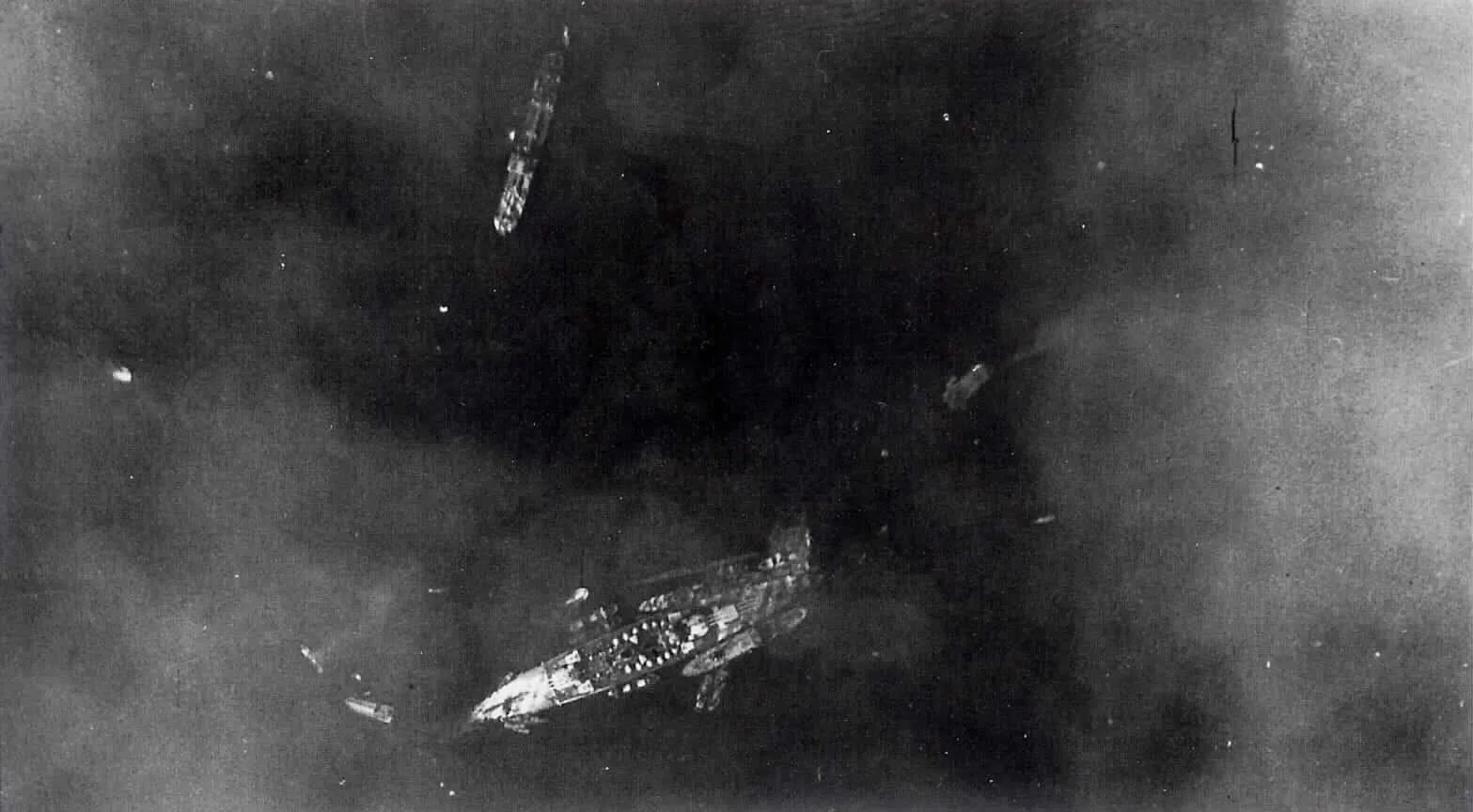
On the night of 11 to 12 November 1940 twenty-one Fairey Swordfish biplane torpedo bombers from the British aircraft carrier HMS Illustrious attacked, in two waves, the Italian fleet lying at anchor in the naval base at Taranto. In less than an hour and a half the airmen put torpedoes into three of the six battleships of the Regia Marina: the modern Littorio and the older Conte di Cavour and Caio Duilio. The British lost two aircraft; two airmen were killed and two taken prisoner. Operation Judgement, planned by Rear Admiral Lumley Lyster and carried out on the orders of the Commander-in-Chief of the Mediterranean Fleet, Admiral Andrew Cunningham, was the first massed attack in history by carrier-borne aircraft on a battle fleet in its own heavily defended base. In a single night half of Italy’s capital ships were put out of action, and navies all over the world had to rethink what naval aviation meant.
A fleet that would not fight
When Italy declared war in June 1940, its fleet was on paper stronger than the British Mediterranean Fleet based at Alexandria. After the capitulation of France and the attack on the French fleet at Mers-el-Kébir, the British were alone in that sea. The Italian navy, however, did not seek a decisive battle. Its high command, Supermarina, knew that no battleship or cruiser that was sunk could be replaced during the war, and kept its heavy ships in harbour as a “fleet in being”, menacing by its mere existence. At the Battle of Calabria (Punta Stilo) in July the Italians turned away after the first hit on a battleship, and in the actions that followed, off Cape Spada and off Cape Passero, lighter Italian ships were badly mauled.
Even so, the Italian fleet at Taranto tied Cunningham’s hands. Every British supply operation to besieged Malta had to be covered by almost the whole fleet, because the Italian battleships could come out against it at any moment. In the summer of 1940 two powerful new Littorio-class ships armed with 381 mm guns entered service, and they were soon joined by two modernised old battleships. In November six capital ships lay at Taranto: Littorio, Vittorio Veneto, Conte di Cavour, Giulio Cesare, Caio Duilio and Andrea Doria, together with seven heavy cruisers, two light cruisers and several dozen destroyers. The fleet was commanded by Admiral Inigo Campioni.
After Italy attacked Greece on 28 October 1940 the stakes rose still higher. The British occupied Souda Bay on Crete and began sending aircraft and supplies to Greece. Convoys to the Aegean, to Malta and to Egypt now had to cross a sea over which an Italian battle squadron might appear at any moment. Cunningham concluded that since the Italians would not come out and fight, they had to be attacked where they lay.
A pre-war plan
The idea of an air strike on Taranto was older in the Royal Navy than the war itself. It was first considered during the Abyssinian crisis of 1935, when after the Italian invasion of Ethiopia war with Italy seemed possible. In 1938, during the Sudeten crisis that ended with the Munich Agreement, the then Commander-in-Chief of the Mediterranean Fleet, Admiral Dudley Pound, ordered it to be prepared afresh. It was drawn up by the captain of the aircraft carrier HMS Glorious, Captain Lumley Lyster, who argued that the airmen of the Fleet Air Arm, the navy’s air arm, could carry out a night torpedo attack. Lyster in fact knew Taranto from the First World War, when the port had served as a base for British warships fighting in the Adriatic alongside the Italians. The crews of Glorious began practising night flying and attacks by the light of flares, and the plan was shrouded in such secrecy that very few documents about it have survived. In 1939 Pound handed it on to his successor, Cunningham.
By 1940 Glorious was gone – she had been sunk off Norway in June – but in September the new carrier Illustrious arrived at Alexandria, with an armoured flight deck, radar and Fairey Fulmar fighters. Aboard her came Lyster, now a rear admiral and in command of the Mediterranean Fleet’s carriers. Together with Cunningham’s staff he worked out the plan for Operation Judgement. The Swordfish were to fly with two-man crews, because the third crewman’s place was taken by an extra fuel tank. Some aircraft were to carry torpedoes, others bombs and flares to light up the targets and distract the defences. The water in the harbour was only about 12 metres deep, and a torpedo dropped from an aircraft usually dived deeper and stuck in the bottom. The British solved the problem by attaching to the torpedo a wire paid out from a drum under the aircraft’s fuselage: at the moment of release the wire pulled the torpedo’s nose up, so that it struck the water flat. The torpedoes also had new magnetic pistols, which detonated the warhead under the ship’s bottom.
The attack was fixed for the night of 21 October, the anniversary of the Battle of Trafalgar, by moonlight. On 18 October a fire broke out in Illustrious’s hangar, destroying two aircraft and damaging several more, so the date was moved to the next full moon. Then the second carrier dropped out of the operation: the old HMS Eagle, whose fuel system had been damaged earlier by near misses from Italian bombs. Illustrious took over five of her Swordfish together with their crews. Originally some thirty aircraft were to be used; in the end there were twenty-four, and when three crashed in the last days before the attack because of contaminated fuel, twenty-one were left.
Operation MB.8
The attack on Taranto was concealed within a large, many-stranded fleet operation designated MB.8. At the beginning of November convoys sailed from Alexandria and Port Said for Malta and Souda Bay, while from Gibraltar Admiral James Somerville’s force escorted reinforcements for the Mediterranean Fleet eastwards, among them the battleship Barham. On the way, on 9 November, aircraft from the carrier Ark Royal bombed the airfield at Cagliari in Sardinia. On 6 November Cunningham’s main force sailed from Alexandria: the battleships Warspite, in which the admiral flew his flag, Valiant, Malaya and Ramillies, the carrier Illustrious, cruisers and a dozen or more destroyers.
The Italians knew the British were at sea, but the multitude of forces and convoys sailing in different directions confused their reconnaissance. Supermarina believed it was yet another routine convoy operation and lost track of the carrier. The British, by contrast, were watching the Italians closely. Martin Maryland reconnaissance aircraft of No. 431 Flight RAF, flying from Malta, photographed Taranto harbour every day. The photographs of 11 November showed that all six battleships had gathered in the port – the sixth had come in the day before – and revealed the positions of the barrage balloons, which forced a change in the approach routes. In the evening a Short Sunderland flying boat flew over Taranto as well, to make sure the ships had not put to sea. Its flight alerted the defences, but the Italians had no radar and could only wait.
Taranto was one of the most heavily defended bases in Europe. According to Italian figures the harbour was protected by more than a hundred anti-aircraft guns and nearly two hundred machine guns, searchlights, and listening posts that detected aircraft by the sound of their engines. The defences had gaps, however. Of the 87 barrage balloons provided, no fewer than 60 had been torn away by a strong wind a few days earlier, and for lack of hydrogen they could not be replaced. Anti-torpedo nets, which industry could not produce fast enough, had been laid round only some of the ships, and they reached down only about 10 metres, not to the bottom. The ships always lay at the same moorings.
On the evening of 11 November Illustrious, escorted by four cruisers – Berwick, Glasgow, Gloucester and York – and four destroyers, detached from the fleet and made for her flying-off position some 40 nautical miles west of the Greek island of Cephalonia, about 170 miles from Taranto. Lyster was aboard the carrier. Cunningham stayed with the battleships in Warspite, covering the whole operation from a distance.
The night at Taranto
The first wave, twelve Swordfish, began taking off at about 8.35 p.m. It was led by the commanding officer of No. 815 Squadron, Lieutenant Commander Kenneth Williamson. Six aircraft carried torpedoes, four bombs and two bombs and flares. In the clouds some of the aircraft became separated and reached the target on their own. The defences, alerted by the listening posts, opened a barrage before the aircraft appeared over the harbour.
At about 11 p.m. the flare-dropping aircraft laid a line of sixteen parachute flares east of the outer harbour, the Mar Grande, which silhouetted the battleships against the sky. Both flare aircraft then bombed the oil storage depot. The torpedo-carrying Swordfish, skimming the water, slipped between the balloons and flew into the fire of hundreds of guns. Williamson dropped his torpedo at the Conte di Cavour and hit her; it blew an enormous hole in her hull below the waterline. A moment later his aircraft, shot down just above the water, crashed into the sea; Williamson and his observer, Sub-Lieutenant Norman Scarlett, survived and were taken prisoner. The next two aircraft missed the Andrea Doria. The following three attacked from the north: two torpedoes hit Littorio, and the third, aimed at the flagship Vittorio Veneto, passed her by. Meanwhile the bomb-carrying aircraft attacked the inner harbour, the Mar Piccolo, where cruisers and destroyers lay alongside the quays. They hit the hangars of the seaplane base, but the bombs that struck the ships, dropped from low altitude, failed to explode.
The second wave took off roughly an hour after the first. It was led by the commanding officer of No. 819 Squadron, Lieutenant Commander John W. Hale. Of its nine aircraft, one turned back when its external fuel tank broke away, and another, damaged on take-off, flew on alone and late. Shortly before midnight flares hung over the harbour once more. Littorio took a third hit, and another aircraft’s torpedo tore open the side of Caio Duilio, flooding her forward magazines. Vittorio Veneto again escaped being hit. Anti-aircraft fire from the cruiser Gorizia shot down the Swordfish of Lieutenant Gerald Bayly; the pilot and his observer, Lieutenant Henry Slaughter, were killed. The last aircraft, arriving a quarter of an hour after the rest, bombed a cruiser in the Mar Piccolo without effect. According to Italian figures the shore batteries fired more than thirteen thousand rounds that night, and the ships thousands more. The searchlights were hardly used.
The aircraft returned to the carrier between one and three in the morning. The airmen, who had been told before take-off that losses might reach half the aircraft, could not believe that only one crew had been killed. Cunningham and Lyster wanted to repeat the attack the following night, but the weather prevented it and the force returned to Alexandria.
The raid in the Strait of Otranto
That same night another part of the fleet went into action. Vice Admiral Henry Pridham-Wippell’s force – the cruisers Orion, Ajax and the Australian Sydney, with the destroyers Nubian and Mohawk – entered the Strait of Otranto, through which supplies flowed to the Italian troops fighting in Albania and Greece. Shortly after midnight on 11–12 November the British came upon an Italian convoy on the route between Brindisi and Vlorë (Valona) in Albania: four merchant ships escorted by the old torpedo boat Nicola Fabrizi and the armed merchant cruiser Ramb III. All four ships – Capo Vado, Catalani, Antonio Locatelli and Premuda – were sunk. The badly damaged Fabrizi fought an unequal battle and survived, and her captain received the Gold Medal of Military Valour. Ramb III escaped to Brindisi. According to Italian figures 36 sailors were killed. The raid showed that the Royal Navy could venture into waters the Italians regarded as their own and threaten the supply line of the army in Albania, which had just ground to a halt on the Kalamas.
The night’s reckoning
On the morning of 12 November the sight of the harbour shocked the Italians. Conte di Cavour had settled on the bottom, with only her superstructure and gun turrets above water. The command had delayed too long in approving her move into shallow water, and she sank deeper than intended. Littorio, hit by three torpedoes, and Caio Duilio were deliberately beached so that they would not sink. According to Italian figures 58–59 sailors were killed, 32 of them in Littorio, and many were wounded. Some bombs fell on the town, killing and wounding civilians too.
Popular chronologies speak of damage to “three battleships, two cruisers and numerous auxiliary vessels”. The first part is correct; the rest needs correcting. The report of cruisers and auxiliaries comes from the first British assessments based on aerial photographs – on 13 November Prime Minister Winston Churchill spoke of two cruisers listing and surrounded by oil slicks and two auxiliaries with their sterns under water – but Italian records do not confirm it. In the Mar Piccolo the Swordfish bombs did hit the heavy cruiser Trento and the destroyer Libeccio, but none exploded and both ships suffered only slight damage. Near misses lightly damaged the destroyer Pessagno. Ashore the bombs destroyed the seaplane base hangars and two seaplanes and set the fuel depot on fire. The real and lasting effect of the attack was three battleships put out of action: Littorio for about four months, Caio Duilio for about six months and Conte di Cavour for good. Raised in 1941 and towed to Trieste, she never returned to service; after Italy’s capitulation she was seized by the Germans, and in February 1945 she sank during an American air raid.
The British lost two aircraft and two airmen killed. At the cost of twenty-one obsolete biplanes flying from a single carrier, they had disabled half of the Italian battle fleet for many months. Cunningham later wrote that Taranto and the night of 11 to 12 November 1940 should be remembered for ever as having shown once and for all that in the Fleet Air Arm the navy had its most devastating weapon.
Reactions in Rome, London and Berlin
The next day Supermarina withdrew the undamaged heavy ships from Taranto to Naples and Sicily, further from the reach of British aircraft. They returned to Taranto only in the spring of 1941, once its anti-torpedo nets and anti-aircraft defences had been strengthened. The Foreign Minister, Galeazzo Ciano, noted in his diary on 12 November that it had been “a black day”, adding that he had expected to find Mussolini downcast, but that the Duce had taken the blow calmly and did not yet seem to have grasped its full significance. The Italian press wrote of a massacre of British aircraft over Taranto, and Mussolini himself, in a speech on 18 November, admitted that three ships had been hit but insisted that none had been sunk. In December 1940 the Chief of Naval Staff, Admiral Domenico Cavagnari, lost his post to Admiral Arturo Riccardi. The defeat at Taranto, coming day after day with the setbacks in Greece, shook the regime’s prestige.
In Britain, which in those weeks was enduring the Blitz, the news was received with enormous relief. On 13 November Churchill announced “good news” to the House of Commons: the Royal Navy had dealt the Italian fleet a “crippling blow”, leaving it with only three battleships fit for action, which altered the balance of naval power not only in the Mediterranean but “in every quarter of the globe”. In the same statement he paid tribute to the crew of the armed merchant cruiser Jervis Bay, which a few days earlier had sacrificed herself defending a convoy in the Atlantic. Decorations, however, were sparing: Williamson and Hale received the Distinguished Service Order, some of the observers the Distinguished Service Cross, and Lyster, in the 1941 New Year Honours, the Order of the Bath. Many of those who took part felt that their achievement was recognised only years later.
In Berlin Taranto, together with Italy’s troubles in Greece, reinforced the conviction that the ally could not cope on its own. On 14 and 15 November in Innsbruck the chief of the OKW, Field Marshal Wilhelm Keitel, spoke with Marshal Pietro Badoglio in a tone markedly cooler than before. The German navy concluded that the Italians would not win command of the Mediterranean, and Hitler decided to send the Luftwaffe south.
Did Taranto secure Britain’s sea lanes?
It is also often written that the attack “secured British supply lines in the Mediterranean”. That is true only in part, and only for a short time. Cunningham gained freedom of movement: he could divide his fleet into two forces, each with a carrier and two battleships, and run convoys without fear of superior Italian capital ships. Supermarina admitted in a report at the end of December that one of the basic assumptions of its strategy – the possibility of striking with superior force at one part of the British fleet – had collapsed.
The Italian fleet, however, had not been destroyed. As early as 27 November Admiral Campioni put to sea with two battleships against Somerville’s force and fought the indecisive Battle of Cape Spartivento. Nor did the attack stop the Italian convoys to Libya: according to figures cited by historians, more cargo was shipped there in the following months than before Taranto. Some historians, such as Angelo Caravaggio, call Taranto a tactical success but a missed operational opportunity. The real threat, moreover, came from the air: in January 1941 the Luftwaffe’s X Fliegerkorps arrived in Sicily, and on 10 January its dive-bombers rained bombs on Illustrious, which barely limped to Malta. For the next two years command of the Mediterranean changed hands, and besieged Malta came close to falling several times.
A lesson for Japan
It is usually added that the British success was studied by the Japanese, who were already preparing the attack on Pearl Harbor. This view needs some refinement. In November 1940 the Japanese navy was not yet preparing an attack on Pearl Harbor: Admiral Isoroku Yamamoto, commander of the Combined Fleet, put forward his idea of striking the American fleet in its base only at the beginning of January 1941, and detailed planning began in the spring. Taranto was nonetheless certainly an important lesson for the Japanese. According to American and Japanese historians, the assistant Japanese naval attaché in Berlin, Lieutenant Commander Takeshi Naitō, went to Taranto to study the attack, and later discussed it at length with Commander Mitsuo Fuchida, who led the aircraft over Pearl Harbor in December 1941. According to some authors, a group of Japanese naval officers also visited Taranto in the spring of 1941. Japanese planners, among them Commander Minoru Genda, knew that Pearl Harbor, like Taranto, was a shallow harbour, and the British had proved that aerial torpedoes could work in such conditions. The Japanese had themselves been working since 1939 on torpedoes for attacks in shallow water, and with wooden stabilising fins they achieved more in this respect than the British.
The scale was entirely different. On 7 December 1941 more than 350 aircraft from six carriers flew over Pearl Harbor and sank or damaged eight American battleships. But the principle was the same, and Lyster’s airmen had been the first to demonstrate it: a fleet in harbour is not safe, and the battleship was no longer queen of the oceans.
Place in the war
The attack on Taranto was Britain’s first great victory over Italy and one of three blows which, within a few weeks – together with the Greek counter-offensive in Albania and the British Operation Compass in Egypt in December – ended Mussolini’s “parallel war”. From then on Italy depended more and more on Germany, which in 1941 sent its troops to North Africa and the Balkans. At sea the hierarchy changed: in March 1941 Cunningham, making use of carrier aircraft and radar, smashed the Italian cruisers at the Battle of Cape Matapan, and in May aircraft from the carrier Ark Royal crippled the German battleship Bismarck with a torpedo. A year after Taranto the Japanese carried the same idea to the Pacific on a far larger scale, and in the Pacific war the aircraft carrier replaced the battleship as the capital ship of the fleet. In Britain the night of 11 to 12 November is still celebrated by the Fleet Air Arm as “Taranto Night”.
Sources
Meanwhile
(04)Elsewhere, within a week.
- 12 November 1940 · AfricaThe Free French take GabonThe surrender of Port-Gentil on 12 November 1940 ended the Gabon campaign. The Free French had taken Vichy's last colony in French Equatorial Africa.
- 13 November 1940 · BalkansThe Battle of PindusOn 13 November 1940 the Greeks cleared the Pindus. The Julia Alpine Division, which took Vovousa on 2 November, was encircled and repulsed with heavy losses.
- 14 November 1940 · Western FrontThe Coventry BlitzOn the night of 14–15 November 1940 hundreds of German bombers razed the centre of Coventry and St Michael's Cathedral. Some 568 people were killed.
- 8 November 1940 · BalkansThe Battle of the KalamasFrom 2 to 8 November 1940 the Italians assaulted the Greek positions at Kalpaki and on the Kalamas. On 8 November they halted and went over to the defensive.
Related events
(04)The same battle, people or subject.
- 28 October 1940 · BalkansItaly attacks GreeceAt 3 a.m. on 28 October 1940 Metaxas rejected the Italian ultimatum. At dawn Mussolini’s troops advanced from Albania into Greece.
- 28 December 1940 · BalkansItaly asks Germany for helpBy late December 1940 the Greeks held about a quarter of Albania, and the Italians, beaten in Egypt too, pressed Germany ever harder for military help.
- 9 February 1941 · MediterraneanThe bombardment of GenoaOn 9 February 1941 Force H shelled Genoa, while aircraft from Ark Royal bombed Livorno and mined La Spezia. The Italian fleet failed to find the British.
- 3 July 1940 · MediterraneanThe attack on the French fleet at Mers-el-KébirOn 3 July 1940 the Royal Navy shelled the French squadron at Mers-el-Kébir near Oran. Nearly 1,300 sailors died, and Vichy broke off relations with London.