1940–1941: The war in the Balkans
Greco-Italian War
- Dates:
- 28 October 1940 – 23 April 1941
- Front:
- Balkans
- Location:
- Epirus and western Macedonia in Greece and southern Albania: the Pindus mountains, the Kalamas river and Kalpaki, Korçë, Pogradec, Gjirokastër, Sarandë, Himarë, the Klisura pass (Këlcyrë) and Tepelenë; the waters of the Ionian Sea and the Strait of OtrantoOn the battle map →
- Sides:
- Greece (with British air and naval support)Alexandros Papagos, Ioannis MetaxasItaly (with Albanian units)Sebastiano Visconti Prasca, Ubaldo Soddu, Ugo Cavallero
- Result:
- Italian defeat at the hands of Greece. The Greeks halted the Italian invasion in Epirus and the Pindus, drove the Italians out of the country and occupied about a quarter of Albania. The war was ended only by the German invasion of 6 April 1941: on 20 April the Greek Army of Epirus capitulated to the Germans, and on 23 April a capitulation to Germany and Italy was signed.
- Author:
- Łukasz
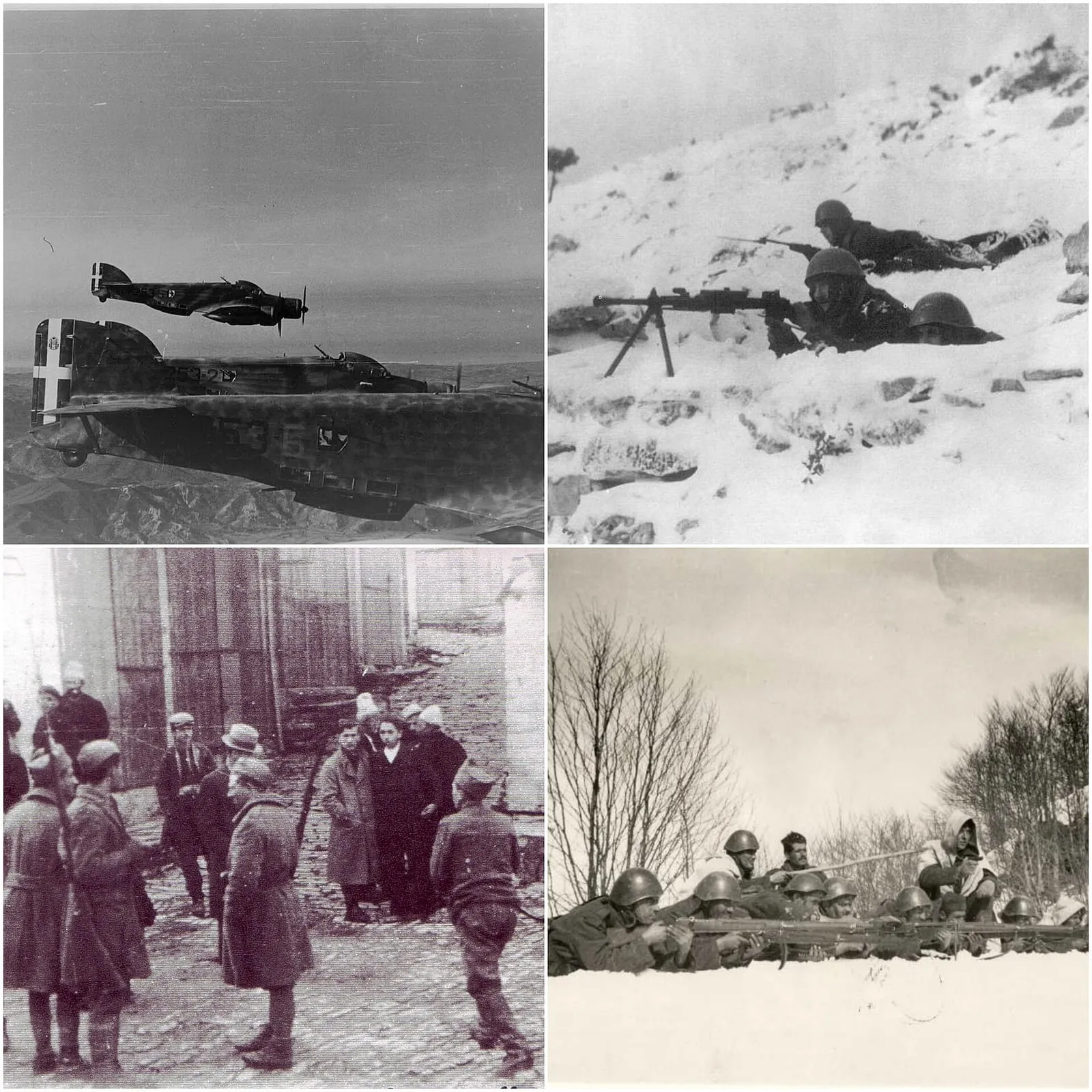
In the Greco-Italian War a small state, for the first time in this war, not only repelled an attack by an Axis power but carried the fighting into territory that power held. On 28 October 1940, after an ultimatum delivered before dawn to the Prime Minister, Ioannis Metaxas, Italian troops stationed in Albania crossed the Greek border. Benito Mussolini expected a march that would give him Epirus and the Ionian Islands within a few weeks and, after that, Athens. Within two weeks the offensive had bogged down in the mud and snow of the Pindus mountains and on the Kalamas river, and in mid-November the Greek army under General Alexandros Papagos went over to the counter-offensive, took Korçë, Sarandë and Gjirokastër, and fought deep inside Albania throughout the winter.
Although the Italians eventually massed more than half a million men in Albania, they could not reverse the course of the war, and their spring offensive of March 1941 collapsed after some two weeks. The decision came only with German intervention: on 6 April 1941 the Wehrmacht attacked Greece from Bulgaria, and the Greek army, whose main forces stood in Albania, was cut off and capitulated. For Greece the war became a national epic, “the Epic of 1940”; for Mussolini it marked the beginning of the end of Italy’s independent conduct of the war.
Name and dates
In English, as in Polish, the conflict is called the Greco-Italian War; in Italy people speak of the Greek campaign (campagna italiana di Grecia), in Greece of the war of 1940 or “the Epic of ’40” (Έπος του ’40). The war began on 28 October 1940: at three in the morning the Italian minister in Athens handed Metaxas an ultimatum, and early that morning – at 5.30 a.m. according to Greek sources, or at 6 a.m., after the ultimatum had expired, according to Italian ones – Italian troops crossed the Greek–Albanian border.
The end of the war needs explaining, because three dates appear in the sources. On 20 April 1941 General Georgios Tsolakoglou, who commanded one of the armies on the Albanian front, offered to capitulate, without the consent of the high command, to Josef Dietrich, commander of the German SS brigade Leibstandarte SS Adolf Hitler, and that same evening signed with him a protocol of surrender to the Germans alone. Mussolini protested, so on 21 April Field Marshal Wilhelm List imposed a new, harsher text on the Greeks, and on 23 April the final instrument of capitulation was signed, this time in the presence of an Italian representative: Tsolakoglou signed for Greece, General Alfred Jodl for Germany and General Alberto Ferrero for Italy. According to most studies this took place in Thessaloniki; some Italian ones give Ioannina. Since it was only this instrument that ended the state of war between Greece and Italy, 23 April 1941 is taken as the closing date. The subsequent fighting against the Germans, in the south of the country and on Crete, belongs to the German campaign.
The official Greek history divides the war into the Italian offensive (to 13 November 1940), the Greek counter-offensive (to 6 January 1941) and the stabilisation of the front up to the German attack of 6 April; this was followed by retreat and capitulation.
Background
Italy and Greece before the war
Disputes between the two states went back to the beginning of the century. In 1912 the Italians seized the Dodecanese, inhabited mainly by Greeks, and never gave it back, and after the First World War they competed with the Greeks for influence in Anatolia, which indirectly contributed to the Greek defeat in the war with Turkey. In 1923 Mussolini used the murder of an Italian general, Enrico Tellini, on the Greek–Albanian border as a pretext to bombard and occupy Corfu; the Corfu incident showed the Greeks what they could expect from Fascist Italy. Later Athens tried to settle its relations with Rome while building a system of regional agreements, crowned by the Balkan Pact of 1934.
From 1936 Greece was ruled by General Ioannis Metaxas, Prime Minister and de facto dictator of the 4th of August Regime, which rested on King George II and the army. The regime imitated the outward forms of fascism, but in foreign policy it stayed close to Britain, with whose help the monarchy had been restored in 1935. When Italy invaded Albania on 7 April 1939, Greece acquired a land border with Italy in Epirus, and on 13 April Britain and France announced guarantees of its independence. In September 1939, however, Mussolini assured Metaxas that he would respect Greek neutrality, and for a few months relations improved.
Mussolini’s “parallel war”
After Italy entered the war on 10 June 1940, Mussolini waged a so-called parallel war: alongside Germany, but for his own aims and with his own forces. Before Hitler could defeat Britain he wanted to seize everything he regarded as Italian living space, including in the Balkans. Berlin, which wanted calm in a region that supplied it with oil and grain, restrained these ambitions and in the summer of 1940 forced the postponement of an attack on Yugoslavia. Greece became the substitute target, accused by the Italian press of tolerating British warships in its waters.
In August the Foreign Minister, Galeazzo Ciano, who treated Albania as his private fief, launched a press campaign against Greece together with the Lieutenant-General of Albania, Francesco Jacomoni. The pretext was the killing of an Albanian bandit, Daut Hoxha, portrayed as a fighter for the “liberation” of Chameria, a borderland in Greek Epirus partly inhabited by Albanians. On 15 August an Italian submarine sank the cruiser Elli in the roadstead of Tinos. The Greek government, although it knew who was responsible, spoke of an “unknown” submarine, but the attack united the quarrelsome Greeks as nothing had before. Under German pressure, and with preparations under way for the offensive in Egypt, Mussolini nevertheless put off the attack on Greece.
The decision to attack
The impulse came from the Germans. At the Brenner meeting on 4 October Hitler did not mention to Mussolini the planned dispatch of troops to Romania, and when a few days later the German military mission began to guard the oilfields around Ploiești, the Duce regarded it as an intrusion into his sphere of influence. According to Ciano’s diary he said that Hitler always faced him with a fait accompli and that this time he would pay him back in his own coin: the Germans would learn of the attack on Greece from the newspapers.
On 13 October Mussolini ordered the Chief of the General Staff, Marshal Pietro Badoglio, to prepare a strike for 26 October. On 15 October, in the Palazzo Venezia, the final decision was taken. The heads of the navy and the air force were not invited to the meeting. The commander of the troops in Albania, General Sebastiano Visconti Prasca, gave assurances that the plan was “as perfect as is humanly possible” and that Epirus would be taken in ten to fifteen days. Ciano and Jacomoni argued that the Greeks would not fight. Badoglio and the Deputy Chief of the Army Staff, General Mario Roatta, warned that occupying the whole country would require some twenty divisions and three months of preparation, but did not press the point hard. The plan adopted was “Emergenza G”: first the occupation of Epirus and the Ionian Islands, then a march on Athens. All Badoglio secured was a postponement to 28 October, the eighteenth anniversary of the March on Rome. At the same time, under an order issued at the beginning of October, the Italian army was sending hundreds of thousands of soldiers home for the winter.
Opposing forces
The Italians had eight divisions in Albania, including the 131st Armoured Division “Centauro” with light tanks, and Albanian units. In Epirus the Chameria Corps attacked with the “Ferrara”, “Siena” and “Centauro” divisions; in the Korçë area stood XXVI Corps with four divisions; and between them, in the Pindus mountains, was the 3rd Alpine Division “Julia”. Studies differ on the strength of the Italian forces at the outbreak of war: from about 87,000 men in front-line units to 140,000–150,000 including rear services. The Regia Aeronautica had some 380 aircraft in Albania and Apulia, which gave it overwhelming superiority in the air.
The Greek army had fourteen infantry divisions, a cavalry division and three brigades, most of them partly mobilised since August but armed with First World War equipment from France, Belgium, Austria and Poland, and without tanks. On the other hand, Greek divisions had three regiments each and were half as large again as the Italian two-regiment divisions, and the officers had a decade of wars behind them, from the Balkan Wars to the Anatolian campaign. The country’s main fortification was the Metaxas Line on the Bulgarian border, since Bulgaria was regarded as the principal enemy. In Epirus the defence was held by the 8th Infantry Division of General Charalambos Katsimitros, who, contrary to staff plans that envisaged a withdrawal inland, decided to give battle on the Kalpaki line on the Kalamas river, where marshes hampered the movement of tanks. The Pindus passes were covered by a detachment of only 2,000 men under Colonel Konstantinos Davakis. The Greek air force had fewer than 80 combat aircraft, including 24 Polish PZL P.24 fighters.
Course of the war
The ultimatum
The Italian minister in Athens, Emanuele Grazzi, was a sincere supporter of Greco-Italian friendship and had been kept in the dark by Ciano throughout. He received the text of the ultimatum, drafted by Ciano as early as 20 October, at the last moment. On the night of 27–28 October, straight from a reception at the legation, he drove to Metaxas’s house in Kifisia near Athens and at about three o’clock woke the Prime Minister. Italy, citing alleged Greek provocations on the border (in reality staged by the Italian side), demanded the right to occupy unspecified “strategic points” on Greek territory for the duration of the war with Britain, and gave three hours for a reply. Metaxas answered in French: “Alors, c’est la guerre” (“Then it is war”). National legend turned this reply into the single word “ochi” (“no”), which the next day was repeated by the newspapers and by crowds in the streets of Athens.
Metaxas at once summoned the British minister, Michael Palairet, and asked for naval and air support. In the morning the government proclaimed general mobilisation. The first Italian bombs fell that day on, among other places, Patras. A few hours after the attack began, Mussolini welcomed Adolf Hitler to Florence; Hitler was returning from his meetings with Franco and Pétain and, on learning of the Italian preparations, had diverted his train to Florence, but arrived after the fact. Inwardly furious at his ally’s high-handedness, Hitler did not show it in public and assured Mussolini of his support.
The Italian offensive (28 October – 13 November 1940)
The Italians attacked on a front some 150 kilometres wide, from the Grammos mountains to the sea. Since 26 October torrential rain had been falling, turning roads and tracks into mud, swelling the rivers and grounding the Italian air force. A planned landing on Corfu was cancelled because of a storm, and the attack became a frontal advance through terrain that the defenders knew far better. The Greek staff took advantage of the fact that Bulgaria, despite Mussolini’s invitation, did not join the attack, while Turkey let it be known that it would side with Greece in the event of a Bulgarian attack. Papagos, until then Chief of the General Staff and from 28 October Commander-in-Chief, could therefore move divisions to the Albanian front from the Bulgarian border and from the reserve. At the beginning of November British troops occupied Suda Bay on Crete, which allowed the Cretan 5th Division to leave for the mainland as well.
In Epirus the Greek covering forces fell back to the line of Kalpaki and the Kalamas river. From 2 November the “Ferrara” and “Centauro” divisions attacked the Grabala heights and the Kalpaki pass, on one occasion supported by several dozen tanks, which became bogged down in the muddy ground. The heights changed hands several times, but the Greek line was not broken, and on 8 November the Italians went over to the defensive. Only on the coast did the coastal grouping and the “Siena” division cross the Kalamas; on 6 November they took Igoumenitsa and reached Margariti. This was the furthest point of the Italian invasion. These battles are known as the Battle of Elaia–Kalamas.
Far more dangerous for the Greeks was the advance of the “Julia” Alpine Division across the Pindus mountains towards Metsovo. Had the Alpini taken that pass, they would have cut off the troops in Epirus from the army in western Macedonia. Davakis’s detachment had to fall back. In rain, and from 29 October in snow, the “Julia” covered some 40 kilometres and on 2 November took the village of Vovousa, about 30 kilometres from Metsovo. That day Davakis was seriously wounded. The Greeks, however, brought up reinforcements to the Pindus, including the 1st Division and cavalry, and began to close a ring around the Italian salient. The inhabitants of the mountain villages, women among them, carried ammunition and food up to the positions on their backs. On 3–4 November the Greeks retook Samarina and Vovousa, and the “Julia”, cut off and supplied only from the air, broke out of the encirclement at the cost of roughly a fifth of its strength. By 13 November the Greeks had cleared the whole Pindus sector and the Grammos and Smolikas massifs.
On 2 November, over Thessaloniki, the Greek pilot Marinos Mitralexis, having run out of ammunition, rammed an Italian bomber with his PZL P.24, which made him a national hero. In the first days of November the first RAF aircraft landed near Athens, followed by further squadrons, including Gloster Gladiator fighters. On the night of 11–12 November British torpedo aircraft from the carrier HMS Illustrious sank or damaged three battleships in the harbour at Taranto. The attack on Taranto tied the Italian fleet’s hands for many months and reduced the risk of an Italian landing on the Greek coast.
The failure of the first offensive led to changes in command in Rome. On 6 November an army group was formed in Albania with the Ninth Army (Korçë and the Pindus) and the Eleventh Army (Epirus), and on 9 November Visconti Prasca was replaced as commander-in-chief by General Ubaldo Soddu. Visconti Prasca was briefly given command of the Eleventh Army, but as early as 11 November it was taken over by General Carlo Geloso, and at the end of the month the luckless commander was placed on the retired list. Soddu ordered a switch to the defensive until reinforcements arrived.
The Greek counter-offensive (14 November 1940 – 6 January 1941)
On the morning of 14 November, without an artillery preparation so as to achieve surprise, the Greek Army of Western Macedonia under General Ioannis Pitsikas launched its offensive. General Tsolakoglou’s III Corps struck in converging attacks at the Korçë plateau, shielded by the Morava and Ivan mountains. Lacking tanks, the Greeks kept to the mountain ridges and stayed out of the valleys. After a week of heavy fighting they took the summit of Morava. Soddu ordered a withdrawal from the Devoll valley, and on 22 November the Greek 9th Division entered Korçë. The whole of Greece celebrated its first victory. In the south, by 23 November, I and II Corps had driven the Italians from the whole of Greek territory and entered Albania, taking Ersekë and Leskovik. That same day Mussolini at last cancelled the demobilisation.
The Greek high command now decided to shift the weight of the attack to the left wing and advance along the Drino valley towards Tepelenë and the port of Vlorë (Valona); its loss would have left Durrës as the Italians’ only main supply port in Albania. At the end of November the Greeks took Voskopojë (Moschopolis in Greek) and Pogradec on Lake Ohrid. On 5 December Delvinë fell, on 6 December the port of Sarandë, renamed Porto Edda by the Italians in honour of Mussolini’s daughter, on 8 December Gjirokastër, and on 22 December coastal Himarë. In southern Albania, which the Greeks called Northern Epirus, they were welcomed by the local Greek population, while Greek aspirations to these lands aroused Albanian mistrust.
On the Italian side the crisis deepened. According to some accounts, on hearing of the fall of Pogradec Mussolini even considered asking for an armistice through German mediation, but in the end he ordered Soddu to hold on at all costs. Senior commanders paid for the defeats: Badoglio, attacked by the secretary of the Fascist Party, Roberto Farinacci, resigned on 26 November and on 4 December was replaced as Chief of the General Staff by General Ugo Cavallero. On 29 December Soddu was recalled to Rome, and from 30 December Cavallero combined the post of Chief of Staff with direct command in Albania. Italian divisions were sent to Albania in haste, often piecemeal, straight from reservists who had been sent home, and because the ports struggled to handle the transports, men were also flown in, among other aircraft in German Junkers Ju 52s.
Winter came early and was very severe. Greek soldiers fought in summer uniforms, and supplies were carried along mountain paths by mules and on women’s backs. Thousands of men on both sides suffered frostbite. On 28 December the Greek command decided to halt large-scale operations, a decision that took effect on 6 January 1941. From then on there were to be only local attacks.
Klisura and the winter stalemate (January–February 1941)
The Greeks’ last great success was the capture of the Klisura pass near the small town of Këlcyrë, which opened the way into the valley of the Vjosë and towards Berat. II Corps attacked on 8 January 1941. The exhausted “Julia” gave way after heavy fighting, and on 9–10 January (the sources differ by one day) the Greeks took the pass. The Italian 7th Division “Lupi di Toscana”, thrown in to retrieve the situation and hastily reconstituted after demobilisation, went into action straight off the march, without artillery or maps, and fell apart within a week. At the end of January the Greeks beat off an Italian counter-attack, and in the first half of February, in the fighting for the Trebeshinë massif, they edged somewhat closer to Tepelenë. The attacks on Tepelenë itself and on towards Vlorë, supported by the RAF, stalled in mid-February in bad weather and against mounting resistance. The front froze roughly 50–60 kilometres beyond the old border.
On 29 January 1941 Ioannis Metaxas died. He was succeeded by the governor of the National Bank of Greece, Alexandros Koryzis, but real decisions now lay with the King and Papagos. Metaxas had feared that British ground forces would provoke Germany, and in mid-January, after talks with Wavell in Athens (13–15 January), the Greeks rejected an offer to send a small contingent. After his death, with German troops concentrating in Romania, Athens changed its mind; in February the Foreign Secretary, Anthony Eden, and General Archibald Wavell held talks there on assistance. On 1 March Bulgaria joined the Tripartite Pact, and from 4 March the convoys of Operation Lustre began to sail from Alexandria, carrying the British, Australian and New Zealand expeditionary force (W Force) of General Henry Maitland Wilson, planned at some 58,000 men.
Fourteen of the twenty Greek divisions were in Albania. There was a shortage of ammunition, boots, uniforms and transport, and no troops with which to relieve the units in the line. The Italians, meanwhile, had more than 270,000 men in Albania on 1 January, and by March some twenty-odd divisions.
The Italian spring offensive (9–24 March 1941)
Mussolini wanted to win a victory with his own forces before the expected German intervention. On 2 March he arrived in Albania to oversee the offensive in person. On 9 March, after a heavy artillery and air bombardment, the Italian corps attacked on a sector some 30 kilometres wide in the centre of the front, aiming to retake Klisura. Hill 731 was attacked more than a dozen times, but the Greeks held their positions. After a pause the Italians renewed the attack on 19 March and made their last assaults on 24 March. Some studies end the offensive as early as 16 or 19 March, after the first phase. The gains were negligible and the losses heavy: according to most sources the Italians lost about 12,000 killed and wounded, the Greeks about 1,250 killed and more than 4,000 wounded. Mussolini himself admitted that the result was nil, and soon returned to Rome.
German intervention and capitulation (6–23 April 1941)
Hitler had been planning to enter Greece since the autumn of 1940, because British aircraft in Greece threatened the Romanian oilfields; Directive No. 20 of 13 December gave the operation the codename “Marita”. After the coup in Belgrade on 27 March 1941, which overthrew the government that had joined the Tripartite Pact two days earlier, Hitler decided to strike at Yugoslavia at the same time. On 6 April the Twelfth Army of Field Marshal Wilhelm List attacked from Bulgaria. The Metaxas Line, manned by less than a third of its intended garrison, defended itself bravely, but the German armoured divisions outflanked it through Yugoslavia and on 9 April took Thessaloniki, and the Army of Eastern Macedonia capitulated. Over the following days, in the course of the Balkan campaign, the Germans pushed through western Macedonia into the rear of the Greek armies in Albania.
Papagos delayed ordering a withdrawal from Albania, because the front-line commanders were unwilling to give up ground won at such cost, and the lack of lorries and mules and the poor road network in Epirus made a retreat extremely difficult. He issued the order only on 12 April. The Italians followed the retreating Greeks: they entered Korçë on 14 April, Ersekë and Klisura on 17 April, and Gjirokastër on 18 April. The morale of the Greek units was collapsing fast. On 18 April Prime Minister Koryzis committed suicide in Athens. The corps commanders of the Army of Epirus and the Metropolitan of Ioannina pressed General Pitsikas to surrender the army to the Germans before it disintegrated completely, and when he refused, General Tsolakoglou took matters into his own hands. On 20 April he agreed with Dietrich on a capitulation to the Germans, leaving the Italians out: Greek soldiers were to be demobilised and sent home, and officers were to keep their personal weapons. Mussolini demanded a part in the capitulation and extracted a new agreement from Hitler. The final instrument was signed on 23 April. That same day King George II and the government flew from Athens to Crete, and from there to Egypt; on 27 April the Germans entered Athens. Greece was divided into occupation zones: German, Bulgarian and, the largest, Italian. Mussolini got the land his army had been unable to conquer.
Losses
According to official Italian figures, Italy lost 13,755 killed, 50,874 wounded and 25,067 missing in the war with Greece, of whom 21,153 were taken prisoner by the Greeks (they were freed in April 1941). In addition there were 12,368 cases of frostbite and more than 52,000 sick. Including those who later died in hospital, Italian fatalities are estimated at over 20,000. The Regia Aeronautica lost 65 aircraft in combat and a dozen or so on the ground. In all, 28 Italian divisions passed through Albania.
Official Greek sources put Greek losses at 13,325–13,408 killed and about 42,500 wounded, as well as more than a thousand missing and about 1,500 prisoners. Some 25,000 soldiers suffered frostbite, many of whom lost fingers, toes or feet. The remains of between 6,800 and 8,000 Greek soldiers, buried hastily where they fell in Albania, were still being recovered and identified in the twenty-first century.
Significance
The British historian Mark Mazower called the Greco-Italian War the Axis’s first setback of the entire war. Small, poor Greece, fighting with obsolete weapons, halted the army of a great power and occupied a quarter of Albania for the whole winter. In occupied Europe and in Britain, which had fought alone since the fall of France, the Greek victories were seen as proof that the fascist armies could be beaten. The saying that “Greeks do not fight like heroes; heroes fight like Greeks” is attributed to Winston Churchill, although his authorship is uncertain.
For Italy the consequences were disastrous. The campaign, which absorbed five times as many men as North Africa, drew forces, aircraft and ships away from the Egyptian front, where in December 1940 the British routed the army of Marshal Rodolfo Graziani. Defeat in Albania, the attack on Taranto and the loss of Cyrenaica ended Mussolini’s “parallel war”: from then on Italy was increasingly dependent on Germany, and Badoglio’s resignation and public discontent provoked the regime’s most serious crisis since the murder of Matteotti in 1924. Growing hostility to the Duce in Fascist circles prepared the ground for his overthrow in July 1943.
The war with Italy drew both the British and the Germans into the Balkans. Hitler had to rescue his ally and secure his southern flank before the planned attack on the Soviet Union. In the last weeks of his life he claimed that the “idiotic campaign in Greece” had delayed Operation Barbarossa by several weeks and cost him victory in the east. Most historians regard this as an attempt to shift the blame: the date of the attack on the Soviet Union was put back above all by the wet spring of 1941 and shortcomings in preparation, and the divisions used in Greece returned in time. What is beyond dispute is that the Greek army, bled white and tied down in Albania, was in no position to stand up to the Wehrmacht, and that Greece paid for its victory with three years of occupation, the great famine of the winter of 1941–1942 and civil war.
In Greece 28 October is a national holiday, Ochi Day (Epeteios tou Ochi, “the Anniversary of the No”). It commemorates not so much the beginning of the war as the rejection of the ultimatum and the unity with which the Greeks then rose to fight. General Papagos, the victor of Korçë, became a field marshal and Prime Minister of Greece after the war.