Italy
Angelo Iachino
Commander of the 2nd Squadron (1940), commander of the Italian fleet (1940–1943), Admiral (ammiraglio d'armata, 1943)
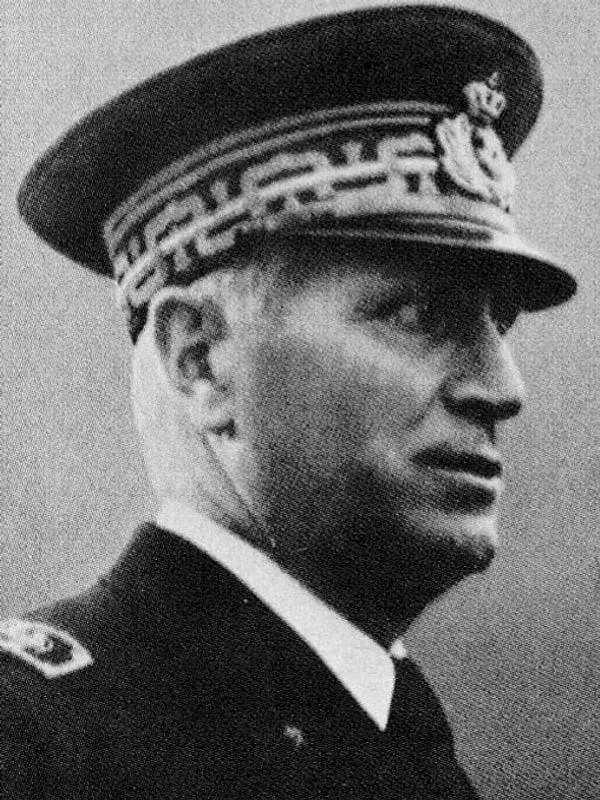
- Born:
- 24 April 1889, San Remo (Kingdom of Italy)
- Died:
- 3 December 1976, Rome (Italy)
- Author:
- Natalia
- Photo:
- unattributed, domena publiczna, Wikimedia Commons

Angelo Iachino (often spelt Jachino in documents of the period) commanded the Italian battle fleet for more than two years, from December 1940 to April 1943, in the war against the British in the Mediterranean. He was a well-educated officer, the author of works on navigation and tactics, and a cautious commander who had to wage war with a fleet that had no radar, no aircraft carriers and meagre stocks of fuel. His name became forever linked with the Battle of Cape Matapan in March 1941, in which he lost three heavy cruisers and two destroyers in a single night and more than 2,300 Italian sailors were killed. For the rest of his life he defended his decisions of that night in one book after another.
Youth and the First World War
He was born on 24 April 1889 in San Remo in Liguria, the son of Giuseppe Iachino, a secondary-school teacher, and Emilia, née Piccione. (Some accounts wrongly give 4 April; the Italian Dizionario Biografico degli Italiani and other sources agree on 24 April.) In August 1904, at the age of fifteen, he entered the Naval Academy in Livorno, and in December 1907 he was commissioned as a midshipman (guardiamarina) and posted to the battleship Regina Margherita. Aboard her he took part in the relief operation after the Messina earthquake in December 1908. In 1911–1912 he fought in the Italo-Turkish War for Libya aboard the battleship Re Umberto. Already then he began writing technical articles for the journal Rivista Marittima.
When Italy entered the First World War in May 1915, Lieutenant Iachino was serving on the modern battleship Giulio Cesare. In 1918 he was given command of the torpedo boat 66 PN and took her on many operations off the eastern coast of the Adriatic. On the night of 31 October – 1 November 1918 his boat was to tow a launch carrying two frogmen with an explosive charge for an attack on the Austro-Hungarian base at Pola (Pula), but an engine failure forced her to turn back, and the task was carried out by a sister torpedo boat. The frogmen then sank the battleship Viribus Unitis (PL). For his actions in the Adriatic Iachino was awarded the Silver Medal of Military Valour in November 1918.
China, London and Spain
After the war he published several manuals, among them works on manoeuvring in naval combat and on the gyrocompass. In May 1922 he took command of the Italian naval detachment in China, and in 1924 of a gunboat operating on the Chinese rivers. As unrest grew in the country, he proposed sending a permanent squadron of warships to protect Italian interests; this proposal gave rise to the Italian Far East Naval Division. (Some studies state that in these years he was naval attaché in China and commanded the gunboat Ermanno Carlotto; the Italian biographical dictionary names the gunboat Sebastiano Caboto.) In 1926, by now a commander, he returned to Italy, completed the course at the Naval War Institute in Livorno and lectured there for two years. From 1929 he commanded the destroyer Nembo and her flotilla, and in 1931–1934 he was naval attaché in London. During this time, in February 1932, he was promoted to captain. He therefore knew well the British navy against which he was later to fight.
In August 1936 he became a rear admiral, and in 1937 he commanded light forces in Spanish waters during the Spanish Civil War, when the Italian navy was quietly supporting Franco’s side. On 1 January 1938 he was promoted to division admiral (ammiraglio di divisione). In his preface to the 1938 navy yearbook he wrote, in line with the views of the Chief of Staff, Admiral Domenico Cavagnari, that Italy did not need aircraft carriers, since land-based aviation would take over their role in the Mediterranean. As commandant of the Naval Academy he likewise gave no support to Professor Ugo Tiberio’s work on an Italian radar. After the war he would write that the lack of carriers and radar had been the Italian fleet’s chief weakness. In April 1939, aboard the cruiser Giovanni delle Bande Nere, he took part in the invasion of Albania, and on 16 September 1939 he was promoted to squadron admiral (ammiraglio di squadra), the equivalent of vice admiral.
Fleet commander
When Italy entered the war in June 1940, Iachino was still commandant of the academy. On 26 July 1940 he replaced the ailing Admiral Riccardo Paladini as commander of the 2nd Squadron, made up of heavy and light cruisers, and hoisted his flag in the heavy cruiser Pola. On 27 November 1940 he led the cruisers in the Battle of Cape Spartivento (known in Italy as the Battle of Cape Teulada) against the British Force H. The engagement was indecisive, and Iachino managed to take the damaged destroyer Lanciere in tow and bring her into Cagliari.
After the attack on Taranto and the indecisive clashes with the British fleet, Benito Mussolini concluded that the fleet’s commander, Admiral Inigo Campioni, who had led it at the Battle of Calabria (Punta Stilo) that summer, was too passive. On 10 December 1940 (9 December according to some sources) Iachino took command of the entire fleet, flying his flag in the new battleship Vittorio Veneto. From then on his opponents were Admiral Andrew Cunningham, commander of the Mediterranean Fleet at Alexandria, and Admiral James Somerville, commander of Force H at Gibraltar. His first attempt brought him no glory: on 9 February 1941 Somerville’s ships bombarded Genoa, while Iachino’s fleet, poorly informed by headquarters and the air force, twice missed them and returned to port empty-handed.
Matapan
In March 1941, under pressure from the Germans, who were demanding attacks on the British convoys carrying troops to Greece, Supermarina (the naval high command) sent the fleet on a sortie into the waters around Crete. Iachino sailed from Naples on the evening of 26 March aboard Vittorio Veneto, with six heavy and two light cruisers and a dozen or more destroyers. He did not know that the British, who were reading Italian ciphers at Bletchley Park, were aware of his intentions. On the morning of 28 March, in the first phase of the Battle of Cape Matapan, his cruisers and battleship fired on British cruisers off the islet of Gavdos, but scored no hits. As he turned back towards his bases, torpedo aircraft from the carrier Formidable hit Vittorio Veneto and, at dusk, crippled the cruiser Pola.
That evening Iachino took a decision that is still judged severely in Italy: he sent the whole of Admiral Carlo Cattaneo’s 1st Division – the cruisers Zara and Fiume with four destroyers – to assist Pola. He believed there were no British battleships nearby, although air reports and radio direction-finding indicated that Cunningham’s fleet was close, and his own signals intelligence officer, Commander Eliso Porta, was convinced that the British were at sea in full strength. Nor did he reckon with the enemy having radar and being prepared to fight at night. On the night of 28–29 March British battleships destroyed Zara and Fiume within minutes at a range of about three kilometres, and destroyers finished off two Italian destroyers and Pola. Cattaneo and more than 2,300 sailors were killed. Vittorio Veneto reached Taranto.
On his return Iachino explained to the Chief of Naval Staff, Admiral Arturo Riccardi, that the strategy of the operation had been set by Supermarina rather than by the commander at sea, that reports had arrived late and were contradictory, that air cover had been practically non-existent, and that the assessment according to which the British had only one battleship fit for action had proved false. Riccardi accepted these explanations and presented the matter to Mussolini accordingly. Contrary to many people’s expectations, Iachino kept command of the fleet, while Mussolini forbade heavy ships to be taken beyond the range of Italian fighters and agreed to the construction of the first Italian aircraft carrier, Aquila, which never entered service.
Sirte and the “mid-June battle”
In the summer and autumn of 1941 Iachino led the fleet out several times against British convoys to Malta, in July and September without result. On 17 December 1941, in the First Battle of Sirte, his battleships clashed with the escort of a British convoy. He succeeded in getting an Italian convoy safely through to Libya, but did not prevent the British from supplying Malta, although he had superior forces. In the Second Battle of Sirte on 22 March 1942, British cruisers and destroyers under Rear Admiral Philip Vian, making use of smokescreens and a storm, beat off the attack by the battleship Littorio on a convoy bound for Malta; most of the convoy’s ships, however, were later sunk by German aircraft. Historians criticise Iachino for having overestimated the enemy’s strength in both battles – with Matapan in mind – for believing reports of non-existent British battleships and for avoiding night action at all costs, so that he failed to exploit his superiority.
On 6 April 1942 he was promoted to squadron admiral designated for the rank of fleet admiral (ammiraglio di squadra designato d’armata). He achieved his greatest success in June 1942, in the operation known in Italy as the “mid-June battle” (battaglia di mezzo giugno). When the British sent convoys to Malta simultaneously from Gibraltar and from Alexandria, Iachino sailed from Taranto against the latter. Although British aircraft and a submarine sank the heavy cruiser Trento and hit the battleship Littorio with a torpedo, he pressed on until the British command ordered the convoy back to Alexandria (Operation Vigorous). Of the other convoy, Harpoon, only two ships reached Malta.
Departure and the post-war years
From the autumn of 1942 a shortage of fuel effectively confined the Italian battleships to port. On 5 April 1943 Iachino handed over command of the fleet to Admiral Carlo Bergamini, and the next day he was promoted to fleet admiral (ammiraglio d’armata), the highest rank in the navy. For several months he sat on the Committee of Admirals and headed a commission coordinating technical projects. He played no part in September 1943 when, after Italy’s surrender, the fleet put to sea to surrender to the Allies at Malta, and Bergamini was killed aboard the battleship Roma, sunk by German aircraft.
In 1945 Iachino was transferred to the reserve. He appealed against this decision and in 1948 was restored to active service, but he was not allowed to take up the chairmanship of the Supreme Council of the Armed Forces, to which he was entitled by law. He finally left the service in April 1954 and retired in 1962. After the war he devoted himself to writing. His books included Gaudo e Matapan (1946), Le due Sirti (1953), Operazione mezzo giugno (1955), La sorpresa di Matapan (1957), Tramonto di una grande Marina (“The Twilight of a Great Navy”, 1959) and Il punto su Matapan (1969), as well as a study of the Battle of Lissa of 1866. In them he argued that the Italian navy had lost above all because of the lack of carriers and radar and poor cooperation with the air force – although before the war he himself had shared the view that carriers were unnecessary. In 1974 he funded a monument to the sailor in Taranto. He died in Rome on 3 December 1976.
Assessment
Iachino was neither a thoughtless nor a cowardly commander: in several engagements he acted skilfully, and in June 1942 his persistence forced the British to turn back. He commanded, however, a fleet that was strategically shackled – Supermarina in Rome set the objectives of operations, the air force was not subordinate to the navy, and every ship lost was irreplaceable. In these conditions he came to embody the caution of the Italian navy, which after Taranto and Matapan surrendered the initiative at sea to the Royal Navy. Of Matapan, which weighed on his whole career, Italian historians write that part of the blame falls on Supermarina and the inept air cover, but that the decision to send the 1st Division to assist Pola when British battleships might be nearby lies above all with him.
Sources
Commanded in battles
(01)Often appears with
People who appear in the same events.