- Category:
- Politics
- Date:
- 10 June 1940
- Author:
- Natalia
- Tags:
- Italy, Benito Mussolini, France, United Kingdom
At 4.30 p.m. on 10 June 1940 the Italian Foreign Minister, Galeazzo Ciano, received the French ambassador, André François-Poncet, at the Palazzo Chigi in Rome and read him a brief note: the King-Emperor declared that from the following day, 11 June, Italy considered herself at war with France. A quarter of an hour later the British ambassador, Sir Percy Loraine, heard the same formula, this time concerning Great Britain. At six in the evening Benito Mussolini stepped out onto the balcony of the Palazzo Venezia and announced to the crowd gathered in the square below that the “hour of irrevocable decisions” had struck. At that very moment the French armies were falling back behind the Seine and the French government was leaving Paris. Italy, for nine months a “non-belligerent”, entered the war at a moment when it seemed already decided.
Nine months of non-belligerence
Mussolini had bound himself to Hitler by the Pact of Steel in May 1939, but he signed it in the belief that a great war would not break out for another three years. When Germany invaded Poland on 1 September 1939, the Italian government announced that it would not initiate any military operations. The word “neutrality” was carefully avoided. Italy was to be a “non-belligerent” state: not fighting, but not breaking the alliance either.
Behind this formula lay an awareness of weakness. Asked in the autumn of 1939 about the state of their preparations, the service staffs replied that the air force would make good its deficiencies in 1942 at the earliest, the navy at the end of 1943, and the army not until 1944. The wars in Ethiopia, Spain and Albania had consumed the stocks of equipment and ammunition. The economy depended on deliveries of coal from Germany and oil from Romania, and the British blockade of German exports forced the Italians to bring coal in by rail over the Alps. The dispute over the colliers detained by the Royal Navy in March 1940 drew Rome still closer to Berlin.
With every month Mussolini found the role of spectator harder to bear. He did not want to be thought a coward, or an ally who, as in 1914, deserts his partner. At his meeting with Hitler at the Brenner Pass on 18 March 1940 he gave an assurance that Italy would enter the war, but said he would choose the moment himself. On 31 March he sent the King and the senior commanders a secret memorandum: Italy could not remain neutral for the whole war without abdicating her role and becoming “a Switzerland multiplied by ten”. The question was not whether to enter the war, but when and how. The war plan, however, was modest: on land the memorandum envisaged above all defence, in the Alps and in Libya, with offensive action mainly at sea.
May 1940: what seemed the last chance
The German offensive in the West, launched on 10 May, swept away his hesitation. As early as 13 May, as the Germans were breaking through on the Meuse, Mussolini told Ciano, according to the latter’s diary, that the Allies had lost the war, that the Italians had been dishonoured enough, and that he would declare war within a month. Reports of the political police meanwhile recorded a surprising shift in public mood. As late as August 1939 most Italians had not wanted war. By the spring of 1940 there was a growing fear that Germany would win on her own and that Italy, by standing aside, would get nothing.
Attempts to restrain Mussolini multiplied, but none had any effect. At the end of April Pius XII wrote to him, in May President Franklin Delano Roosevelt sent further letters, and on 16 May so did the new British Prime Minister, Winston Churchill. King Victor Emmanuel III warned against war, mindful of the army’s weakness. When at the end of May the Allies were considering whether to buy Italian neutrality with concessions, and a dispute in the War Cabinet was raging over the question in London, Mussolini would not even listen. On 27 May the American ambassador in Rome conveyed a proposal from Roosevelt: the President would put Italy’s demands to the Allies and guarantee that Italy would take her seat at the peace table on an equal footing with the belligerents, provided she stayed out of the war. The same day François-Poncet indicated that France was ready to talk about Tunisia. The answer was no. Ciano noted that even if Mussolini could obtain twice as much as he was asking for by peaceful means, he would still refuse.
The marshals’ warnings
On 26 May Mussolini told the Chief of the Supreme General Staff, Marshal Pietro Badoglio, and the Governor of Libya, Marshal Italo Balbo, that he intended to enter the war so as to have a seat at the peace table “when the world is divided up”. Both tried to dissuade him. They said that the divisions were under strength, the army was short of equipment, the colonies were unprepared, and the merchant fleet was scattered across the world and would be seized in foreign ports. Badoglio claimed after the war that he had called the decision suicide and reminded Mussolini that the soldiers were short even of shirts. Mussolini is said to have replied: “I assure you that by September it will all be over, and I need a few thousand dead so that I can sit at the peace conference table as one who has fought.” These words, known from Badoglio’s own account, are dated by different studies to the last days of May or the beginning of June, but they capture the Duce’s calculation well: the war was to be short and its cost small.
The figures bore out the marshals’ fears. The army had mobilised more than a million and a half men and formally numbered 73 divisions, but only 19 of them were complete and ready for combat. The divisions had recently been converted to a “binary” structure, with two infantry regiments instead of three, which made them weaker than French divisions. Most of the tanks were light, and much of the artillery dated from the First World War. The Regia Aeronautica nominally had more than three thousand aircraft, a large proportion of them trainers and obsolete machines, and biplanes such as the Fiat CR.42 predominated among the fighters. The strongest service was the Regia Marina, with modern cruisers and more than a hundred submarines, but no aircraft carriers. Of its battleships only two were ready for action in June, and the two newest, Littorio and Vittorio Veneto, had only just entered service.
On 29 May, at the Palazzo Venezia, Mussolini assembled Badoglio and the chiefs of staff of the three services, among them the army chief of staff, Marshal Rodolfo Graziani. The meeting lasted half an hour. The Duce announced that entering the war after Allied resistance had collapsed would be seen by the Germans as joining in “when the job is already done”, and Italy would have no right to the spoils. No one protested. That same day the King agreed to hand Mussolini operational command of the armed forces, which under the constitution belonged to the monarch. Victor Emmanuel formally kept the title of Commander-in-Chief, and on 11 June, in a proclamation to the armed forces, he named Mussolini commander of the troops operating on all fronts.
Choosing the day
On 30 May Mussolini wrote to Hitler that Italy would enter the war on 5 June. Hitler asked for a few days’ delay so as not to disrupt German plans in France, but as early as 2 June the German ambassador in Rome, Hans Georg von Mackensen, let it be known that Berlin had no objection to an earlier date. In the end Monday 10 June was chosen, with the state of war to take effect a few minutes after midnight, on 11 June.
Right up to the end there was no plan for an offensive. On 7 June the Supreme General Staff reiterated the Duce’s wishes: to maintain “an entirely defensive attitude towards France, both on land and in the air”. At sea, ships were to attack British forces, and French ones only if the French attacked first. Some 300,000 soldiers in 22 divisions stood on the Alpine frontier, but they were deployed to defend the valleys, not to storm the French forts. General Quirino Armellini, one of the staff officers, later summed it up in a single sentence: “For now we are entering the war, and then we shall see.”
Nor did anyone define the aims of the war precisely. Since the autumn of 1938 Fascist propaganda had been demanding Nice, Corsica, Savoy, Tunisia and Djibouti from France, and Mussolini dreamed of freeing Italy from the “prison” of the Mediterranean, whose keys – Gibraltar and the Suez Canal – were held by the British. But how this was to be achieved without a fight in which Italy stood no chance, nobody knew.
The afternoon of 10 June
On the morning of 10 June Ciano informed the ambassadors in London and Paris of the time at which the declarations would be handed over in Rome. In accordance with diplomatic custom, he read them out in person. François-Poncet, according to Ciano’s diary, received the news with emotion. He said he had been expecting it for two years, since the signing of the Pact of Steel, and called it a dagger blow struck at a man already lying on the ground. Yet he could not regard the Italians as enemies, and added on parting that the Germans would prove to be hard masters for them. Loraine, Ciano noted, “did not bat an eyelid”. He merely asked politely whether he was to treat the formula he had heard as advance notice or as an actual declaration of war, and left without comment. That evening Ciano wrote in his diary: “The news of the war has surprised no one and has not aroused much enthusiasm. I am sad, very sad. The adventure begins. May God help Italy.”
At 6 p.m. Mussolini, in the uniform of an honorary corporal of the Fascist Militia, spoke from the balcony of the Palazzo Venezia. Loudspeakers carried his words to the squares of the largest cities, and the radio to the whole country:
“Fighters of the land, the sea and the air! Blackshirts of the revolution and of the legions! Men and women of Italy, of the Empire and of the Kingdom of Albania! Listen! An hour marked out by destiny is striking in the sky of our fatherland. The hour of irrevocable decisions. The declaration of war has already been handed to the ambassadors of Great Britain and France. We are taking the field against the plutocratic and reactionary democracies of the West, which have always hindered the advance, and often threatened the very existence, of the Italian people.”
Mussolini said that Italy had done everything humanly possible to avoid war, and that it would have been enough to revise the treaties and not to reject the peace proposal Hitler had made on 6 October 1939 after the campaign in Poland. He defined the aim of the war thus: “We take up arms in order, having settled the problem of our land frontiers, to settle the problem of our maritime frontiers. We want to break the territorial and military chains that are strangling us in our own sea, for a nation of forty-five million souls is not truly free unless it has free access to the ocean.” He presented the war as “the struggle of poor and populous peoples against the starvers who jealously guard their monopoly of all the riches and all the gold of the earth”. He assured Italy’s neighbours that she did not intend to drag Switzerland, Yugoslavia, Greece, Turkey or Egypt into the conflict, but added that it was up to them whether these words would be kept. He recalled that, according to Fascist morality, when one has a friend one marches with him to the end, and he saluted “the Führer, leader of the great allied Reich”. He ended with the slogan that would hang on the walls of Italian towns for years to come: “To win! And we shall win!”
The crowd cheered, and the next day the press printed quotations from the speech in huge letters. Ciano noticed, however, that the enthusiasm was moderate. Many Italians received the news with anxiety, though it was widely believed that the war would last a few weeks at most. None of the regime’s dignitaries who privately doubted the wisdom of the war protested publicly, and no one resigned.
“The hand that held the dagger”
Hitler at once sent telegrams of congratulation to Mussolini and to the King. Privately he was less pleased. He would have preferred the Italians to attack Malta and other British bases without a declaration, rather than declare war on France, which was already beaten anyway. The German military had long since ceased to count on Italian help, and feared rather that a new Alpine front would complicate negotiations with France.
In the Allied and neutral countries the declaration of war on a defeated opponent was received with contempt. That same day Roosevelt was speaking in Charlottesville at the commencement ceremony of the University of Virginia, where his son Franklin Jr. was receiving his law degree. He described his unsuccessful efforts to restrain Mussolini, and then said: “On this tenth day of June, 1940, the hand that held the dagger has struck it into the back of its neighbor.” According to his aides, the State Department had struck this sentence out of the draft so as not to provoke the Italians and the many Italian-American voters, and the President restored it himself. In the same speech he announced a turn in American policy: “we will extend to the opponents of force the material resources of this nation”. He also warned against the “obvious delusion” that the United States could remain “a lone island in a world dominated by the philosophy of force”.
In Britain the police began that very night to detain Italian men deemed suspect, and soon thousands of Italians were interned, including many long settled in Britain. In London, Edinburgh and other cities crowds smashed the windows of Italian cafés and shops. Canada declared war on Italy on 10 June itself, and Australia, New Zealand and South Africa a day later. In France the authorities called on Italians living near the border to report to the police, and most of them signed a declaration of loyalty to the country that had become their home.
The first days of the war
The war that began on 11 June showed from its very first hours what Italy’s “parallel war” amounted to. On the morning of 11 June Italian bombers twice raided Malta, where the British air defences had only a handful of guns and a few obsolete fighters. The island, which was to become the key to the struggle for the Mediterranean, was one the Italians never dared to attack from the sea. On the night of 11–12 June British bombers flying from England bombed Turin, and on 14 June French warships shelled the Ligurian coast. About a quarter of the Italian merchant ships that were in Allied ports or far from home when war was declared were lost to Italy: they were seized or scuttled by their own crews. On 12 June an Italian submarine sank the British cruiser Calypso south of Crete, and on 14 June British forces from Egypt captured Fort Capuzzo, just across the border in Libya.
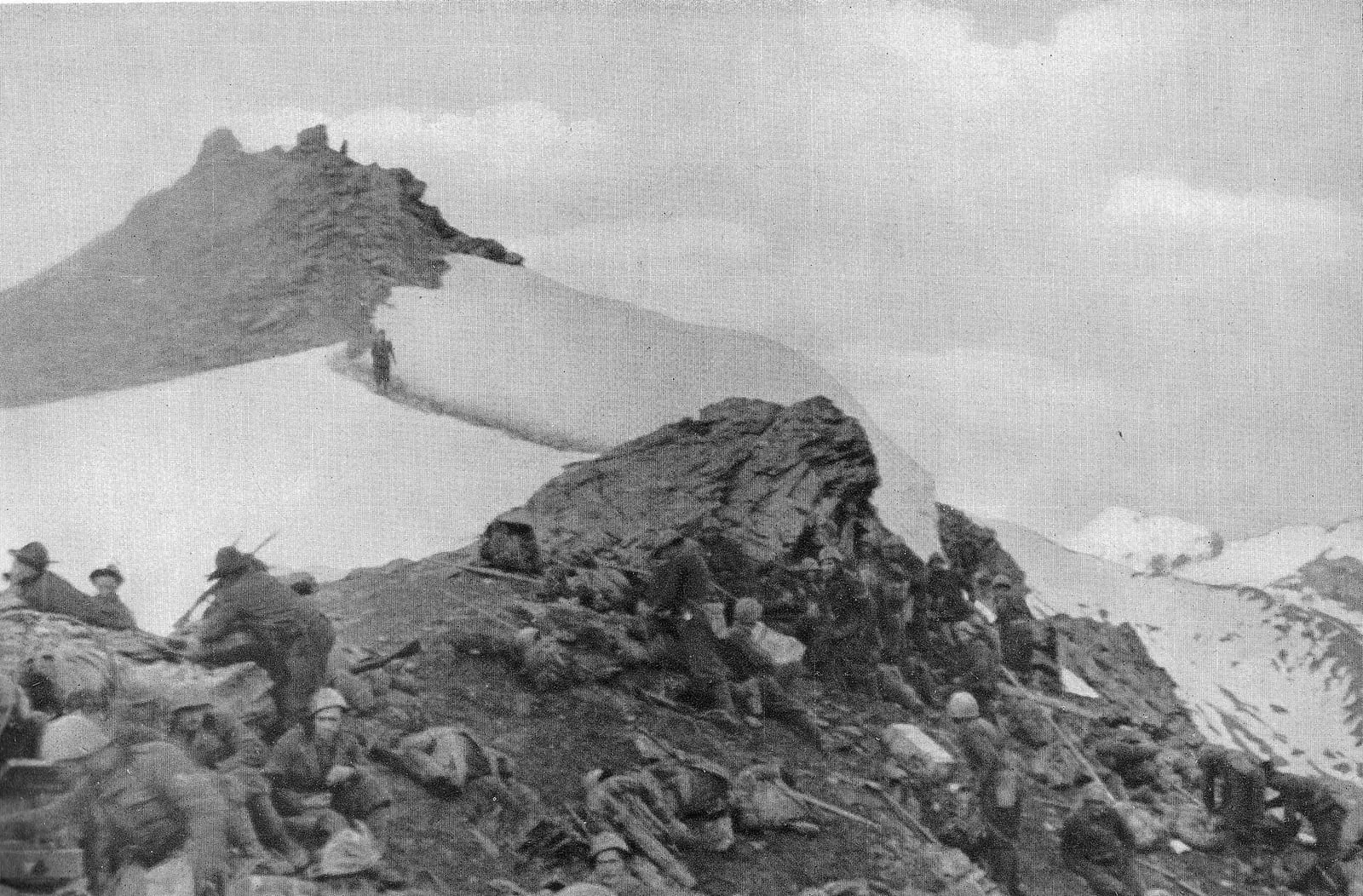
In the Alps little happened for ten days. Only when France asked Germany for an armistice did Mussolini, afraid that the war would end without any Italian gains, order an offensive against the French Army of the Alps on 21 June. The attack, launched without preparation in mountains still covered in snow, brought the capture of Menton and a few border villages at the cost of heavy losses. On 24 June the Franco-Italian armistice was signed at the Villa Incisa near Rome. Italy, which two weeks earlier had been demanding Nice, Corsica and Tunisia, received a sliver of territory with fewer than thirty thousand inhabitants.
Its place in the war
Italy’s entry into the war carried it to the Mediterranean, to North and East Africa, and later to the Balkans. Mussolini had counted on a few weeks of fighting and a place at the victors’ table; instead he got a war that lasted three years and destroyed his regime. Britain did not make peace after the fall of France, and Italy had to fight her at sea and in the colonies without the carrier fleet, the fuel or the industry to do so. In the autumn of 1940 Italy attacked Egypt and Greece. Both offensives ended in defeats from which the Italians were rescued only by the Germans, who in the spring of 1941 sent a corps to Africa and attacked Yugoslavia and Greece. From then on Mussolini was Hitler’s subordinate in the war, not his parallel partner.
For the Allies, 10 June 1940 meant a new front and a new threat to the sea route through the Suez Canal to India, but also an opponent whose weakness was soon exposed. For France, a declaration of war on the day her government was fleeing the capital remained a symbol of humiliation, and Roosevelt’s phrase, “a stab in the back”, clung to Mussolini’s decision for decades. Italian historians, even those most indulgent towards the Duce, agree that it was an opportunistic decision, taken against the advice of his own staffs and of the King, in the belief that Britain would sue for peace any day. That calculation was proved wrong as early as July 1940, and Italy paid for it with hundreds of thousands of dead, the loss of her empire, German occupation and civil war in 1943–1945.
Sources
Meanwhile
(04)Elsewhere, within a week.
- 11 June 1940 · MediterraneanThe siege of Malta beginsOn 11 June 1940, hours after Italy entered the war, bombers from Sicily attacked Malta for the first time. So began a siege of almost two and a half years.
- 12 June 1940 · Western FrontThe surrender at Saint-Valery-en-CauxOn 12 June 1940 the British 51st Highland Division and French IX Corps, trapped by Rommel's panzers, surrendered at Saint-Valery-en-Caux. Fog foiled evacuation.
- 14 June 1940 · Western FrontThe Germans enter ParisOn 14 June 1940 German troops entered Paris, declared an open city, without a fight. A swastika flag was hoisted over the Eiffel Tower.
- 14 June 1940 · MediterraneanThe French Navy against ItalyOn 14 June 1940 French cruisers from Toulon shelled Vado, Savona and the outskirts of Genoa. Until 21 June the French fleet fought the Italians at sea.
Related events
(04)The same battle, people or subject.
- 1 July 1940 · MediterraneanGraziani takes command in LibyaOn 1 July 1940 Marshal Rodolfo Graziani arrived in Tripoli as Balbo's successor. Mussolini demanded a swift attack on Egypt; Graziani held back.
- 18 March 1940 · DiplomacyHitler and Mussolini meet at the Brenner PassOn 18 March 1940 Hitler and Mussolini met in a train at the Brenner Pass. The Duce pledged that Italy would enter the war, but at a moment of his choosing.
- 28 June 1940 · MediterraneanThe death of Italo BalboOn 28 June 1940 Italian anti-aircraft guns over Tobruk mistakenly shot down the aircraft of Marshal Italo Balbo, Governor of Libya. Nine people were killed.
- 24 June 1940 · Western FrontThe Franco-Italian armisticeOn 24 June 1940 Huntziger and Badoglio signed the Franco-Italian armistice near Rome. Italy, halted in the Alps, got only Menton and scraps of border land.