India
Subhas Chandra Bose
President of the Indian National Congress (1938–1939), head of the Provisional Government of Free India (Azad Hind) and of the Indian National Army (1943–1945)
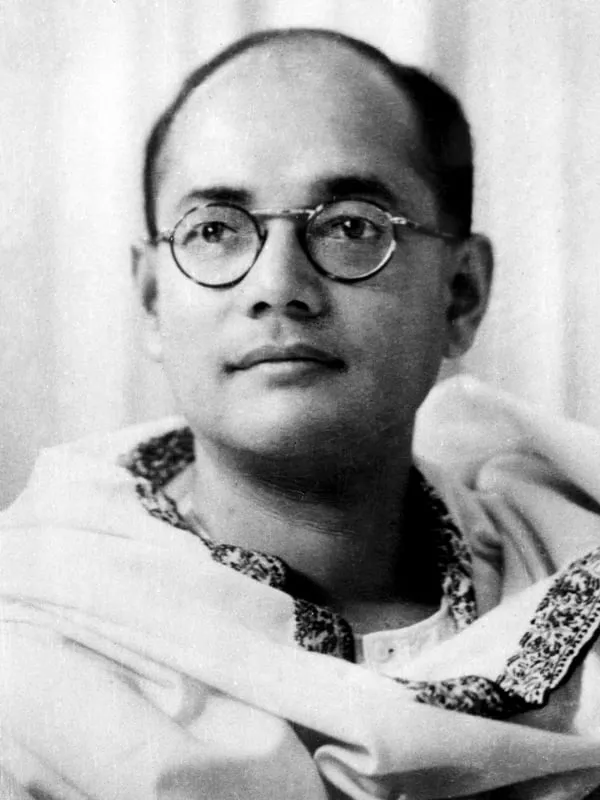
- Born:
- 23 January 1897, Cuttack (Bengal, British India)
- Died:
- 18 August 1945, Taipei (Taihoku, Japanese-ruled Taiwan)
- Author:
- Natalia
- Photo:
- Netaji Research Bureau, Kalkuta, domena publiczna, Wikimedia Commons

Subhas Chandra Bose, known to his followers as Netaji (“Respected Leader”), was one of the most popular leaders of the Indian independence movement and at the same time its most controversial figure. A radical rival of Mahatma Gandhi within the Indian National Congress, elected its president in 1938 and 1939, he saw the outbreak of the Second World War as an opportunity to throw off British rule by force. To that end he sought help from Britain’s enemies: first Nazi Germany, then Japan. At the head of the Provisional Government of Free India and the Indian National Army he fought alongside the Japanese against the Allies. He died – according to the findings of successive commissions of inquiry – in an air crash three days after Japan’s surrender; the circumstances of his death are still disputed in India. In India he is revered as a national hero, while historians debate the price of his alliance with the Axis powers.
Youth and Cambridge
He was born on 23 January 1897 in Cuttack, in what is now the state of Odisha but was then part of the province of Bengal, the ninth of fourteen children of a prosperous lawyer, Janakinath Bose, and his wife Prabhabati. The family belonged to Bengal’s educated Hindu class, and his elder brother Sarat Chandra Bose later became one of the leaders of Congress in Bengal. As a young man Subhas devoured the writings of Vivekananda, who combined Hindu spirituality with patriotism.
In 1913 he began his studies at the elite Presidency College in Calcutta. In February 1916 a group of students there assaulted an English history lecturer, E. F. Oaten, who – according to the students – had insulted Indians; Bose was deemed one of the ringleaders and expelled. He completed his philosophy degree at the Scottish Church College. In 1919 his father sent him to England to prepare for the examinations for the elite Indian Civil Service (ICS). Bose studied at Fitzwilliam College, Cambridge, and in August 1920 passed the open competitive examination, placing fourth. In the spring of 1921, however, under the influence of Gandhi’s non-cooperation campaign and the Amritsar massacre, he gave up a career as a colonial official. On 22 April 1921 he wrote to the Secretary of State for India, Edwin Montagu, asking for his name to be removed from the list of probationers, and returned home.
In Congress
On 16 July 1921 Bose landed in Bombay and met Gandhi the same day. The conversation disappointed him – Gandhi’s programme struck him as vague – and he chose as his mentor the Bengali leader Chittaranjan Das. When Das became mayor of Calcutta in 1924, Bose became chief executive officer of the city corporation. Later that year the authorities arrested him on suspicion of links with revolutionaries and imprisoned him without trial in Mandalay in Burma, where his health seriously declined.
After his release in 1927 he became general secretary of Congress and, together with Jawaharlal Nehru, led its younger left wing, which demanded complete independence rather than dominion status. In 1930, shortly after coming out of another spell in prison, he became mayor of Calcutta. In 1932 he was arrested again and, because of his poor health, allowed to leave for Europe. From 1933 to 1936 he lived mainly in Vienna, travelled around the Continent and met Indian students and European politicians, among them Benito Mussolini. During this period he wrote The Indian Struggle (1935), a book on the national movement in 1920–1934. He was fascinated by the discipline and efficiency of authoritarian states, and believed that an independent India would for a time need a strong, centralised government combining socialism with nationalism. In Vienna he met his secretary, an Austrian named Emilie Schenkl. According to her later accounts, they married secretly in 1937; in November 1942 their daughter Anita was born, who later became an economist in Germany.
President of Congress and the break with Gandhi
In February 1938, with Gandhi’s support, Bose became President of Congress. He argued that the party should become a broad anti-imperialist front fighting for political freedom and a socialist order, and he called for the coming crisis in Europe to be used to present the British with an ultimatum. This alienated Gandhi and most of the leadership. In January 1939 Bose stood for a second term against their wishes and defeated Gandhi’s candidate, Pattabhi Sitaramayya. Gandhi declared that Pattabhi’s defeat was “more mine than his”, and most members of the Congress Working Committee resigned, refusing to work with the new president. Bose, who was ill, was carried on a stretcher to the session at Tripuri in March 1939. At the end of April, unable to form a leadership, he stepped down.
On 22 June 1939 he founded the All India Forward Bloc, a left-wing faction within Congress that was strongest in Bengal; for indiscipline he was removed from his party posts. When in September 1939 the Viceroy, Lord Linlithgow, declared India at war without consulting Indian politicians, Bose called for mass civil disobedience. Gandhi chose a more cautious path, and in 1940 confined himself to individual satyagraha. In July 1940 Bose was arrested in Calcutta and, after a hunger strike, transferred in December to house arrest in the family home on Elgin Road.
Escape and Germany
On the night of 16–17 January 1941 Bose, disguised as a Muslim Pashtun, slipped out of the house, which was under police surveillance. With the help of his nephew Sisir he reached Gomoh station by car, then went by train to Peshawar, and from there with guides, posing as a deaf-mute, across the tribal borderlands to Kabul. His guide, Bhagat Ram Talwar, was – unknown to Bose – a Soviet agent. After weeks of seeking help at the Axis legations he obtained an Italian passport in the name of “Count Orlando Mazzotta”, travelled across the USSR to Moscow and reached Berlin at the beginning of April 1941.
The Germans received him kindly but without commitments. He was attached to a special India office in the Foreign Office (Auswärtiges Amt), where Adam von Trott zu Solz, among others, worked. In Berlin Bose founded the Free India Centre and the Azad Hind Radio station, which broadcast appeals to Indians to rise against the British – including in August 1942, after the arrest of Gandhi and the Congress leaders. From Indian prisoners captured in North Africa the Indian Legion (Legion Freies Indien) was formed, numbering, according to various sources, around 3,000–4,500 men. The soldiers swore obedience to Adolf Hitler as commander of the German armed forces “in the struggle for India”, whose leader was Bose. In 1944 the Legion was incorporated into the Waffen-SS. It was among the soldiers in Germany that the title Netaji took hold.
Bose did not obtain what he wanted most: a joint declaration by the Axis powers recognising India’s independence. At Hitler’s meeting with Mussolini in April 1942 it was decided that the time for it had not yet come. Bose’s only meeting with Hitler, at the end of May 1942, produced no political commitments, but Hitler agreed to provide him with transport to Asia, where, after taking Singapore and Burma, the Japanese stood on India’s frontiers. Bose remained publicly silent about Nazi policy towards the Jews, and his collaboration with the Third Reich is, for historians – including those sympathetic to him – the most difficult chapter of his life.
By submarine to Asia
In February 1943 Bose sailed from Kiel aboard the German submarine U-180. At the end of April, off the coast of Madagascar, he transferred to the Japanese submarine I-29 – according to an often repeated claim, the only wartime transfer of civilian passengers from a submarine of one navy to that of another. At the beginning of May he reached Sabang off Sumatra, from where he flew to Tokyo. Prime Minister Hideki Tōjō, sceptical at first, concluded after talks in June 1943 that he was a useful ally.
An Indian National Army already existed in South-East Asia, formed in 1942 by Captain Mohan Singh from prisoners taken in Malaya and Singapore, but in December 1942, after a clash between Singh and the Japanese, it had practically fallen apart. On 4 July 1943 in Singapore Bose took over the leadership of the Indian Independence League from the veteran exile Rash Behari Bose, and the next day the command of the reconstituted army. His slogan became “Dilli Chalo!” (“On to Delhi!”). He also created the women’s Rani of Jhansi Regiment, commanded by a doctor, Lakshmi Swaminathan.
Azad Hind
On 21 October 1943 in Singapore Bose proclaimed the Provisional Government of Free India (Azad Hind), taking the offices of head of state, prime minister and minister of war. The government declared war on Britain and the United States; it was recognised only by the Axis powers and the governments dependent on them, among them Ba Maw’s Burma and the Nanjing government of Wang Jingwei. At the Greater East Asia Conference in Tokyo in November 1943 Bose attended as an observer, and Tōjō announced that the Andaman and Nicobar Islands would be handed over to his government. On 29 December 1943 Bose arrived in Port Blair and raised his flag there, but the islands remained under the actual control of the Japanese navy, which terrorised the local population; Bose, kept isolated by his hosts, did nothing to counter it.
In 1944 the Indian National Army, numbering several tens of thousands of men, only some of whom reached the front, took part in the Japanese offensive against Imphal and Kohima. The Japanese treated it chiefly as an instrument of propaganda and intelligence and did not entrust it with independent tasks. The offensive ended in catastrophe: the Indian units, like the Japanese, lost thousands of men, above all to hunger and disease, and many soldiers deserted or surrendered. In the spring of 1945, as the British retook Burma, Bose’s army disintegrated, and after the fall of Rangoon in May most of its soldiers went into captivity. Bose withdrew to Singapore and Bangkok.
Death and controversy
After Japan’s surrender Bose most probably intended to make his way to Manchuria and from there seek contact with the USSR. On 18 August 1945 the Japanese bomber in which he was flying from Saigon crashed on take-off from Taihoku airfield on Taiwan (today Taipei). Bose suffered severe burns and, according to witnesses, died the same night in a Japanese military hospital. His body was cremated on 20 August and the ashes taken to Tokyo, where since September 1945 they have been kept at the Buddhist temple of Renkō-ji.
Many Indians refused to accept the news. Legends arose of Bose’s escape to the USSR, of his death in a Soviet labour camp, or of his living in hiding in India as an ascetic. Indian inquiries – the Shah Nawaz Khan committee in 1956 and the commission of Justice G. D. Khosla in 1970–1974 – confirmed his death in the crash; British investigators had reached the same conclusion earlier, as did Japanese documents published later. In 2005 the commission of Justice M. K. Mukherjee concluded that Bose had not died in the crash and that the ashes at Renkō-ji were not his, but the Indian government rejected its report. Most historians accept that Bose died at Taihoku.
Legacy
Militarily Bose’s enterprise ended in defeat, but politically it played a role even after his death. When in the autumn of 1945 the British court-martialled three officers of the Indian National Army – a Hindu, a Muslim and a Sikh – in the Red Fort in Delhi, the trial provoked a wave of protest throughout India, and Congress, which during the war had condemned Bose’s methods, took up the defence of the accused. The Commander-in-Chief in India, General Claude Auchinleck, commuted the sentences of transportation for life to dismissal from the service. Many historians believe that the affair of Bose’s army, followed by the mutiny of the Royal Indian Navy’s sailors in February 1946, convinced London that it could no longer rely on the loyalty of Indian soldiers, which hastened the decision to withdraw from India in 1947.
In independent India Bose became, alongside Gandhi and Nehru, one of the foremost national heroes, especially in Bengal. Calcutta’s airport is among the places named after him, in 2018 one of the Andaman Islands was renamed in his honour, and since 2021 his birthday has been celebrated as Parakram Diwas (“Day of Valour”). Historians’ judgement is more complex. They admire his courage, his organisational ability and the fact that in the army he created Hindus, Muslims and Sikhs served together across religious and caste divides. At the same time they stress that in the name of India’s freedom he allied himself with regimes responsible for crimes on an unimaginable scale, the Third Reich among them, that his army was dependent on the Japanese occupation forces, and that his vision of an independent India presupposed authoritarian rule.
Sources
Mentioned in battles
(02)Often appears with
People who appear in the same events.