United Kingdom
William Slim
Commander of the 10th Indian Infantry Brigade (1940–1941), the 10th Indian Infantry Division (1941–1942), Burma Corps (1942), XV Corps (1942–1943) and the Fourteenth Army (1943–1945), Chief of the Imperial General Staff (1948–1952), Governor General of Australia (1953–1960), field marshal
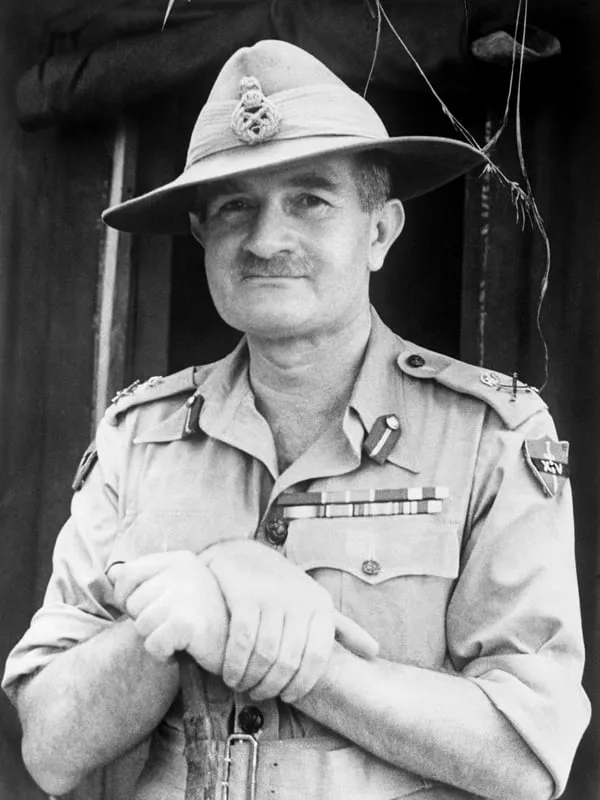
- Born:
- 6 August 1891, Bishopston, Bristol (United Kingdom)
- Died:
- 14 December 1970, London (United Kingdom)
- Author:
- Łukasz
- Photo:
- No 9 Army Film & Photographic Unit, domena publiczna, Wikimedia Commons

William Joseph Slim, known to his soldiers as “Uncle Bill”, is regarded as one of the finest British commanders of the Second World War, even though for most of the war he fought on a front whose own soldiers called themselves the “Forgotten Army”. The son of a bankrupt Bristol merchant, he never went to university and entered the army by the back door; in 1942 he conducted the longest retreat in the history of the British Army, and in 1944–1945, as commander of the Fourteenth Army, he inflicted on the Japanese at Imphal and Kohima the greatest defeat on land in their history and reconquered Burma. After the war he headed the British Army, and then for seven years was Governor General of Australia.
Bristol and Birmingham
He was born on 6 August 1891 in Bishopston, a district of Bristol, the younger son of John Slim, a wholesale ironmonger, and Charlotte, née Tucker. The family was Catholic. His father’s business failed, and in 1903 the Slims moved to Birmingham, where William was educated at the Catholic St Philip’s Grammar School and then at King Edward’s School. There was no money for university. From 1910 he worked as an elementary school teacher in a poor district, and then as a clerk at the Stewarts & Lloyds steel tube works.
But he dreamed of the army. Although he was not a student, he managed in 1912 to join the Officers’ Training Corps of the University of Birmingham. Thanks to this, in August 1914, immediately after the outbreak of war, he was commissioned as a second lieutenant in the Royal Warwickshire Regiment.
Gallipoli and Mesopotamia
Slim landed on the Gallipoli peninsula with the 9th Battalion, Royal Warwickshire Regiment, in 1915 (the Gallipoli campaign). In August, in the fighting for the Sari Bair heights, he was seriously wounded in the chest. The doctors judged him unfit for front-line service, but he managed to obtain a regular commission in the West India Regiment and in October 1916 rejoined his old battalion – this time in Mesopotamia. There he was wounded again in 1917, and in February 1918 he received the Military Cross. He spent the rest of the war in India, on the army staff.
An officer of the Indian Army
In 1919 he transferred to the British Indian Army, and in 1920 he was posted to the 1st Battalion of the 6th Gurkha Rifles, in which he served as adjutant. In January 1926 he married Aileen Robertson, the daughter of a Scottish minister; they had a son, John, and a daughter, Una.
In 1926–1928 he passed through the Staff College at Quetta, then worked at Indian Army headquarters, and in 1934–1937 was an instructor at the Staff College, Camberley, as the Indian Army’s representative. In 1937 he attended the course at the Imperial Defence College. He supplemented his income with his pen, publishing stories and articles in magazines under the pseudonym Anthony Mills. In 1938 he took command of the 2nd Battalion of the 7th Gurkha Rifles, and in 1939, as a colonel, he became head of the Senior Officers’ School at Belgaum.
Gallabat, Iraq, Syria and Iran
The Second World War carried him rapidly upwards. In the autumn of 1939 he took over the 10th Indian Infantry Brigade, with which in 1940 he went to the Sudan, to the front of the East African campaign. On 6 November 1940 his brigade, supported by a few tanks, recaptured the border fort of Gallabat from the Italians, but the attack on neighbouring Metemma failed – under the bombs of the Italian air force part of one of the battalions panicked, and Slim had to abandon the fort. In January 1941, during the advance into Eritrea, he was wounded when an Italian aircraft attacked his car. His superior in this campaign was General William Platt.
After recovering he was posted to the staff in India, from where in May 1941 he was sent to Iraq. In mid-May, during the Anglo-Iraqi War, he took command of the 10th Indian Infantry Division as a major general, succeeding the sick General William Fraser. The fighting ended with the surrender of Baghdad at the end of May, and in June Slim’s division took part in Operation Exporter against the Vichy French forces in Syria: it advanced from Iraq along the Euphrates and on 3 July 1941 attacked Deir ez-Zor, taking the town after a short fight. In August 1941 the 10th Division took part in the Anglo-Soviet invasion of Iran.
The retreat from Burma
In March 1942, when the Japanese had already taken Rangoon, General Archibald Wavell sent Slim to Burma. On 19 March the 1st Burma Division, the 17th Indian Division and the 7th Armoured Brigade were formed into Burma Corps (Burcorps), command of which Slim took as a lieutenant general, under General Harold Alexander. His task was to defend the Irrawaddy valley and the oilfields in co-operation with General Joseph Stilwell’s Chinese forces. The Japanese, however, were faster, better prepared for jungle warfare and masters of the air. In the Battle of Yenangyaung in April 1942 the 1st Burma Division was encircled and broke out thanks to an attack by the Chinese 38th Division, abandoning its heavy equipment.
All Slim could do was save what could be saved. The corps fell back northwards and then across the mountains into India, among thousands of refugees and under the constant threat of Japanese outflanking moves. The retreat – some 1,450 km (900 miles), according to the figure often cited – is considered the longest in the history of the British Army. The end of the Burma campaign is dated to 20 May 1942, when the corps, which was being disbanded, came under the command of IV Corps in India. Slim brought his exhausted soldiers, who had lost almost all their equipment, to Imphal. He later described the whole Burma campaign of 1942 with bitter candour.
Arakan and the making of the Fourteenth Army
On his return to India he took over XV Corps. Slim’s corps did not at first take part in the first Arakan campaign (1942–1943), conducted by General Noel Irwin, commander of Eastern Army; Slim was sent to the coast only in the spring of 1943, when the offensive had collapsed, to retrieve the situation. In October 1943, with the creation of Admiral Louis Mountbatten’s South East Asia Command, the forces on the Burmese frontier became the Fourteenth Army, and Slim was made its commander.
The most important battle he fought then was for morale. He put his faith in training in the jungle and at night; in the fight against malaria (treatment on the spot, mepacrine and strict discipline in prevention, for whose neglect commanders were held responsible); in supply by air; and in the principle that an encircled unit does not retreat but stands and fights, waiting for supplies and relief. He toured his units, convincing the soldiers in plain language that the Japanese could be beaten. The new methods were put to the test in the Arakan offensive of the winter of 1943–1944, and above all in the defence of the so-called Admin Box at Sinzweya in February 1944: the encircled 7th Indian Division, supplied by air, withstood the Japanese attack in Operation Ha-Go and helped bring about its defeat. It was the first clear British success against the Japanese in Burma.
Imphal and Kohima
In the spring of 1944 General Renya Mutaguchi’s Japanese Fifteenth Army launched Operation U-Go – an offensive against Imphal and Kohima in Manipur in India. Slim expected it and decided to fight the Battle of Imphal and Kohima on the Imphal plain, far from the Japanese bases, so that the enemy would be fighting at the end of long and wretched supply lines. He later admitted to two serious mistakes himself: he gave the order for the forward 17th Division to withdraw from Tiddim too late, and he underestimated the strength the Japanese sent against Kohima – where instead of the expected regiment the whole of General Kōtoku Satō’s 31st Division attacked. He saved the situation by flying in the 5th Indian Division from Arakan and sending reinforcements from India to Kohima.
The besieged Imphal was supplied by air, while the Japanese, who had been counting on capturing British depots, died of hunger and disease. On 22 June 1944 the link-up of the forces advancing from Kohima and from Imphal ended the siege, and in July the remnants of the Fifteenth Army began to retreat. According to the figures cited in British historiography, Japanese losses exceeded 50,000 men, of whom some 30,000 – including those who died of hunger and disease – were killed. This was the end of the Japanese invasion of India and the turning point of the war in Burma. On 15 December 1944 the Viceroy, Wavell, knighted Slim at Imphal as a Knight Commander of the Order of the Bath, together with three of his corps commanders – Stopford, Scoones and Christison.
Meiktila, Mandalay and Rangoon
In the autumn of 1944 the Fourteenth Army, despite the monsoon, set off after the Japanese across the Chindwin. General Heitarō Kimura, the new commander of the Japanese army in Burma, did not, however, accept battle on the Shwebo plain, but withdrew behind the Irrawaddy, with Slim’s troops in pursuit. Slim then switched to a bolder plan. General Montagu Stopford’s XXXIII Corps forced the Irrawaddy north and west of Mandalay, pinning down the main Japanese forces, while General Frank Messervy’s IV Corps moved secretly south along the Myittha valley, crossed the river near Nyaungu in mid-February 1945 and hurled General David “Punch” Cowan’s 17th Division, with an armoured brigade, at Meiktila – the enemy’s main communications hub and supply base. The town fell on 3–4 March 1945, and for several weeks the Japanese tried in vain to retake it. On 20 March Fort Dufferin in Mandalay fell. Many historians regard this manoeuvre as the finest operational achievement of the British Army in the war.
Then came the race south against the monsoon to Rangoon. The city, abandoned by the Japanese, was occupied on 3 May 1945 by the 26th Indian Division, landed from the sea in Operation Dracula, a few days before Slim’s spearheads arrived.
Immediately afterwards came a dispute that could have ended Slim’s career. In May 1945 his superior, General Oliver Leese, commander of Allied Land Forces South East Asia, informed him that Christison would take over the Fourteenth Army, while he himself would get the less important Twelfth Army. Slim refused and announced that he would leave the army. Opposition in London meant that it was Leese who lost his post, while Slim was promoted to full general in July 1945 and named as his successor in command of Allied Land Forces South East Asia (ALFSEA). The war ended before he could lead them into battle – the planned landing in Malaya took place only after Japan’s surrender.
Chief of staff and Governor General
After the war, in 1946–1947, Slim was Commandant of the Imperial Defence College, and in 1948 he retired and became deputy chairman of the Railway Executive of the nationalised British railways. Soon, however, Prime Minister Clement Attlee, against the recommendation of the outgoing Field Marshal Bernard Montgomery, who wanted General John Crocker to succeed him, appointed him Chief of the Imperial General Staff. Slim took up the post at the end of 1948, the first Indian Army officer ever to do so, and in January 1949 he received his field marshal’s baton. He led the army until 1952, in the years of the Korean War, the Malayan Emergency and the building of NATO.
In 1953, at the request of Prime Minister Robert Menzies, he became Governor General of Australia, holding the office from May 1953 to February 1960. Although he had had no previous connection with Australia, he won over many Australians – also as a Gallipoli veteran – with his directness and plain speaking. In 1959 he was appointed to the Order of the Garter, and in 1960 he was created Viscount Slim.
In 1956 he published his memoirs, Defeat into Victory, and in 1959 Unofficial History, a volume of sketches from his early years of service. From 1964 he was Constable and Governor of Windsor Castle. He died in London on 14 December 1970. After the funeral in St George’s Chapel, Windsor, his body was cremated; a memorial plaque was placed in the crypt of St Paul’s Cathedral, and in 1990 his statue was unveiled in Whitehall in London. The viscountcy passed to his son John.
Significance
Slim was neither as famous as Montgomery nor as colourful as Orde Wingate, with whom he disagreed about the value of detaching special forces. Out of a broken, sick and dispirited army, however, he built a force that defeated the Japanese in the field, on their own terms, in the most difficult terrain of the war. Mountbatten called him the finest general the Second World War produced, and many military historians share that view. At the same time his victories depended on air supply, on the Allies’ material superiority and on the soldiers from India, Nepal and Africa who made up the majority of the Fourteenth Army. For the Burmese his campaign meant the expulsion of the Japanese, but also enormous destruction and the return – for a short time – of British colonial rule.
Sources
Commanded in battles
(04)Mentioned in battles
(03)Often appears with
People who appear in the same events.